Monthly Archives: March 2014

Including All Students in the Conversation

I (Clive) am a great believer in whole-class and small-group discussion. However, three and four years ago I was terrorized by a series of individual students who dominated discussion in class, speaking at least 50% of the time – they would have talked 90% if I’d let them. I’m sure they did the same in their small group, if I wasn’t in the group.
This forced me to develop a set of techniques for giving everyone a turn. They’re simple but effective. Most students appreciate them, and they’ve enabled me to relax and not always be cutting people off (though I still have to be firm). I wish someone had introduced me to them long ago.

     The techniques assume the class is no larger than 35 (I have any bigger class divided up) and is seated in a large circle (I arrange the seating before the students come in). They also assume that students get a lot of “air time” in class, otherwise it’s impossible for everyone to have a turn.

Here are the techniques:

  • Going around the room, with each student (or every 2nd or 3rd student) saying what they think about the topic in hand (don’t worry if you don’t get all the way round).
  •      Discussion in 2s and 3s around the room, followed by reporting from each group.
  • Numbering off to form small groups, followed by discussion and reporting back.
  • Individual prepared presentations (ungraded, maximum 4 minutes) – 2 to 4 per class – with 3 people to the left or right of the presenter responding.
  •       Whole-class discussion after a “mini-lesson” from me, with a speakers list formed as people put up their hands.

I find students are very glad to be called on in these ways: no one has ever declined. And the approach greatly strengthens community as we hear from and get to know everyone, including many who’ve been largely “voiceless” throughout their school and university career. It fosters oral literacy and results in truly inclusive education.

If anyone has other strategies, please let me know!
Grade Two Flash Mob

I (Cathy) love Flash Mobs.  Someday, I hope to be lucky enough to be in the right place at the right time to witness one. Members of a symphony orchestra  in Sabadell, Spain clearly excel at creating them.  There are many clips to be found on Youtube by this group, but my favorite is the one set up for a grade two classroom.  In the link below, the classroom flash mob is embedded with several others.  Just keep watching.  I love the look on the children’s faces; their reactions as they get lost in the music; and, their ability to conduct!  Ah, the joy of it.  I wonder how many of these children will dabble in music after this experience. 

http://www.youtube.com/watch?v=y0-2d__wi7k

Congratulations Tiffany Harris

Tiffany Harris and Clare Kosnik

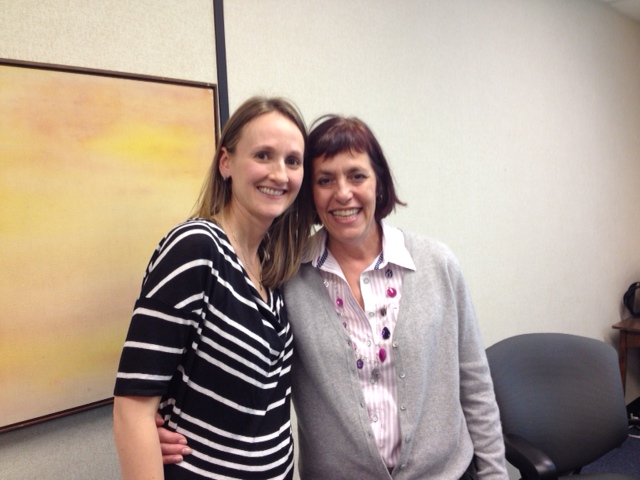
Congratulations to Tiffany Harris (member of our research team) who successfully defended her PhD thesis yesterday. The thesis, Multiliteracies Theory into Practice: An Inquiry into Junior-level Literacy Classrooms, was a study of classroom teachers (grades 4 – 6) which examined their understanding and use of a multiliteracies approach in their teaching. The thesis is outstanding because Tiffany closely studied her participants’ views of literacy, their practices, and the challenges they face. The analysis is outstanding because Tiffany is both a very accomplished classroom teachers and an excellent researcher. She brought to bear on her work her understanding of the work of teachers and her extensive knowledge of multiliteracies theory. As a result, her work will definitely contribute to our understanding of how literacy is evolving and how teachers are adjusting their teaching. It is rare to have a study that moves so effectively between theory and practice. Her thesis will soon be available through the Proquest Dissertation Database. Congratulations Dr. Harris. Attached is a picture of Tiffany and me (Clare) after her thesis defense.

A Daily Reminder

I (Pooja) work at a higher ed. institute with a population that is very diverse. I have many mature students, with a history of interrupted education, who are looking to make a fresh start with school after work many years in unfulfilling jobs. Even though school has failed them in the past, they come in hoping to form a new relationship with school. This cartoon and this quote are taped up above the photocopier in our office. It is a daily reminder of my work and the students I serve.

comic

Everybody is a Genius. But If You Judge a Fish by Its Ability to Climb a Tree, It Will Live Its Whole Life Believing that It is Stupid. –Einstein

Yiola Cleovoulou wins OISE Teaching Award

Congratulations to Yiola Cleovoulou a member of our research Yiola Cleovoulouteams who has just received the OISE teaching award for Excellence in Initial Teacher Education. She was nominated by her students which in itself is  an honour. This is a very competitive award so to win it is a real  accomplishment. I have team taught with Yiola and know that she is a truly outstanding literacy teacher educator. For more info on Yiola click on the link About Our Research then click on Meet the Research Team. Clare

Guest Blog: Monica McGlynn-Stewart

Monica McGlynn-Stewart who is part Monica McGlynn-Stewartof our research team on the longitudinal study of teachers is our first guest blogger. For more information on Monica click on the tab About our Research then click on Meet the Team.

I (Monica) gave my 16-year-old daughter I am Malala by Malala Yousafzai for Christmas and now I am getting a chance to read it.  It is the memoir of a 16-year-old girl who was shot by the Taliban for speaking out about girls’ right to education. I find it fascinating for many reasons, not least of which is what I am learning about life in the Swat Valley in Pakistan. As an educator, I am always interested in learning about different systems of education and different pedagogical practices. Malala is the daughter of a school I am Malalaprincipal and had access to formal education except for a brief period when schools were closed by the Taliban, but many girls in the Swat Valley do not have access to education. In her descriptions of her studies, she relates how she memorized and recited religious texts, poetry, history, and even chemistry formulas. Her mother, who did not learn to read and write, can also recite many texts that she learned through hearing them. When I went to elementary school in the 70’s, we sometimes had to memorize a poem and recite it, but it was a rare occurrence. As an elementary teacher, I never asked my students to memorize texts, but they would learn many poems by authors such as Dennis Lee or Shel Silverstein because we read them out loud so often. For young students, “memory reading” a text that they had memorized was an important step in learning to read. So I am wondering, what role does memorization and recitation play in literacy learning? And can we consider someone illiterate who has memorized and can purposely refer to a large body of literature?

Student Teachers in School Practice: An Analysis of Learning Opportunities by Alaster Scott Douglas

Alaster Scott Douglas

I (Clare) thought Alaster Scott Douglas’ recently published text, Student Teachers in School Practice: An Analysis of Learning Opportunities, might be of interest to those of you involved in teacher education. Douglas is the Assistant Director of Education and Reader in Education and Professional Practice at the University of Roehampton. He has written a book thatexamines student teacher learning during school teaching practices. The book includes a number of case studies that illustrate how learning opportunities for students are very different. Click on the link for more information about the text. Alaster Douglas Flier_STUDENT TEACHERS IN SCHOOL PRACTICE US
Congratulations Alaster on the publication of this important text. For all of us involved in teacher education we know how complex student/practice teaching can be and it is an area that warrants much more research. This text promises to add to our understanding of a critical yet often misunderstood aspect of teacher credential programs.  Clare

The Power of Introverts

“In a gentle way, you can shake the world.” – Gandhi

Introverted-Thinkers

At a professional development session I (Pooja) attended this week, I joined a conversation about the power of introverts. The conversation was framed around Susan Cain’s book entitled Quiet: The Power of Introverts in a World That Can’t Stop Talking. We live in a society where extroverts are the ideal; we value personality over character. This presentation, given by some of my quieter colleagues, was  powerful because it forced me to reflect on ways I engage and include introverts in the classroom. The presenters explained that introversion and extraversion is not a black or white matter; rather we all fall somewhere along the continuum depending on the situation we find ourselves in. I also learned that introversion is not to be confused with shyness- a mistake many people (including myself) make when speaking about introverts.

images

I mostly identify as an extrovert. Knowing this is important because it can influence how I design my  course to be more inclusive for all my students. As a more extroverted person, I walked out of the session with practices to consider revising in my classroom. Here are a few of the things I’ve been thinking about:

  • Mindful of airtime- I often become uncomfortable in silence, and so I will fill in silent moments with talking or engaging only the most vocal members of the class in discussion. Silence can be a powerful thing; these are the moments where reflection occurs.
  • Independent Work vs. Group Work- I try and put my students into pairs and/or groups every chance I get. I now am beginning to realize this is not the optimal working condition for all. I need to find a balance of group work and independent work.

Learn more about the power of the introverts here:

http://www.thepowerofintroverts.com