Monthly Archives: July 2014

Interviews and the Research Process

I (Yiola) have used the method of interviews for data gathering for over a decade. I love it;the entire process is fascinating. From designing research questions, to finding suitable participants, to setting up interview dates, to meeting with participants, to reading the transcript and to sharing the transcript with the participants.

images


There is something special about qualitative interviews.  Perhaps what is special is the human connection, perhaps the interaction, perhaps the commitment demonstrated by the participants . I think perhaps all of the aforementioned make the interview process special. In my many years of interviewing participants,  what inspires me the most is the passion the participants demonstrate as they explain with detail and careful description their thoughts and experiences about education.  I can (and do) listen for hours. The participants I have worked with show appreciation for their involvement in the research and often express how much learning they receive from the experience. The latter is particularly true of participants in longitudinal studies.

The role of the researcher: what an honour and privilege to spend time with willing participants; to be privy to their time and thoughts. A special relationship develops between research and participant that is built on trust, respect and commitment.  This relationship takes time to foster and requires thoughtfulness.  The interview data is often the foundation of the research.  This data is built upon a deep understand of research literature, thoughtful research questions, carefully crafted interview questions, and committed research participants.  Relationship building is key when using interviews in the research process.


Teaching Good Manners: An Aspect of Way of Life Education

I (Clive) appreciated Leah McLaren’s column in the Globe & Mail on Friday. She reported that Tatler editor-in-chief Kate Reardon was recently “pilloried in the British press” for “a graduation speech at a private girls’ school…in which she highlighted the importance of manners over good grades.” Among other things, Reardon said that “if you have good manners people will like you. And if they like you they will help you.” McLaren commented that “as both a feminist and a mother” she agrees with Reardon, but noted that “[w]hen it comes to instilling basic values and good behaviour, parents have never been more on their own.” http://www.theglobeandmail.com/life/parenting/the-importance-of-being-courteous/article19661557/

This should not be. Schools should support parents in this basic work (and they do to some extent). As I stressed in a recent posting, way of life (or values) education should be a major component of schooling, integrated into subject teaching and the life of the classroom and school.

The difficulty, however, is that we haven’t articulated a deep and comprehensive theory of way of life education. Advocacy in this area comes across as moralistic or, in the Reardon case, as old fashioned and conformist.

What could be more important than the quality of our way of life, in itself and in relation to others? It’s current neglect by advocates of “coverage” and testing is weird. “Good grades” as the goal of 12 years of schooling is totally inadequate. People should be pilloried for pushing such a position, yet it is so common.

Any goal can seem superficial when advocated in isolation. As educators, we need to develop for students, parents, and the general public a broad rationale for way of life (or values) education in terms of individual and societal happiness and what is ultimately important in life. We should help everyone – ourselves included – to stop fixating on narrow goals to the neglect of general human well-being.


Good-bye Michael Gove!

Michael Gove Although I (Clare) live in Canada I am well aware of the challenges teachers and teacher educators in England are facing. We have a number of literacy/English teacher educators in our study of teacher educators who have recounted the  challenges they are facing (e.g., funding reduction, stringent/ridiculous accountability measures). At our Symposium on teacher education in London participants recounted how demoralized teacher educators felt.

The Secretary of State for Education, Michael Gove, who was instrumental in bringing in a number of draconian measures in education has been demoted to Chief Whip. http://www.theguardian.com/commentisfree/cartoon/2014/jul/17/steve-bell-cartoon-michael-gove-first-day-chief-whip He wanted to reshape education based on his own experiences in elite private schools – or as I see it, drag education back to the 19th century. He seemed to be waging war on schools of education by creating so many alternative routes into teaching that he was stripping teacher educators of their place in preparing teachers. His inability or unwillingness to listen to reason and research led to him implementing a number of measures that are so wrong headed it is mind-boggling. He was never a teacher nor did he do research on teaching and teacher education so how did he think that he knew how to prepare teachers?  When you compare his approach to the one used in Finland (see blog post on Thursday, July 17) the contrast is glaring. Respect and trust were not his modus operandi.

On his first day of his new job as party whip he got stuck in the toilet! Hmmmmm…….. Read into that what you like!

Let’s hope that the path he set for education will be altered by his successor so that education and teacher education can get back on track and become relevant and appropriate for the 21st century. There is a growing body of research on teacher education which should guide policy. It is time for policy-makers in England to refer to it.

Stimulating Writing with Youtube

I (Cathy) teach Writer’s Workshop in my university literacy class by having my student teachers participate in one.  They engage in the entire process from selecting a genre, to peer editing, to learning from descriptive feedback, to publishing their work.   I am amazed every year how much the student teachers gain from the experience.  They often begin the process terrified of being a writer and of  teaching writing.  The Writer’s Workshop structure helps them overcome much of that fear.   One of the biggest challenges they must overcome is selecting a genre to write in.  Every year several students are completely stymied by this.  To aid these students I provide wordless picture books for which they must write the words.  They love it and swear they will do this for their own students when they are teachers.

The other day I came across a new source for stimulating writing.  It made me laugh out loud.  Would you write it from the sea gulls point of view, or the cat’s?

https://www.youtube.com/watch?v=b38li3CHOg0


Happy Teaching, Happy Learning: 13 Secrets to Finland’s Success

I (Clare) read a fabulous article, Happy Teaching, Happy Learning: 13 Secrets to Finland’s Success in Education Week. http://www.edweek.org/tm/articles/2014/06/24/ctq_faridi_finland.html?tkn=XTXDqgQYqARkH8OSadND1VkL5PvV%2BGHkxJFc&intc=eschildren reading

A teacher, Sophia Faridi, visited schools in Finland where she was so impressed:

Perhaps what struck me most about schools in Finland was the relevant, genuine learning taking place right before my eyes. For example, I had the chance to sit down with a group of high school seniors working on a project examining U.N. extradition trials. Without any teacher present, students were engaged simply because the subject was important to them.

She identified 13 features of this remarkable school system.

1. A heavy emphasis on play.

2. No high-stakes standardized testing.

3. Trust.

4. Schools don’t compete with one another.

5. Out-of-this-world teacher prep programs.

6. Personal time is highly valued.

7. Less is more.

8. Emphasis on quality of life.

9. Semi-tracked learning.

10. National standards are valued.

11. Grades are not given until 4th grade.

12. Ethics is taught in the primary grades.

13. Collaboration and collaborative environments are strongly emphasized.

This article would be a great resource for discussing the big and small picture of education. It shows that in a system where teachers are valued, respected, and trusted, high quality education results.

Re-blog: Reflections on the Words of J. Krishnamurti

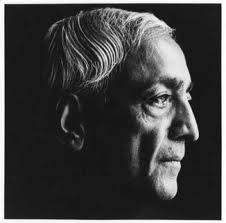
One of my(Pooja) dearest friends  recently started her own blog: www.edumodels.ca. Roopa and I have been best friends for almost twenty years. We are both educators and can discuss our views on education for hours on end. Her most recent post was so beautiful, I decided to re-blog it here. She reflects on book written by  J. Krishnamurti (philosopher/educator): Education and the Significance of Life. I have not yet read this text, but after reading Roopa’s blog post, it is at the top of my reading list.krish

 Below is an excerpt from Roopa’s blog:

 Taking an important step (leap!) back, Krishnamurti pushes us to think fundamentally about the purpose of education, and focuses on the importance of self-knowledge and individual freedom. In a chapter on “The Right Kind of Education” he expands:

 The purpose of education is to cultivate right relationship, not only between individuals, but also between the individual and society; and that is why it is essential that education should, above all, help the individual to understand his/her own psychological process. Intelligence lies in understanding oneself and going above and beyond oneself.

 In addressing the danger of setting ideals for children (whether in educational institutions, or as parents), and in conditioning them, Krishnamurti makes his views clear:

 The right kind of education consists in understanding the child without imposing upon her an ideal of what we think she should be. To enclose her in the framework of an ideal is to encourage her to conform, which breeds fear and produces in her the constant conflict between what she is and what she should be; and all inward conflicts have their outward manifestations in society.. If a child lies for example, of what value is it to put before her the ideal of truth? One has to find out why she is telling lies. To help the child, one has to take time to study and observe her, which demands patience, love and care.

 Krishnamurti’s emphasis on the primary importance of self-understanding; the secondary importance of technique and profession; and the understanding of the individual child, all resonate very strongly with me. In practice, I’m curious as to how this plays out at the Krishnamurti schools; and I will follow up with a post on the schooling Krishnamurti called for later this week!

To read Roopa’s entire blog post as well as her previous posts, click below:

http://www.edumodels.ca/blog/education-and-the-significance-of-life

Attack on “Balanced Literacy” Is Attack on Professional Teachers, Research

I (Clare) read this article and felt it would add to the posts on this blog about teachers as decision-makers and the need for teachers to be seen professionals.

plthomasedd's avatardr. p.l. (paul) thomas

The allusion in Robert Pondiscio’s Why Johnny won’t learn to read accomplishes something different than intended. Pondiscio’s uninformed swipe at balanced literacy actually reveals that, once again, ideology trumps teacher professionalism and literacy research.

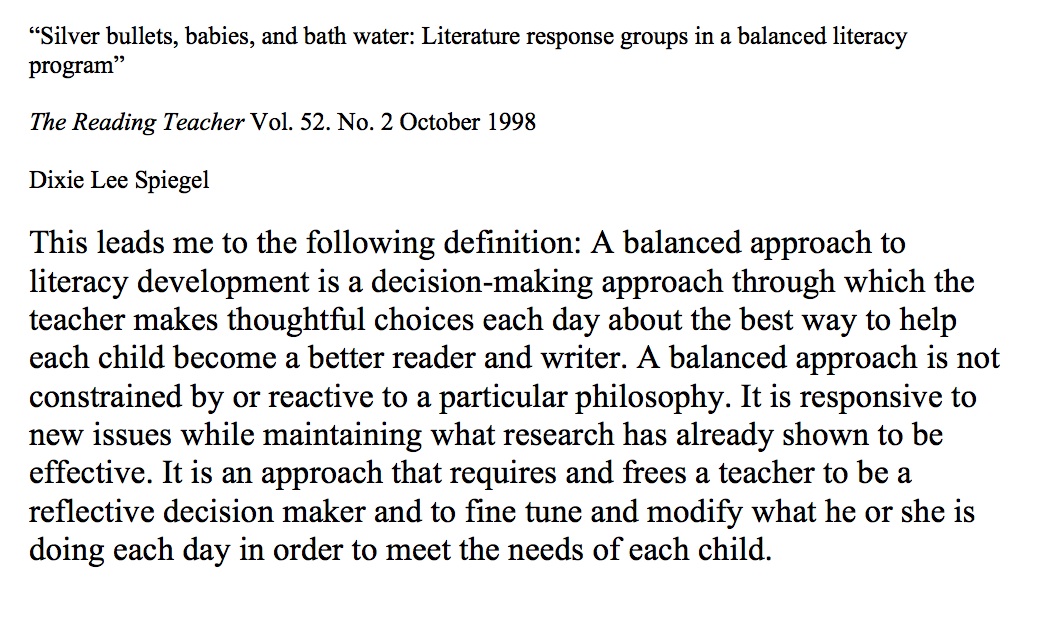
The reading wars are about almost everything except reading, but the most important lesson from this newest version of the same old thing is that if we start with what balanced literacy is, we begin to see just what those who attack balanced literacy believe:

Spiegel 3

Spiegel’s definition shows that the term “balanced literacy” is about the professional autonomy of the teacher, the wide range of research on how children acquire literacy, and honoring individual student needs (those who need direct instruction and those who do not).

Like “whole language,” balanced literacy does not reject any practice that is needed or effective, and does not prescribe practices either.

When Pondiscio and others, then, reject balanced literacy, they reject…

View original post 23 more words

Giving Voice to All Students: Jigsaw

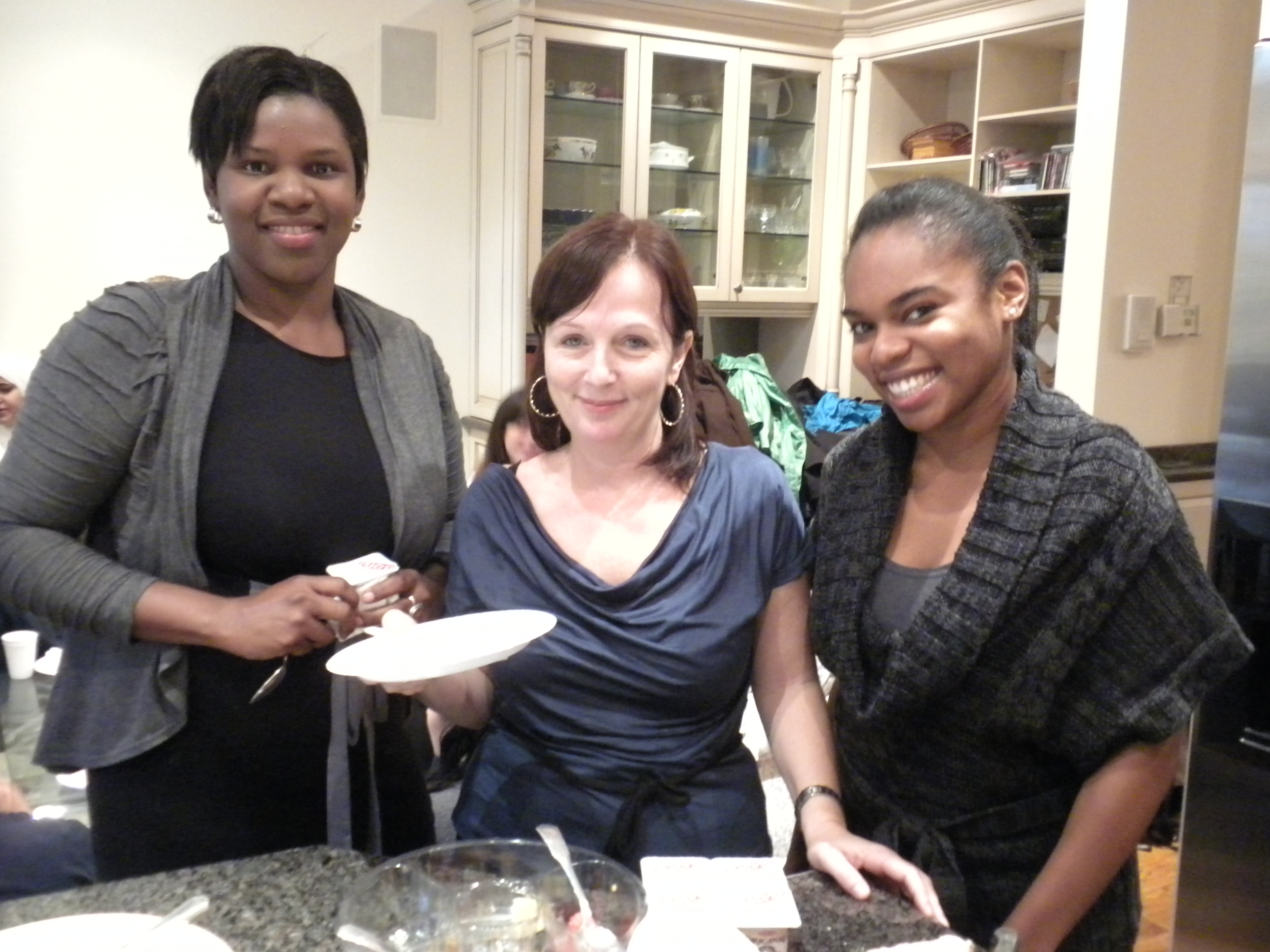
In an earlier posting I (Clive) DSCN0710advocated giving students a lot of “air time” in class, and outlined several techniques for ensuring that all students are heard. I’ve just (re)discovered a further technique – “Jigsaw” – and am using it in my summer courses. I can’t believe I took so long to see its potential! IMG_0038

In Jigsaw the readings for a class are assigned beforehand to different students, and when they go into small groups each has to speak to “their” reading. This reduces the reading load and gives each student a chance to speak to their item. It also decreases the likelihood of one student dominating the small group. Moreover, it takes some pressure off the teacher to expound all the readings themselves.

I used to employ Jigsaw but stopped because it seemed as if I was forcing students to read the articles; also it seemed to require having the same groups for every class, a practice I’ve moved away from.

What I do now is give every student a permanent Jigsaw number – either 1 or 2 – and assign just 2 articles for small group discussion. This means I can form new groups each class. Another advantage is that with more than one student speaking to an article, the pressure on individual students is reduced and the discussion becomes more collaborative.

As with any group work, of course, the topic has to be interesting to the students so they approach the discussion with enthusiasm rather than just going through the motions. So far, it seems to working!

German Literary History

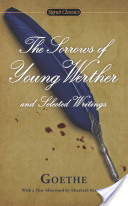
I (Cathy) make a point of reading a novel either about or from a country I am about to visit. As Germany is my next destination, Goethe became my author of choice. I was familiar with his now famous work, Faust, but the book I selected is known as The Sorrows of Young Werther. In all honesty, it was not the plot or the style, but the details about the book that enticed me to read it. This novel had an enormous cultural impact on Germany and surrounding countries.

Written in just six short weeks by a young Johann Wolfgang von Goethe (only 24), it was largely autobiographical. In the book, the hero, Werther, through a series of letters, describes his over-infatuation with a young woman named Charlotte. This novel was an immediate success and sold so many copies it became the first block buster novel. It even had merchandizing to support it: perfume, Werther dolls and Werther clothes. The book launched an entire literary genre, Sturm und Drang(Storm and Stress), inspired an opera, and instigated the romanticism movement. Sadly, the book was also banned in four countries because many young men imitated the tragic fate of the hero. I am intrigued that this book had such an extensive affect, long before the age of computers or mass marketing. This book was written in 1774. Such is the incredible power of literature. I am excited about going to Weimar, Germany to appreciate the monuments and museums dedicated to the work of Goethe. I may even buy a Werther doll.

wurther220px-Goethe_(Stieler_1828)wurther