All posts by Dr. Cathy Miyata
Assessing Multimodal Projects
You may remember, in a former post on Mar. 21, 2014, I (Cathy) shared some of my pre-service students’ multimodal projects. The dilemma facing me after these wonderful creations were submitted, was how to assess them. As these were only part of a larger assignment, I already had a rubric in place for whole project, but after seeing the brilliance of the multimodal aspect, I felt these alone warranted more thought and introspection on my part. Having a background in the arts, I was used to assessing creative process and final product, but this was different. Although artistic and expressive, this wasn’t “art”. Hence, I looked up a number of sources on assessing multimodal work and discovered a few different opinions.
Kalantzis, Cope & Harvey (2003) argued that a multimodal assessment needs to measure the creative process and the collaborative skills demonstrated. Jacobs(2013) suggested it wasn’t about the final product, but “watching and noticing what students are doing and then using that information to guide the students toward new skills and knowledge”. In the end I sought out the opinion of Gunther Kress, the founder of the Multimodalities Theory. Kress (2003) explained that representation and communication were an affective/cognitive semiotic process and this must be taken into account in the assessment. He suggested that I, as the teacher [educator] should not ask “How does this project match what I wanted or expected?”, but instead should ask, “How does this project give me insight into the interests and motivations of my learner?” I found this question quite insightful. In the end, I used Kress’ question to guide my feedback, which will hopefully guide the students toward new insights and knowledge. The required ‘grade’ was based on a combination of the learners’ expressed interests from within the context of the whole project (which was on diversity), the creative process and the collaborative nature of the work.
Through this process I discovered that assessing in the new age of multimodality demands mindfulness, insight and the ability to make many connections. To be effective, it also requires that the teacher educator, or teacher, know his/her students well. This type of assessment takes time, but it is much more meaningful. I have to admit, as much as the students loved doing these multimodal projects, I loved assessing them in this “new” way. We all got more out of the process. Below is a link to one more student project expressed as POW TOON digital creation. How would you assess it?
POW TOON Link
http://www.youtube.com/watch?v=9uM68P2rk24&feature=share&list=UUdKEvJ3G8Z-W-geAhhsX9IA
Multimodal Literacy
My (Cathy) pre-service students were assigned a multimodal aspect to a major assignment this year. If you are not familiar with the Theory of Multimodality, it is Gunther Kress’ alternative to Linguistic Theory (which only privileges reading and writing as the main modes of communication in a school curriculum). The Multimodal Theory contests that in our new age of multiple literacies, students need to be communicating, responding and expressing through many different modes of communication (e.g. speaking, music, moving, gesturing, image, and digital technology).
When I first introduced the multimodal assignment to my students, there was some trepidation and even some anger. It was suggested I did not have the right to be marking them on their artistry or on creativity. Hence, I had to teach the concepts behind Multimodality Theory so they could better understand what we need to be offering students of the 21st century. They needed to see that it would allow them the freedom to express in modes of their own choosing; that it was not graded as art but as a production of design; and, that the work could be symbolic or interpretive depending on the meaning they were portraying. The multimodal projects would also be shared in class so all could learn from them. This project was not just them regurgitating information for me, it was them designing and producing personally meaningful projects that express what they learned and what they deemed significant.
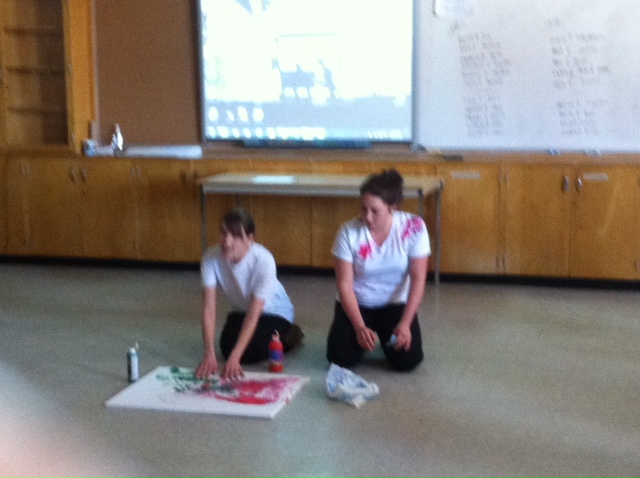
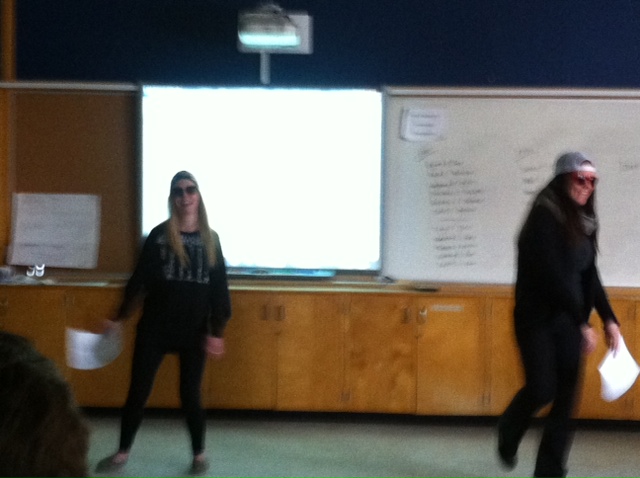
This week we finished viewing the projects. They were amazing, and the student response to these projects was encouraging. My students (concurrent students just finishing a five year educational degree) had never been given this kind of an assignment before. They loved the element of choice; working together; taking a risk; pushing their boundaries; feeling creative; and, doing something they were interested in. The modes they selected to express themselves though were sometimes more traditional (dancing, rapping, singing, writing and reciting poetry, creating 3D sculptures, puppetry, multi-sensory art installation pieces); sometimes digital (iMovies, pod-casts, prezis, Pow Toons, popplets, infographics); and, were often a combination of both.
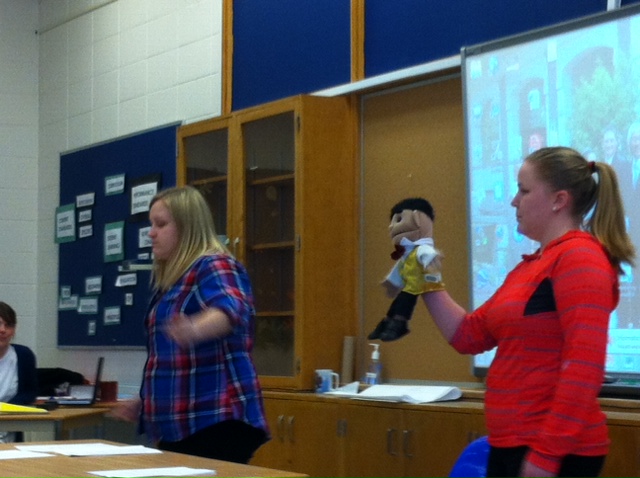
Collectively, we were all blown away by the results. We were moved. We were inspired. My students all said they would definitely use multimodality now as teachers. Below are a few images of my students presenting their projects:
Now, I have to assess these designs… but that, dear reader, is for another blog.
Dialogic Talk
It’s a powerful statement about a book when while reading it, you implement a suggested strategy the next day in class. That’s exactly what happened while I was reading Classroom Talk: Understanding dialogue, pedagogy and practice, by Edwards-Groves, Anstey and Bull (2014). The premise- talk is the foundation to all learning- is not new, but the connections made to multiple theories (e.g. Theory of Practice Architectures, Theory of Multimodality, Social Semiotic Theory) makes this book very current.
I particularly enjoyed the section on conversation vs dialogic talk. I do believe in “vacating the floor” as is suggested in the book and letting the students discuss issues in small groups. In one particular class I teach, I always allowed my students to select their own discussion groups, as these are university students and felt they needed to make their own choices. However, many of the groups were not focused, they veered way off topic (or never addressed the topic at all) and some students were still not voicing their opinion (even after much community building). The section on dialogic talk prompted me to reframe my concept of small group discussion. It suggested conversation is an informal discourse where direction and end point of the talk are unclear. This was pretty much where my students were with their discussions. Dialogic talk, however, sought to engage all listeners and had more purpose. Plus, dialogic talk was not as relaxed as conversation, it was driven. I needed driven. I wanted more engagement.
As a result, I immediately set up ‘Dialogue Groups’ with an assigned moderator, who ensured everyone’s opinion was invited and heard. I decided who would go into each group (which I thought they might resent and discovered they preferred!). For each discussion I provided prompt questions to get the talk started. I also assigned a time keeper who kept the dialogue to the time limit and a recorder who kept general notes about what was discussed. I honestly didn’t think this would be necessary at the university level, but the difference was incredible. There was thoughtfulness in the answers. The discussants were suddenly animated and energetic. They were really listening to each other. This was a small change, but it made a world of difference in how they were hearing and responding to each other.
Of course there are many other interesting and practical suggestions in the book. The connections between theory and practice are very strong. I highly recommend it. This book was published by the Primary English Teaching Association of Australia (PETAA). Check out their web site!
Grade Two Flash Mob
I (Cathy) love Flash Mobs. Someday, I hope to be lucky enough to be in the right place at the right time to witness one. Members of a symphony orchestra in Sabadell, Spain clearly excel at creating them. There are many clips to be found on Youtube by this group, but my favorite is the one set up for a grade two classroom. In the link below, the classroom flash mob is embedded with several others. Just keep watching. I love the look on the children’s faces; their reactions as they get lost in the music; and, their ability to conduct! Ah, the joy of it. I wonder how many of these children will dabble in music after this experience.
Walking for the Brain
To further our theme from earlier posts on well-being and schooling, I (Cathy) looked up the right time to exercise to help your brain. These tips were suggested:
- In general, anything that is good for your heart is great for your brain.
- Aerobic exercise is great for body and brain: not only does it improve brain function, but it also acts as a “first aid kit” on damaged brain cells.
- Exercising in the morning before going to work not only spikes brain activity and prepares you for mental stresses for the rest of the day, but also produces increased retention of new information, and better reaction to complex situations.
- When looking to change up your work out, look for an activity that incorporates coordination along with cardiovascular exercise, such as a dance class.
http://www.positscience.com/brain-resources/everyday-brain-fitness/physical-exercise
These all made sense, but none of them identified when or why I like to exercise for my brain. When my mind is somewhat numb after a few hours of academic writing, I need to push the refresh button. I achieve this walking by the lake. I am sure it is good for my lungs, my joints and my heart, but I really head to the water to recharge my neuro cells and feast my eyes. The scenery renews me as much or more than the exercise. Maybe just seeing what I saw yesterday will refresh your neurons…
Teaching Music Literacy – It Ain’t Easy but Must be Done
Young people spend so much of their day listening to music, yet it’s barely addressed in school. Something needs to be done about that – but it won’t be easy. I remember my (Clive’s) grade 5 teacher telling us that Bing Crosby couldn’t sing, he was just a crooner. He probably thought he was “educating” us about music, but he fed into my early prejudice against popular music.
In France there’s a lot of “music appreciation” in schools, which is great because music-making shouldn’t be all we teach. However, again the stress is on classical music.
One of the teachers in our longitudinal study (Candice) recently became a music specialist in her school and established a wonderful approach. In her seventh year she said:
I’ve become keen on the Orff method: it emphasizes improvisation and creating your own music, and leads in the teen years and adulthood to more of a jazz approach…. My focus is on teaching children in such a way that they can create music, understand it, and participate in it. So when they’re listening to pop music they understand what instruments are used, how the music is made, and what mood it creates.
But is there still too much emphasis here on performance?
A respected Toronto columnist recently wrote a rather negative article about popular music. He asked how much of interest could come from a genre where everything is a sentimental song about 3 minutes long in 4/4 time? I asked a musician in my ITE class about this and he said there’s an enormous variety and depth of structure and rhythm in popular songs. We noted that a similar argument could be made against English literature on the ground that it uses just 26 letters and a few punctuation marks (see the quote form Neil Gaiman in Lydia’s recent blog).
Teaching music literacy in schools has many pitfalls. Like the Fiddler on the Roof, teachers will have difficulty keeping their balance. But a way must be found – in many subject areas – if schooling is to be relevant.
The Power of Believing
Building on Clare’s blog from yesterday and the notion of connecting well-‐being to schooling, I (Yiola) feel compelled to share with you the story of Simon Marcus. He is a member of my extended family and one of Canada’s top athletes in the sport of Muay Thai. In fact, Simon is a 5 time World Champion.
http://en.wikipedia.org/wiki/Simon_Marcus
Simon’s story is not uncommon: a Black, male disengaged with traditional school. As a child, he was an active boy and excelled in sports but had very little patience and interest for learning inside the classroom. He has shared his schooling story with me numerous times and the story has been consistent, “It is not that I was not capable of doing the work, I just had no interest or motivation”. As his schooling years progressed he found himself deeper and deeper in spaces of alienation and low expectation for successful schooling. And then, he met Master Suchart, a Master teacher of Muay Thai. Through a pedagogy that engaged him (physical literacy), a teacher that knew how to connect to his well-‐being, and a developing belief in himself as a learner and a winner, Simon went from detentions and failure to being on top of the world. The one statement that rings in my ears about Simon’s journey to success is this turning point, “I knew Master Suchart believed in me. His belief in me made me believe in myself”. The ideas of well-‐being, trust, care and belief paved the way to Simon’s success. A teacher’s role in the well-‐being of a student is key: the social conditions created in a classroom, the relationships fostered and the pedagogical decisions a teacher makes are key.
From my own experiences as a Muay Thai fighter, I can say it is much easier to prepare for and pass a science test at school than it is to prepare for and step into a Muay Thai ring and yet the big questions worth exploring are: how did the teaching and learning at the Muay Thai school connect well-‐being to schooling success? What process took place for Simon to connect with the learning, embrace the teacher and believe in himself? Perhaps the kinesthetic element of the pedagogy, perhaps the content, perhaps the teacher as role model and unconditional supporter, perhaps the challenge and, very likely the overheard whisperings of his teacher: “see that boy over there, he’s my future champion”.
Simon’s victory in Buenos Aires, Argentina against Argentina’s #1 fighter.
Simon with his teacher, celebrating a victory together.
Semiotic Linguistic Quiz
Ferdinand de Saussure (1857-1913)
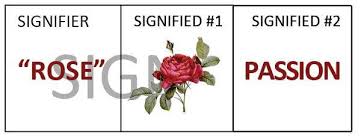
As of late, I (Cathy) have been exploring semiotic linguistics to further my understanding of multimodality (Jewitt & Kress, 2003). Ferdinand de Saussure is considered to be one of two fathers of 20th century semiotic linguistics. He described semiotics a as a system of signs that are created within a cultural context. Sausuure defined a sign as being composed of:
- a ‘signifier’ – the form which the sign takes; and
- the ‘signified’ – the concept it represents.
On the internet I stumbled upon these diagrams which are intended to illustrate the meaning of signifier and signified. Do you think they are both correct?
Multimodal Valentines
I (Cathy) love special occasions. Just give me a theme and I suddenly have an opportunity to be creative. Lately, my outlet is a three dimensional mode of expression- cupcakes! I can experiment with my designs using colour, texture, size, shape, and taste. For my Valentine’s cupcakes, aside from the cake and icing choices, there were a multitude of affordances (decorative toppings) to choose from. For this dozen, I decided on a range of tastes and textures: cinnamon heart candies, red and white jube jubes, tiny snowflake hearts, red sugar sprinkles, silver balls and message hearts. Remember those tart tasting message hearts? They say things like “hug me”, “I love you”, “kiss me”, and now there is one that says “text me”- so new literacies! This is truly a multimodal sensory experience for me (the designer) and everyone that gets one (the receiver of my communication). I see this as a perfect example of my Western culture influences channeling through me to create a social semiotic representation of my caring. But I won’t tell that to my husband. All he will see a pretty cupcake that is “Mmmmm, delicious!” And that’s fine too. I am not sure if this is what Gunther Kress had in mind when he created the Centre for Multimodal Research, but it works for me. Happy Valentine’s Day all!