All posts by Dr. Cathy Miyata

Unknown's avatar

About Dr. Cathy Miyata

Cathy Miyata is a professor at Wilfrid Laurier University. She is also an acclaimed storyteller and writer. She has performed and lectured in Serbia, Japan, Malaysia, Germany, Greece, Portugal, Sweden, Mexico, the United States, Egypt, and across Canada

Financial Literacy Advocate?

I (Cathy ) have met many literacy specialists, but never a  financial literacy advocate- until I met Shannon Lee Simmons. Her delightful sense of humor, bubbly personality, and brilliant financial mind make an intriguing combination.  Shannon is a Certified Financial Planner (CFP), Chartered Investment Manager (CIM), media personality, personal finance expert, and financial literacy advocate. She was named one of Canada’s Top 30 Under 30. Her passion: helping everyday people survive the new economic climate through personal finance, ethical investing and small business advice.

I explored her New School of FinanceTM   which is a collection of very practical and realistic on-line courses regarding every day finances. And the advice is excellent!  She truly makes finances understandable and interesting.  The list of her courses illustrates her quirky sense of humor and reveals her target audience- the millennials:

Can You Afford to Buy a Home?                                                                                                                            Sole Prop School                                                                                                                                              Budgeting with Your Boo                                                                                                                                        Don’t Get Effed at Tax Time                                                                                                                                    Baby Proofing Your Finances                                                                                                                                Track that Shiz                                                                                                                                                    GST/HST- The Good,  The Bad + The Ugly

I am fascinated by Shannon’s savy use of technology (she is wild about social media, especially Twitter) and how well she understands her market.  I suspect this very up-and-coming entrepreneur will do very well for herself and could probably give lessons to financial literacy teachers on how to engage an audience.  Check out her web site and view some of her videos.  You will know exactly what I mean.

http://www.newschooloffinance.com

shan

Shannon Lee Simmons:  Financial literacy advocate


What Children Hear

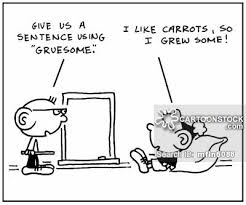
grew some

This charming cartoon reminded me (Cathy) of an incident I had as a young child.  My family was staying at a cottage of friends’ located on the shores of James Bay.  One evening we all sat by a large camp fire on the beach.  As the children roasted marshmallows, the parents chatted.  I happened to hear the grown ups  mention “fairy.” Puzzled I listened more intently.  “Oh, she’s grand to see, really.  She turns around right over there, off the end of our dock.”  My parents’ friend pointed out over the dark water.  I looked at my dad.  He was listening  and nodding.  No smile.  “Really?”  asked my mother.  “I’m surprised she’d come so close to shore.”  “Yeah, so were we,” said the friend.   “We’ve seen her a few times now.   All lit up, reflecting in the water.  Quite a sight really.  Maybe you’ll see her.”

I remember holding very still and being slightly afraid.  I was sure they had told me fairies weren’t real…  yet here they were discussing “her” like they would talk about dinner or the car.

I watched for “her” but never saw those wonderful lights.  Perhaps just as well.  It gave me a couple more years of believing in the impossible.

Teacher Education through an Ethnographic Perspective

A book that helped me (Cathy) process my observations more astutely is Ethnographic Eyes : A Teachers Guide to Classroom Observation, by Carolyn Frank.  This book describes how a teacher educator trains her student teachers to see the classrooms they visit through an ethnographic perspective.  To accomplish this, the teacher educator used the tool described below:

I used an activity called Notetaking/Notemaing to help student teachers understand the differences between their own personal perspectives and an insider, classroom perspective. Notetaking/notemaking was presented to the student teachers as an ethnographic tool to help them observe in classrooms.  The student teachers were asked to keep an observation notebook and to divide their observations into two sections: Notetaking (or descriptive fieldnotes) on one side and notemaking (interpretations of what is being observed) on the other side.  We then showed them either a photograph or a video of a classroom.  In this way, it was hoped that the student teachers would begin to reflect on how their own personal biases interfered with an objective account or differed from the classroom members’ perspective.  (p. 9)

This tool was used by this teacher educator throughout the year.  She also showed her student teachers how to use it as a means of data collection towards effective assessment.  At the close of the year, one of the student teachers stated, “[e]thnography has prepared me to think in a new way: a way that makes me think critically about everything that happens in my classroom.”

Try watching part of a classroom literacy event or a video of a class just to observe, then watch using notetaking/ notemaking.  You may be surprised by what comes up.

E eyes


Treasuring Picture Books

Like many literacy teacher educators, I (Cathy) sometimes tasked my student teachers with bringing in, or finding pictures of (if possible), their favourite picture book from childhood. My student teachers loved this task, and were excited when someone else brought in the same book.  I often saw Mr. Muggs books; Robert Munch books (especially I Love You Forever); Amelia Badelia; Madeline, and; super hero comics!  But I never saw mine.

As late as grade five, I would sneak the book home, terrified of being teased or bullied for taking it out of the library.  It was a book for little children after all, but I loved it so. It was worth the risk.   It was called, When the Root Children Wake Up.  I have searched for a hard copy to own, but have never found one.  I have discovered many newer versions (Helen Dean Fish’s, Audrey Wood’s) and as lovely as these illustrations are, they simply don’t touch me the same way. 

            Recently, however, I discovered my treasured version posted in the International Digital Children’s Library. ( http://www.childrenslibrary.org/ )  The author is listed as Sibylle von Olfers (1881–1916), and the text is in German.  I suppose the book was originally in German. I had no idea the book was so old.  The title is different than I remember, but I actually held my breath when I saw the illustrations again.  Those were the pictures I held dear: so simple, so precious.  I still love them.

What’s your favorite picture book form childhood?

wake up the root childrenroot mother

parade

Caring through Social Media

Recently, a friend of mine (Cathy) started blog site (using blogspot.com) for a colleague that is being treated for cancer.  It is called Art for Adrienne (pseudonym).   This is a use of social media I had not encountered until now.  As an invited participant, I am encouraged to contribute artifacts of anything in my everyday life that strikes me as artistic and/or meaningful:  photos, quotes, poetry (found or created) film clips, pod casts, youtube videos, snippets of conversations, photos from trips, art projects, family stories, ect.  I love to look at the posts.  They are a brilliant demonstration of insight, caring, beauty, humor, wit, meaning, and joy.  The variations are enormous.  Some posts are long, some complicated, some simply a thought or a word.

Occasionally our stricken colleague comments, but that is not expected.  We know she is weak and tired.  The purpose of the blog is to let her know she is on our minds.  Unlike flowers, the posts never wilt, and the “visits” are not taxing on her. She chooses when to go on the site, day or night.  Her few comments indicate she loves the site.  With permission, I am sharing some of the posts below:

Dear Adrienne, Greetings again from my beach in Nicaragua.  I’ve embarked on an art project I thought you might like.  Before I left, I was given candles that look like pebbles.  I brought them with me.  I have been photographing them at dawn and dusk.  I hope you like them.  Sam

candle experiement 6candle in hand 5candle in driftwood


Hi Adrienne, we have arrived in Corsica , France.  It’s beautiful here.  Thinking of you.  Jason

cave for Adelle


Dear Adrienne,

One of my friends that I met in Banff hosted a “Visioning Board Party” recently. 

The idea was to collage a collection of images that speak to what you vision for your future. Some people choose very literally, some people just choose images that attracted them without too much interpretation in the process and then they looked at the final product for meaning. I ripped out enough images to cover at least three big bristol board pages and so had much to select from when filling up just one. 

Here is what I created. What do you see in my vision?

Hugs, Nicky

big pic

Do you have a stricken or needy friend (with internet access) who may benefit from such a blog?  It costs nothing to set up, but may have very meaningful results.

Finding a New Community- in Baseball

The wild ALDS Blue Jays Game Clare mentioned in her post earlier this week marked my (Cathy’s) induction into a new community.   The “baseball fan” community.  This may seem strange to people who know my family well, as they see us as a baseball family.  Both of my children were catchers in elite ball.  They toured the United states, and played in several world series tourneys. They trained year round.  My husband was a coach and scout.   For twelve years, every weekend during the official season I attended a baseball tournament in some city or other.  As the dutiful and loving wife and mother, I was ever supportive: cheering in the rain, patching their injuries; cursing poor sportsmanship, and; washing smelly baseball socks in hotel laundry mats in the dead of night.  Even today, with my children well into adulthood, my son coaches a rep team; my daughter plays on several adult softball teams; my husband is a rep pitching coach;  and I still attend some games. But it has always been their passion, not mine.  I was, and am, an artsy.  To their chagrin  I still occasionally refer to their uniforms as costumes and their practices as rehearsals.

This all changed this past season and Wednesday was the culminating event.  This year, I decided to be an “insider.”  I worked hard at not watching, but belonging.  I wanted to have a team .  I learned the names of all of the Jays players and their positions.  I learned about them as people, and watched specials about their lives and how many obstacles they had to overcome to get to wear a Jays cap.   I picked a favourite player, Jose Bautista, and proudly wore his name and number on the back of my new T-shirt.  I even wore a cap. Strangely,  I felt akin to complete strangers who also wore Bautista garb.   I quickly learned that I could cheer and sing, wave towels and even dance in the street after a game in Toronto, and it was smiled upon.  (As an artsy I would have willingly  done this anytime, but my husband would not have necessarily smiled!).  I even found a vendor outside of the Rogers Center who served gluten-free wieners, and brought my own bun so I could eat hot dogs like everyone else.  I learned it is work to belong to a new community- any community- but you have to really want it.

On Wednesday I watched the game at home with my husband and found myself  on the edge of my seat.  I was so tense!  I waved a towel to support my pitchers; Stroman, Sanchez, and Osuna.  I found myself yelling in protest in the 7th inning when  Toronto catcher Russell Martin’s return throw to the mound hit Choo’s bat and Odor raced home.  I shouted and danced when my man, Bautista, hit that remarkable home run.

As I reflect on this now, I have to laugh.  I actually know these players’ names.  I am emotionally involved in people I don’t even know.  I have acquired a new language, and a different way to communicate with people .  I can and want to discuss the plays, highlights, and quirks of the game.  I was texting friends and family throughout the game- about the game.  My son was lucky enough to be at the game and I waited up for him so I could talk to him about it- actually needed to talk about it!

I feel like I am part of something. It was worth the effort.  I suspect I still may slip up and refer to practices as rehearsals, but that is okay.  My literacy research informs me we belong to many communities and foster many identities.  I am no longer just the artsy and the baseball mom and wife. I am a FAN.jays game             My husband and I on our way to a game with my new-found community.

How Self- Selected is Self -Selected Reading?

I (Cathy)  was touched by the following tale shared by guest bloggers Burkins and Yaris (Think Tank for 21st Century Literacy) on Brenda Power’s Choice Literacy blog site.  The post is titled, The Tyranny of Levels. It reminded me of the time I was visiting a classroom to observe my student teacher and saw two bins labelled Boy’s Books and Girl’s Books.  When I inquired about the bins, my student teacher assured me the children never dared choose from “the wrong bin.”  I was mortified.  Thankfully my student teacher also was mortified.  After that experience, the tale below did not seem very far fetched…

Daisy: A Cautionary Tale

Once upon a time, there was a third-grade girl, Daisy, who loved to read. She read all the time. While she liked to read about horses and outer space, she especially loved to read stories. She had read every single Magic Tree House, Junie B. Jones, and Amber Brown book ever written.  Recently, she had been into reading books about animals, and had devoured Shiloh and Charlotte’s Web.

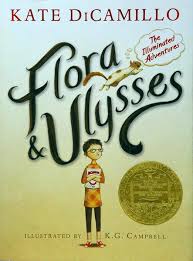
One day, as she browsed through books at the school library, she found a book with a beautiful cover of a girl wearing glasses and holding a comic book. When she saw it, she thought, “That girl looks like me!” She ran her fingers over the letters scrawled grandly across the cover and read the title aloud: Flora and Ulysses.

download

It was then that she noticed a small animal tucked up in the corner, which compelled her to read the back cover. As her eyes skimmed over the words describing a story about a squirrel who gets run over by a vacuum cleaner and strangely develops superpowers, she opened the book and began to read.

Before she knew it, the librarian was shouting a last call to check out books.  Daisy hurried to have her book scanned and joined the rest of the children lined up at the door to return to class. Ms. Wright, her teacher, walked up and down the line surveying the children’s choices. Every now and then she’d murmur things like, “Oh! Great author!” and “You’ll love this one.”  By the time Ms. Wright arrived at Daisy, she was nearly bursting with excitement.  Daisy couldn’t wait to tell her how she loved what she had read so far, and she longed to hear Ms. Wright say what a great choice she had made, choosing a book with a medal on the cover.

However, when Ms. Wright glanced at the book in Daisy’s hand, she looked between the book and Daisy and said, “Oh sweetheart, you’re going to need to return this book.”

Return this book?  Did she hear correctly? Confused, Daisy looked at her teacher who kneeled beside her, looked   her eyes, and said, “You’re a level R.  This book is much harder than that.  Run and put this back. You can choose something from the R bin when we get to the classroom.”

Crestfallen, Daisy handed the book back to the librarian. In her head, she kept hearing the echo of Flora’s voice speaking the same words she said when she witnessed Mrs. Tickham vacuum up the squirrel: Holy bagumba.

What was she going to read now?

Back in the classroom, Daisy dragged herself to the R bin and without even looking, grabbed the book that was on top.  She returned to her seat and muttered the title: Captain Underpants and the Attack of the Talking Toilets. Grudgingly, she began to read.

 Fellow teacher educators, I guess we still have much work to do… Be diligent. Our furture generations need you.

https://www.choiceliteracy.com/contributors-bio.php?id=11


Growing through Research

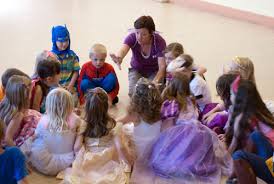
drama children

Embedded within my passion for literacy is my love for developmental drama.  I do love theatre as well (I as a professional actress for a couple of years), but developmental drama is fundamentally different than theatre.  Theatre is about performance.  Developmental drama is about developing human potential, and that is my heart song.

I was recently asked to present a Literacy Workshop for the Royal Conservstory’s new Smart Start Programme .  This Early Childhood Education (ECE) programme uses a multiple arts approach to develop four specific cognitive skills: attention, memory, perception, cognitive flexibility.  It was my role to model and lead a group of ECE leaders through creative drama experiences so they could experience first-hand how developmental drama can and does develop cognitive skills. We explored many drama strategies in the workshop: storytelling; role play; group drama; teacher-in-role; voice over narration; hot seat; tableaux, and; story drama.  My favourite of the eight listed is story drama which uses the events and characters in a story to stimulate the drama experiences, plus, I got to use my storytelling skills.   We became the characters; good and bad.  We learned about a culture from the other side of the world.  We asked questions.  We problem solved.  We also had fun.  The participants left with many practical ideas and felt they were inspired to explore this world with the children they are responsible for.  But, in all honesty, I think I was the one who left with the most insight.

I used to present this kind of workshop regularly, but have not done one in a few years. Due to my dissertation work in multiliteracies (Cope & Kalantzis, 2000), I discovered I was seeing the experiences through new eyes.  I was identifying modes instead of arts disciplines and using critical discernment instead of point of view.  The experience was a literacy event that we constructed within a social paradigm and the participants contributed their own knowledge and expertise in an environment that supported situated practice.  It wasn’t just a new set of vocabulary; it was a much more informed and theoretical perspective of the work.  Vygotsky, Luke, Peabody, Vasquez, Kress, Cope and Kalantzis occupied every corner of the room.  I was well supported.  I recognized a noticeable difference between my role as  intuitive drama leader and informed theoretical guide.  It was progress and it felt good.

drama


Cope, B. & Kalantzis, M. (Eds.) (2000). Multiliteracies: Literacy Learning and the Design of             Social Futures. New York: Routlage