All posts by Dr. Cathy Miyata

Unknown's avatar

About Dr. Cathy Miyata

Cathy Miyata is a professor at Wilfrid Laurier University. She is also an acclaimed storyteller and writer. She has performed and lectured in Serbia, Japan, Malaysia, Germany, Greece, Portugal, Sweden, Mexico, the United States, Egypt, and across Canada

No Reading on the School Bus!

Literacy advocates, beware.  This news story might break your heart.

Eight-year-old Sarah Auger, from St-Jean-sur-Richelieu, Quebec,  was told she was no longer allowed to read books on the school bus.  The bus driver thinks it poses ” a safety risk to the other students”.

When the child’s father challenged the rule,  the school board conceded that “obviously” reading was not dangerous.  Yet, Mario Champagne, the general secretary and director of communications for the Hautes-Rivière school board, said, “The responsibility of a school bus driver is to transport students safely”.  And since the bus driver makes the rules- No Reading!

school-bus-cameras

http://www.cbc.ca/news/canada/montreal/quebec-girl-told-to-stop-reading-book-by-school-bus-driver-1.3043652


Teaching Hybrid

In a couple of weeks, I (Cathy)  will start teaching my first hybrid course.  Also known as mediated learning, blended learning, and web-enhanced instruction, this kind of course can be considered  “the middle ground between our society’s adolescent love affair with technology and ancestral need for human contact and a sense of belonging” (Landau, 2015).

Baker College’s Instructional Technology Web site on blended instruction defines some of the advantages of hybrid or blended instruction:

  • Providing tools to facilitate communication outside of scheduled class time and office hours enhances student-student and faculty-student communication.
  • The blended learning environment supports different learning styles and methods.  Students have time for reflection when participating in online discussions and can participate at a time and place that meets their needs.
  • Online materials are available 24 hours a day, seven days a week, insuring that students always have access to assignments and other handouts.
  • On-line testing can be used for student pretests and practice.  On-line discussion between class sessions can identify areas of student difficulty that need to be addressed in class.
  • Course management and administration is simplified with an online gradebook and tools for email management.

http://www.baker.edu/departments/instructech/blended.html

The Hanover Research Council (2009) suggests the following  best practice teaching strategies for online education:  Group problem-solving and collaborative tasks;  Problem-based learning;  Discussion;Case-based strategies;  Simulations or role play;  Student-generated content;  Coaching or mentoring;  Guided learning;  Exploratory or discovery;  Lecturing or teacher-directed activities;  Modeling of the solution process; and  Socratic questioning

Yet, even though there are numerous advantages to online learning and many strategies  to make it effective learning,  I am told many students simply ignore the online material and rely on what they learn in class.  I suspect this may be because they feel it is easier to play hooky from a computer, or their schedules simply get in the way.   However, I feel my students will miss a lot if they ignore the online portion of our course. So I am collecting strategies to entice the students to engage in the online offerings;

  • offer a mark for engaging on line
  • provide enticements or teasers for what they might find online
  • review of intended learning for online work in class to ensure clarity,

and finally

  • use video streaming and/or chat rooms at designated hours so students feel connected to the site

I hope these ideas work, as I am looking forward to giving this a try.  If you have taught a hybrid course and have some more ideas, I’d really like to hear about them… online of course!

Fostering Home Literacy

A while ago, my (Cathy’s) niece asked me why I only gave her (and her brother) books and crafts as gifts.  I had suspected that she was sometimes disappointed her gift wasn’t a toy. I thought carefully before I answered.  “Well honey”, I said, ” I want you and your brother to grow up knowing you are smart and creative.  And I think books and arts and crafts help you to know that about yourself”     She pondered that for  few seconds and then said, “Ok, thanks”.  We have never looked back.

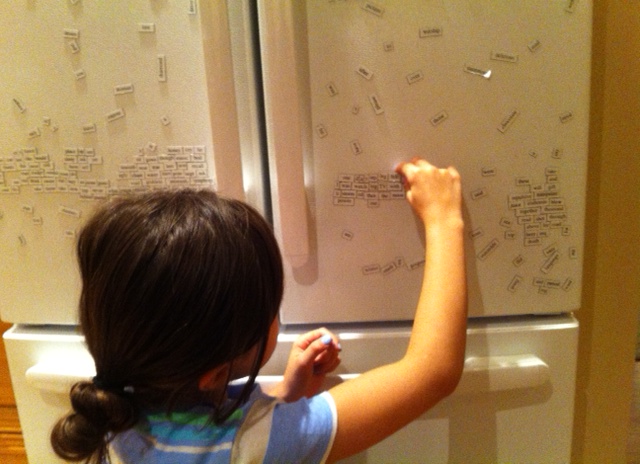
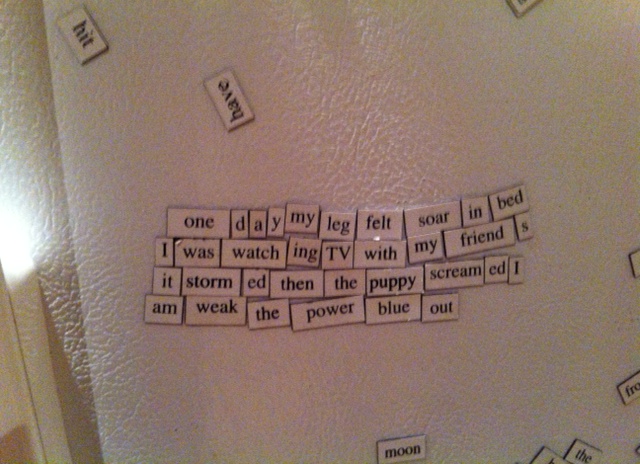
Lately, my niece has taken to the magnetic poetry on my fridge (words on little magnets that you can move around to create meaningful messages).  When she first noticed it, we only used it to find a word she knew.  Then she moved on to constructing a sentence.  When she came last weekend, she wanted to create a story.  It was challenging, because she could only words she could find on the refrigerator.  I was amazed at how long she stayed with the task.  I was also intrigued by the fact she knew two words were synonyms.  She didn’t call them that, she just knew they were the right word but spelled the wrong way.  I was delighted how long we spent together looking for the right words to move our story forward.  It ended up being a ‘scary’ story because the there was  storm and the puppy screamed, “which can only happen in a not real, scary story” I was told.   My niece was so thrilled with the results she invited several  people at the family party to come and read it.

When we felt our little project was complete, I said  to her “Brook, you are so creative and so smart” and she said, “I know”. That was my reward.  She did know it.  I also know what her next gift will be… a box of magnetic poetry for her own refridgerator at home.  I don’t know if her parents will appreciate it, but she will.  And that’s all that matters.

brookstory


                                                           http://magneticpoetry.com

Implementing Change

I (Cathy) and my faculty development team have been tasked with gently suggesting  best practices for new faculty.  This is not not easy task and must be handled with sensitivity.   Administrator,  Ross Cooper, suggests the following five tips when sharing new ideas and practices with others:

Be contagious: Get genuinely excited about what you have to offer, which should come naturally if your ideas are valuable.

Involve as many stakeholders as you can: This is a point that may seem obvious, but it is one that is often ignored. David Weinberger writes, “The smartest person in the room is the room.” Keep this thought in mind, as in no way can a few people sitting behind their desks be able to operate more effectively on their own than with the help of various colleagues from throughout their organization.

Empower those with strengths that compliment yours:   Odds are there is at least one person in your organization/institution with strengths that compliment yours in every education-related area. Know who these players are and take advantage of them, especially if they are well respected by others.

Evoke emotions: According to John Kotter, one of the biggest mistakes you can make when attempting to achieve buy-in “is to communicate with all ‘head’ and no ‘heart.'”

Be Experiential: Try modeling inquiry-based learning by only revealing the research until you have clenched the attention and curiosity of your educators and made them realize that there just might be a way for them to improve upon a particular area of their practice.

Changes can not happen overnight.  \but these five steps might serve as a strtting pint for anyone who hopes of making an impact within a school district or institution.  http://blogs.edweek.org/edweek/finding_common_ground/2014/11/implementing_best_practice_overnight_is_not_best_practice.html

Embracing the Backchannel

The backchannel is the conversation that goes on alongside the primary activity, presentation, or discussion in your classroom. Victor Yngve first used the phrase back channel” in 1970, in a  linguistic context, referring to how people communicate back and forth alongside a conversation.  I (Cathy) have recently started using TodaysMeet as a backchannel chat platform to help me redirect the constant distractions or backchannel discussions in the classroom, especially, the digital ones. Have you ever been frustrated by the frequent use of digital devices (i.e. digital phones, computers, tablets) in your classroom that are not related to your lesson?  This tool may help.  I use TodaysMeet to help me harness the backchannel and redirect it onto a platform that can enable new activities and discussions.  My students are invited, through a link, into a “room” much like a chat room. I then project this “room” onto my screen for all to see.  As I progress through my lesson, questions and comments about the lesson are posted by the students through their own computers or other devices.

Below are a list of benefits from using backchannel tools in your classroom.

  1. Shy/introverted students are given a place to ask questions and contribute to conversations.
  2. Students who process information by asking a lot of questions can ask an unlimited amount of questions without dominating the classroom conversation. Everyone can see their questions and you can choose when to address their questions.
  3. Gauge students’ interest in and or prior knowledge of a topic.
  4. Extend your classroom conversations beyond the time in your school’s schedule. If you have started a backchannel during a classroom conversation and it’s going well you don’t have to worry about running out of time because you can have students continue the dialogue later in the day.
  5. Gauge the effectiveness of an activity in real time, by having students share questions and comments during an activity
  6. Conduct formative assessment by asking students about their understanding of a topic and gauging the responses

From :  http://www.freetech4teachers.com/2013/06/5-benefits-of-using-backchannels in.html#.VRAQv-E01q8

Other backchannel platforms include: Socrative, Padlet, and BluePulse. And, yes, tweeting on the same hash tag, during an event, is also a form of backchannelling. To obtain a comprehensive guide on harnessing the backchannel, follow the URL below: http://www.freetech4teachers.com/2013/09/backchannels.html#.VRAXx-E01q8

todaysmeet

‘Shadiowing’ through Critical Reflection

I (Cathy) am currently working my way through a book on critical reflection.  ‘Working’ is the operative word, as this book, What Our Stories Teach Us, is set up as a guide to take us ( the teacher, professor, etc.) through an active critical analysis of our lives as educators using storying and  critical incidence.  The author, Linda Shadiow, loves to share stories herself.  Below is one of her favourites.  Apparently she has told it often and she uses it in her  book to illustrate how our stories can impact our lives.

A graduate student is attending a lecture being given by one of her intellectual heroes, the Brazilian educator and theorist Paulo Freire. She takes notes furiously, trying to capture as many of his words as possible. Seeing that she is keenly interested in what Freire had to say, his translator asks if she would like to meet him. Of course! She is introduced and he begins by inquiring about her work. Then he graciously agrees to respond to a set of questions she and her colleagues hoped they would get the chance to ask him. She is impressed beyond belief, but time prevents her from asking one last, difficult question. They meet accidentally once more at the event and he wonders if she asked all her questions? No, there is one more. “Given your work, we want to know ‘where is the hope’?” Without hesitating he moves toward her, takes her face in his hands, looks into her eyes, and replies, “You tell them, ‘you are the hope, because theory needs to be reinvented, not replicated … it is a guide. We make history as we move through it and that is the hope.”

(Taken from  http://www.facultyfocus.com/articles/teaching-professor-blog/reflections-on-teaching-learning-from-our-stories/ )

The graduate student is, of course, Shadiow.  She explains in her book that her experience with Freire never left her.  It energized and motivated her.  She had to “give back “.  She invites us as both reader and participant to rediscover our incidences of profound learning and let them move us.

shadoiw_

Powtooning about Powtoon

I (Cathy) made a Powtoon about making a Powtoon.  Just follow the link below:

http://www.powtoon.com/show/dK9qzPurSC7/intro-to-powtoon/#/

If you are not familiar with Powtoon, it is an animated on-line presentation software tool that creates explainers, videos and presentations.  If you can create a power point, you can create a  Powtoon.  Only a Powtoon is much more interesting and fun!  It is an effective  tool for flipped classrooms and they make great multimodal assignments for students.  You can find many how-to videos on youtube.  My favourite was  on script writing (for powtoons):

https://www.youtube.com/watch?v=lyB1Y9xkSec

The Powtoon web site also hosts a set of tutorials to help you get started:

http://www.powtoon.com/tutorials/#prettyPhoto

The Powtoon I created was through a free account.  In that account I have access to  five minutes of Powtooning, 10 tunes and 11 animation styles.  Cant wait to make another.

Hope you give it a try!


Cartooning the Digtial World

Danish writer Mikael Wulff and cartoon artist Anders Morgenthaler are the creative duo known as Wumo (formerly known as Wulffmorgenthaler).  Their rise to success started in 2001 when they entered and won a cartoon competition. When they won, they received a one-month run of their comic strip in Politiken, a national Danish newspaper.  Their popularity soared with the new exposure, and they soon found more and more publishers, including several blogs and newspapers throughout Scandinavia and Germany.

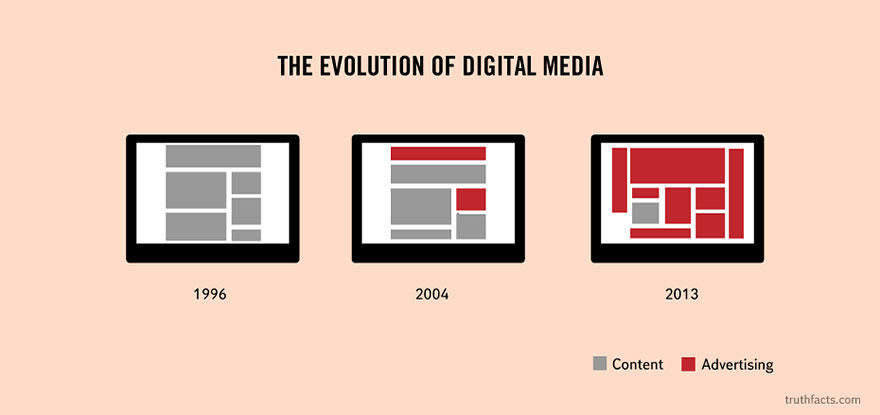
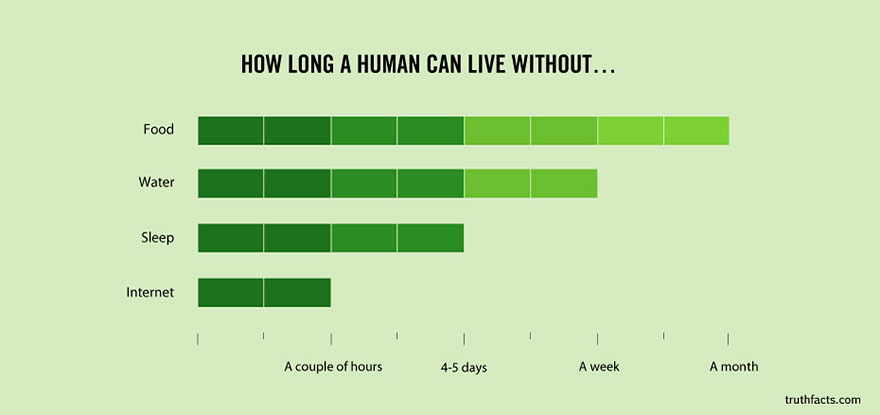
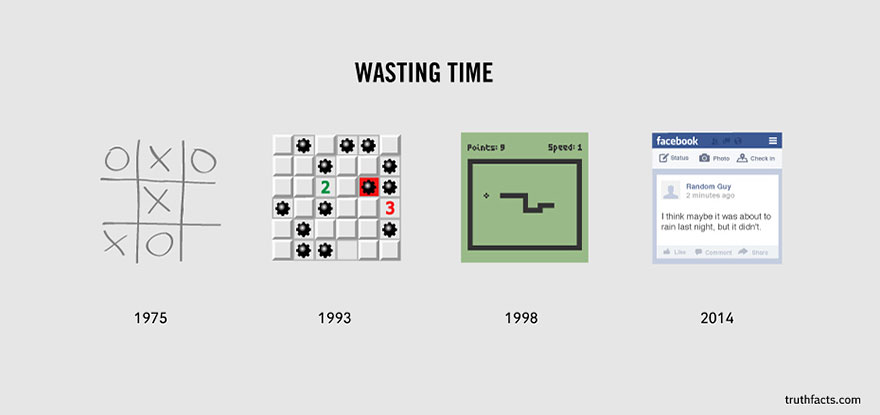
Among their works is a brilliant series of graphs and diagrams that illustrate some of the basic painful truths of everyday life in the Western world.  For your entertainment I (Cathy) have selected a few of my favourites that pertain specifically to digital technology and shared them below.  (Too enlarge a graphic, simply click on it).

Enjoy!

digitl medialed loled need interneted on line datinged facebooked wasting time