All posts by lmmenna

A Community Literacy Initiative

On a recent walk I noticed the front lawn of a home in my neighborhood proudly exhibits a quaint little wooden structure perched a top a post, which at first glance looked like an oversized bird house, however, upon closer examination I noticed that the petite house is full of books and displays a sign that invites passersby to take a book and return a book. The small wooden house is part of the Little Free Library initiative, a not-for-profit organization that promotes literacy, a love of reading, and a sense of community. The project began in 2009 when Todd Bol of Hudson, Wisconsin, built a model of a one-room schoolhouse in honor of his mother, a former teacher who loved reading.  He filled the model schoolhouse with books and put it on a post in his front yard. According the website www.littlefreelibrary.org “a loyal cadre of volunteers made it possible to expand the organizational reach…. By January of 2014, the total number of registered Little Free Libraries in the world was conservatively estimated to be nearly 15,000, with thousands more being built.” Do you have a Little Free Library in your neighborhood or a community literacy initiative that you would like to share?

LittleFreeLibrary

A Strong Tradition of Inuit Oral History

This month Parks Canada announced the discovery of one of the lost ships from Sir John Franklin’s Arctic expedition. The two ships from the Franklin expedition, HMS Erebus and HMS Terror, and their crews disappeared during a search for the Northwest Passage in 1846. Recent sonar images from the waters of Victoria Strait, just off King William Island in Nunavut, revealed the wreckage of a ship on the ocean floor.

The discovery of the Franklin ship demonstrates the strength and reliability of Inuit oral history. For more than 30 years local historian Louie Kamookak has been interviewing elders to collect the stories about the Franklin expedition. According to Inuit oral history the two ships appeared on the northwest side of King William Island. One of the ships was crushed in ice and the other ship floated further south. The Parks Canada team may not have discovered the Franklin ship without Inuit knowledge and the strong tradition of Inuit oral history. Kamookak noted, “for us Inuit it means that oral history is very strong in knowledge, not only for searching for Franklin’s ships but also for environment and other issues.”

www.cbc.ca/m/news/canada/north/franklin-find-proves-inuit-oral-history-is-strong-louie-kamookak-1.2761362

FranklinShip

Independent Reading

This Washington Post article features former school principal Joanne Yatvin’s thoughts on why it is important to provide students with the opportunity to self-select texts and to have designated time in the school day for independent reading. Yatvin notes that in many US schools the practice of independent reading “has been abandoned in favor of systematic programs that promise to raise student test scores.” Link to article: www.washingtonpost.com/blogs/answer-sheet/wp/2014/09/08/why-kids-should-choose-their-own-books-to-read-in-school

What are your thoughts — do you consider independent reading to be an important part of a literacy program?

OliverJeffers

Rich Hill: Documents Rural Poverty In America

“We’re not trash. We’re good people,” says Andrew, one of the adolescent boys featured in the documentary Rick Hill, a film about rural poverty in America. As directors Tracy Droz Trago and Andrew Droz Palermo chronicle the lives of three adolescent boys Andrew, Harley and Appachey, they challenge us to take an unflinching look at a cycle of poverty that often locks families into socio-economic hardship for generations. The intimate use of the camera, and a narrative that builds slowly, provides viewers with unfettered access to the intricate relationships that exist between the boys and their families and the complex hardships they face daily.

Louise Erdrich wins Dayton Literary Peace Prize

Author Louise Erdrich has been named as the winner of the Dayton Literary Peace Prize. The Dayton prizes recognize “literature’s power to foster peace, social justice and global understanding.” Erdrich’s written works, which includes novels, short stories, poetry, and children’s books, candidly explore contemporary Aboriginal life. She has been praised for “weaving a body of work that goes beyond portraying contemporary Native American life as descendants of a politically dominated people to explore the great universal questions – questions of identity, pattern versus randomness, and the meaning of life itself.”

http://www.cbc.ca/news/aboriginal/louise-erdrich-wins-dayton-literary-peace-prize-s-achievement-award-1.2739805

Erdrich

Using Digital Texts in a Grade One Classroom

On twitter today I (Lydia) came across an interesting blog post from grade one teacher Kathy Cassidy from Moose Jaw Saskatchewan, in which she describes how she incorporates digital texts into her shared reading program. I hope to share some of the activities reported on Ms. Cassidy’s classroom blog with the pre-service teachers in our literacy methods courses this fall.

http://kathycassidy.com/2014/08/08/changing-face-of-early-literacy-why-digital/

Can you find your cat?

An article from the Toronto Star caught my attention it features the website I Know Where Your Cat Lives. Owen Mundy, an associate professor in digital media art at Florida State University, developed the website in an effort to highlight potential privacy concerns related to the use of public websites. Mundy collected one million cat photos with geographic data embedded from public photo sharing sites (e.g. Instagram, Flickr) and placed the photos on a world map. The motivation behind the project came about when Mundy realized that photos of his young daughter had been posted online with embedded geographic co-ordinates pinpointing the location of his backyard. He then thought “What’s the closest thing people have to them that they photograph that’s like a child, but not as scary as mapping someone’s child? That’s a cat.” Mundy’s web project is meant to illustrate the substantial amount of personal data individuals share, often unwittingly, when they post photos on social media sites.

Link to Toronto Star Article:

m.thestar.com/#/article/life/2014/08/01/how_curiosity_killed_your_cats_privacy.html

Reading Choices

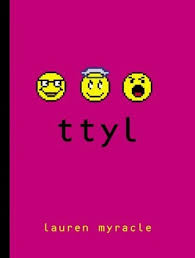
In general terms, my (Lydia) dissertation research examines the ways in which student teachers construct conceptions of literacy and enact literacy pedagogy when they view themselves as in conversation with a broader field of literacy (e.g. Multiple Literacies, New Literacy Studies). One aspect of this research considers how student teachers’ personal literacy practices inform their approach to literacy pedagogy. In some cases student teachers’ personal reading practices have been influenced by the interests and reading choices of the pupils they teach. These student teachers have often engaged with texts recommended by their pupils (e.g. graphic novels, young adult literature), and these shared texts become a space within which teacher and pupil connect. One of the student teachers participating in this research discussed the text ttyl written by Lauren Myracle, who has been referred to as a modern day Judy Blume. This young adult novel, which is part of a series, is written entirely in instant messages. Interesting, this best selling novel has been on the annual list of the “Most Challenged Books” released by the American Library Association. In other words, people have requested that this book be ban from libraries and schools “due to sexually explicit material and offensive language.” I plan to share this text with the student teachers in our literacy courses this year. I think it could contribute to an interesting conversation about text structure, style, controversies, and pupils’ diverse reading interests.

ttyl

Teaching as a Relational Practice

The Chronicle of Higher Education reporting on a survey of 30,000 college graduates, noted that graduates “had double the chances of being engaged in their work and were three times as likely to be thriving in their well-being if they connected with a professor on the campus who stimulated them, cared about them, and encouraged their hopes and dreams.” The article also highlighted both the sceptical responses to the survey as well as the potential value the findings could offer institutions of higher education.

See more at: http://m.chronicle.com/article/A-Caring-Professor-May-Be-Key/146409/

Teaching