All posts by ycleovoulou

Allegory as a Literary Device and the big Screen

Allegory as a literary device is a powerful tool in literacy development.  Beginning in the early years teachers use allegory to explore moral lessons and critical issues. How often do we read books with animal characters who experience significant challenges and how well do children respond to the texts?… very well!

Last week I (yiola) took my children to a birthday party at the movie theatre where they watched The Angry Birds.

Angry-Birds-final-quad

I had no idea what the movie was about although my 4 year son mentioned it had to do with birds protecting their eggs from pigs. Hmmmm, sounds… interesting.  As I sat in the movie theatre I watched and chuckled at the community of birds and enjoyed the simple characters of each bird… and then I watched as ships sailed onto “Bird Island” and a King Pig with a small entourage befriended the birds, showering them with gifts and new ‘treasures’ that were unfamiliar to the birds. Slowly the pigs began to take over the island and they stole all the birds’ eggs.  The birds then tried to rescue their eggs. Lines such as: “They stole our kids… who DOES that?” and later when the birds invaded “Piggie Island” to rescue the eggs the “King Pig” exclaimed, “what are you doing here? This is a civilized brunch” left me sinking in my seat and feeling uncomfortable. Without doubt The Angry Birds, to me, is an allegory of colonialism. After viewing the movie I began researching articles and critiques and while I found several interpretations very few note colonialism.

To my surprise, many an in-depth discussions have occurred over The Angry Birds. From story line to historical facts to critical literacy to media literacy, I am pleased to see how an animated film could spark such interesting discussion. Now, imagine how using popular culture like the popular video game The Angry Birds and combining it with popular media like a Hollywood movie and applying analysis and interpretation of the use of allegory in a middle school or high school setting to discuss critical social issues like Aboriginal history or immigration. Narratives are such powerful tools for thinking about life. Allegory as a literary device has the potential to raise significant awareness and heighten a love for literacy.

 

Authors and Amazing Tales: In Awe of Lawrence Hill

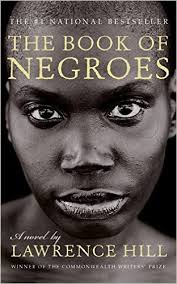
During the school year my night table fills with novels; one beautiful literary piece after the other, the books pile up. The vision is to retreat to my room early enough to read these marvellous texts at an enjoyable pace in order to get to the next… yet my  time during the academic term does not allow me the pleasure.  With the coming of summer and the end of an academic term I find some space where I can begin to read the books I attempted to read throughout the year.  This year, I begin with Lawrence Hill.  Most are familiar with Lawrence Hill, a Canadian writer whose most popular texts include: Blood: The Stuff of Life  and The Book of Negroes.

Unknown-2 Unknown

Blood: The stuff of life was turned into a lecture series. You can listen to excerpts of the Massey Lecture series here:

http://www.cbc.ca/radio/ideas/the-2013-cbc-massey-lectures-blood-the-stuff-of-life-1.2913671

Two incredible literary works that move me to think about humanity… and inhumanity. The Book of Negroes was turned into a  television mini series. Based on historical fiction The Book of Negroes is the story of young African girl, her voice, her journey in the 1700s from Mali, Africa to South Carolina, New York, Cape Breton, and London. How impactful a process to explore the novel — to try to make sense of history and our present — to think about narratives and then consider the media and digital implications for developing such an intense story into a visual series.  I think of how high school teachers could use this novel to explore so many issues and then to look at the decisions one makes when transforming such a sensitive story into film.

As I read Hill’s novels I cannot help but consider how  the narratives in these literary texts can be used to improve my own practice in teacher education. I ask myself: Can they inspire the reader to more deeply understand the intensity of the relational acts involved in teaching in classrooms?  Why do certain groups of children have a greater likelihood of failing at school? How do our systems shut people out without some of us ever realizing it? What kinds (if any) of understandings should teachers have about the histories of our communities before ever stepping into classrooms? How in teacher education can we support a deep understanding of children’s learning?

There is just so much to know while in pre-service and so much to teach in teacher education. What is most important? Why? When I think about the construction of teacher education programs I am now thinking less in terms of required courses and more in terms of broad understandings and the connections across disciplines and understandings. For example, as we teach about child and adolescent development (psychology) we must thing about language and literacy development (content) inclusive of social context (equity and foundations).  After all, when we enter classrooms we know that our work as teachers is dynamic, complex, forever evolving and completely relational.

Thinking about Reading Recovery

I (Yiola) am interested in early literacy for a number of reasons: my area of expertise is elementary  education; I was an early years teacher for ten years; my own children are now in early years programs; and, I believe that understanding literacy in the early years is  foundational for understanding teaching and learning.

With recent discussions going on about early years literacy programs and talk of play versus direct instruction; and, exploration and social development versus academic rigour (neither of which I believe are true binaries but instead call for a thoughtful consideration of a developmental and critically rich fusion) I am compelled to think about reading in the early years. You see, it seems to me parents are often in a panic if their child is not reading and more and more I am hearing of excited parents proudly sharing that their child was reading at 3 or 4 while other parents are silently panicking if their child is not reading by 6 years of age.

I often think back to when I was a classroom teacher and I recall the complex yet carefully crafted time sensitive processes for reading acquisition. I also clearly remember having a Reading Recovery Program at our school and watching our first and second graders enter and exit the program with a good degree of improvement and development. Most children would come out of reading recovery with gains. The very few who did not required further testing and support that went beyond the readiness phenomenon.

In my readings I came across this interesting article about Reading Recovery and the relevance of levelled texts, phonological processing AND comprehension as all significant  components of early reading development.

Here is the article in full: http://onlinelibrary.wiley.com/doi/10.1111/1467-9817.12041/epdf

This reading reminded me that there needs to be an amalgamation of approaches and strategies in the early years classroom. More and more I think that the programming and planning of early years teachers is by far their greatest challenge – not deciding upon play versus directed learning – knowing how to plan in ways that are engaging, that tap into curiosities and children’s questions and that allow for literacy rich exploration while also ensuring time for literacy focused experienced.


FDK Update:Literacy happenings and the like

I (Yiola) having been sharing my experiences with the Full Day Kindergarten (FDK) program from a parent’s point of view and here is another update.  My wee ones, Sylvia Clare (Senior Kindergarten) and Gallaway (Junior Kindergarten) are trekking merrily along in their kindergarten programs.  They are happy — and this makes me very happy. Some updates and observations about FDK and literacy.

  1. Sylvia Clare got into French Immersion. In our province, not all school board’s hold the same policy on French Immersion. This makes understanding the program less clear.  Some school boards/districts give every child the opportunity to go into French Immersion while others (like the one we are in) have a first come/first serve system.  The online database opened at 12pm on a set date and by 12:01 Sylvia Clare was 63rd on the list. 42 students are admitted into the program… We were notified last Monday that Sylvia Clare has been admitted and on Tuesday I registered her into the program. What does this mean? Beginning in first grade 50% of her learning will happen in French. She will have 2 classrooms teachers plus a “prep” teacher.  Big questions arise: How will this impact her language development in the short term/long term?  How will this impact her social development? Will this slow down her reading development?  Will this alter her level of engagement? So many questions and uncertainties and I’m not entirely convinced yet much of the literature AND community feedback suggests to go for the French. As a teacher educator I can speak to the general trends of French Immersion programs: students in immersion programs: acquire more vocabulary over time; catch up and often exceed reading levels of monolingual students… and yet when I look at this wee individual child, in spite of what research and theory state, only time and experience will determine if its best for her. I will keep you posted.
  2. Technology in FDK. Amazing things are happening with the whiteboard in the FDK classroom. I have observed students working individually and in groups: standing directly in front of it, touching it and manipulating shapes, words, images on the screen to solve problems. I have seen students engaged in listening activities and responding with their whole bodies to instructions provided through programs on display on the white board. I have seen attendance being tracked on the white board: all students’s names are in one row and as students enter they go up to the white board and slide their name to the other side — small details to practical use of technology in FDK.  I have seen iPads used in the FDK classroom: for gathering research, reading, listening to stories, and playing “games”. And, I have experienced communication with the teacher via REMIND technology. Oh how I love receiving a text with a pic of my son in educational action accompanied by a short text from the teacher. It makes me smile each and every time. The way digital technology is used in the classroom is meaningful, productive, and purposeful. I have also observed that it has just become a way of being in the classroom. It just is.
  3. My last update on FDK is on the idea of inquiry. I will share my understanding of inquiry in FDK with a anecdote.  Yesterday, as we drove on the Gardiner passing the CN Tower, Sylvia Clare explained Mommy we did research at school.  Harrison asked the teachers if the CN tower was the tallest building in world  and the teachers said they did not know but that it was a good question to research. So we started to research.  We looked in books and on the computer and guess what? We found out its not.  You know where the tallest building is mommy? Its not in Canada. We also learned the CN tower is a tower but not a building… and on and on she spoke about her research on towers and buildings.

These are some of the key literacy based elements that have me excited about FDK. Am I concerned about how many sight words they know? Not really. I am more concerned with their active engagement in learning and wanting to learn and this is what I see happening in the early years.

Why I love blogging: Take my creativity post and watch the learning grow

Writing blog posts is one of my most favourite things to do. I (Yiola) do not think I’m an entirely seasoned blogger but with time, practice, and learning I hope to become good at it one day. Why? Well, as an academic one of my goals is to share what I study and what I know with others. One way I do this is through my teaching. I am a teacher educator. My goals as a teacher educator are to prepare pre-service teachers to become excellent teachers by thinking about what they teach, how they teach and most importantly who they teach.  I am also a writer — but a very particular kind of writer. I have been taught to write in academic prose for journal articles and book chapters. Sometimes our articles and books are read by others in the field.  But… blogging… this is an entirely different genre and such a wonderful way to network and meet amazing people – some directly in the same field and others in slightly different but related fields – while sharing knowledge and information. Since writing on the academic / teaching blog I have met wonderful people and learned many things and taken away wonderful ideas. Let me share an example based on something that happened recently.

Some time ago I posted a blog about creativity in teacher education. Here is the link below:

Promoting creativity in teacher education

Last week I received an email from a person who is in the field of creativity who has also done some good work in the area. This person shared their insights on what I had written and provided supportive feedback and then also shared their work with me. What a delightful process! I am now sharing their work with you. The following link leads to a list of ways to infuse creativity into the classroom. I reviewed the link and like it for several reasons: 1. It’s foundations and theoretical underpinnings are closely linked to the work I shared with my student teachers in our classes on creativity  2. The list is very easy to view and accessible  3. I found the list inspiring and doable — so yes! I will now proceed to share this link with my student teachers and friends.

http://www.fusionyearbooks.com/blog/creative-classrooms/

This is but one example of how blogging in academia and in teacher education serves such good purpose. Yet another example of how digital technology and literacy work hand in hand to foster communication and learning. I am delighted when I receive messages with feedback, interest, and sharing. Looking forward to more connections and learning through this medium.

Photo Journal of my Experience @ AERA

Here are some snapshots and highlights of my experience at AERA this year. If I (yiola) could name the experience I would call it:  Goosebumps and Inspirations… it was just that good.

  1.  I attended a Round Table session (this is where presenters gather at a “round table” and share their research). The Round table is a great opportunity to not only share your work but hear from others in a less formal manner.  This round table was hosted by the  Writing and Literacies special interest group (SIG) and the focus of the round table was critical literacy.  Dr. Barbara Comber from the University of South Australia presented on critical literacy pedagogy in the early years. Her work and my work are closely aligned.

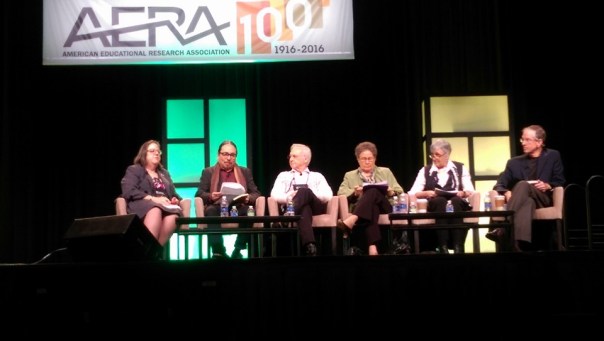
2.I attended a presidential talk that was a tribute to the life and work of Dr. Phil Jackson. The focus of the talk was on the question of education.  I really like what this panel did: each panel member selected a passage from a text written by Dr. Jackson and talked about its significance to them. A paragraph was read from The Practice of Teaching and the idea of transformative teaching… such an important and central idea in progressive education. A piece was read from Handbook of Research on Curriculum: Conceptions of Curriculum and the the idea that school is systematically harming children… and how can we work against that?  Linda Darling-Hammond read a passage from his famous book Life in Classrooms and spoke of the “multi-dimensionality and simultaneously nature of teaching” and the essential relationships associated with teaching. And, one panel member shared from Dr. Jackson’s last book published in 2012, What is Education and spoke of education as pure and simple; something we must rededicate ourselves too over time.

13001211_10156947381755121_1868962252431060235_n

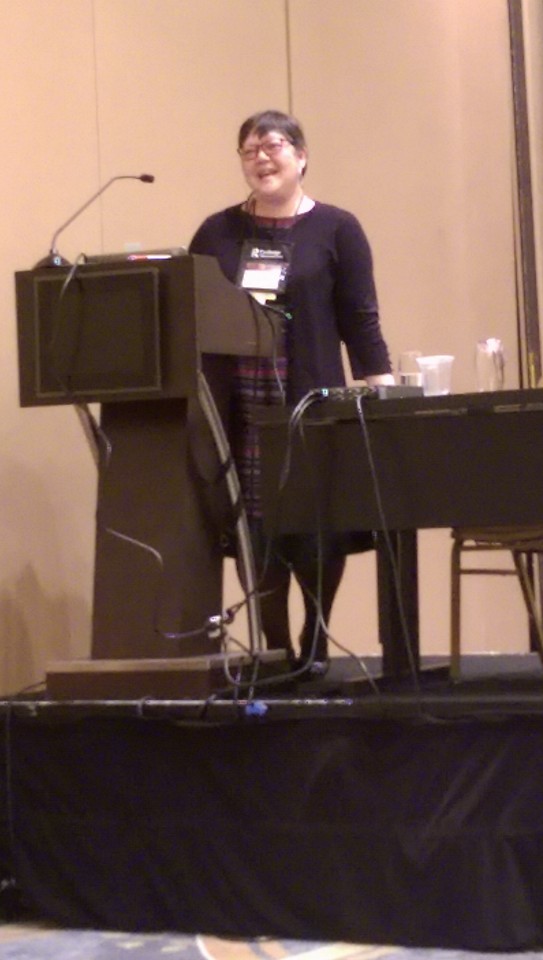
3. I was very fortunate to have the opportunity to listen to the presidential lecture  for Division K hosted by Dr. Lin Goodwin, Teachers College Columbia University.  A remarkable speaker who not only inspires with her words but truly challenged me to think about what quality teacher education requires. What I like most about Dr. Goodwin is her genuine nature. A distinguished academic and also a beautiful human being. Here are some pictures from her talk including slides from her presentation.

12998610_10156947381220121_6198746793740451746_n

13015255_10156947381525121_6392246007407300412_n13043368_10156947381450121_231103480067251929_n12994363_10156947381300121_7467634140817060326_n13012864_10156947381375121_7210803705214951729_n

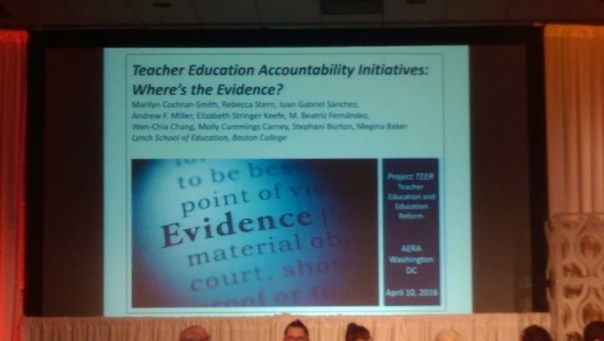
4. Yet another interesting Presidential session with Wayne Au, Marilyn Cochran-Smith, Kevin Kumashiro (and others) that explored policy and standards in Teacher Education. Laden with some controversial findings for the testing systems for new teachers and teacher education programs, the presentations were provocative and interesting:

13055504_10156947381160121_3248944785834068614_n13012858_10156947381050121_2214069562201491393_n

5. The last session I would like to share is one where we presented at the Constructivist SIG. A lovely group of people from across North America, we exchanged ideas of what it means to teach in constructivist ways. Our team leader Dr. Clare Kosnik presented work from the Literacy Teacher Education research and presented on a group of literacy teacher educators who had strong constructivist pedagogies.

Finally, AERA is held at such interesting places. One has to take some time to enjoy the beauty of the district and take in some of the sights.

Preparing for AERA

I (yiola) along with the research team and many other colleagues are preparing for the American Educational Research Association (AERA) conference that will be held in Washington DC this year. The conference begins on Thursday April 7th until Tuesday April 12th.

An enormous conference that attracts thousands of educational researchers from around the world and across disciplines and methodologies in the area of education. Each year the conference has a theme. This year the theme is Public scholarship to educate diverse democracies.  Here is a link to the site and more information about the conference:

http://www.aera.net/EventsMeetings/AnnualMeeting/2016AnnualMeetingTheme/tabid/15861/Default.aspx

The team and our close colleagues will be presenting at AERA.  We will be sure to post pictures and updates from the various sessions we attend. We hope to see you there. If you are not attending this year be sure to check out out blog for highlights next week.


Global Conversations in Literacy Research

One of the amazing things about our research team is we share common interests in literacy teaching and teacher education while at the same time we explore our own avenues of research. My areas of interest are in critical literacy pedagogy and teacher development.  I (yiola) have been enjoying and learning a great deal from another amazing literacy research based website and would like to share it with you.

Here is the link: https://globalconversationsinliteracy.wordpress.com

Global Conversations in Literacy Research (GCLR) is a series of interactive open access web seminars that feature cutting-edge literacy research conducted by international literacy researchers. GCLR is grounded in critical literacy, and sees as its mission to use networked technologies to connect global audiences in a virtual space that allows participants to exchange ideas on literacy theory, research, and practice. Each year, GCLR features scholars whose work addresses a range of literacy areas of interest to international audiences.

Some of my favourite researchers in critical literacy have shared webinars on the site.  I appreciate the global nature of the site and the sense of shared understandings through varied contexts.

An inspiring site — enjoy!

Butterfly Books: An amazing resource

It is common to find educators and parents in search of good books for children.  What makes a book good? What is a worthwhile read? What kinds of books do we want children to read? Why?  I have discovered a resource for thinking about and finding children’s books and am excited to share it with you.

Helen Antoniades, founder and operator of Butterfly Books, has embarked on a most inspiring journey in search of great books for children.

A front line social worker in Toronto, Ontario Canada, Helen has spent her adult life counselling children and adults from all walks of life. The  last 4 years of her practice was at the Hospital for Sick Children.  After 17 years of social work Helen, feeling burned out,  decided to start something new and explore her passion for healing others in an alternative way. Always passionate about books, she chose to share her knowledge of and experience with using books to help children understand and deal with issues in their lives.

Helen began her search by asking a lot of social worker colleagues for their go to books. Then she began asking friends in related fields. This interest grew into the blog, where she alternated “regular” pictures books with therapeutic books as suggested readings for children. As her journey continued Helen began exploring the “regular” books she was coming across and has broadened her scope to quality books that are reflective of diversity.  You can find Helen’s website at:

http://www.butterflychildrensbooks.com

Butterfly Book’s mission statement:

Butterfly Books is a children’s book subscription service whose goal is to make receiving a new book an eagerly anticipated, joyful event with an aim to foster and sustain a love of reading in children.
In addition to creating excitement about reading, the service will give children the opportunity to explore other worlds and experiences through books.  Part of the focus will therefore be on ensuring diversity of characters and topics within the books chosen.
This service is also a way to make giving books as a gift more inviting.  This personalized approach will connect families through the love of books and the satisfaction of a quality gift given and received. 
There is also a handy Facebook page with wall postings that share a book per week. It is an efficient and helpful way to access interesting books and gain insight to how they can be explored with children, often including book reviews.
Check out the website, like the FB page, and get connected with Butterfly Books!

What makes a teacher a good teacher?

A few posts ago Clare wrote about teacher characteristics. I  (yiola) am following up on her post with considerations for what makes a good teacher?

Take a look at this link:

http://www.npr.org/2016/03/09/469097318/a-great-teacher-illustrated?utm_source=facebook.com&utm_medium=social&utm_campaign=npr&utm_term=nprnews&utm_content=20160312

I think it is quite fantastic as it tells, in an nuanced way, the narrative of one good teacher.

Jimi has many qualities, characteristics and knowledge including:  content knowledge, pedagogical knowledge, an understanding of development, a clear philosophy/vision of teaching, a belief that all children can learn, patience and care.  What stood out most for me as I read this tale was the teacher’s capacity for care.  I believe care is central to good practice —  care for children’s well being;  care for children’s learning;  care for the future.

I often think about the possibilities of experience in school and the stories of positive and negative experience and time and time again the experiences that inspire and motivate children to learn are often centred around the teacher who cares.