I (Yiola) am terribly excited about this week. This week my dear friend Julia, who is now a seasoned administrator in a local school board, will be visiting my pre-service classroom to share her insights on assessment, evaluation and reporting in the elementary schools. I invited Julia to my class because I want students to hear from an administrator the expectations and specifications for assessing and reporting on student learning. I look forward to presenting with Julia – going back and forth between what we talk about in class about best practice and what the day to day expectations are in schools for teachers. The process of assessment, of course, goes hand in hand, with instruction and pedagogy. And so, Julia and I got to talking…
It seems that so much of “real life” practice is still about the paper/pencil test or the worksheet. It also seems that while the ideas of inquiry pedagogy are “out there” and there are impressions of its practice, that when it comes to assessing students’ learning, there is the inclination to revert back to traditional methods.
I call this post “The Irony with Inquiry” because I spend much of my time framing my courses through an inquiry lens and using concrete examples of inquiry pedagogy from my own research (because it IS our there) and yet so much of what student-teachers see and experience in their placements is not connected to inquiry. How then can we expect teachers to move their learning and practice forward? We know from Hattie’s meta-analysis of thousands of studies of student achievement that the number one factor is the teacher. It seems to me then that teacher knowledge and teacher development is just so important. And yet, this irony that manifests itself in theory vs. practice is out there.
Julia explains the reality when she described the following: we see new teachers stepping in and they are filled with wonderful ideas and good pedagogy and they want to do so many things all at once. The new teachers hit the ground, not running but, sprinting… there is limited time to think and so they ask their teaching partners or colleagues how to proceed. They are sometimes handed tests and worksheets to help them get through the first months of teaching. These worksheets become familiar and it is hard to develop new practices.
Clare and Clive and our team of researchers have documented similar examples of the pressures and time crunches of early years teachers.
I tell student teachers to not try to do everything well at once but to focus on one domain at a time. Sometimes I wonder if even this is too hard to accomplish.
I am looking forward to this class, to the candid discussions that may arise, and to coming to some understanding of how we can better reconcile the ironies new teachers face.
Last year, I (Yiola) wrote several blogs about my Sylvia Clare’s first year of kindergarten. In Canada children begin school at four years of age, sometimes three, and they enter Junior Kindergarten (JK). The following year they are in Senior Kindergarten. So, my Sylvia Clare is in SK this year and my son, Gallaway, has begun JK. The school year started well. The children are happy. A few of my favourite things about early years schooling:
Regular communication from the teacher — brought home in “zippies”
A lot of outdoor exploration
Weekly library visits — I am fascinated by my children’s choice of books!… Sylvia Clare tends to select “Fancy Nancy” books and Gallaway selects books about Dinos doing sports
Uniforms — mornings are so easy
White collared uniform shirts covered in paint at the end of the day
Cereal boxes / tissue boxes with paper towel rolls (towers) poking out — every invention you can imagine
Listening to my son sing songs learned at school
Being given clear instructions with strong convictions – “Mommy, my teacher said so…”
My favourite: Picking the children up at the end of the day to be greeted by big hugs and smiles
I know children learn enormous amounts in the early years — vocabulary, numeracy, inquiry, motor skill development — so much happens in a kindergarten classroom. For me, as a parent, what I am most concerned about is my child’s well being. That is, their happiness.
The other day, Sylvia Care brought a note home that was written by a classmate. It was an apology note. Sylvia Clare was teased at school and the child wrote her an apology. My initial reaction was that it was somewhat funny. I did not really think it was significant. The following day when I picked the children up from school I spoke to one of Sylvia Clare’s teachers and brought up the note. First I said, “Hysterical” and then I paused when I noticed the teacher not laughing. I asked the teacher if Sylvia Clare was genuinely upset. In a serious tone the teacher explained that she was. It was in that moment that I recognized how much respect the teacher had for her student. Acknowledging Sylvia Clare’s feelings and addressing her hurt made me appreciate her teacher even more. Valuing young learners and appreciating their feelings is just so very important. The problem was quickly resolved; Sylvia Clare felt her feelings were validated, and her dignity restored. And only then, when a child feels secure, can learning occur.
And so we begin our second year of the Early Years with confidence, resilience and excitement. I look forward to sharing, every now and then, the nuances of one FDK experience.
Gallaway and Sylvia Clare during their first week of school.
Somehow, since the beginning of my teaching career, I have found myself in collaborative teams:
As a classroom teacher, I found amazing ‘teaching partners’. As a doctoral student, I was an apprentice in Clare’s literacy courses where collaborative practice was modelled. As a beginning teacher educator I looked to my mentors and found support through our strong research groups. Now, as a teacher educator I have developed strong partnerships with colleagues and have invited doctoral students to co-instruct my courses. How wonderful it feels to not only be a mentor but to learn from others while modelling good practice.
This year I am working with a doctoral student who has experience in teaching with technology. Not only am I learning a lot about practical use of technology in classrooms, and the theoretical underpinnings, but my students are benefitting from our partnership. My course has gone from limited technology to a rich and authentic integration of technology. Let me share some examples:
Developing a sense of Social Media/Digital Citizenship: We now have a class Twitter account and hashtag. We are composing tweets as a class, or as individuals which share what we are learning in the course. This link helps those who do not know how to use twitter (i.e. me) get started: https://www.smore.com/x97w-the-14-day-twitter-challenge
Improving communication: We now have the class connected with Remind, a communication app that many schools and teachers use to communicate with parents/students.
When we first established this system our students raised the concern about access — what if parents do not have the technology to communicate in this year? What if they do not have the language to do so? We had thoughtful, critical discussions about access and inclusion
Demonstrating connected learning: My teaching partner is going to blog about the course, as a model for how teachers can do this. She is walking us through the process of setting up a blog, including asking all the students to sign a permission form as a teacher would ask parents. If not all students sign the form to agree, she will model how to handle this in their future classrooms.
Building our Digital Footprint: We are having students create About.Me or LinkedIn pages so when searched on Google, a professional reference to them, their work, and their values, will appear.
This experience will link closely to the course content. In our course we explore our Ministry’s Heath curriculum. The curriculum documents looks at teaching children about making good decisions when confronted with online challenges. We explore how important it is to model good decision making online and to think about ourselves as professionals.
Learning about online tools for teachers: Have one week with a Backchannel discussion tool. https://todaysmeet.com
Connecting to a broader community: Our course looks at teaching the Arts. We are going to have a few students volunteer to look for arts integration projects on the crowdfunding site https://myclassneeds.ca/en/, present them to the class, and then have the class vote on which one we could support. Each person could donate a Loonie, and we could contribute $30 to a classroom in need somewhere near our community, or somewhere in Canada.
I am extremely excited about infusing these elements into my course. I have realized from our beginning classes that it is so much more than the actual doing and integrating of the technology that becomes important. I am learning that the discourses around the infusion is equally, if not more, relevant to developing good pedagogy. I cannot say enough just how wonderful and beneficial collaborative practice can be.
I will let you know how it all plays out. I am anticipating a heightened program and learning experience for the students and me.
A poem I wrote today to try to relieve some first day jitters:
T’was the night before a new school year and all the through the house
Papers were flying and textbooks arouse
The course syllabi posted online with such care
In hopes that the students soon would be there
The readings updated and carefully writ
Ensuring inquiry, equity and technology fit
And I in excitement yet dutifully prudent
Wait for the joy of engaging with each student….
——-
Revising university courses is not a simple task. I (Yiola) have spent several weeks reworking my courses and developing new ones for the coming year. While my courses have been consistently well received by students I felt they needed updating: readings, perspective, pedagogy as though the domino effect could not be more evident. Piecing together what to share and how to share it so that student learning is not only deeply enjoyable but also optimal is no easy feat. As teacher educators we need to model good practice — after all, how can you spend an entire 3 hour class talking about the importance of inquiry pedagogy with power point presentations and lecture notes and expect students to understand and transfer their learning to the classroom? And then, on the other hand, how does a Masters level instructor justify spending hours having Masters level students “inquire” as children would in their elementary classrooms?
Finding the balance between theory and practice, between scholarship and the “daily grind” of classroom life, between academic rigour and child centred practice is, for me, an exceptional challenge. I want student teachers to know what to do when they enter their elementary classrooms and I want to model it for them in our class (i.e. small group activities, equitable practices, varied experiences, and direct instruction) and I also want students to understand WHY we do it (i.e. research based literature and engaging discourse). I want students to be self-directed learners (to share their ideas, to bring news to the classroom, to extend their own learning outside our class time) and I also want to provide students with connections between best practice and what they see out there (use of technology, positive learning environments, etc…)
Some changes I have made to my courses this year:
more use of technology (in my teaching, in my teaching of, and in students experience with)
lessened the number of assignments but deepened the expectations of the ones included
varied the nature of the assignments (included presentations, group and individual assignments, concept maps, papers)
updated my methods of assessment: to reflect/model practices used in our school system, to include students in the process itself
continue to invite guests to the class (classroom teachers, doctoral students, school administrators) as co-presenters as a means for sharing knowledge and modelling collaborative practice
Updated the readings to better reflect the issues of 21st century teaching
Researching teaching education, speaking with colleagues who are deeply invested in teacher education and knowing what other great educators are doing not only keeps me motivated but is one of the best professional development tools out there.
I wish all teachers and teacher educators and wonderful school year!
I (Yiola) have been hard at work preparing my teacher education courses. This year was an complete review and reconceptualization of the courses — significant updates to not only the literature but to the ways in which we will explore the content. I will share some of the changes to the pedagogy of my courses next week. This week I want to start at the start. Where does accelerated begin and how does it begin? I came across this interesting post and wanted to share it here. It is about paperless early years classrooms.
I remember when I taught first and second grade, I seldom used worksheets but I also did have the inquiry-based play either. My pedagogy was somewhere in between. But, truth be know, the teacher across the hall who had a full curriculum of worksheets was often commended for being highly organized and “on the ball” with her program. I always wondered if that way of teaching was better. Her students, most of them, were learning to read and write. That is another truth. However, were they creative thinkers and problem solvers? Again, another truth, we did not pay much attention to those sorts of skills. This was but a mere 10 – 15 years ago.
But now, I think we can all agree, that critical thinking and creativity and problem solving are very important skills for children to develop early in life. These skills do not develop from worksheet tasks. The link above talks about this and other inspirational considerations.
And so I share this post to begin at the beginning — play in the early years and how we move forward from there to more sophisticated modes of learning, through the grades and into post secondary teaching. Next week I plan to share some of challenges and questions I faced when reconstructing my courses.
My (Yiola) summer has been filled with reading, writing, and a lot of play with my two young children. From Curious George to Jane Yolan, we covered a lot of ground… and then there was some time for me. One of the texts I read this summer was an interesting report by journalist Amanda Ripley. In her book, The smartest kids in the world and how they got that way Ripley tracks three American high school students who went on exchange to three of the top performing PISA countries: Finland, Korea, and Poland. What I like about the text is that the three countries Ripley selects could not be more different in culture, and systems.
While there is much controversy about the PISA test and its effects, the details outlined in the book are interesting and insightful. I found the following key points interesting:
The countries that score high on PISA value academic and take academic learning seriously:
“The question then was not what other countries were doing, but why. Why did these countries have this consensus around rigor? In the education superpowers, every child knew the importance of an education. These countries had experienced national failure in recent memory; they knew what an existential crisis felt like. In many U.S. schools, however, the priorities were muddled beyond recognition. Sports were central to American students’ lives and school cultures in a way in which they were not in most education superpowers. Exchange students agreed almost universally on this point. Nine out of ten international students I surveyed said that U.S. kids placed a higher priority on sports, and six out of ten American exchange students agreed with them. Even in middle school, other researchers had found, American students spent double the amount of time playing sports as Koreans.”
Countries whose students who did well on the PISA value early childhood education:
“In most countries, attending some kind of early childhood program (i.e., preschool or prekindergarten) led to real and lasting benefits. On average, kids who did so for more than a year scored much higher in math by age fifteen (more than a year ahead of other students).”
Parental involvement IS important:
“Parents who read to their children weekly or daily when they were young raised children who scored twenty-five points higher on PISA by the time they were fifteen years old. That was almost a full year of learning. More affluent parents were more likely to read to their children almost everywhere, but even among families within the same socioeconomic group, parents who read to their children tended to raise kids who scored fourteen points higher on PISA. By contrast, parents who regularly played with alphabet toys with their young children saw no such benefit.”
What I appreciated the most when reading the book was the message that teachers in the high scoring countries are deeply valued members of society. From university admissions through to classroom practice, teachers are carefully selected, very well educated, and they maintain high standards in their practice.
I like the contrasts it provides between nations that have high test scores. As I read I kept comparing Canada, and more specifically the Ontario context to the countries (mainly Finland) and was feeling rather optimistic about the direction we are going.
I believe that until you experience teaching it is hard to fully understand what it means to build a safe, secure learning environment that builds intrinsic motivation and confidence in children.
I believe, in teacher education, we teach all that the article describes, yet students do not always see this out in the field. There are many reasons for this theory/bridge gap. Regardless of the gap, it is important that in teacher education we continue to prepare our teacher with best practice and provide them with both the “how” and the “why” of it.
What I love is that we do not even call it “classroom management” at all… at the lab school it is only about building a learning environment that focuses on engagement, safety and securing of the individual. The idea of “managing” children is counter productive to the philosophy of building creative, innovative, independent and confident children.
I (Yiola) cannot help but sing Kool and the Gang’s popular 80s song Celebrate these days. There is just so much to celebrate. A warm and special congratulations to Professor Clare Kosnik for her appointment as Director at the Dr. Eric Jackman Institute of Child Study (JICS).
JICS is a remarkable place. It is a place where exemplary Teacher Education (The Child Study and Education Program) meets exemplary teaching (The University of Toronto Laboratory School) meets world class research and faculty (The Laidlaw Research Centre). This tripartite forms a powerful relationship for developing all that is exceptional in teaching and learning.
Clare Kosnik is a remarkable academic. She brings considerable experience in academic leadership to this important role. She was Director of the Elementary Preservice Program at the Ontario Institute for Studies in Education at the University of Toronto from 2000 to 2003, Head of the Centre for Teacher Development from 2007 to 2009, and Director of the Master of Teaching Program in the Department of Curriculum, Teaching and Learning from 2009 to 2011. Her colleagues, students and online followers know of her international contributions to scholarship on teacher education, action research and teacher inquiry, and literacy education which are made possible through large research funds, including support from the Social Sciences and Humanities Research Council of Canada, the Carnegie Foundation, the Spencer Foundation, to mention just a few. But, so much more than this, Clare Kosnik is a remarkable person. Like past Directors at the Dr. Eric Jackman Institute of Child Study, Clare brings compassion, care, and deep commitment to student learning and teacher development through teacher education and research.
Welcome to the Dr. Eric Jackman Institute of Child Study, Clare. I look forward to working with you!
Everyone around the world, come on! Yahoo! It’s a celebration.
And so, this week marks the last week of school for my Sylvia Clare. For those who have read my (Yiola) FDK blog posts you may recall that this year my daughter, Sylvia Clare, attended school for the very first time. As a four year I could only imagine what thoughts and ideas ran through her mind as she entered the big institution of schooling.
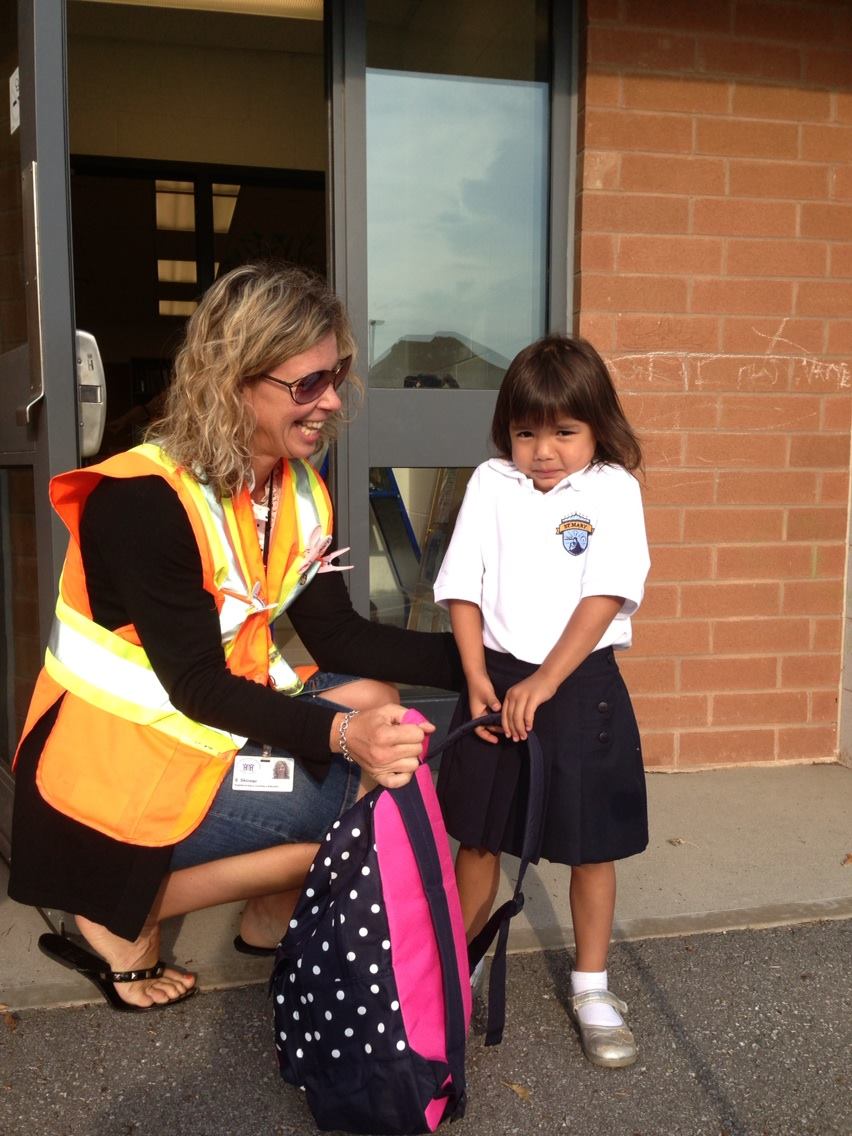
Here is an image of Sylvia Clare on her very first day:
1st day of school. The teacher purposefully crouches to be at the same level as the child — smiles and gentle demeanour go a long way in the early years classroom.
This little human being, with only four years experience in the world, ventured alone into an unfamiliar place with strangers for full day school. How grand is that expectation? I imagine in the mind of my Sylvia Clare it was a significant challenge. And yet, from the first day there was calm and there was success. What is success you ask? From my (a parent’s) perspective it is this: a child who is confident and competent in her environment; a child who is provided opportunities to play, explore, inquire and make decisions about their own learning; and success is when a child is able to manage her day in ways that are comfortable, productive, and enjoyable. This is what full day learning in Junior Kindergarten (JK) means to me. Through this, I have witnessed Sylvia Clare develop skills: critical thinking, creativity, collaboration, and of course literacy skills.
When Sylvia Clare began JK she could not spell her name, she was just learning her ABCs and 123s, and there was no experience with print. Reading was one dimensional, where mommy or daddy read to her. Somehow, by the end of JK, things now are quite different.
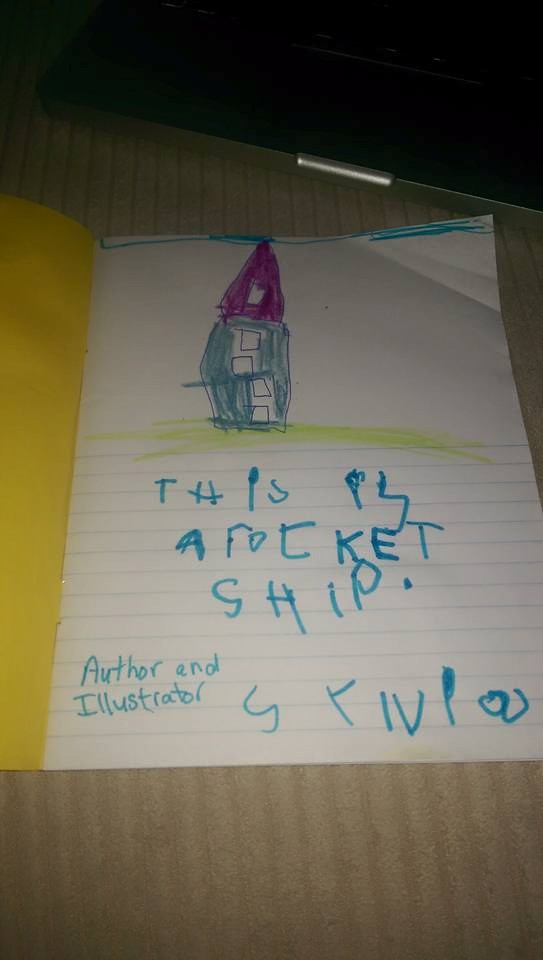
The following example sums up just how much Sylvia Clare has changed. The other other day she stumbled across some of my old school supplies from back when I was a teacher. She helped herself to a journal book and immersed herself in activity. Independently, this is what she produced:
While I was thrilled to see that YES Sylvia Clare understands the beginnings of language, how to write, how to spell, how to produce a sentence, how to tell a story!!! This experience told me so much more about my daughter as a learner: the initiative, confidence, risk, and desire “to do” were even more thrilling for me to witness.
From this simple experience I see the work that has gone into bringing Sylvia Clare to this point. I wish to tell her teachers this:
Thank you for fostering a learning environment that is safe, secure and open for exploration.
Thank you for encouraging Sylvia Clare to speak and to be heard.
Thank you for fostering friendships and encouraging inclusive play in the classroom and the playground.
Thank you for modelling respect and kindness and expecting that from all children in your school.
Thank you for teaching phonemic awareness and for providing direct instruction.
Thank you for listening to Sylvia Clare’s stories about “Old Man’s Lake” and asking her questions.
Thank you for encouraging her sense of invention and creation (I have more cereal boxes than I know what to do with!)
Thank you for using your smart board in ways that enhance students’ awareness of technology and literacy.
Thank you for developing fun games that helped her develop her literacy and numeracy awareness.
Thank you for encouraging Sylvia Clare to sound out words and to try reading books on her own.
Thank you for instilling a love of reading.
Thank you for teaching in ways that are so transparent that Sylvia Clare is able to come home and tell me exactly what she did in school. In fact, she clearly instructs me on what I need to do to have her prepared for the next day!
Thank you for fostering a love and care for the environment. We will be sure to visit “Woody” (the tree) in our local forest.
Thank you for the consistent routines and systematic communication with parents.
Thank you for celebrating my child and every child in the class.
Thank you for caring so deeply about my Sylvia Clare. Your care is evident in her development.
Thank you for working with me to ensure Sylvia Clare is happy, secure, confident, and learning.
You see, teaching literacy is not only about teaching phonics or repetitive worksheets as the proven way to acquire language… or whether direct instruction is proven to increase awareness… without the thoughtful consideration and doing of all of the above, that is the “teaching of children”, something is missing in learning development.
And so here we are, the final week of JK. It has been a remarkable year for Sylvia Clare.
Here is Sylvia Clare during her last week of school with her teachers:
Last week of school- standing tall, Sylvia Clare feels comfortable in hear learning environment.
In the image immediately above, I see comfort and trust. I see calm and happiness. I see a readiness to enjoy a day filled with learning. In my teacher education classes I work hard to share with student teachers the nuances of teachers’ work in order to understand that these elements of school are not innate or simply exist. These elements are crafted with thoughtful consideration on the part of teachers. Our research on literacy teacher educators and on classroom teachers over the years demonstrates these nuances well.
This post present one story, of one child, in her early years schooling experience. It is not the experience of every child. It is, in my opinion, an exemplary experience because of the teachers. We know from research that teachers’ work is the leading factor of student achievement: what teachers plan, do, say, and develop within a classroom often dictates how children experience school and learn. Sylvia Clare’s teachers are an incredible team — and we also know from the research on early years classrooms that the relationship between the teams of teachers is paramount to the success of the program. Teachers, partnerships, pedagogy, and content all come together to form a young child’s experience.
In my final FDK blog post, I want to say, Thank You teachers for bringing all of the above together, for making Sylvia Clare’s (and my) first year of schooling such a wonderful experience. Wishing all teachers and parents and children a wonderful and safe summer holiday.



 Literacy Teaching and Teacher Education