Category Archives: academics

Buried in Acronyms

Hi, I (Cathy) am the new T&LC in CTL, working in FD at SC.  Today I will be exploring ULD in the TLA.  Yesterday I had a meeting with the BBAs from PSOB.   I am now a member of OPSEU and CAAT.  I look forward to working with FAST, FAAD, FAHCS, FHASS, and FCAPS.

Lost?  Welcome to my world.  Last month I started  a new position in HE.  I love the people, the work and the institution.  What I am struggling with are the acronyms.  OMG.  If you think texting is bad, try starting a new position in a new institution.  Everyone talks in code.  During my first week as a new hire, I was given a cheat sheet of common internal and external acronyms to learn.  I had my husband drill me on these so I could learn them right away and feel comfortable in meetings.  Ah, no.  I leave every meeting with a list I have composed that were not on my original list.  Everyday I experience new discourses, practices and social norms.  Enculturation is tiring.  I feel as though I am living my research on new literacy practices.  Yesterday an employee asked me what faculty I was in and I answered ” TLC” instead of  “CTL” and he never even blinked.  Was he just being polite or do we have a faculty called TLC?  I wonder.

If you would like to know what my new position is and where I work now, just check the cheat sheet below.   I’ll let you know in a month how I’m doing with my acronyms.

T&LC – Teaching and Learning Consultant                                                                                                       CTL- Centre for Teaching and Learning                                                                                                           FD- Faculty Development                                                                                                                                      SC- Sheridan College                                                                                                                                              ULD-Universal Learning Design                                                                                                                            TLA – Teaching and Learning Academy                                                                                                .  BBA-Bachelor of Business Administration                                                                                                      PSOB- Pilon School of Business                                                                                                                       OPSEU- Ontario Public Service Employees Union                                                                                       CAAT-Colleges of Applied Arts and Technology                                                                                             FAST – Faculty of Applied Science and Technology                                                                                   FAAD- Faculty of Animation, Arts and Design                                                                                           FAHCS- Faculty of Health and Community Services                                                                                 FHASS – Faculty of Humanities and Sciences                                                                                               FCAPS- Faculty of Continuing and Part Time Studies

“The Long Shadow”: The fortification of socio-economic class

A mere 4 percent of the first-graders Alexander and Entwisle had classified as the “urban disadvantaged” had by the end of the study completed the college degree that’s become more valuable than ever in the modern economy. A related reality: Just 33 of 314 had left the low-income socioeconomic status of their parents for the middle class by age 28.

A 25 year long study named The Beginning School Study out of John Hopkins University explores “disadvantaged” populations in Baltimore. The researchers observed and interviewed first graders into their adult lives over the course of twenty-five years. The evidence shows there is little upward mobility.

http://www.washingtonpost.com/blogs/wonkblog/wp/2014/12/27/what-your-first-grade-life-says-about-the-rest-of-it/

I am troubled by a comment made in the article: The families and neighborhoods these children were born into cast a heavy influence over the rest of their lives, from how they fared in the first grade to what they became as grownups. 

In my (Yiola) opinion, the perspective of family and community as the influence and determinant of health and success is short sighted. How a society and government collectively and resourcefully (or not) engage with families and neighbourhoods is by far the greater influence as is illustrated when the journalist explains:

The findings, meanwhile, accumulated in dozens of journal articles. Alexander and Entwisle helped establish that young children make valuable subjects, that their first-grade foundations predict their later success, that more privileged families are better able to leverage the promise of education. Also, disadvantaged children often fall even further back over the summer, without the aid of activities and summer camps.

These findings are not about the influence of family or neighbourhood; they seem more the result of the influence of quality of education, resources, opportunities that are available to populations, all of which surround socio-economic class. The structures and systemic values and institutions in place are not equal between those of high and low economic status: for example, inner city schools do not have the same resources as the schools in affluent areas – this is not the fault of the families nor the neighbourhoods nor the teachers.

We like to think that education is an equalizer — that through it, children may receive the tools to become entrepreneurs when their parents were unemployed, lawyers when their single moms had 10th-grade educations. But Alexander and Entwisle kept coming back to one data point: the 4 percent of disadvantaged children who earned college degrees by age 28.

“We hold that out to them as what they should work toward,” Alexander says. Yet in their data, education did not appear to provide a dependable path to stable jobs and good incomes for the worst off.  

My question then become  WHAT CAN BE DONE WITHIN EDUCATION and POLICY to allow education to be a dependable pathway?

It is not only a question of class but race certainly factors into the discussion as the researchers also discovered the following:

Alexander and Entwisle found one exception: Low-income white boys attained some of the lowest levels of education. But they earned the highest incomes among the urban disadvantaged.

They were able, Alexander and Entwisle realized, to tap into what remains of the good blue-collar jobs in Baltimore. These are the skilled crafts, the union gigs, jobs in trades traditionally passed from one generation to the next and historically withheld from blacks. These children did not inherit college expectations. But they inherited job networks. And these are the two paths to success in the Beginning School Study.

The findings confirm what we have known all along, that is classism and racism are an integral and embedded piece of our policies and existence. The idea that families and neighbourhoods are the influence is not accurate. Families and neighbourhoods are the circumstances caused because of the structures/policies/beliefs of society.

I cannot help but think of the book “The Short and Tragic Life of Robert Peace” a biography that Clare recommended some time ago here on the blog. Robert Peace grew up much like the urban youth in Baltimore. He was a genius and thrived in school so much so that he found himself a Yale graduate. However, he could not escape the drug-dealing life and was ultimately murdered in the neighbourhood where he grew up. Moving upward in socio-class is not only a matter of doing well in school or acquiring money (although these elements too are extremely difficult today). Education and money are not indicators of moving outside one’s class. There seems to be fortress like walls around different classes of our given society and only with extreme leaps and bounds and circumstances can one truly cross the borders.

The research methodology of this study is fascinating. 25 years of observation and interviews, of relationship building and reporting. The work of the researchers is exciting and so very interesting.

Txtng is killing language. JK!!!

I (Clare) am sure you have heard the moanings and groanings that texting is ruining English? Well think again. I watched this amazing Ted Talk by Iphone John McWhorter who argues that texting is another form of communication. Here are some excerpts from his talk.

We always hear that texting is a scourge. The idea is that texting spells the decline and fall of any kind of serious literacy, or at least writing ability, among young people in the United States and now the whole world today. The fact of the matter is that it just isn’t true, and it’s easy to think that it is true, but in order to see it in another way, in order to see that actually texting is a miraculous thing, not just energetic, but a miraculous thing, a kind of emergent complexity that we’re seeing happening right now, we have to pull the camera back for a bit and look at what language really is, in which case, one thing that we see is that texting is not writing at all. What do I mean by that?

What texting is, despite the fact that it involves the brute mechanics of something that we call writing, is fingered speech. That’s what texting is.

But the fact of the matter is that what is going on is a kind of emergent complexity. That’s what we’re seeing in this fingered speech. And in order to understand it, what we want to see is the way, in this new kind of language, there is new structure coming up.

So we have a whole battery of new constructions that are developing, and yet it’s easy to think, well, something is still wrong. There’s a lack of structure of some sort. It’s not as sophisticated as the language of The Wall Street Journal.
And so, the way I’m thinking of texting these days is that what we’re seeing is a whole new way of writing that young people are developing, which they’re using alongside their ordinary writing skills, and that means that they’re able to do two things … If somebody from 1973 looked at what was on a dormitory message board in 1993, the slang would have changed a little bit since the era of “Love Story,” but they would understand what was on that message board. Take that person from 1993 — not that long ago, this is “Bill and Ted’s Excellent Adventure” — those people. Take those people and they read a very typical text written by a 20-year-old today. Often they would have no idea what half of it meant because a whole new language has developed among our young people doing something as mundane as what it looks like to us when they’re batting around on their little devices.
…  if I could go into the future, if I could go into 2033, the first thing I would ask is whether David Simon had done a sequel to “The Wire.” I would want to know. And — I really would ask that — and then I’d want to know actually what was going on on “Downton Abbey.” That’d be the second thing. And then the third thing would be, please show me a sheaf of texts written by 16-year-old girls, because I would want to know where this language had developed since our times, and ideally I would then send them back to you and me now so we could examine this linguistic miracle happening right under our noses. Thank you very much.

If you want to hear the whole talk, click on: http://www.ted.com/talks/john_mcwhorter_txtng_is_killing_language_jk
It is only 13 minutes long and worth every second.

Resolutions, Reforms, and Incremental Change in Education

Clive BeckNew Year’s resolutions are notoriously poorly kept. At our local gym, the regulars joke about the “resolutioners,” who sign up for a year but barely make it to the end of January. Sadly, a lot of proposed educational “reforms” are like that.

Clare, Lin Goodwin, and I (Clive) are working on a chapter on teacher education reform for the next Handbook of Research on Teacher Education. In reviewing the literature, we came across a wonderful article by Mary Kennedy called “Against Boldness” (Journal of Teacher Education, 61 (1-2), 16-20). In it, she makes a plea to avoid taking a “bold” approach to teacher education reform. The article has important implications not only for teacher education but for teaching in general and even everyday life (as in trying to keep fit). Kennedy remarks:

[B]old ideas are part of our problem, for by definition they are unrealistic, out of range, over the top. Ultimately, bold ideas fail because they don’t take real circumstances into account or because they expect too much from people. Eventually, each of us runs out of gas, gets tired and disheartened. (p. 17)

In my view Kennedy isn’t a pessimist or anti-idealist: she thinks substantial improvement is possible and should be pursued. But she believes we must pursue it by (a) acknowledging and building on present achievements and (b) proceeding incrementally (like the tortoise that finally won the race). She says:

What we need in education are ideas that develop slowly and that build on what we already have, not ideas that develop excitedly or that deviate markedly from current practice…. [B]old ideas…hinder our progress toward real improvements by distracting educators and making it more difficult to concentrate…. Every helpful idea requires teachers to make adjustments. Every time we help teachers, they have to stop thinking about how to wrap their students’ minds around a concept and instead turn their attention toward accommodating the new innovation…. [T]here is no doubt that we need to find ways to improve teaching and teacher education. But [instead of pursuing bold ideas, we should be] studying our practices closely and deliberately, deepening our understanding of the circumstances in which we work, and finding small and sustainable ways to improve. (p. 19)

As the JTE editors rightly point out, Kennedy’s position is itself bold! Indeed, it is radical in today’s climate. But it is productively bold, offering an alternative to the myriad high-sounding, contradictory, and often damaging measures, frequently promoted for political reasons rather than out of genuine concern for improvement. Let’s be systematic and effective in our renewal work, not “bold.” How’s that for a New Year’s resolution!

Predatory Journals Part 2

On January 4th I (Clare) did a post about predatory journals. My good friend Tim Fletcher (professor at Brock University) sent me a useful link. Brock has put together a list of guidelines for evaluating journals and gives a link to Beall’s list of predatory journals.   Here is the link: http://www.brocku.ca/library/services-lib/faculty/guidelines-for-evaluating-a-journal-publisher

Visiting the Rishi Valley School… Part 1

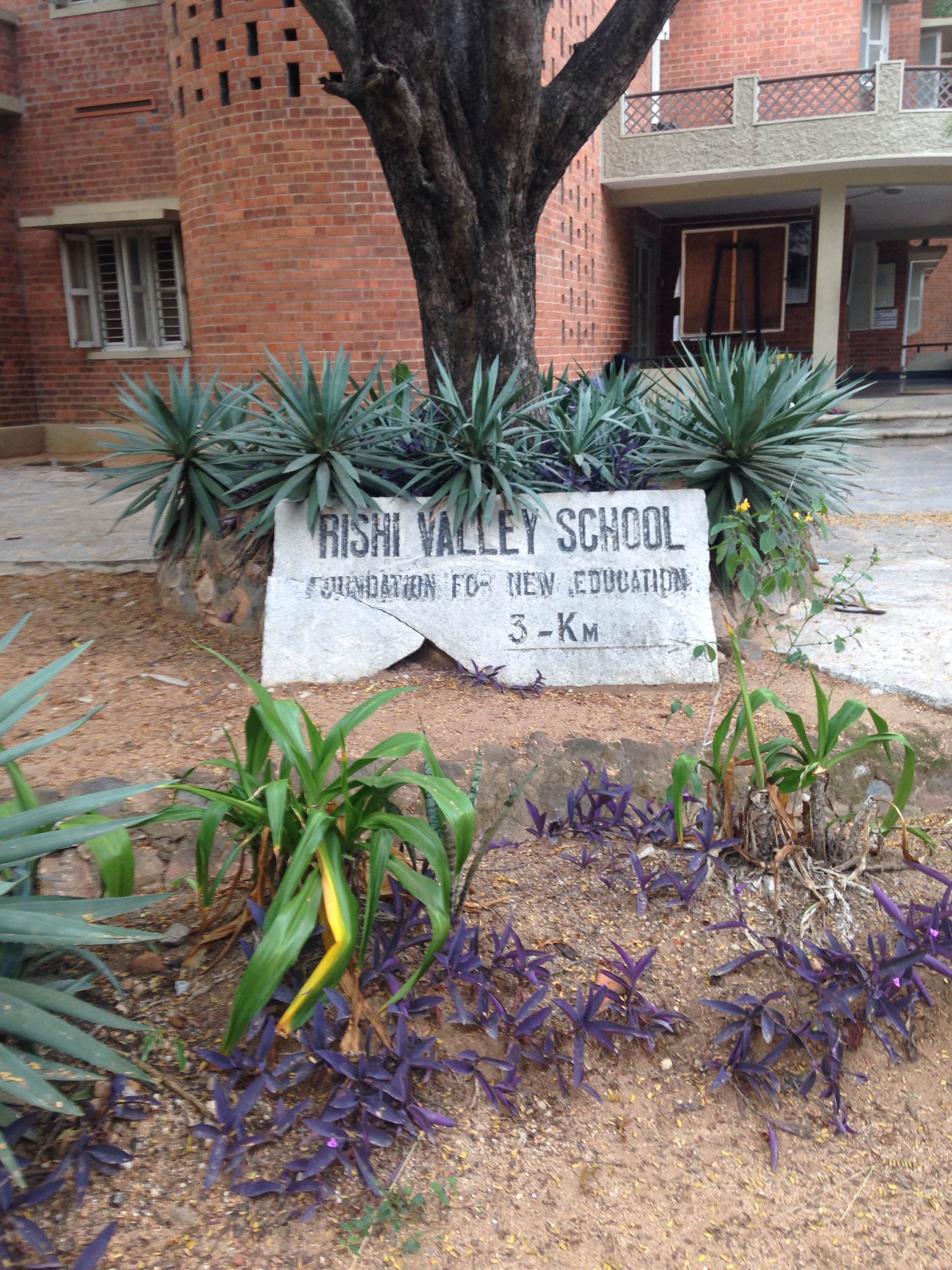
I (Pooja) have just returned from an extraordinary two days at the Rishi Valley School in India.There is simply too much for one blog post, so I will share my experiences over a few blog posts. In this blog, I will focus on the principles which guide the school along with a photos of the campus.

The alternative school is guided by principles of holistic education which aim for the growth of student’s intellectual, emotional, physical, artistic, creative, and spiritual potential. The educational philosophies of the Rishi Valley School include:

  • To educate students so that they are able to explore both the world and their inner being
  • To inculcate a love for nature and respect for all forms of life
  • To create an atmosphere of affection, order and freedom without either fear or license
  • Not to condition the students in any particular belief, either religious, political or social, so that their minds may remain free to ask fundamental questions, enquire and learn. (http://www.rishivalley.org/school/aims.htm)

The philosopher Jiddu Krishnamurti established the Rishi Valley School in 1962. There are now Krishnamuti schools across India and the world, but this was the first educational site. The school is located “in a sheltered valley in the interior of rural Andhra Pradesh…about 140 km north-east of Bangalore.” (http://www.rishivalley.org/school/aims.htm) When we first arrived we met with the school principal. He listened to us attentively, and when he spoke it was softly and always with purpose. He said something in that meeting that has stuck with me. He said that although the teachers differed in teaching approach, the important quality was that they approached their teaching from a place of care and love. By walking around the campus, speaking with teachers and students, and observing classes I witnessed this in so many ways. For example, each morning the students gather in an open-air auditorium for an assembly. My experiences with assemblies have usually included announcements, performances, or guest speakers. At the Rishi Valley school, the assembly is dedicated to singing. The students and faculty gather in a circle and sing for half an hour. At the end of the school day, after dinner, we gathered in the auditorium again to watch an absorbing documentary on particle physics called Particle Fever.

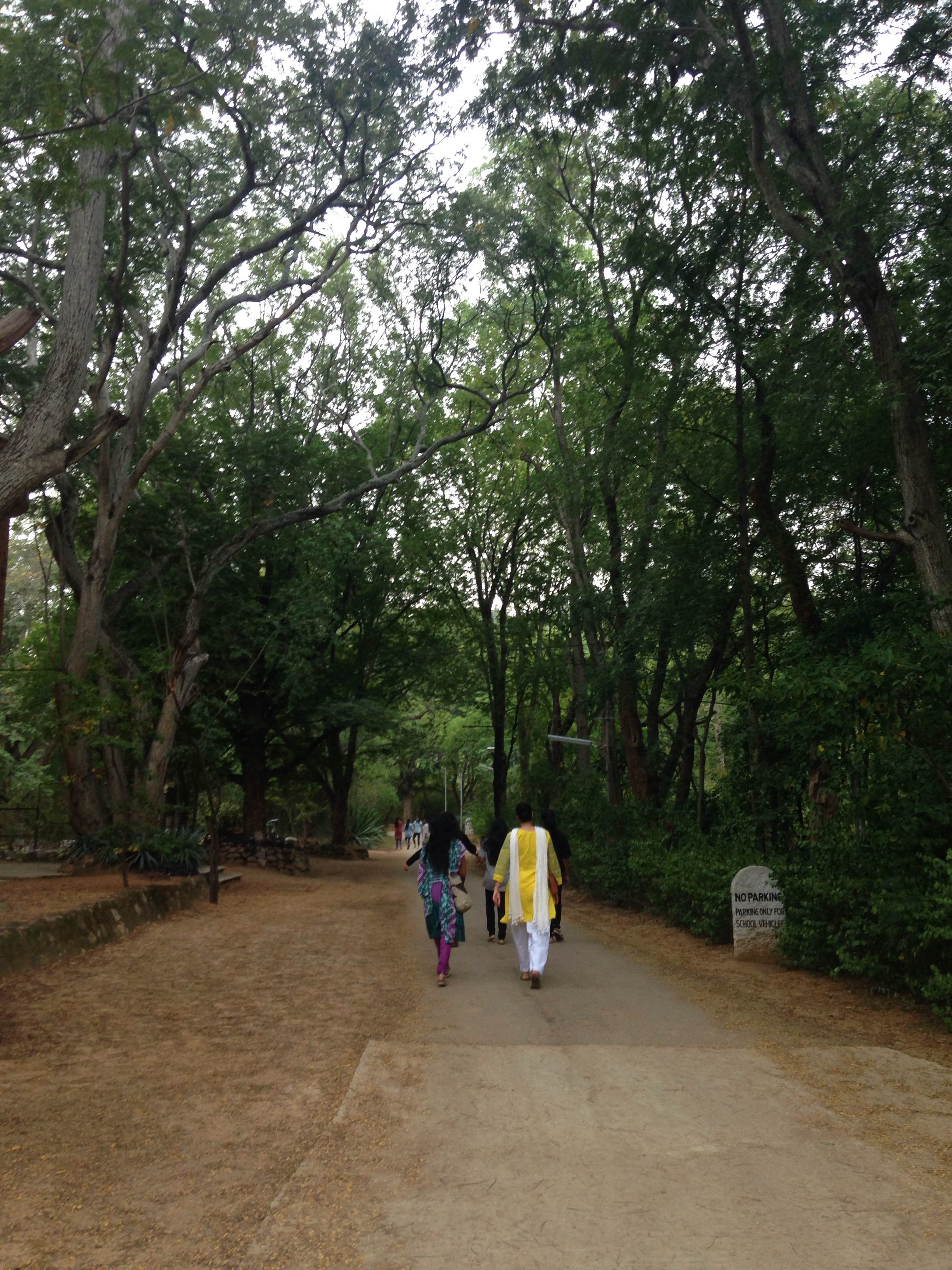
The following are a few photos of the campus and school activities. I believe they speak volumes about the principles from which the Rishi Valley School runs.

IMG_8011

The Rishi Valley School is a boarding school serving student from grade 4-12. There are approximately 325 students and 60 faculty members who live on campus.

IMG_8017

The morning all-school assembly. Students and faculty are seated on the ground.

IMG_8056

One of the many outdoor classrooms. My friend, a spoken-word artist, had the opportunity to facilitate a class here (More about that in the next blog!).

IMG_8009

The student art gallery. It was common to see students around the campus working on their art; fine art, poetry, and music permeated the student culture.

IMG_8013

Walking to class is a meditative experience. The campus is spacious, situated on approximately 360 acres of land. There have been over 200 species of birds identified, with the Indian Government officially declaring the school a bird sanctuary.

To read more about the Rishi Valley School: http://www.rishivalley.org/default.html

Publish or Perish: The Rise of Predatory journals

In the past year, on a regular basis, an email would pop up in my (Clare) inbox about a new journal and invite submissions. I would scan the email and wonder – is this legit or is it a boondoggle? I usually deleted the email because I was not sure if it was spam but I have often thought that I might be missing a great publishing opportunity. Am I being old-fashioned and not using social media? Mark Kingwell, Professor at the University of Toronto, wrote a GREAT column about “predatory journals” which answered my question. So new scholars, do not get fooled. Press the delete button! And all academics will find his stats about acceptance rates at top journals a bit disheartening. Here is an excerpt from his column and at this bottom of this blog is a link to the entire article.

Predatory journals take a bite out of scholarship by Mark Kingwell

The academic imperative “publish or perish” is so well known that people with no intention of entering scholarly life are familiar with it – no tenure for you, my friend, without at least a handful of citations. The journals should be reputable and selective, as all the best ones are, but in the crunch quantity might just trump quality. Alas, now comes this new storm on the horizon of university careerists: predatory journals.

Nobody inside academic life will consider it news that the number of journals, in almost every field, has risen in the post-print era. The good ones remain, and sometimes even retain a print version, but they are now flanked by opportunistic newcomers who prey on the desires of tenure-seeking scholars.

That, in itself, is no big deal. A new journal can publish work as accomplished as an established one, assuming the usual practices of double-blind peer review: The reviewers, assumed to be experts in the field, don’t know the identity of the author, and the author doesn’t know who the reviewers are. In my field, philosophy, acceptance rates at good journals run to about 5 per cent, or one in 20 of submitted pieces, and rare is the article that goes into print without extensive revisions suggested by the reviewers.

Predatory journals are a whole different beast. Instead of you seeking their grudging approval, they come after you. And then they demand money.

http://www.theglobeandmail.com/globe-debate/predatory-journals-take-a-bite-out-of-scholarship/article22275403/

Supporting Teacher Educators for Better Learning Outcomes

The European Commission on Teacher Education has done some amazing work looking at teacher educators. “The European Commission’s Thematic Working Group on ‘Teacher Professional Development’ brings together national experts from 26 countries. It is recognised that Peer Learning activities between Member States can provide opportunities to share knowledge about current policy and to exchange best practice.” In 2013 they produced the document Supporting Teacher Educators for Better Learning Outcomes. I (Clare) found the document quite systematic and informative because in considers a number of issues and provides examples from various countries. Here is a link to the entire document. European Commision on Tchr Ed

Here are some findings you might find interesting.

Member States increasingly acknowledge the need to define clearly what those who teach teachers should be expected to know, and be able to do; they acknowledge that great care needs to be taken in recruiting and selecting

teacher educators, and in facilitating their career-long professional development. By stimulating and supporting the development of explicit frameworks and policies, national and regional education authorities can assist teacher educators to be as effective as possible.

Given the influence that teacher educators have on the learning of (student)teachers, ensuring that their work is of high quality is extremely important (Snoek et al. 2011). Raising teacher educators’ quality and formal qualification requirements can lead to wider improvements in education (Buchberger et al.2000, European Commission 2012b). In European countries, however, there seems to be little explicit policy, either to define what quality means in teacher education, or to define the formal education and professional development required of teacher educators.

Professional ownership seems to be promoted also by Dutch teacher educator standards (Koster and Dengerink 2008); on the other hand, teacher educators can see standards linked with assessment systems (such as in England) mainly as external quality assurance tools, and therefore perceive them as constraints on professional autonomy (Morley 2003). Policies in European countries which show growing interest in these aspects can provide examples for reflection. In some countries, teacher educator competences are already defined by the government and specified in law (e.g. in Portugal), or they are being developed (e.g. in Austria and Germany).

In the Netherlands, a set of professional standards for teacher educators is in place, developed by the relevant professional body through dialogue with stakeholders.

In Belgium (Flanders), a developmental profile for teacher educators was devised by one regional teacher education network, in consultation with other networks; it is now disseminated on a national scale by the professional association of teacher educators. The definition of minimal levels of competence in this professional profile is considered as important; the Ministry can have a facilitating and supporting role.

The Netherlands have had a complete set of teacher educator standards for more than ten years now; it has been revised to include school-based teacher educators, and currently, competence levels. This is complemented by a specific knowledge base that describes the key elements of being a teacher educator, undertaken jointly by the professional association VELON and the VU University Amsterdam (in place since 2011).

In Luxembourg, following up recent educational policy for teaching and learning improvement in schools, a university working group has the task of defining competences for teacher educators in primary education, facilitating collaboration between university faculty and school mentors. A university research project has also been launched to develop a handbook for secondary school teacher educators, who all receive specific training.

In Estonia, guidelines about competences of teacher educators (mentors) in induction are used for their selection in schools: they underline the importance of first and second order competences, but also of professional attitudes –commitment, responsibility, willingness to support and supervise. There are also interesting initiatives in academic institutions. The categorisation of teacher educators aims to develop professional career models in teaching practice schools, where teacher educators can express multiple identities and competences – teaching, supervising and carrying out action research

In Germany, national standards for teacher education offer guidelines for teachers’ and teacher educators’ quality, defining specific knowledge requirements for teacher educators. Those working in University Colleges of teacher education (Ausbilder) are generally expected to have the competences mapped above – including intercultural, collaborative, supervision and pedagogical competences. In most Länder there are special regular offers of CPD for teacher educators, within regional partnerships and cooperation structures with teacher educators from Universities.

In Austria, legislation on the duties and responsibilities of teacher educators in University Colleges will provide a point of reference for the description of necessary competences, working in parallel with a Quality Act recommending the competence requirements of teacher educators working in schools and continuing professional development (CPD). The profile of CPD trainers, for instance, focuses on competences about counselling, process management and implementation, communication, and so on.

In some countries of the cited survey, formal qualification requirements for teacher educators have been introduced, focusing on specific groups (e.g. in Sweden, Hungary and Finland). Other countries have approached this issue in the context of the accreditation of institutional providers of teacher education, as in Ireland (Caena 2012).

In Sweden, all teacher educators working at universities are required to have a PhD, with the development of intensive support programmes for those teacher educators that need to achieve a PhD qualification.

In Hungary, formal university education programmes for school-based teacher educators (mentors) are being introduced.

In Finland, the requirements for teacher educators working in teacher education institutions include MA qualifications and advanced Education studies (at least 90 ECTS).

In Ireland, the Teaching Council has developed revised criteria for teacher education providers, which now express requirements for staff responsible for student teachers’ learning. They include:

  • a qualification at a higher level than the one being taught;
  • teaching experience in the relevant sector (primary or post-primary);
  • research activity as for supporting theory-practice integration; and
  • registration with the Teaching Council (it is recognised that all these criteria might not be met by all staff).

The Teaching Council has also begun to identify some of the competences needed by school-based teacher educators, within a pilot model of induction/probation. Such teacher educators should:

  • be fully registered and have at least five years’ experience as such;
  • be good communicators, sensitive to the viewpoints of others;
  • be committed to providing professional as well as personal support and

challenge;

  • be good role models, with a wide repertoire of teaching styles;
  • be committed to high standards of professional practice and conduct;
  • be willing to commit time and effort in the interest of developing newly

qualified teachers as well as their own practice;

  • be open to being observed in their practice by other teachers.

Consideration is being given to developing similar sets for teacher educators

involved in facilitating induction workshops.

Guest Blog: Gisela Wajskop’s Reflection on Her Time in Canada

Gisela WajskopIt’s snowing! But I (Gisela) have nothing to complain about! From January 2014 until today I have enjoyed many winter days in Toronto. I’ve been a Visiting Scholar from Brazil sponsored by Clare Kosnik for almost a year at OISE/University of Toronto. It has been an amazing experience! More than the cold weather I’ve discovered a great country: from red maple leaves to squirrels on streets, from Lake Ontario to Lake Louise, from Quebec City to Montreal, from AGO to Canadian Museum of Human Rights in Winnipeg, from rainbow positive to multicultural spaces. The environment and people have touched my heart and brain!

I have interviewed teachers and educators and I have observed many babies and kids at schools and Day Care Centres. I have met many smart people — undergraduate students, faculty, and newcomers to Canada (who have diverse cultures, values and languages).

This sabbatical opportunity contributed to my analysis of teacher education in Brazil. The insights I have gained came about through discussion of my data at Clare’s and Clive’s BTE team meetings and by comparing my findings to some of the points made in lectures that I attended at OISE and at conferences both in Canada and the U.S. One of the exciting developments was that my proposal on my research was accepted by AERA. I will present my work in Chicago next year.

This wealth of experiences and my academic partnership improved my own vision of education. Being a teacher is complicated because of the many dilemmas and issues yet being a teacher should connect to one’s own life. Teaching occurs in a dynamic, diverse, and interactional-based setting!

My experience in Toronto gave me spectacular new knowledge about being a teacher in a democratic and multicultural city! I have learned from OISE and the Toronto District School Board that a good and positive vision of education is supported by research. This vision is “tested” daily by students, parents, and principals. The most important piece of the education puzzle is teachers. I have been impressed with the ways that teachers think critically about education and have developed many good strategies for teaching which in turn supports student learning!

I learned also that accountability counts! More than policy initiatives, accountability should include the community’s attitude towards the kids and youths in schools! Even though Canadians complain about their schools, I have seen some great initiatives: Triangle Program that supports LGBQT high school’s students; a Parkdale school that supports ESL students who often struggle financially and has a number of refugee children from around the world; and schools with an Afrocentric-positive space to support student well- being. I have learned about connecting undergraduates students with teacher education research which will help these future teachers build a whole identity and professional practice.

Thanks everyone who supported me in the time I spent in Canada! I hope that OISE will help my country improve our national system of education. Doors are open between our countries! See you soon!

What’s on a good research project site?

I (Clare) thought this post about a research blog would be relevant for our research blog. Terrific suggestions lots of which I will follow.

Tseen Khoo's avatarThe Research Whisperer

Old Story (Photo by Place Light | www.flickr.com/photos/place_light) Old Story (Photo by Place Light | http://www.flickr.com/photos/place_light)

It seems to be the done thing these days to have a webpage about your research project.

In fact, I think it’s fair to say that it’s considered an increasingly essential part of research engagement and dissemination, and – really – it is so easy to set something up these days.

Right?

Well…yes and no. (Stay with me, I’m a humanities scholar and that’s how we answer everything)

I had a great chat recently with a researcher who was wanting to set up an online presence for his project. Part of the task of this presence was to recruit subjects for his PhD study.

It was a valuable conversation for him (or so he tells me…!) and also for me, because it clarified our perceptions of what was necessary, good, and ideal.

What I’m talking about in this post isn’t focused on what specific funding bodies…

View original post 889 more words