The Washington Post calls attention to the ongoing debate over the Common Core Standards by featuring a letter writing exchange between two school Principals who express their differing views on the standards. The first letter is written by Carol Burris, Principal of South Side High School in New York, who was once a strong supporter of the Common Core but is now a critic of the standards. Burris noted, “I do not think it is a good idea to homogenize standards as untried as the Common Core, across our nation. What we teach our children is far too important to submit to a national experiment. Practicing educators, child development experts and parents should be deeply engaged in the process of standard setting in our states. Standards should be debated, reviewed and refined.” A response will be written by Jayne Ellspermann Principal of West Port High School in Ocala, Florida. See the link provided to read this informative exchange:
Full Day Kindergarten (FDK) Blog #4 tells the literacy teaching story from the perspective of a first time Full Day Kindergarten parent (Yiola). In this post I share elements of the assessment process and how my child’s development has been communicated.
Here in Ontario it is “Parent-Teacher Interview” time. First term report cards have been written and parents and teachers, and sometimes students, are meeting to discuss student progress. There are a number of ways the interviews are conducted: student-led conferences are now quite popular processes and the more traditional teacher-led conference sans student are still in effect.
When I received the school newsletter and read that report cards and interviews were about to take place I was surprised and a little anxious; I felt it was too early to have the teachers share my child’s development… I knew my Sylvia Clare was learning a lot but to put in writing her ‘levels’ or acquired learning after 8 short weeks of school seemed far too soon. Well, I was right. The report cards and formal interviews were meant for students in grades 1 and up, not for kindergarten. Phew! That made more sense to me. As a parent of a child in kindergarten it makes good sense that children in the early years are not formally assessed … well, too early. From a parent’s perspective, I wonder if I would feel the same way if my children were in first or second or third grade?
What the FDK program has established is an “observation” time where each parent/guardian is invited to visit the classroom in action, to observe the daily life of the classroom and their child in the classroom. During the observation time the teacher offers some time to discuss questions or concerns with the parents/guardians. I was thrilled with the sounds of process as I was feeling so very curious about the sounds and vibes of the classroom and how Sylvia Clare got on inside that environment. A first hand eye-witness makes such good sense.
A short note arrived home a week before the observation. We were assigned a half hour observation time the following Monday morning. This worked well for me, but I did wonder, how do full-time working parents without flexible schedules manage the observation?
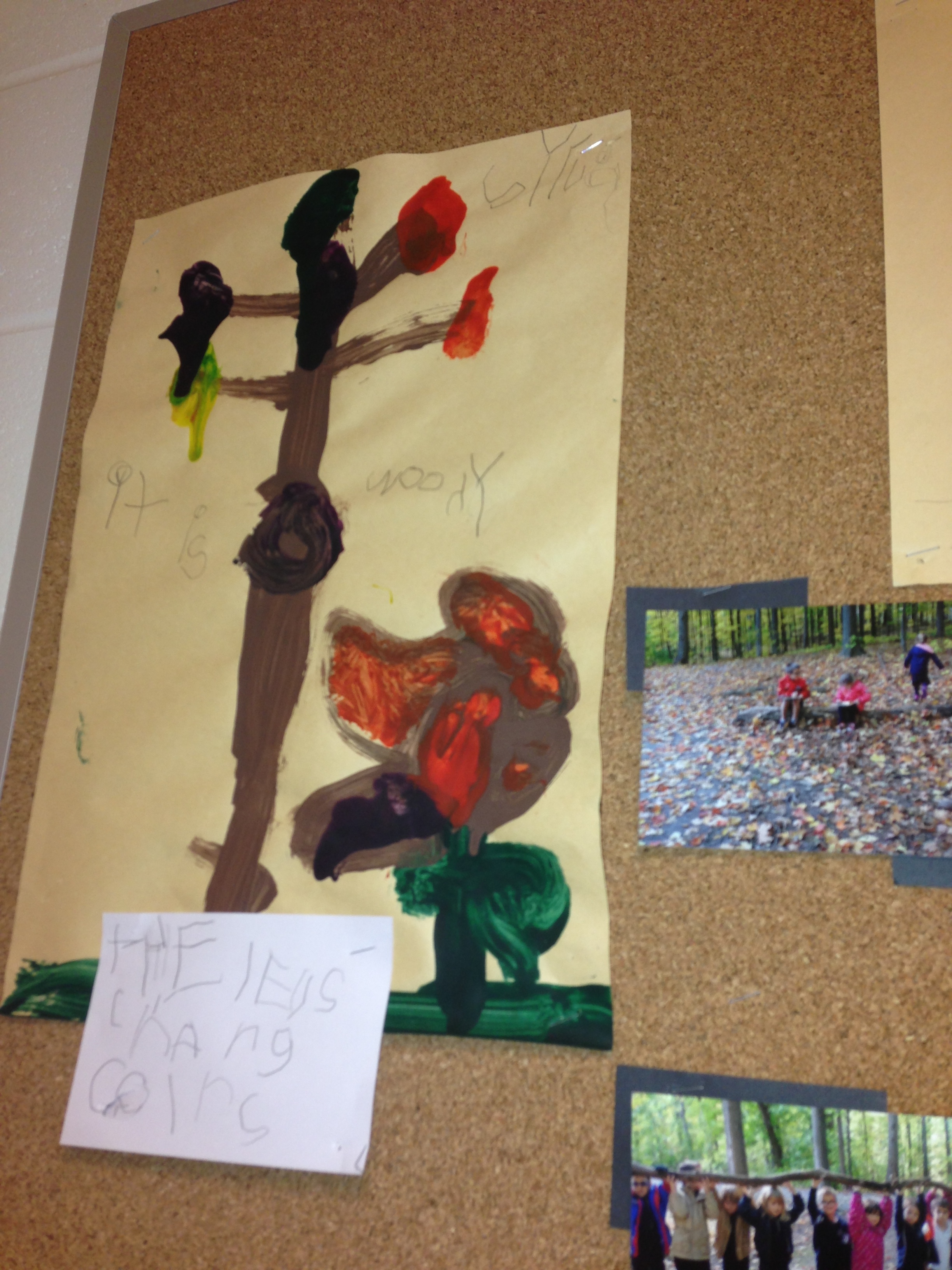
Monday morning arrived and off I went to visit the classroom. Alive with children’s voices, questions, and energy I walked into a vibrant room filled with learning. I was welcomed by the Teacher and Early Childhood Educator. Sylvia Clare’s face lit up when she spotted me as she hustled over with excitement. I quickly slid into the flow of the room and began to learn what it was my child did in the FDK room. Sylvia Clare was working with another student building the 100s chart on the huge carpet area. She had the 70s cards and while the Senior Kindergarten student was building from the 40s, she watched and waited patiently for the 70s to turn up so she could add to the massive chart… a wonderful, collaborative learning experience. When done, she showed me around the room: building centres, reading nooks, sand table, art table, writing table, snack table and well organized low rise shelves embodied the room. The room was as I remembered it back in August (neutral colours, natural light, natural materials) but now evidence of student learning lined the walls; drawings, colourings, writings were on display and I could see Sylvia Clare’s work.
Sylvia Clare’s portrait of “Woody”, the tree the class adopted from the neighbourhood forest.
Children working in pairs, in small groups, independently on a variety of tasks throughout the room. The room was bustling yet highly organized. The room was loud but not noisy. I was thrilled to see so many “languages” brought to life (Reggio Emilia’s notion of the 100 languages in the classroom) ~ art opportunities everywhere; all purposeful and engaging. Everyone, including my Sylvia Clare had a place in the space and was engaged in the life of the room. The teachers encouraged Sylvia Clare to show me her portfolio (a binder with evidence of her work). Then Sylvia Clare led me to her interests where we explored and worked together. Once well settled into the observation, the teacher sat down next to me and asked, “Do you have any questions or concerns?” This was such an open and welcoming way to start our discussion. My questions:
Is Sylvia Clare happy at school?
Does she have friends and is she social? Who does she play with the most?
Where does she spend most of her time in the room?
I see she is learning a lot from all that she shares at home. What do you think?
The teacher provided specific description of Sylvia Clare’s work in the classroom: what she talks about, who she plays with, what she enjoys doing, and how she interacts in the classroom. It was clear to me the teachers have a good sense of who Sylvia Clare is, what she likes, areas she has shown significant growth already and areas for improvement. Then I asked:
What can we work on at home to support her learning?
Continued literacy development, focusing on sound/letter recognition. I realize now, as a parent of a child who is developing their reading skills just how complex the process is for children. It takes time. Some children acquire skills faster than others; some struggle but all children need time, exposure, practice to basic skill development. In theory, I knew this. To witness it through the lens of a parent however is somewhat different. Experiencing literacy development in one young child in live time, watching her gain letter recognition, one letter at a time, one sound at a time, is quite fascinating. Sylvia Clare is getting there. Beyond the daily read alouds and story telling I need to work through phonic games and drills with Sylvia Clare.
After our brief conversation I felt comfortable and confident that my child has adjusted to full day schooling and getting along well. Sylvia Clare then ushered me over to the snack table and we chatted while some of her friends came over to meet me. Shortly after, I said my goodbyes and was on my way.
It was remarkable observing my child in this setting; a setting outside our home, a setting in which I am but an observer and Sylvia Clare is the participant. The observation experience provided very clear, detailed description of my child’s work at school, far more than I would have gathered from a formal report card.
With the first month of school soon behind us I (Yiola) want to share some examples of my 4 year old daughter’s (Sylvia Clare) literacy learning in Full Day Kindergarten (FDK).
Example 1: Phonemic awareness. Sylvia Clare must be learning about the letter H. On more than one occasion she has demonstrated her understanding of phonemes and phoneme isolation. I said, “Sylvia Clare you must be hungry”. Sylvia Clare paused and responded, “Mommy, is hungry like Henry? huh huh huh.” I paused in surprise of her observation and connection and simply said, “Yes”. Later in the evening I said, “Hendrix and Orion are going to visit soon” and Sylvia Clare responded, “Hendrix is like hungry and Henry, right mommy?”
Example 2: Letter recognition. One night earlier this week while tucking Sylvia Clare in bed I noticed she was curled in the most unusual position. I observed but said nothing. Just as I was about to pull the bed sheets up Sylvia Clare said, “Mommy, what letter do I look like?” I respond, “hmmmm, interesting. I’m thinking you look like an I?” Sylvia Clare laughs, “Noooooo. What letter do I look like mommy?”
She is also taking objects and forming letters. For example, while playing outside, she took two twigs and placed them together to form the letter “V” and asked, “Does this look like a letter mommy? What letter is this?”
Example 3: Vocabulary development and comprehension. More and more Sylvia Clare comes home with stories. Vivid stories. Curious stories. Each day her stories grow in detail and description. The other day she explained she went on a trip to the forest in search of an oak tree. She shared, “On the way to the forest, I held a boy’s hand [she paused and blushed]. His name is *Sam (changed) and he is in SK (senior kindergarten) so he is bigger. I fell down on my way to the forest but I did not get hurt and the teacher gave me a bandaid. The forest close to the park mommy, you know the one we always go to. We went into the forest just a little, not deep in the forest, only at the entrance. There we found a humungous oak tree. It had 4 trunks and they went out like this (uses her arms and points in four different directions). So it really looked like four trees stuck together. We looked at the bark”. I asked if it was an angel oak tree. She was not sure but she continued to share news about her experience.
Example 4: Confidence. Sylvia Clare drew a map of the world at home, wrapped it up and took it to school. I thought nothing of this as I dropped her off in the morning. Then I realized I left her lunch bag at home! I scrambled home and rushed back to the school to bring her lunch. By the time I returned to the school the children were engaged in outdoor play/education/inquiry. I saw Sylvia Clare standing with one of her teachers, her map open and making reference to it. The teacher saw me and smiled, “Sylvia Clare is reading her map and we are now trying to find the treasure”. How wonderful to see play and literacy in harmony. A reader is a person who reads. Sylvia Clare was demonstrating she is a reader. Then, at the end of the day when I went to pick her up she had another paper in hand. I asked, “What did you work on today?” and Sylvia Clare explained that she lost her map so she made another one – she developed a graphic organizer, a way to read, understand and appreciate the world. My thoughts: thank you teachers, for providing the time and space for Sylvia Clare to engage in what interests her and thank you for appreciating those interests.
On her own, without probe, Sylvia Clare is offering hints of literacy teaching and learning. With sly enthusiasm she is sharing her learning with me, in subtle, whimsical ways. She is sharing her achievements and understandings and I can tell she is proud that she is learning new things. What excites me is that her learning is evident; in her sharing, practice and happiness. It is not coming home by way of worksheets or alphabet books. I look forward to seeing and sharing what the upcoming months hold.
As I continue to read the news about states exiting the Common Core standards to reclaim standard-setting autonomy, I am reminded of a quote from a participant from our SSHRC study on literacy teacher educators:
“You’re teaching the student. You’re not teaching the curriculum. The student should be in the middle and to try to stretch the curriculum to fit around that.” (Melissa)
The Common Core Standards are national U.S. standards for English Language Arts and Mathematics grades K-12. The implementation of these standards began in 2011. However, in the past few months three states have formally withdrawn from the Common Core Standards (Indiana, Oklahoma, and South Carolina). Recently, Governor Bobby Jindal of Louisiana made public that he was also looking to formally withdraw from the Common Core Standards.
This turbulent time in the implementation of national standards reminds me of the stance several of our literacy teacher educators had on teaching directly to national mandates. Several had lived through many curricula, and so tended to veer away from explicitly teaching the curriculum. Rather, they emphasized with their student teachers that the focus should always be on the student.
Below is a chart summarizing U.S. resisting the implementation of the Common Core:
Finally some “push-back” to PISA’s growing dominance of education. I (Clare) found this article in the Guardian newspaper very interesting. For full article see: http://www.theguardian.com/education/2014/may/06/oecd-pisa-tests-damaging-education-academics
In this letter to Dr Andreas Schleicher, director of the OECD’s Programme for International Student Assessment, academics from around the world express deep concern about the impact of Pisa tests and call for a halt to the next round of testing.
Excerpts from the letter are below:
We are frankly concerned about the negative consequences of the Pisa rankings. These are some of our concerns:
• While standardised testing has been used in many nations for decades (despite serious reservations about its validity and reliability), Pisa has contributed to an escalation in such testing and a dramatically increased reliance on quantitative measures. For example, in the US, Pisa has been invoked as a major justification for the recent “Race to the Top” programme, which has increased the use of standardised testing for student-, teacher-, and administrator evaluations, which rank and label students, as well as teachers and administrators according to the results of tests widely known to be imperfect (see, for example, Finland’s unexplained decline from the top of the Pisa table).
• In education policy, Pisa, with its three-year assessment cycle, has caused a shift of attention to short-term fixes designed to help a country quickly climb the rankings, despite research showing that enduring changes in education practice take decades, not a few years, to come to fruition. For example, we know that the status of teachers and the prestige of teaching as a profession have a strong influence on the quality of instruction, but that status varies strongly across cultures and is not easily influenced by short-term policy.
• By emphasising a narrow range of measurable aspects of education, Pisa takes attention away from the less measurable or immeasurable educational objectives like physical, moral, civic and artistic development, thereby dangerously narrowing our collective imagination regarding what education is and ought to be about.
• As an organisation of economic development, OECD is naturally biased in favour of the economic role of public [state] schools. But preparing young men and women for gainful employment is not the only, and not even the main goal of public education, which has to prepare students for participation in democratic self-government, moral action and a life of personal development, growth and wellbeing.
• Unlike United Nations (UN) organisations such as UNESCO or UNICEF that have clear and legitimate mandates to improve education and the lives of children around the world, OECD has no such mandate. Nor are there, at present, mechanisms of effective democratic participation in its education decision-making process.
• To carry out Pisa and a host of follow-up services, OECD has embraced “public-private partnerships” and entered into alliances with multi-national for-profit companies, which stand to gain financially from any deficits—real or perceived—unearthed by Pisa. Some of these companies provide educational services to American schools and school districts on a massive, for-profit basis, while also pursuing plans to develop for-profit elementary education in Africa, where OECD is now planning to introduce the Pisa programme.
• Finally, and most importantly: the new Pisa regime, with its continuous cycle of global testing, harms our children and impoverishes our classrooms, as it inevitably involves more and longer batteries of multiple-choice testing, more scripted “vendor”-made lessons, and less autonomy for teachers. In this way Pisa has further increased the already high stress level in schools, which endangers the wellbeing of students and teachers.
We are just back from New York and New Jersey where we interviewed a number of teachers who are part of our longitudinal study. Since we have been following these teachers for 7 years, I (Clare) feel I know them well. These are very able educators who are now working in very difficult conditions because of external constraints. I heard stories of them having to submit DETAILED lesson plans regularly (for the following two weeks), being observed/assessed five times per year, having to change their programs in order to comply with the Common Core, assessing the children an excessive amount, having to forgo pedagogies/books/activities they know are what the children need, and tying their teacher evaluations to student performance on standardized tests. All of these supposed measures to improve education in fact are undermining education. These teachers are spending so much time testing and writing lesson plans, they do not have time to actually work with the children. And they know what needs to be done and how to do it! All reported HIGH levels of stress. They are being deprofessionalized as these overbearing compliance methods are imposed on them. The phrase, lack of respect, was uttered over and over again by them. When asked the question — If you had to do it over again, would you become a teacher? – the responses were disheartening. Most said no and many said they are actively thinking about other careers. What has happened to education in the U.S.?
At the end of May, 2013, I began what would turn into a four part series on the problem of mandatory, high stakes testing in education. Much has changed since that series. I’ll provide links for the original series at the end of this article, but the series that begins with this article is substantially updated. As is always the case, I don’t know where the series–and the interests of readers–will take me. I simply hope I can provide some useful and thought-provoking ideas.
The school year is drawing to a close. It’s always a bittersweet time. It is good to bring the year to a close, to finish all that we’ve worked on for a year and to take some small satisfaction in all we’ve learned. But it’s a sad time as well, for all too soon, each of my classes, made up of all of…
I (Clare) was in my department yesterday and ran into a number of colleagues. Most were bemoaning their heavy marking load. This is the end of the semester and most seemed snowed under with the grading papers. A few weeks ago I observed a number of student teachers submitting their assignments. They too looked tired and were complaining about their assignments and workload. Yes assignments are work. Yes as instructors we need to grade student work. But there is something wrong with this picture. Many of the student teachers do not find their assignments useful (as a few commented – “they are just make- work projects”) and faculty spend huge amounts of time marking projects their student teachers found wanting. We definitely need to have assignments but I think it is time to discuss what are useful assignments for student teachers. The corollary issue is how can marking assignment be useful for faculty?
A number of years ago when I was Director of the Elementary Preservice program at OISE we created a survey about assignments which we distributed to around 600 student teachers. The results were surprising: they did not like having to self-assess, they disliked group projects, and they would rather have fewer, more in-depth assignments, than many little ones. (Most criticized were submitting long lesson plans with reflections. Many admitted they simply made up the reflections.) What was not surprising is they valued assignments where they had choice in both the topic and the format. If we (faculty and student teachers) are going to spend significant time on assignments then let’s use our time more fruitfully and productively. We cannot do away with assignments but I think we can reconceptualize them to be more useful for everyone involved.
A feature in the Guardian on the 15th March, by left-wing journalist John Harris, aroused a good deal of interest among teachers (still going if last Saturday’s letters page is anything to go by). But ‘Inside the A* Factory’ received little coverage elsewhere in the media and the underlying issues (teacher workload, teacher morale and the factory model of schooling) also continue to be ignored by the press and broadcasters. There is a national teacher strike this coming week and a lay reader would be hard-pressed to know it was happening let alone why it was happening.
The article was essentially a collection of stories of different teachers’ experiences of working in schools over the last 20 years or so. The age of the teachers reflected that but the majority of Harris’s sample seemed to be 30 or under and talking about the last five or six years. The picture…
You may remember, in a former post on Mar. 21, 2014, I (Cathy) shared some of my pre-service students’ multimodal projects. The dilemma facing me after these wonderful creations were submitted, was how to assess them. As these were only part of a larger assignment, I already had a rubric in place for whole project, but after seeing the brilliance of the multimodal aspect, I felt these alone warranted more thought and introspection on my part. Having a background in the arts, I was used to assessing creative process and final product, but this was different. Although artistic and expressive, this wasn’t “art”. Hence, I looked up a number of sources on assessing multimodal work and discovered a few different opinions.
Kalantzis, Cope & Harvey (2003) argued that a multimodal assessment needs to measure the creative process and the collaborative skills demonstrated. Jacobs(2013) suggested it wasn’t about the final product, but “watching and noticing what students are doing and then using that information to guide the students toward new skills and knowledge”. In the end I sought out the opinion of Gunther Kress, the founder of the Multimodalities Theory. Kress (2003) explained that representation and communication were an affective/cognitive semiotic process and this must be taken into account in the assessment. He suggested that I, as the teacher [educator] should not ask “How does this project match what I wanted or expected?”, but instead should ask, “How does this project give me insight into the interests and motivations of my learner?” I found this question quite insightful. In the end, I used Kress’ question to guide my feedback, which will hopefully guide the students toward new insights and knowledge. The required ‘grade’ was based on a combination of the learners’ expressed interests from within the context of the whole project (which was on diversity), the creative process and the collaborative nature of the work.
Through this process I discovered that assessing in the new age of multimodality demands mindfulness, insight and the ability to make many connections. To be effective, it also requires that the teacher educator, or teacher, know his/her students well. This type of assessment takes time, but it is much more meaningful. I have to admit, as much as the students loved doing these multimodal projects, I loved assessing them in this “new” way. We all got more out of the process. Below is a link to one more student project expressed as POW TOON digital creation. How would you assess it?



 I (Clare) was in my department yesterday and ran into a number of colleagues. Most were bemoaning their heavy marking load. This is the end of the semester and most seemed snowed under with the grading papers. A few weeks ago I observed a number of student teachers submitting their assignments. They too looked tired and were complaining about their assignments and workload. Yes assignments are work. Yes as instructors we need to grade student work. But there is something wrong with this picture. Many of the student teachers do not find their assignments useful (as a few commented – “they are just make- work projects”) and faculty spend huge amounts of time marking projects their student teachers found wanting. We definitely need to have assignments but I think it is time to discuss what are useful assignments for student teachers. The corollary issue is how can marking assignment be useful for faculty?

 Literacy Teaching and Teacher Education