Category Archives: Curriculum Resources

“Pete the Cat” takes our home by storm!

Have you heard of Pete the Cat?  This children’s book series is a favourite in our (Yiola) Pete the Cathome. My 4 year-old daughter and my 2 year-old son love reading/singing along to the stories.

What I like about Pete the Cat ( by Eric Litwin) is its simplicity – the language is simple and the rhythm of the language is catchy. My son is able to connect to the repetition and sings along with joy.

I also like the messages in the stories – they call to issues of mental health and wellness. Pete the cat is calm and does not worry about some of life’s potential anxiety ridden experiences. For example, in “Pete the Cat Rocking in My School Shoes”, Pete is confronted with unfamiliar spatial settings, noisy lunchrooms and bustling playgrounds; common childhood circumstances that can cause anxiety. Yet Pete handles each situation with grace and confidence because, “it’s all good”.

In “Pete the Cat and His Four Groovy Buttons” Pete’s buttons keep popping off of his shirt, but Pete does not get upset because “it goes to show that stuff will come and stuff will go. But do we cry? Goodness no! We keep on singing”.

When reading “Pete the Cat: I love my white shoes”, Pete steps in a variety of ‘stuff’ that cause his white shoes, which he LOVES, to change colour but Pete does not get upset.

The moral of the story is: “no matter what you step in keep walking along singing your song because its all good.”

Check out a Pete the Cat story here:

http://www.youtube.com/watch?v=uuHzYssjjGc


Dialogic Talk

It’s a powerful statement about a book when while reading it, you implement a suggested strategy the next day in class.  That’s exactly what happened while I was reading Classroom Talk: Understanding dialogue, pedagogy and practice, by Edwards-Groves, Anstey and Bull (2014).  The premise- talk is the foundation to all learning- is not new, but the connections made to multiple theories (e.g. Theory of  Practice Architectures, Theory of Multimodality, Social Semiotic Theory) makes this book very current.

book

I particularly enjoyed the section on conversation vs dialogic talk.  I do believe in “vacating the floor” as is suggested in the book and letting the students discuss issues in small groups.  In one particular class I teach, I always allowed my students to select their own discussion groups, as these are university students and felt they needed to make their own choices.  However, many of the groups were not focused, they veered way off topic (or never addressed the topic at all) and some students were still not voicing their opinion (even after much community building).  The section on dialogic talk prompted me to reframe my concept of small group discussion.  It suggested conversation is an informal discourse where direction and end point of the talk are unclear.  This was pretty much where my students were with their discussions.  Dialogic talk, however, sought to engage all listeners and had more purpose.  Plus, dialogic talk was not as relaxed as conversation, it was driven.  I needed driven.  I wanted more engagement.

As a result, I immediately set up ‘Dialogue Groups’ with an assigned moderator, who ensured everyone’s opinion was invited and heard.  I decided who would go into each group (which I thought they might resent and discovered they preferred!).  For each discussion I provided prompt questions to get the talk started.  I also assigned a time keeper who kept the dialogue to the time limit and a recorder who kept general notes about what was discussed.  I honestly didn’t think this would be necessary at the university level, but the difference was incredible.  There was thoughtfulness in the answers.  The discussants were suddenly animated and energetic.  They were really listening to each other.   This was a small change, but it made a world of difference in how they were hearing and responding to each other.

Of course there are many other interesting and practical suggestions in the book.  The connections between theory and practice are very strong.  I highly recommend it.  This book was published by the Primary English Teaching Association of Australia (PETAA).  Check out their web site!

http://www.petaa.edu.au/

Picture Books

arrival_02Clare and I (Lydia) routinely integrate picture books into our pre-service literacy methods courses. We often begin each class with a read aloud from a picture book. The feedback we have received from student teachers suggests they appreciate this practice because it introduces them to a variety of texts they can use in the classroom, and it models storytelling and read aloud techniques. We have often used the creative and compelling picture books of author Shaun Tan in our literacy courses. I wanted to share a quote from Shaun Tan in which he comments on the “visual language of illustrations”.

“the word illustration is a little misleading, because the best illustrations do not actually illustrate anything, in the sense of describing or illuminating. My own narrative images, and those of my favourite artists, are actually far more concerned with deepening the uncertainty of language, enjoying its ambiguous references, exploiting its slipperiness, and at times, confessing its inadequacy.  My own aspirations as an illustrator – using that term advisedly – is to simply present the reader with ideas that are essentially silent, unexplained, and open to very broad interpretation”.— Shaun Tan

(Quote taken from an essay originally written for ABC Radio National’s Lingua Franca.)

Experimenting with Collaborative Discussion Strategies

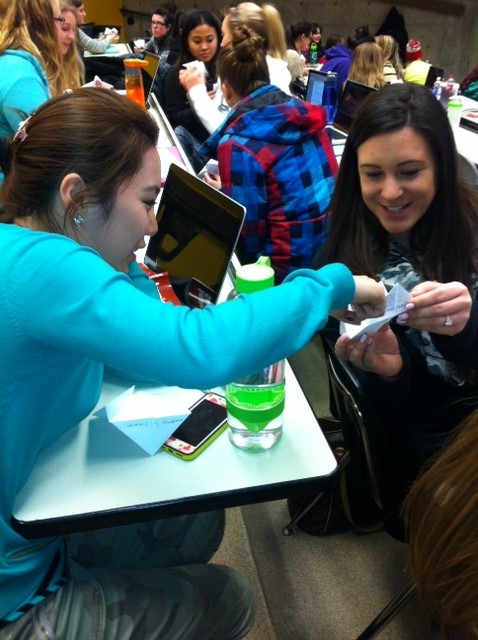
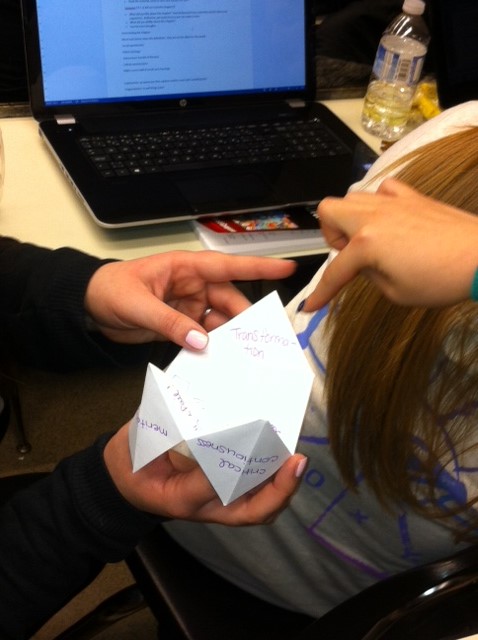
The class I (Cathy) teach for the Bachelor of Early Childhood Education program is from 7-10 in the evening.  I feel for my students as this is a demanding time to be learning something new.  To make matters worse, many of the students arrive rather fatigued having just left another class that is strictly lecture format.  I need to wake them up and get them thinking again.  So, capitalizing on my belief in a dialogical approach, for part of each class I implement a different collaborative discussion strategy (e.g. gallery walk, expert groups, four corners, placemat).  Our last class, however, was rather unique.  I was looking for a way to explore chapter summary and discussion.  Plus, I wanted to incorporate our ongoing work on metaphors in education.  Suddenly, the strangest memory came to mind… cootie catchers.   I wasn’t even sure that was the name until I found it online.  Traditionally, this is Japanese origami work, known in the paper folding world as the ‘Fortune Teller’.  How, I wondered, could I use this to motivate discussion and review?  After some tinkering with my objectives, I had the students place new/significant vocabulary from the chapter on the outside, which the origami maker had to define and spell to move the sections around.  Images representing significant ideas and concepts were drawn on the inside, which the player had to identify from the chapter.  Guesses were confirmed in writing which were under the hidden flap.  Guess what?  They loved it and played it many times with many partners, hence reviewing key concepts in the chapter with several people.  Then we discussed what happened.  Some said now they will never forget their selected words/phrases (e.g. critical consciousness, diaspora, social reproduction and juxtaposition).  They were a challenge to spell, too!  Others said the images were hard but made them think carefully about the chapter content. The most challenging images I drew on the board at the front of the lecture hall and collectively we tried to guess what they represented.  Sometimes we had to get clues from the image maker and we cheered or groaned when we finally got it.  At the conclusion of the class we left rather refreshed and interestingly, nostalgic.  Every student, no matter what the cultural background or gender, reminisced about playing this game as a child.  This was as diverse a literacy event as I have ever encountered and I don’t think I have ever enjoyed a collaborative review more.  Below is the website I used to remind the students how to create the origami form.  yes ori oop

http://www.origamiway.com/how-to-make-a-paper-fortuneteller.shtml

Teaching in a Digital Age

Facebook Logo As an instructor of literacy methods courses in preservice teacher education, one of the challenges is remaining current. I feel that I must have current knowledge of research on literacy and literacy development, current knowledge of curriculum resources and government initiatives, and be current with ever-changing social media trends. The last point is one that is often overlooked but equally important. To prepare my student teachers to be effective literacy teachers, I need to know them and this entails knowing the social media they are using. If I do not have some working knowledge of their communication patterns they might view me as a dinosaur which in turn can create a barrier to me understanding where they are coming from. Also, both student teachers and I need to know what pupils are using if we want to connect home and school literacy practices. Not having a teenager makes it difficult to stay current – many adolescents are far more in tune than me. So what to do? I found this website http://www.commonsensemedia.org/educators/blog which is helpful. I am not sure who sponsors it but there is a treasure trove of info for those of us trying to figure out what adolescents and young adults are using. One page that was very useful lists11 sites that kids go to after Facebook http://www.commonsensemedia.org/educators/blog/11-sites-and-apps-kids-are-heading-to-after-facebook . I liked the thumbnail sketches of each site and the pros and cons of each site.
Another page identified top digital citizenship bloggers.
http://www.commonsensemedia.org/educators/blog/our-favorite-digital-citizenship-bloggers-to-follow-in-2014
These bloggers identify issues that are often invisible to me.
Knowing popular culture I feel is essential to being a literacy professor. Clare