Category Archives: curriculum; teachers

Back to School

school

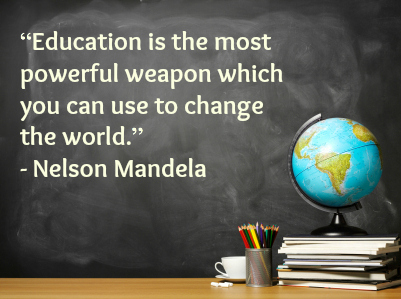
I (Cathy) have always loved the end of summer. I love the change in the temperature, the lush ripe tomatoes, and most of all, the start of a new year at school. There is an excitement to it- like New Years- full of potential and possibilities. Plus, the tasks I have been performing,  provided me with a sense of order and purpose.   I’ve reviewed notes from last year on changes I want to make for this year; prepared class lists, syllabi, and power points.  I sorted the art supplies, pulled books, and looked up newer resources. I also looked up a few quotes to start the year off…fireSingle bowl of healthy organic basmati rice.quote

Today is my first day of teaching.  I feel ready.  Hope you do too.  Have a great year!

Travel is an Education

When I (Cathy) was a grade school teacher, there were times when parents took their children out of school for a family trip. Often, a parent would ask if they could borrow a math or language text book to bring along so the child could “keep up”. I begged them not to. “Please,” I would say, “have them keep a journal. Draw what they see. Describe the people they meet. Take pictures and keep a record of them. Videotape a special event. Make a scrap book. Record the weather. Calculate the distance you travel every day. Follow the map. Plan an excursion.” In other words, I would ask the parent to use the trip as a resource.  I would also suggest the child prepare to share some of their experiences with the class when they retuned, so we could all learn from the trip.map


I was alarmed to think they would imprison their child in a hotel room or trailer to keep up with what we were doing in the classroom sometimes hundreds of miles away. There was so much to see and learn from the incredible world around them!child videotaping

Now, the affordances available for a child to investigate, record and share a trip are so much more interesting! A colleague of mine asked a grade one student of hers, who was going to the Olympics, to Skype the class every Tuesday morning from wherever she was and share her experiences. Her class loved it. They felt like they were there with her. After the Skype meeting the class would research the people and places she talked about. That one student’s trip became a class project.

This past summer, I travelled through Greece with my husband. I was delighted to see so many children capturing the sites we visited on an tablets and smartphones. I wondered if they would share any of it with classmates. I would still encourage a parent to not use a text book on a trip. The real world is just too interesting and there are so many creative ways to explore it. It’s all learning.tablets

Creativity and the Curriculum

I (yiola) will admit that as a classroom teacher  – while I thought I was a good teacher of student  learning – I lacked creativity both in content and pedagogy. Recently, I came across this link:

30 Dad Jokes That Are So Bad, They’re Great

and now, as a more experienced (teacher) educator and reflective practitioner  what came to mind was, “wow… so many interesting ways to use this link and these beautiful images with the mandated Ontario curriculum”. For example, any grade and topic in the Social Studies curriculum could be applied: Grade 2: Communities Around the World; Grade 3: Living and Working in Ontario (a perfect opportunity to explore the various regions and compare and contrast their beauty); Grade 4: Physical Regions in Canada (exploring photography to “unearth” physical landscapes); Grade 6: Canada’s interactions with the Global Community (moving beyond the political and economic).  Social studies can be seamlessly linked to literacy and the more I explore multiliteracies the more inspired  I am to employ the visual and the aesthetic to develop meaning and understanding… and communication.  Imagine the Visual Arts lessons and opportunities front these images — ‘Hello group of 7″ — and colour, and perspective, and line and emotion.  And to grasp onto the beauty of what may be unfamiliar to students living in urban centres or familiar to those living in more remote regions to discuss lifestyles and Healthy Living from the Health and Physical Education curriculum.

Which ever way children chose to inquire,  creative opportunities and aesthetic resources may offer new and exciting opportunities for seeing the world and themselves.  This concept for teaching is more inspiring than how I recall teaching and learning (i.e. comparison worksheets of city life vs. rural life).

PS — I thought of my good friend Clive Beck as I enjoyed these beautiful images! I hope you enjoy them too.


Reading Choices

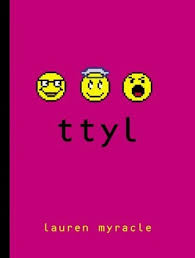
In general terms, my (Lydia) dissertation research examines the ways in which student teachers construct conceptions of literacy and enact literacy pedagogy when they view themselves as in conversation with a broader field of literacy (e.g. Multiple Literacies, New Literacy Studies). One aspect of this research considers how student teachers’ personal literacy practices inform their approach to literacy pedagogy. In some cases student teachers’ personal reading practices have been influenced by the interests and reading choices of the pupils they teach. These student teachers have often engaged with texts recommended by their pupils (e.g. graphic novels, young adult literature), and these shared texts become a space within which teacher and pupil connect. One of the student teachers participating in this research discussed the text ttyl written by Lauren Myracle, who has been referred to as a modern day Judy Blume. This young adult novel, which is part of a series, is written entirely in instant messages. Interesting, this best selling novel has been on the annual list of the “Most Challenged Books” released by the American Library Association. In other words, people have requested that this book be ban from libraries and schools “due to sexually explicit material and offensive language.” I plan to share this text with the student teachers in our literacy courses this year. I think it could contribute to an interesting conversation about text structure, style, controversies, and pupils’ diverse reading interests.

ttyl

Just for Fun- A Literacy Word Search

In the word search below, can you find…

1. The name of the theorist generally accredited with the origins of Social Constructivist Theory

2. The term used to identify a branch of linguistics which contends that meaning-making manifests through human interpretations of sign systems

3. The names of the two researchers accredited with constructing the four resource model

4. The term assigned to multiple modes of communication

5. The Literacy Theory that purports literacy and language are not neutral but political.

6. The name of a pedagogical approach designed by 10 scholars known as the New London Group in 1996

Scroll down for answers- but no peeking!


Z C X B N O L M R T Y Y I O P K
A C V N Q W R U T U J L A S D F
B V M N W E F L A S D F G H H J
Q Y W E M U L T I M O D A L O P
A G D G J K O I M N B V C X Z A
W O E T Y P U L U K J H G F D S
Z T X C V B N I M L H F D S A E
C S T G H K L T O U Y T E R W Q
V K N N L H O E I T R E W A Q P
R Y T Y U I P R I Z X C V B N M
Z L U K E M V A O P U Y T R E W
C X B N M L Q C R I T I C A L Q
Q W E R T Y U I I O P L K J H G
H G F D S A S E R T Y U I O M N
D F G H J K L S E M I O T I C S
Q S D C F R E E B O D Y C A T Y


Answers:  1.  VYGOTSKY 2.  SEMIOTICS  3.  LUKE, FREEBODY  4.  MULTIMODAL  5.  CRITICAL  6.  MULTILITERACIES


Focus on Teaching the Student

As I continue to read the news about states exiting the Common Core standards to reclaim standard-setting autonomy, I am reminded of a quote from a participant from our SSHRC study on literacy teacher educators:

“You’re teaching the student. You’re not teaching the curriculum. The student should be in the middle and to try to stretch the curriculum to fit around that.” (Melissa)

 The Common Core Standards are national U.S. standards for English Language Arts and Mathematics grades K-12. The implementation of these standards began in 2011. However, in the past few months three states have formally withdrawn from the Common Core Standards (Indiana, Oklahoma, and South Carolina). Recently, Governor Bobby Jindal of Louisiana made public that he was also looking to formally withdraw from the Common Core Standards.

This turbulent time in the implementation of national standards reminds me of the stance several of our literacy teacher educators had on teaching directly to national mandates.  Several had lived through many curricula, and so tended to veer away from explicitly teaching the curriculum. Rather, they emphasized with their student teachers that the focus should always be on the student.

Below is a chart summarizing U.S. resisting the implementation of the Common Core:

commoncoreparticipation

Source:

http://dailysignal.com/2014/06/19/want-bobby-jindal-pulls-louisiana-common-core/

Back to Values Education

WClive Becke recently had postings from Shelley on fostering student “well-being” through “mindfulness” and Yiola on “mental health” education. Both these topics are increasingly prominent today. In Ontario character education has been stressed for several years, and currently mental health education is an MOE emphasis.

I (Clive) did my PhD in moral philosophy and researched, wrote, and Lydia and Shelleytaught in values or “way of life” education for a couple of decades. I even developed grades 1-12 learning materials in the area. But finding that teachers had very little time for separate values instruction, I broadened my work to teaching and teacher education in general – and haven’t regretted the shift.
However, it’s becoming increasingly apparent to me that teaching well requires a sound set of values and approach to life, society, and the world. Educational issues are ultimately life issues, and we can’t resolve one without the other.

Fortunately, the scope for addressing life issues in subject teaching is enormous. In literacy/literature, for example, a large proportion of the discussion and project work could be on values related matters. What is needed is for teachers and teacher educators to take up this area in a systematic way in the context of promoting subject learning, which is our main occupational mandate.

This in turn requires a much deeper understanding of the nature and importance of values, and the need to have an articulated approach to life. We’ve been used to leaving values up to philosophy and religion, or to saying (especially since the 60s) that it’s just a personal thing. But the task is extensive, fundamental, and something we must all engage in – together. Each person will have their own way of life but there are important general elements, and teachers and students should work together on both.

Are Public Libraries a thing of the past?

As a girl, I (Cathy) used to walk to the library regularly.  It was a good two mile walk and I usually went alone because no one I knew was as passionate about books as I was.  I never minded.  I loved the library.  It was a treasure chest for me.  I find I don’t go very often any more because I can often find what I need on line.  But I still like the actual feel of a book.  Guess it’s comfort food for the eye and hand.  I wonder how many young children actually still go?  library card

Reflecting on my time at the International Symposium for Digital Technology and Literacy/English Teacher Education

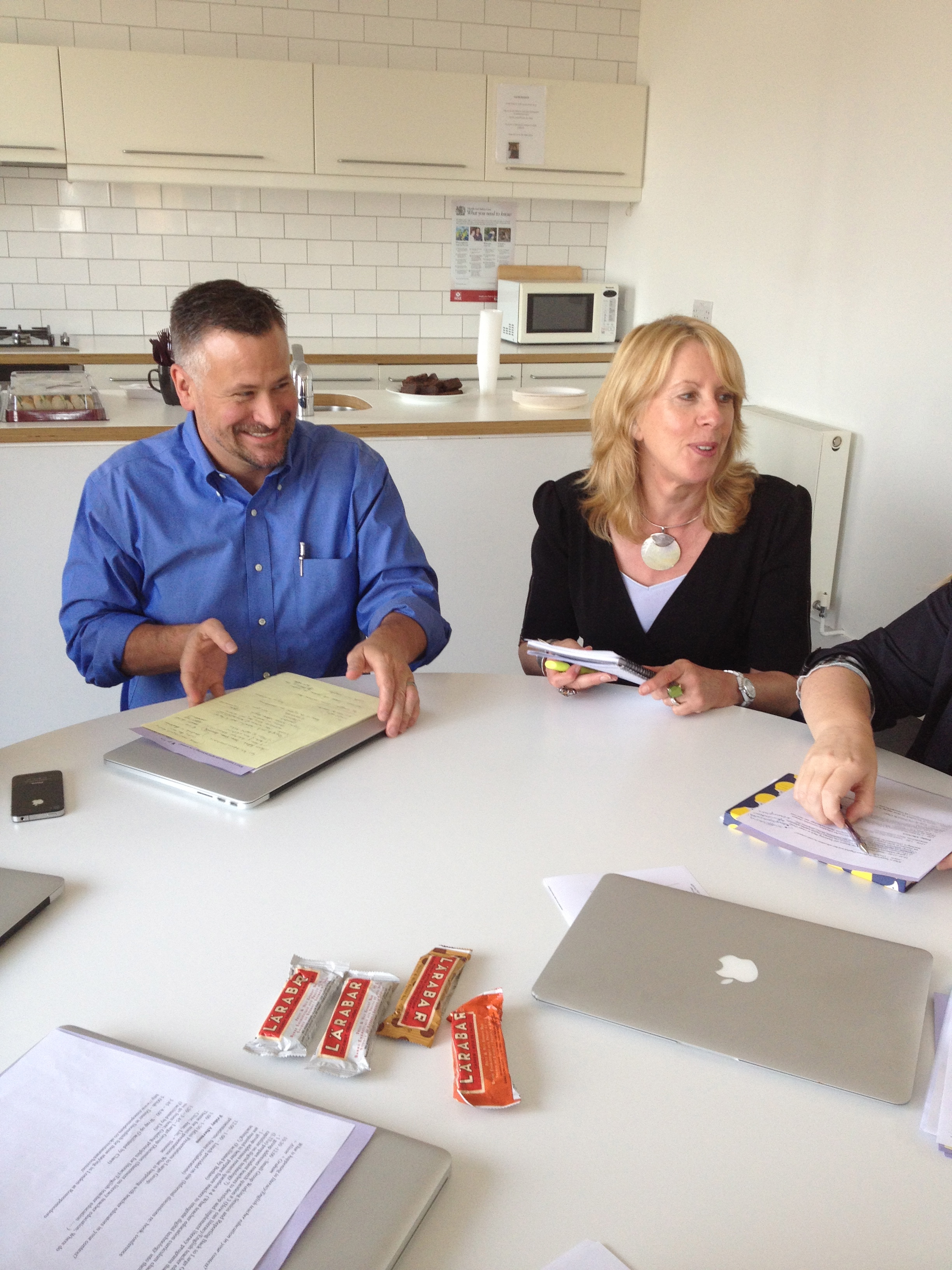
I (Lydia) feel fortunate to have had the opportunity to participate in the symposium last week as many of the issues raised resonated with my current research examining student teachers’ experiences with contemporary literacy teaching and learning. The issues highlighted during the individual presentations and accompanying discussions offered rich insights into the status of teacher educational internationally.

IMG_2590

I’d like to share a few of the questions raised during the symposium that remained with me and will continue to inform my research in literacy teacher education: What should a curriculum of contemporary teacher education include? In what ways can a curriculum of teacher education provide the space and quality time necessary for student teachers to truly engage as learners? How does power continue to operate in the curriculum? How do digital tools and social media spaces construct reading and writing? What do these digital spaces permit and what do they restrict? How is knowledge constructed, represented, and distributed within digital spaces? What are the pedagogical consequences as students engage with different modes within digital spaces? These are just a few of the questions I continue to consider upon my return from the symposium. Having the opportunity to consider the complexities and issues relevant to teacher education with international scholars was truly inspiring. I look forward to continuing our rich conversations.

IMG_2560