Category Archives: curriculum; teachers

Teaching Social Justice Through Action

j4mw

Last week at the 22nd Annual Labour Fair my (Pooja) class attended several sessions, but one profoundly affected us all. Activist Chris Ramsaroop from Justice 4 Migrant Workers (J4MW) came in and spoke to us about issues migrant workers in Canada face such as a lack of health benefits, sub-par living conditions, and low hourly wages. For many, this was the first they had heard about migrant workers in Canada. And so, many were surprised to learn some of the unsettling history around migrant workers and human rights violations.

To deepen our awareness on the issue, the following day we watched Min Sook Lee’s documentary “El Contrato.” This heart-wrenching documentary gave faces and narratives to the cases Ramsaroop spoke about the previous day. Students were deeply moved by the documentary, asking after:“What can we do?”; “How can we show we care?”

Wanting to take action, a moved student looked through the J4MW website and found there was something we can do: The J4MW group is looking for court support on Tuesday, March 25, 2014 (today) regarding migrant workers access to healthcare. To demonstrate support and solidarity, the J4MW wants to fill up the open court at Osgoode Hall to send a message. My class, along with two other sections eager to attend, will be in attendance at the court today.

I have deviated from my curriculum to make room for this issue my students (and I) have come to care so passionately about. I’ve seen students utilize an extensive range of literacies over just one week: they have organized themselves into groups to get to Osgoode Hall and back; they have conducted research on previous cases related to migrant workers’ access to healthcare in Ontario; and they have critically thought and discussed what it means to buy “local” produce in Ontario.

To learn more about the provincial court hearing today at Osgoode Hall, check out the link below:

http://j4mw.tumblr.com/post/80321298359/defend-migrant-workers-access-to-healthcare-in-ontario?utm_content=buffer9bc1c&utm_medium=social&utm_source=twitter.com&utm_campaign=buffer

If you haven’t had the opportunity to watch “El Contrato,” I  highly recommend watching it. Below is a synopsis and link to the documentary:

This documentary from Min Sook Lee (Tiger Spirit) follows a poverty-stricken father from Central Mexico, along with several of his countrymen, as they make their annual migration to southern Ontario to pick tomatoes. For 8 months a year, the town’s population absorbs 4,000 migrant workers who toil under conditions, and for wages, that no local would accept. Yet despite a fear of repercussions, the workers voice their desire for dignity and respect.a poverty-stricken father from Central Mexico, along with several of his countrymen, as they make their annual migration to southern Ontario to pick tomatoes. For 8 months a year, the town’s population absorbs 4,000 migrant workers who toil under conditions, and for wages, that no local would accept. Yet despite a fear of repercussions, the workers voice their desire for dignity and respect.
https://www.nfb.ca/film/el_contrato

Multimodal Literacy

My (Cathy) pre-service students were assigned a multimodal aspect to a major assignment this year.  If you are not familiar with the Theory of Multimodality, it is Gunther Kress’ alternative to Linguistic Theory (which only privileges reading and writing as the main modes of communication in a school curriculum).  The Multimodal Theory contests that in our new age of multiple literacies, students need to be communicating, responding and expressing through many different modes of communication (e.g. speaking, music, moving, gesturing, image, and digital technology).

When I first introduced the multimodal assignment to my students, there was some trepidation and even some anger.  It was suggested I did not have the right to be marking them on their artistry or on creativity.  Hence, I had to teach the concepts behind Multimodality Theory so they could better understand what we need to be offering students of the 21st century.  They needed to see that it would allow them the freedom to express in modes of their own choosing; that it was not graded as art but as a production of design; and, that the work could be symbolic or interpretive depending on the meaning they were portraying.  The multimodal projects would also be shared in class so all could learn from them.  This project was not just them regurgitating information for me, it was them designing and producing personally meaningful projects that express what they learned and what they deemed significant.

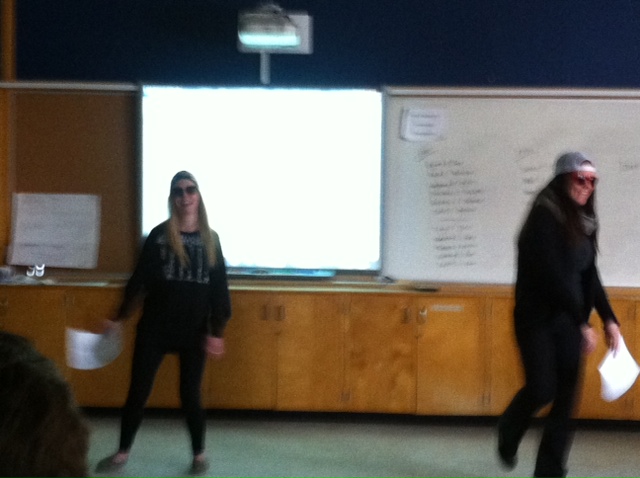
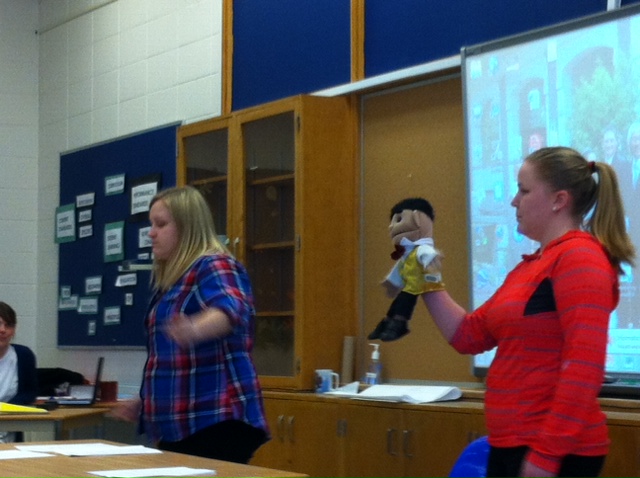
This week we finished viewing the projects.  They were amazing, and the student response to these projects was encouraging.  My students (concurrent students just finishing a five year educational degree) had never been given this kind of an assignment before.  They loved the element of choice; working together; taking a risk; pushing their boundaries; feeling creative; and, doing something they were interested in.  The modes they selected  to express themselves though were sometimes more traditional (dancing, rapping, singing,  writing and reciting  poetry, creating 3D sculptures, puppetry, multi-sensory art installation pieces); sometimes digital (iMovies, pod-casts, prezis, Pow Toons, popplets, infographics);  and, were often a combination of both.

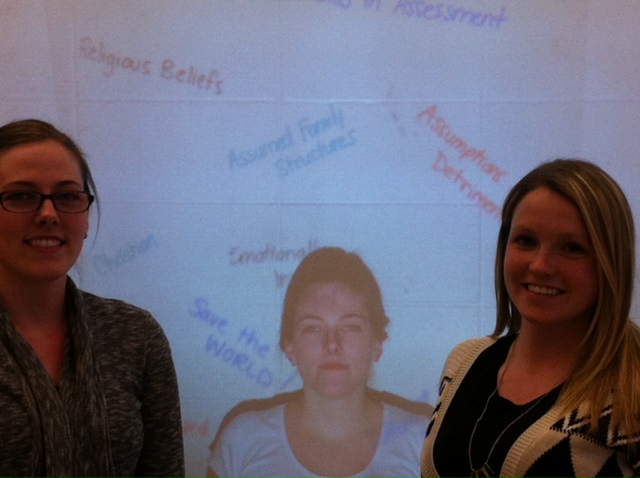
Collectively, we were all blown away by the results.  We were moved.  We were inspired.  My students all said they would definitely use multimodality now as teachers.  Below are a few images of my students presenting their projects:

role play poemfish bowlRAPguitarpuppet photo (13)

Now, I have to assess these designs… but that, dear reader, is for another blog.

St. Patrick’s Day

Today is St. Patrick’s Day – an Irish holiday. St. Patrick’s day is a significant day here in Toronto and includes a big parade, people wear Green, restaurant and pubs turning themselves into Green enterprises, classrooms talking about and celebrating all that is Green and Irish.  What began as a religious holiday is now a festive c Image Shamrock_with_Pipeelebration in many parts of the world.
St. Patrick’s Day is about St. Patrick, the Apostle of Ireland. St. Patrick is credited for bringing Christianity to Ireland. The shamrock is what St. Patrick used to illustrate the Holy trinity.  March 17th is believed to be the day St. Patrick died.
Thinking about schools and classrooms, should we teach St. Patrick’s Day from a perspective other than a festive celebration? Why is it a prominent celebration here in Canada?  How is it that Irish and other ethnicities alike rejoice in St. Patrick’s Day? When I taught in the public schools we encouraged students to dress in Green, we had a parade through the halls of the school, we read books about St. Patrick’s day and Ireland, and had several activities (arts, crafts, writing) to honour the celebration. Yet not once do I recall and inquiry or examination of what the Day represents both historically and for today.  What are the roles and responsibilities of teachers when it comes to celebrations and religious based traditions? In Toronto, Christmas has been the hotly debated and accommodated celebration for decades. What about the celebrations that are not framed in religion and yet are still entrenched in identity and power? Do we blindly and happily engage in the happiness and celebration without thought to the messages of exclusion and power we send when we honour one group and not another? Or do we engage in the often burdensome experience of exposing the inequities of such celebrations? Or, do we do nothing at all?
In an interesting article by Sallie Marston (1989), “Public rituals and community power: St. Patrick’s day parades in Lowell, Massachusetts, 1841–1874”, Marston states, “parades and other forms of mass public ritual are better characterized as demonstrations of community power and solidarity and serve as complex commentaries on the political economy of urban-industrial social relations”.  Perhaps a safe and productive space for exploring the ‘power’ of celebrations is better served in teacher education classrooms. Teacher educators who take a critical stance in their practice raise consciously engaging issues and connect social theories to classroom practice and student learning. Yiola

Dialogic Talk

It’s a powerful statement about a book when while reading it, you implement a suggested strategy the next day in class.  That’s exactly what happened while I was reading Classroom Talk: Understanding dialogue, pedagogy and practice, by Edwards-Groves, Anstey and Bull (2014).  The premise- talk is the foundation to all learning- is not new, but the connections made to multiple theories (e.g. Theory of  Practice Architectures, Theory of Multimodality, Social Semiotic Theory) makes this book very current.

book

I particularly enjoyed the section on conversation vs dialogic talk.  I do believe in “vacating the floor” as is suggested in the book and letting the students discuss issues in small groups.  In one particular class I teach, I always allowed my students to select their own discussion groups, as these are university students and felt they needed to make their own choices.  However, many of the groups were not focused, they veered way off topic (or never addressed the topic at all) and some students were still not voicing their opinion (even after much community building).  The section on dialogic talk prompted me to reframe my concept of small group discussion.  It suggested conversation is an informal discourse where direction and end point of the talk are unclear.  This was pretty much where my students were with their discussions.  Dialogic talk, however, sought to engage all listeners and had more purpose.  Plus, dialogic talk was not as relaxed as conversation, it was driven.  I needed driven.  I wanted more engagement.

As a result, I immediately set up ‘Dialogue Groups’ with an assigned moderator, who ensured everyone’s opinion was invited and heard.  I decided who would go into each group (which I thought they might resent and discovered they preferred!).  For each discussion I provided prompt questions to get the talk started.  I also assigned a time keeper who kept the dialogue to the time limit and a recorder who kept general notes about what was discussed.  I honestly didn’t think this would be necessary at the university level, but the difference was incredible.  There was thoughtfulness in the answers.  The discussants were suddenly animated and energetic.  They were really listening to each other.   This was a small change, but it made a world of difference in how they were hearing and responding to each other.

Of course there are many other interesting and practical suggestions in the book.  The connections between theory and practice are very strong.  I highly recommend it.  This book was published by the Primary English Teaching Association of Australia (PETAA).  Check out their web site!

http://www.petaa.edu.au/

The Danger of a Single Story

When engaging with students about Media Literacy, I (Pooja) often like to begin with novelist Chimamanda Ngozi Adiche’s powerful TED talk entitled The Danger of a Single Story. Through the use of her own narrative, Adiche speaks about the prevalence of a “single story” or the dominant culture portrayed throughout most school curriculums. Adiche shares the following memory of being taught a single story:

At about the age of seven … I wrote exactly the kinds of stories I was reading: All my characters were white and blue-eyed, they played in the snow, they ate apples, and they talked a lot about the weather: how lovely it was that the sun had come out. This despite the fact that I lived in Nigeria; we didn’t have snow, we ate mangoes, and we never talked about the weather, because there was no need to.

Adiche speaks about the impacts the single story has on an individual, on a community, and on society at large. While a young school girl in Nigeria, Adiche recalls only reading authors from the West. Having never encountered the works of an African author or seeing people like her appear in books, she believed she could not (or should not) be a writer.  She asserts that when we receive only one perspective on anything it creates stereotypes, “and the problem with stereotypes is not that they are untrue, but that they are incomplete. They make one story become the only story.”adiche

This TED talk sparks lively discussion in the classroom. Students often think back to their early schooling and many recall “single stories” they experienced. As a class, we capture all of these experiences on a large poster. As new text is introduced in the course we often refer back to this “single story” poster and discuss who’s stories are being represented in what we read/hear/see.

Including All Students in the Conversation

I (Clive) am a great believer in whole-class and small-group discussion. However, three and four years ago I was terrorized by a series of individual students who dominated discussion in class, speaking at least 50% of the time – they would have talked 90% if I’d let them. I’m sure they did the same in their small group, if I wasn’t in the group.
This forced me to develop a set of techniques for giving everyone a turn. They’re simple but effective. Most students appreciate them, and they’ve enabled me to relax and not always be cutting people off (though I still have to be firm). I wish someone had introduced me to them long ago.

     The techniques assume the class is no larger than 35 (I have any bigger class divided up) and is seated in a large circle (I arrange the seating before the students come in). They also assume that students get a lot of “air time” in class, otherwise it’s impossible for everyone to have a turn.

Here are the techniques:

  • Going around the room, with each student (or every 2nd or 3rd student) saying what they think about the topic in hand (don’t worry if you don’t get all the way round).
  •      Discussion in 2s and 3s around the room, followed by reporting from each group.
  • Numbering off to form small groups, followed by discussion and reporting back.
  • Individual prepared presentations (ungraded, maximum 4 minutes) – 2 to 4 per class – with 3 people to the left or right of the presenter responding.
  •       Whole-class discussion after a “mini-lesson” from me, with a speakers list formed as people put up their hands.

I find students are very glad to be called on in these ways: no one has ever declined. And the approach greatly strengthens community as we hear from and get to know everyone, including many who’ve been largely “voiceless” throughout their school and university career. It fosters oral literacy and results in truly inclusive education.

If anyone has other strategies, please let me know!

A Daily Reminder

I (Pooja) work at a higher ed. institute with a population that is very diverse. I have many mature students, with a history of interrupted education, who are looking to make a fresh start with school after work many years in unfulfilling jobs. Even though school has failed them in the past, they come in hoping to form a new relationship with school. This cartoon and this quote are taped up above the photocopier in our office. It is a daily reminder of my work and the students I serve.

comic

Everybody is a Genius. But If You Judge a Fish by Its Ability to Climb a Tree, It Will Live Its Whole Life Believing that It is Stupid. –Einstein

Guest Blog: Monica McGlynn-Stewart

Monica McGlynn-Stewart who is part Monica McGlynn-Stewartof our research team on the longitudinal study of teachers is our first guest blogger. For more information on Monica click on the tab About our Research then click on Meet the Team.

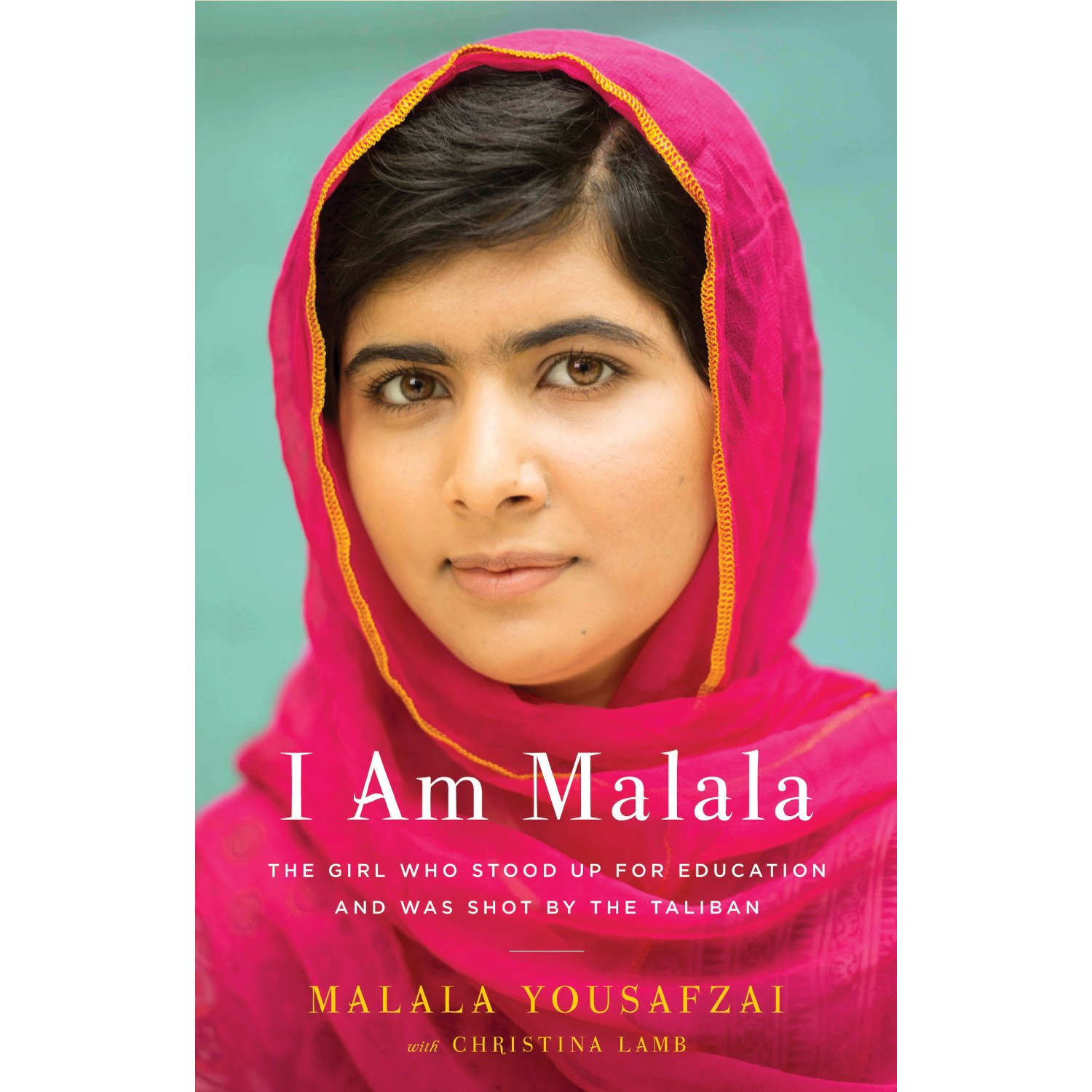
I (Monica) gave my 16-year-old daughter I am Malala by Malala Yousafzai for Christmas and now I am getting a chance to read it.  It is the memoir of a 16-year-old girl who was shot by the Taliban for speaking out about girls’ right to education. I find it fascinating for many reasons, not least of which is what I am learning about life in the Swat Valley in Pakistan. As an educator, I am always interested in learning about different systems of education and different pedagogical practices. Malala is the daughter of a school I am Malalaprincipal and had access to formal education except for a brief period when schools were closed by the Taliban, but many girls in the Swat Valley do not have access to education. In her descriptions of her studies, she relates how she memorized and recited religious texts, poetry, history, and even chemistry formulas. Her mother, who did not learn to read and write, can also recite many texts that she learned through hearing them. When I went to elementary school in the 70’s, we sometimes had to memorize a poem and recite it, but it was a rare occurrence. As an elementary teacher, I never asked my students to memorize texts, but they would learn many poems by authors such as Dennis Lee or Shel Silverstein because we read them out loud so often. For young students, “memory reading” a text that they had memorized was an important step in learning to read. So I am wondering, what role does memorization and recitation play in literacy learning? And can we consider someone illiterate who has memorized and can purposely refer to a large body of literature?

The Power of Introverts

“In a gentle way, you can shake the world.” – Gandhi

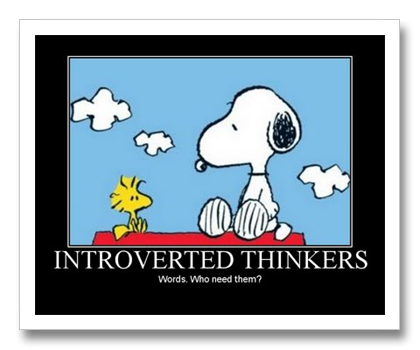
Introverted-Thinkers

At a professional development session I (Pooja) attended this week, I joined a conversation about the power of introverts. The conversation was framed around Susan Cain’s book entitled Quiet: The Power of Introverts in a World That Can’t Stop Talking. We live in a society where extroverts are the ideal; we value personality over character. This presentation, given by some of my quieter colleagues, was  powerful because it forced me to reflect on ways I engage and include introverts in the classroom. The presenters explained that introversion and extraversion is not a black or white matter; rather we all fall somewhere along the continuum depending on the situation we find ourselves in. I also learned that introversion is not to be confused with shyness- a mistake many people (including myself) make when speaking about introverts.

images

I mostly identify as an extrovert. Knowing this is important because it can influence how I design my  course to be more inclusive for all my students. As a more extroverted person, I walked out of the session with practices to consider revising in my classroom. Here are a few of the things I’ve been thinking about:

  • Mindful of airtime- I often become uncomfortable in silence, and so I will fill in silent moments with talking or engaging only the most vocal members of the class in discussion. Silence can be a powerful thing; these are the moments where reflection occurs.
  • Independent Work vs. Group Work- I try and put my students into pairs and/or groups every chance I get. I now am beginning to realize this is not the optimal working condition for all. I need to find a balance of group work and independent work.

Learn more about the power of the introverts here:

http://www.thepowerofintroverts.com


Well-being and Skills Go Hand-in-Hand

We have had many blog posts about teaching for relevance. I (Clare) was reading a chapter in Martin Seligman’s book Flourish: A Visionary new Understanding of Happiness and Well-Being. http://www.amazon.ca/Flourish-Visionary-Understanding-Happiness-Well-being-ebook/dp/B0043RSK9O/ref=sr_1_1?ie=UTF8&qid=1392996735&sr=8-1&keywords=martin+seligman
Here is an excerpt from Chapter Five.

  • Question one: in one or two words, what do you most want for your children?
  • If you are like the thousands of parents I’ve polled, you responded “happiness,” “confidence,” “contentment,” “fulfillment,” “balance,” “good stuff,” “kindness,” health,” satisfaction,” “love,” “being civilized,” “meaning,” and the like. In short, well-being is your topmost priority.
    • Question two: in one or two words, what do schools teach?
      • If you are like other parents, you responded, “achievement,” “thinking skills,” “success,” “conformity,” “literacy,” “math,” “work,” ‘test taking,” “discipline,” and the like. In short, what schools teach is how to succeed in the workplace.
      • Notice that there is almost overlap between the two lists. The schooling of children has, for more than a century, paved the boulevard toward adult work. I am all for success, literacy, perseverance, and discipline, but I want you to image that schools could, without compromising either, teach both the skills of well-being and the skills of achievement. I want you to image positive education.

I found his perspective refreshing and inspiring. In my teaching, I need to be mindful to address both well-being and skills and to talk to my student teachers about the need to do both.