Category Archives: education

Travel is an Education

When I (Cathy) was a grade school teacher, there were times when parents took their children out of school for a family trip. Often, a parent would ask if they could borrow a math or language text book to bring along so the child could “keep up”. I begged them not to. “Please,” I would say, “have them keep a journal. Draw what they see. Describe the people they meet. Take pictures and keep a record of them. Videotape a special event. Make a scrap book. Record the weather. Calculate the distance you travel every day. Follow the map. Plan an excursion.” In other words, I would ask the parent to use the trip as a resource.  I would also suggest the child prepare to share some of their experiences with the class when they retuned, so we could all learn from the trip.map


I was alarmed to think they would imprison their child in a hotel room or trailer to keep up with what we were doing in the classroom sometimes hundreds of miles away. There was so much to see and learn from the incredible world around them!child videotaping

Now, the affordances available for a child to investigate, record and share a trip are so much more interesting! A colleague of mine asked a grade one student of hers, who was going to the Olympics, to Skype the class every Tuesday morning from wherever she was and share her experiences. Her class loved it. They felt like they were there with her. After the Skype meeting the class would research the people and places she talked about. That one student’s trip became a class project.

This past summer, I travelled through Greece with my husband. I was delighted to see so many children capturing the sites we visited on an tablets and smartphones. I wondered if they would share any of it with classmates. I would still encourage a parent to not use a text book on a trip. The real world is just too interesting and there are so many creative ways to explore it. It’s all learning.tablets

Using Digital Texts in a Grade One Classroom

On twitter today I (Lydia) came across an interesting blog post from grade one teacher Kathy Cassidy from Moose Jaw Saskatchewan, in which she describes how she incorporates digital texts into her shared reading program. I hope to share some of the activities reported on Ms. Cassidy’s classroom blog with the pre-service teachers in our literacy methods courses this fall.

http://kathycassidy.com/2014/08/08/changing-face-of-early-literacy-why-digital/

The Triple Focus

I (Pooja) came across a new book I am interested in reading , so I thought I’d share it with our blog community. The new book by Daniel Goleman and Peter Senge is entitled The Triple Focus: A New Approach to Education (2014) and makes a case that education should focus on three things:

  1. Self-awareness
  2. Empathy
  3. Understanding our relationship with the larger world

Triple-Focus-Cover1-300x300

This focus on self, other, and world in the classroom is something I am particularly interested in as I feel it is increasingingly necessary in today’s classrooms. Daniel Goleman explains:

 These skill sets interact very naturally. We feel that this complete inner tool kit should be a part of every child’s learning as the world they are growing into becomes more distracted, relationships more besieged, and everything more interconnected and complex.


Below is an excerpt from the new book:

Empathy and Academic Success

The key to compassion is being predisposed to help — and that can be learned.

There is an active school movement in character education and teaching ethics. But I don’t think it’s enough to have children just learn about ethical virtuosity, because we need to embody our ethical beliefs by acting on them. This begins with empathy.

There are three main kinds of empathy, each involving distinct sets of brain circuits. The first is cognitive empathy: understanding how other people see the world and how they think about it, and understanding their perspectives and mental models. This lets us put what we have to say in ways the other person will best understand.

The second is emotional empathy, a brain-to-brain linkage that gives us an instant inner sense of how the other person feels — sensing their emotions from moment to moment. This allows “chemistry” in our connections with people.

Those two are very important of course; they’re key to getting along with other people, but they’re not necessarily sufficient for caring. The third is called, technically,empathic concern — which naturally leads to empathic action.Unlike the other two kinds of empathy, this variety is based in the ancient mammalian circuitry for caring and for parenting, and it nurtures those qualities.

Read more at:

http://www.huffingtonpost.com/dan-goleman/triple-focus-excerpt_b_5638646.html?1407243583

Self-portraits and sparkling feet: Communication & representation in the early years

It seems my (yiola’s) blog posts run parallel to the foci in my life. This makes good sense as it seems the blog genre, whether an MAB or personal, pulls from the writer their interests, latest happenings and experiences. This past month I have had the privilege of  spending a great deal of time with my two young children; hence the sharing of teaching and learning and literacy in the early years in many of my posts.

My four year old has been busy communicating, sharing and representing. Through her drawings she expresses her feelings and is able to share stories and ideas.

In March she drew and spoke about our family:

family

Her most recent self portrait:

selfportait

Note the addition of the ears and arms that are now present in every drawing she creates.

For me, these developments are huge; for ECE researchers and educators these drawings are nothing new:

http://www.learningdesign.com/Portfolio/DrawDev/kiddrawing.html

And yet, I still marvel at my child’s ability to communicate and represent in such meaningful ways.  My daughter expressed the other day  “momma, my feet are sparkling”… I did not bother to explain that wasn’t the case, that instead, her “feet fell asleep” because really, is one expression more accurate than the other?

An interesting and short description of stages of art development:  http://www.artjunction.org/young_in_art.pdf

What caught my attention from the article was the statement below:

Of course, what children seem to do naturally and what they are capable of doing are entirely different matters. It is likely that teachers will find that students within their classrooms are at varied points in their graphic development since some have had abundant prior experiences with art, whereas others, may have had limited creative opportunities. Thus, teachers should avoid the temptation to place children at a particular stage simply because of their age or grade level.

… and how true this is of exposure to all subject/school related matter.

As I read about child development and literacy I appreciate  the stages of development. As a teacher (and now parent) I have seen the stages unfold; however, as I read and observe the effects of providing opportunities for creative development and the use of multi literacies with young children I am more excited about the possibilities for language and literacy development  in areas such as: creative thinking, communication, problem solving and representation.

In keeping with ‘you teach who you are’, I cannot help but think about these areas of interest for my work.  As I prepare my courses for the coming year I am searching for readings and experiences for student teachers that will encourage discussion about creative thinking/problem solving and the implementation of various kinds of opportunities for pupil’s acquiring literacy both in and out of classrooms.


Workshopping Literacy in East Germany

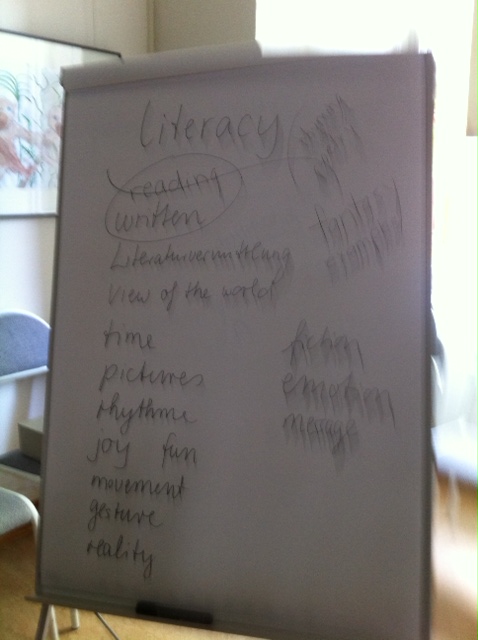
Last month,  I (Cathy) was invited to present a workshop on literacy and the arts in Gotha, Germany, for a group of educators.  At the beginning of the workshop, one of the teachers admitted, “I really don’t know what literacy means.” I wasn’t really surprised as interpretations of literacy are so varied. When a few others also admitted they were not sure, I invited them to find a matching-shoe partner and share with them what they thought literacy meant.

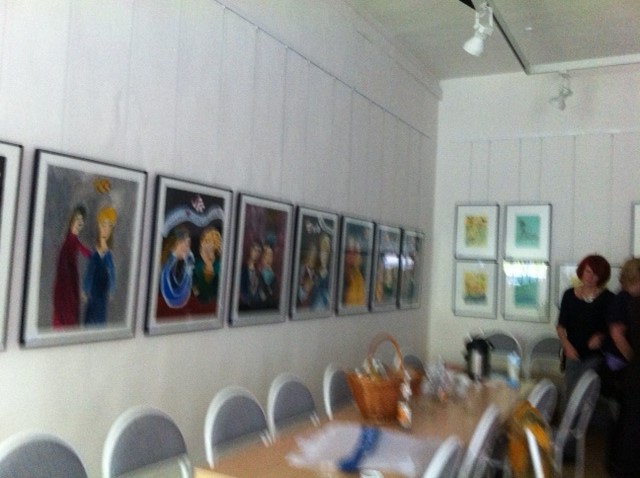
Once the discussion was opened up to the whole group, it was interesting to hear what they came up with.  They started off with the traditional reading and writing interpretation and we decided together these were forms of communication. From there, the definition really expanded. One participant suggested literacy included reality, while another suggested emotion. As we probed deeper the idea literacy was a view of the world was introduced. Eventually I asked them to look around the room at the fabulous paintings hanging on the walls. They were painted by local school children and they were emoting wonderful narratives. Yes, they decided, the paintings were also literacy. Throughout the rest of the workshop we explored ways to use storytelling and drama as literacy.

It was exciting to witness the development of a deeper understanding of an enormous concept like literacy. I like to think this encounter helped these teachers to see meaning-making in a new way. I wonder how it will affect their use of literacy in their classrooms.   On the chart we created together, it was also suggested literacy was fun.  It was.  Hope it is for their students too.

photophoto wall


Teacher inquiry: this just in from Piaget!

Yes, I (Clive) know I should get a life, but lately I’ve been reading Dewey, Vygotsky, and Piaget (there’s a constructivist connection).

Skimming through Piaget’s The Moral Judgment of the Child (R&KP, 1932) I came across this wonderful quote in the very last paragraph (p. 414).

“Educational experiment…is certainly more instructive for psychology than any amount of laboratory experiments…. But the type of experiment which such research would require can only be conducted by teachers or by the combined efforts of practical workers and educational psychologists. And it is not in our power to deduce the results to which this would lead.”

This captures so well what I was trying to say in my previous blog. Academics and teachers must inquire together, rather than taking pot-shots at each other.

It feels good to be backed up by the likes of Piaget.


Can you find your cat?

An article from the Toronto Star caught my attention it features the website I Know Where Your Cat Lives. Owen Mundy, an associate professor in digital media art at Florida State University, developed the website in an effort to highlight potential privacy concerns related to the use of public websites. Mundy collected one million cat photos with geographic data embedded from public photo sharing sites (e.g. Instagram, Flickr) and placed the photos on a world map. The motivation behind the project came about when Mundy realized that photos of his young daughter had been posted online with embedded geographic co-ordinates pinpointing the location of his backyard. He then thought “What’s the closest thing people have to them that they photograph that’s like a child, but not as scary as mapping someone’s child? That’s a cat.” Mundy’s web project is meant to illustrate the substantial amount of personal data individuals share, often unwittingly, when they post photos on social media sites.

Link to Toronto Star Article:

m.thestar.com/#/article/life/2014/08/01/how_curiosity_killed_your_cats_privacy.html

A Book on Critical Literacy and Teacher Education

I (Pooja) am currently re-reading Negotiating critical literacies with teachers: Theoretical foundations and pedagogical resources for pre-service and in-service contexts (Vasquez, V.M., Tate, S.L, & Harste, J.C., 2013). This book suggests a theoretical framework, provides insightful examples, and offers pedagogical resources when incorporating critical literacy practices into pre-service and in-service teacher education.

I share some moments in the book which really stood out for me during my second reading:

1. Vasquez et al. suggest this book fills a gap in the literature about critical literacy and teacher education. Specifically,

 This book speaks to what Dozier et al. (2006) observe as a profession that has not publicly articulated the nature of the alignment between our expectations for our [teacher educators’] own literate lives and our expectations for our students as literacy learners.

 2. As I was more closely re-reading the final chapter of this text, a section on “Dealing with Accountability and Standards” really stood out for me. This section dealt what our critical literacy participants in our SSHRC study have expressed to be a tension in their work. Vasquez et al. (2013) take the following stance on dealing with accountability and standards as teacher educators,

A question that often arises for us is how to get beyond the hurdles of incorporating a critical stance when we live in a world of accountability and standards….we have found that these difficulties become easier with teachers who have a concrete philosophy about their pedagogy and can demonstrate how this type of pedagogy has changed their own academic and personal lives as well as that of their students.

3. They go on to provide insights into how best practice critical literacy in teacher education,

We have also found that you cannot do this work alone. Having other to think with and reflect with, even if they are not in your workplace makes all the difference in whether you continue to create more and more spaces for critical literacy in your setting or whether you throw in the towel.

Creativity and the Curriculum

I (yiola) will admit that as a classroom teacher  – while I thought I was a good teacher of student  learning – I lacked creativity both in content and pedagogy. Recently, I came across this link:

30 Dad Jokes That Are So Bad, They’re Great

and now, as a more experienced (teacher) educator and reflective practitioner  what came to mind was, “wow… so many interesting ways to use this link and these beautiful images with the mandated Ontario curriculum”. For example, any grade and topic in the Social Studies curriculum could be applied: Grade 2: Communities Around the World; Grade 3: Living and Working in Ontario (a perfect opportunity to explore the various regions and compare and contrast their beauty); Grade 4: Physical Regions in Canada (exploring photography to “unearth” physical landscapes); Grade 6: Canada’s interactions with the Global Community (moving beyond the political and economic).  Social studies can be seamlessly linked to literacy and the more I explore multiliteracies the more inspired  I am to employ the visual and the aesthetic to develop meaning and understanding… and communication.  Imagine the Visual Arts lessons and opportunities front these images — ‘Hello group of 7″ — and colour, and perspective, and line and emotion.  And to grasp onto the beauty of what may be unfamiliar to students living in urban centres or familiar to those living in more remote regions to discuss lifestyles and Healthy Living from the Health and Physical Education curriculum.

Which ever way children chose to inquire,  creative opportunities and aesthetic resources may offer new and exciting opportunities for seeing the world and themselves.  This concept for teaching is more inspiring than how I recall teaching and learning (i.e. comparison worksheets of city life vs. rural life).

PS — I thought of my good friend Clive Beck as I enjoyed these beautiful images! I hope you enjoy them too.


Congratulations to Tim Fletcher

Congratulations to our friend and colleague Tim Fletcher on the publication of Self-Study in Physical Education Teacher Education which he co-edited Tim Fletcherwith Alan Ovens. Tim has a long-time commitment to the practice and study of health and physical education. Teaching at Brock University where he is an Assistant Professor and conducting research on the preparation of teachers to teach phys ed, he understands the complexity of the issues facing teachers and teacher educators. Helping children and youth acquire the skills and attitudes to lead a healthy and active lifestyle is not easy but is critically important. This text will help us think differently about preparing teachers to teach health and physical education.
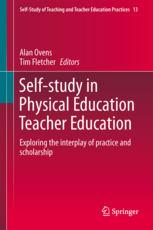
Here is a description of the book:Book cover

In this in-depth examination of self-study as a research methodology, an international selection of physical education scholars share their ideas and experiences and consider the value of self-study as a vector for highlighting the emerging conflicts, dilemmas, and debates currently developing in teaching and teacher education pedagogies. A vital new addition to Springer’s series Self-Study of Teacher Education Practices, the volume is divided into three sections assessing the significance of the approach itself, offering detailed subject-relevant case studies, and exploring the nuances and controversies attending the evolution of the methodology.
The contributors show how self-study enables reflexivity in pedagogical practice, a notable lacuna in current critical research, and at the same time they make the technique accessible to scholars of physical education wanting a practicable introduction to the subject. The analysis also explores the implications of applying self-study to pedagogy itself, to the curriculum, and to human movement and educational practice more generally. By embracing more organic, emergent notions of research practice and learning, the book achieves a broader and more inclusive survey of pedagogical work in physical education teacher education that fully acknowledges the complexities of the field. http://www.springer.com/education+%26+language/learning+%26+instruction/book/978-3-319-05662-3