Category Archives: Literacy teacher educators

Semiotic Linguistic Quiz

Saussure   Ferdinand de Saussure (1857-1913)

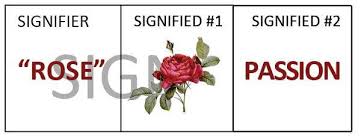
As of late, I (Cathy) have been exploring semiotic linguistics to further  my understanding of multimodality (Jewitt & Kress, 2003). Ferdinand de Saussure is considered to be one of two fathers of 20th century semiotic linguistics.  He described semiotics a as a system of signs that are created within a cultural context.  Sausuure defined a sign as being composed of:

        • a ‘signifier’ – the form which the sign takes; and
        • the ‘signified’ – the concept it represents.

On the internet I stumbled upon these diagrams which are intended to illustrate the meaning of signifier and signified.  Do you think they are both correct?

tree

rose

A multitude of communication resources

cartoon_newliteracies

When I saw this comic it made me chuckle.  I enjoyed the comic’s gentle reminder that children/youth routinely engage with and expertly navigate a variety of communication tools. Clare and I (Lydia) conducted a two-year collaborative self-study of our efforts to incorporate various technological resources (e.g. a wiki) into our pre-service literacy methods courses. This research helped us identify both the challenges and successes we encountered along the way.  Our research efforts also made us more mindful of why we chose to incorporate certain technological resources into our pedagogical practice — questioning for what purpose and to what end.   Through the analysis of our efforts we realized that we had initially seen technology as an end in itself, not as a tool to support learning. In the second year of the study, we focused much more on student learning and became more systematic in our efforts. Over the two years of the study, our identities as teacher educators shifted as our pedagogies became richer, our use of technology more fully integrated into our literacy courses, and we received validation from others and from each other.

Defining Literacy

Literacy in the 21st century. What does it mean? Or perhaps the better question to ask is, what does it mean TO YOU?Children reading

  • If you are a writer, editor, public relations manager perhaps literacy means the the ability to read and write.
  • If you are a financial advisor perhaps literacy means the ability to understand “how money works in the world” (financial literacy).
  • If you are a journalist, analyst, or film maker perhaps literacy means the ability to “analyze, evaluate and create messages in a wide variety of media modes…” (media literacy).
  • If you are weather analyst, forest ranger, or environmentalist perhaps literacy means the ability to “understand ecological principals and the ways society  affects, or responds to environmental conditions” (environmental literacy).
  • In keeping with the Winter Olympics, if you are an athlete, perhaps literacy means the ability to “move with competence and confidence in a wide variety of physical activities in multiple environments” (physical literacy).
  • If you are an elementary school educator, literacy means all of the above. If you are a elementary school student, literacy means all of the above.
  • If you are a literacy teacher educator, literacy means… By Yiola
    * definitions taken from online google searches, mainly wikipedia.

Reflecting on Our Strengths and Weaknesses

I (Cathy) was reading a literacy newsletter yesterday and was intrigued by an article by literacy educator, Clare Landrigan.  She reminisced about a saying her father used to share with her, “Everyone’s greatest strength is their greatest weakness and their greatest weakness is their greatest strength.” I have heard this before and tend to agree with it.  I have referred to it often while exploring Brookfield’s critical incidences with my student teachers.  We would reflect on the possibility of how our greatest strength could be holding us from recognizing our own literacy assumptions.

What intrigued me about Landrigan’s article was the educational perspective she introduced that I simply had not entertained before.  She asked her readers to look at the weaknesses of her students and try to see them as their greatest strength.  For example, the student who cannot sit still . . . has the potential to be incredibly productive and he student who takes forever to do something . . . is attentive and thoughtful.   What a wonderfully productive way to look at the students we teach, regardless of age.  It also might help us recognize positive aspects in ourselves when we are feeling particularly critical.  What is your greatest weakness?

Narratives of Teacher Educators

Book cover

I (Pooja) recently finished reading Negotiating critical literacies with teachers: Theoretical foundations and pedagogical resources for pre-service and in-service contexts (Vasquez, V.M., Tate, S.L, & Harste, J.C., 2013). This book provides a theoretical framework, insightful examples, and pedagogical resources for ways to incorporate critical literacy practices into pre-service and in-service teacher education. The final chapter of this text entitled “Teaching and living critical literacies” especially interested me. This concluding chapter focused on the narratives of the authors who are all teacher educators. They shared early childhood memories, classroom teaching experiences, and turning points (e.g. being the first in the family to attend college; protesting the Viet Nam War). Much of what the book’s authors shared in their written narratives reflected closely what many of our critical literacy participants in our SSHRC study have expressed. Many can identify turning points and life events in their early childhood, which contributed significantly to their philosophy and stance towards teaching and learning. Maya from our study identified being placed in a low-track after immigrating to the U.S. as a defining moment. This has influenced her practice because she now focuses on having her student teachers understand multiple perspectives and interrogate their assumptions of students, curriculum, and schooling. Providing a specific example of this pedagogical stance, Maya told us about how she conducts an entire lecture in Spanish, locating student teachers as second language learners.

This final chapter reinforced how meaningful it is to create space for the voices of literacy teacher educators.  The narratives of our participants are rich with experiences that influence their practices in the classroom. Stacie L. Tate, book author and teacher educator, articulates this well: “When people ask how I decided to become a teacher and researcher, I always reply, “I was groomed for this.” (p. 99).

Family Literacy Day

Today is Family Literacy Day in Canada. http://abclifeliteracy.ca/fld/family-literacy-day
It is a day that recognizes the importance of families building literacy skills together.  Looking back, what did family literacy look like in your household? In what capacity did Young girl in schoolliteracy development occur? In my home I (Yiola) taught my parents the language of English and my parents taught me the value of English.
I find Family Literacy Day to be a very well intentioned initiative.  The ideas presented in the link on family literacy are interesting.  As a Teacher Educator who teaches from a critical perspective I cannot help but ask, how can the concept of family literacy be made accessible for all families? How do we make the concept more inclusive?  When thinking about ‘Daily Literacy Activities’ I wonder, what can we add to the list found on the website?
See: http://abclifeliteracy.ca/files/Daily_literacy_activities.pdf
I plan to share this list with my student teachers and ask them for additional activities to include that may draw in a variety of families.  I’m thinking of multilingual processes, digital opportunities, oral traditions.
Happy Family Literacy Day!
Yiola

Writing a Review Takes TIME

I (Cathy) discovered, having just submitted my first academic book review, that the process takes TIME.   The T in my acronym represents allowing for lots of time to move through the process. The I represents investigating the journal for which I am submitting.  The M is for mining the book under review. The E is for editing- of course- what would writing be without editing?  I developed my TIME acronym through both the experience of writing the review and doing some homework on review writing.  One of the suggestions I came across, which was a valuable piece of advice, was to allow one month to write the review:  two weeks to read the book; one week to write the review; and one week to edit the work.  This turned out to be true.  There was no hurrying the process.  I also spent time reading many other reviews from the same journal for which I was submitting.  This was the investigation part.  I compared five reviews for style, content and length.  One was much more academic in style than the others.  All were not hesitant to praise the work.  This was reassuring, as I liked the book a lot.  The mining part was the surprise.  As I read the book, I listed the things I liked about it and possible flaws, only to discover that when I got to the end, it was not enough information.  I had to read it again and work harder at comparing the chapters for content consistency, look for related themes and any patterns the editors may have requested.  I also spent a lot more time scrutinizing the forward and conclusion and discovered some great quotes I had missed the first time.  This was similar to reading a book in order to teach it.  Impressions are not enough.  I needed more meat.   And finally came the editing.  After several iterations, I thought it was ready for someone else to see.  I gave it to five people to read. Every one of them found corrections and made suggestions. Some I used, while others were stylistic suggestions that I let pass.  All were insightful.  The best part though, was the response.  When one of my friendly editors replied, “You really made me want to read this book!”  then I knew the review hit its mark.  Like I said, I liked the book.  Oh, and by the way, the book is called Literacy teacher educators: Preparing teachers for a changing world.  I recommend it!     BTW  The journal I submitted to is called Research in Teacher Education.  Excellent resource!  Check it out…  http://www.uel.ac.uk/rite

Women in Leadership Positions in Higher Education

In our study of literacy/English teacher educators we asked participants about their career path. They did a timeline (personal and professional) of turning points. A number have held administrative positions in the university but many found the workload crushing. So I (Clare) was very interested in the recent study, Lost leaders – Women in the Global Academy, which studied females in administrative positions in higher education. http://www.universityworldnews.com/article.php?story=20140108162154821
It showed that “[g]ender equality legislation, socio-economic and de-traditionalisation factors have all played a part in this welcome trend [increase in female students in higher education], yet so far they appear to have had relatively little impact on opportunities for women to reach senior management and academic leadership positions in the sector.”  Why are women under-represented in senior leadership positions in universities? In the study they found that “[m]any women … discussed the benefits of gaining power and influence in organisations to effect change. However, leadership was frequently constructed as loss – loss of status and self esteem in the case of unsuccessful applications, but loss of independence, autonomy, research time and well-being when applications were successful.”
I believe there is a real loss not only to women themselves when they choose to not pursue leadership positions but also to institutions when women are under-represented at the decision-making table. I have held a number of senior administrative positions and I can relate to feelings of loss but I also felt there were much higher expectations for me than for my male counter-parts. As a result the position became untenable.  I felt it was a loss to me definitely. Was it a loss to the institution?  Hhhhmmm….. Clare

Classroom Teachers and Critical Literacy

Yiola CleovoulouI am fascinated with classroom teachers’ pedagogy. In particular, how elementary school teachers teach critical literacy to young children.  How teachers plan, what materials they choose and the discussions they facilitate in the classroom were some of the areas I asked classroom teachers in relation to their efforts to build critically literate students. My research team spent half of the  school year observing classroom teachers` daily practices with a special focus on  critical literacy. We also interviewed the teachers to gain an understanding of their thinking about their practice. One interesting finding is the close connection between content (often driven by narrative texts) and pedagogy. That is, teachers (in the early primary grades) focused heavily on narrative texts to relay information about critical social issues and designed learning opportunities (discussions, extensions) based on the texts. This process resulted in children sharing their own stories and understandings of the critical social issues (i.e. identity and exclusion,  inequitable distribution of resources, class).  Understanding teachers` classroom practices is connected to phase two of our study on literacy teacher educators.  I want to know how the two sets of pedagogical practices connect: how does the pedagogy of literacy teacher educators who have a critical stance transfer to classroom teachers’ practices?

By: Yiola Cleovoulou

Study of Literacy Teacher Educators

We are well into phase two of the study on literacy teacher educators in four countries having interviewed 27 of our 28 participants. In this phase we have been looking at goals for their preservice literacy courses, teaching style, and pedagogies. One of the most interesting series of questions has to do with assignments. I have found that asking professors about their assignments tells a great deal about their goals. We have classified assignments into a few categories: digital-related assignment (e.g., digital essay), literacy autobiography, reading logs, lesson plans, curriculum units, portfolios, case study of a child, and assessment-related. There has been remarkable consistency in the types of assignments. Interestingly, almost all feel that the workload is demanding. A question we as a research team and as experienced literacy instructors are asking ourselves, Is the workload too heavy? Clare