I came across the graphic below on Twitter entitled Helping Students Find the Right Book. It reminded me of our pre-service P/J and J/I literacy courses yesterday in which we discussed the place of the novel study in the classroom and the importance of engaging students in the reading of a variety of genres.
Category Archives: Literacy teacher educators
Teaching with a Sense of Humour
The What is Education? blog for teachers states that having a sense of humor is,
very useful in creating a classroom climate and the development of learning processes that are more healthy and enjoyable. In fact, Melissa Kelly said that a sense of humor is one of the keys to being a successful teacher. According to Melissa, teachers’ sense of humor can relieve tension in the air and can prevent the onset of disruptive student behavior in the classroom, and can be used as a way to attract the attention of students in the class. And most importantly, with its sense of humor, a teacher would show that he/she is a person who has a personality and mental health, to enjoy life, and be able to live a normal life without the stress of his/her career.
http://what-education.blogspot.ca/2013/06/the-importance-of-teachers-using-humor.html
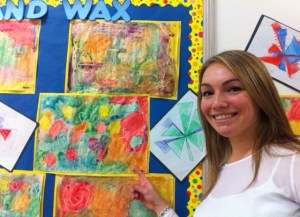
I (Cathy) was delighted to see one of my student teachers, Carolyn, using her sense of humor throughout her literacy lesson. Her grade one and two students found her quite amusing and would joke along with her. Sometimes her humor was self-depricating, and sometimes it was as innocent as, “Who me? I would never do that!” It was never sarcastic and always made her students smile. She even used it as a classroom management technique to keep the students focused and engaged. When I asked her about her technique, she said it made teaching and leaning more enjoyable. Then she described an art lesson she had just taught using candle wax and water colours. She drew a picture on the white paper using a white candle, so it was not visible. While introducing the lesson she held up the paper and kept telling the students how proud she was of her picture. When the students kept insisting there was nothing there, she applied the water colours and, of course, the picture magically appeared. The humor came to play when she allowed each student to play the same joke on her as they created their pictures. All of the magic pictures were displayed proudly in the hallway of the school. Carolyn said the students still refer to it and giggle.
I think having a sense of humor is an asset. We all definitely need to laugh more, especially in our schools. 
Explaining Explain Everything (App)
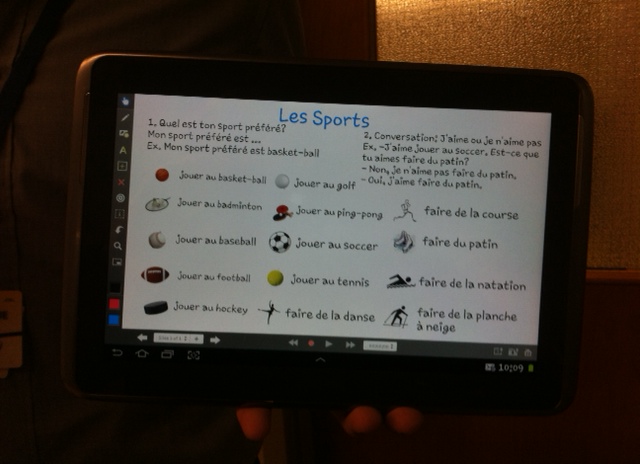
I (Cathy) find that one of the exciting aspects of teaching is learning from my students- especially about digital technology. One of my student teachers, Drake, taught a lesson last week using Explain Everything. With the aid of this app he successfully taught a lesson in French which enabled his grade 6 students to engage in conversations about sports. How he used the app was definitely key to the success of his lesson and I gave him full credit for cleverly scaffolding the sequence of the questions and answers so that that student conversations were set up for success. Yet, Drake insisted it was the app that enabled him to teach the lesson so clearly. Below are pictures of how Drake set up the lesson on his ipad and then mailed it to himself as a handout for his students. Well done Drake!
Intrigued, I began to play with this app myself. I discovered it has a wide range of applications. It feels like a cross between a power point and a smart board, but completely doable on an ipad. Very convenient. Below is an link to a you tube video that demonstrates how students can use the app in a classroom.
Celebrating the 25th Anniversary of True Story of the Three Little Pigs
As the 25th anniversary of the picture book The True Story of the Three Little Pigs approaches author Jon Scieszka and illustrator Lane Smith recount the origins of their collaboration and the challenges of securing a publisher for the sophisticated parody. As Smith recalls, “some editors liked it but were a little confused and not sure if there was a market for it. Back at that time, children’s books were either serious, earnest books, or really funny books. But the sense of parody and irony that is rampant now didn’t really exist then…Viking put the book out very tentatively. They weren’t convinced of anything and did a small run that immediately sold out. It was all word-of-mouth from teachers, librarians and booksellers. They didn’t run ads or do a publicity push. Finally by the fourth or fifth printing the runs were more like 50,000.”
Follow the link below to read the full interview with Jon Scieszka and Lane Smith:
Responding Critically to Azalea’s ‘Bounce’
In class this week my (Cathy’s) teacher education students were exploring indirect instruction through learning centers. One of the centers featured Iggy Azalea’s music video, Bounce, and the instructions to discuss the work through a critical literacy lens. (E.g. What message do you think the artist wants us to get from this video? Based on the artist’s thoughts and actions (expressed in the song), how would you say she is portraying herself to the world?)
Most of the students had heard of the video but never actually viewed it until arriving at the literacy center. (Perhaps you haven’t either). Without revealing the content, I will reiterate the general tone of the reactions. Most students were annoyed by the video content. One student said she was disgusted (and this is not sexual content). One group, however, tried to take a broader view. They said they could not judge the work until they understood Azalea’s intent. So they took it upon themselves to look up an interview in which Azalea discusses her purpose for portraying her song the way she did. After viewing the interview, they were angry. Azalea explained that she portrayed herself thusly so she would be seen as “flashy”. No message, just glamour. After this insight, some wonderful discussion ensued about cultural ethics and hegemony.
One student spoke to me at the conclusion of class and confessed that she was surprised by her own reaction. In her words, “I have changed. Studying literacy education has given me a different perspective. I see the world differently, especially things like music videos.”
Below is the link so you can view this content for yourself and decide. The second link is the video in which Azalea discusses her purpose for making the video.
Happy critical viewing!
All About Me Texts
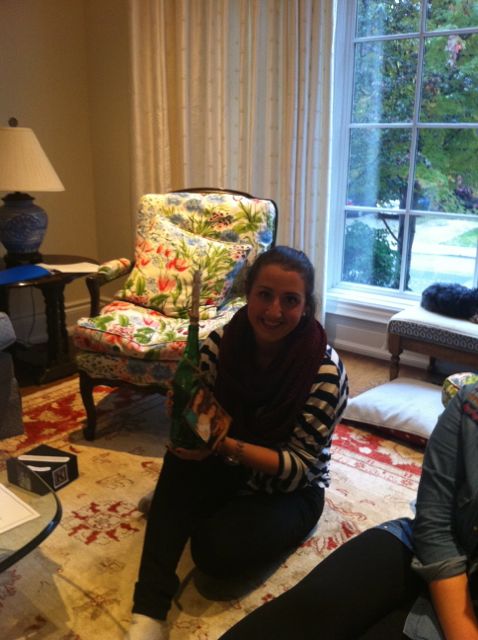
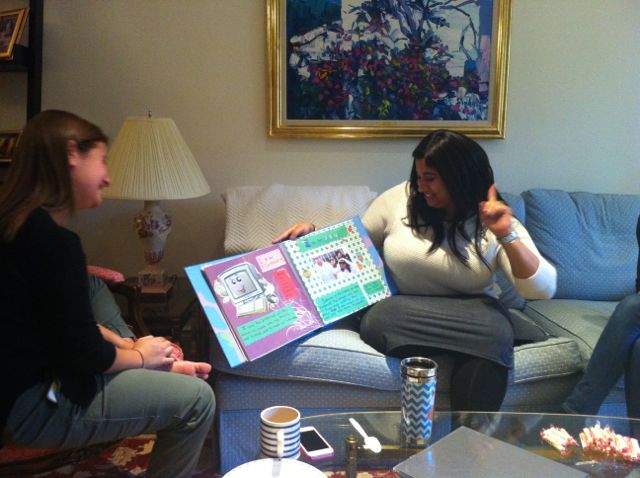
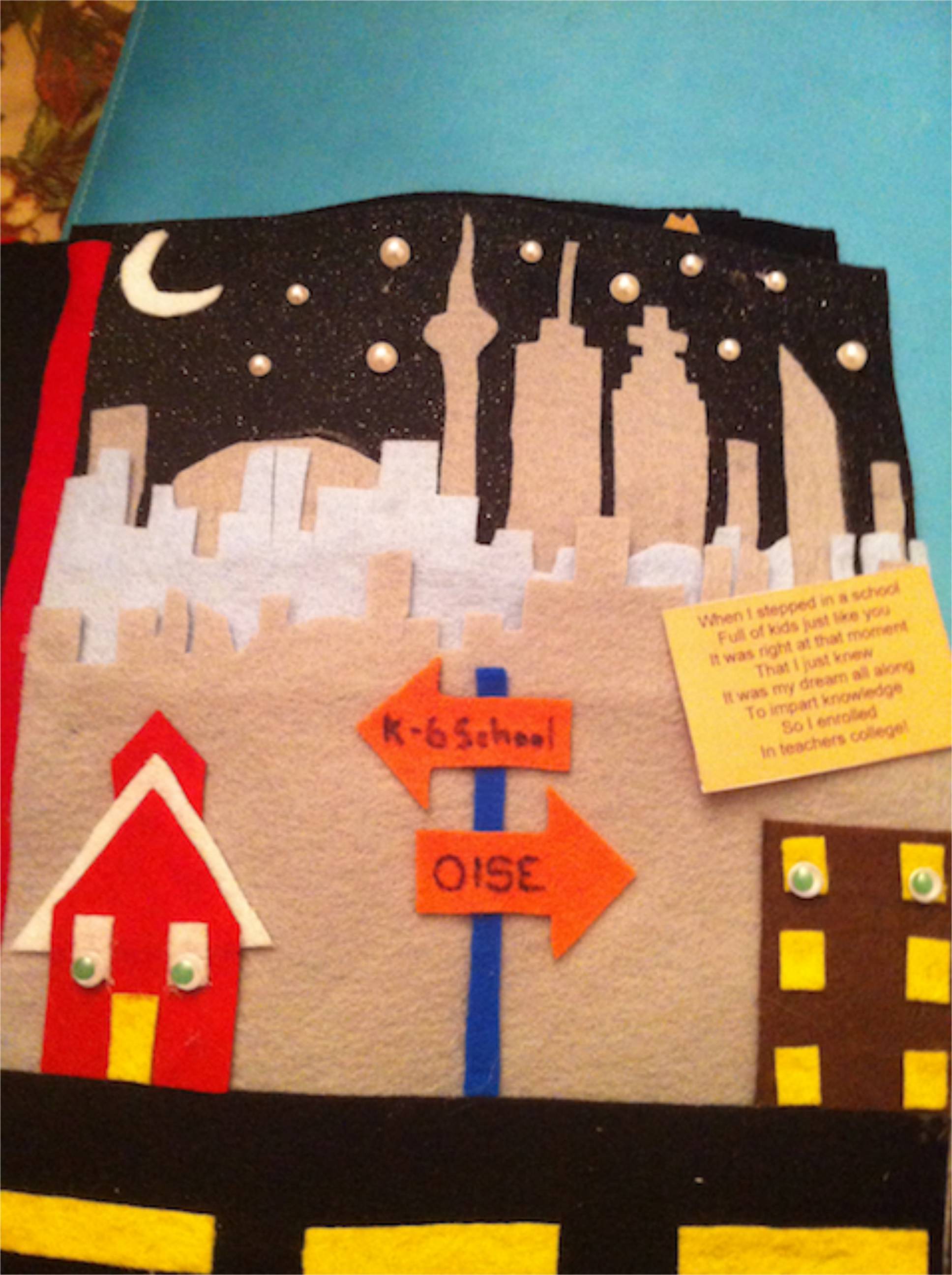
We had an amazing literacy class yesterday. We (Clare and Lydia) along with the student teachers in our P/J and J/I literacy courses shared our All About Me texts. As a class we meet weekly in a designated classroom on campus, but this week class was extra special, as Clare graciously invited us into her home to share our texts in a more personal space. The student teachers engaged a rich array of storytelling formats including – playbills, a message in a bottle, interactive ABC books, puzzles, dual language texts, a personal timeline plotted out with illustrated cityscapes, e-books, comic strips, Pokémon cards, nesting boxes housing artifacts documenting developmental milestone – to share aspects of themselves to an attentive audience of their peers. The depth of thought and creativity communicated through their texts was truly impressive and inspiring. I’m sure the children/youth they’ll be teaching in their upcoming placements will enjoy these texts as much as we all did. It was a truly enjoyable day. Thank you to all the student teachers in our literacy community!!
Reading Choices
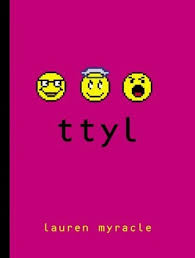
In general terms, my (Lydia) dissertation research examines the ways in which student teachers construct conceptions of literacy and enact literacy pedagogy when they view themselves as in conversation with a broader field of literacy (e.g. Multiple Literacies, New Literacy Studies). One aspect of this research considers how student teachers’ personal literacy practices inform their approach to literacy pedagogy. In some cases student teachers’ personal reading practices have been influenced by the interests and reading choices of the pupils they teach. These student teachers have often engaged with texts recommended by their pupils (e.g. graphic novels, young adult literature), and these shared texts become a space within which teacher and pupil connect. One of the student teachers participating in this research discussed the text ttyl written by Lauren Myracle, who has been referred to as a modern day Judy Blume. This young adult novel, which is part of a series, is written entirely in instant messages. Interesting, this best selling novel has been on the annual list of the “Most Challenged Books” released by the American Library Association. In other words, people have requested that this book be ban from libraries and schools “due to sexually explicit material and offensive language.” I plan to share this text with the student teachers in our literacy courses this year. I think it could contribute to an interesting conversation about text structure, style, controversies, and pupils’ diverse reading interests.
How do you Know What To Blog About?
I (Clare) recently did a presentation to a group of teachers on a self-study I conducted with
Lydia Menna and Shawn Bullock on our efforts to integrate digital technology into my literacy methods courses. (Here is the powerpoint from that presentation. BERA + ECER-DT 2013in Dropbox) I talked about my initiatives which led to me showing how my efforts in my literacy teaching led to a greater use of digital technology in other parts of my life (e.g., using NVivo for data analysis). The success of my initiatives with my teaching gave me the confidence to take the plunge to do a website. My technical skills had improved and my identity shifted so that I now see myself as “digitally competent.” During the presentation I showed our website and one of the participants raised an interesting question: How do you get ideas for your blog? He recounted how he wanted to do a blog but did not know what to write about. I told him to just start! I believe that writing a blog is a different genre – it requires different writing skills than other forms of writing. Since we started this blog, I feel that my blog-writing skills have improved. I now focus on one topic in a blog; I am more comfortable sharing my insights; I will raise questions; I make links to other resources; and I no longer feel the blog needs to be perfect (so what if there is a typo. We will survive.) Blogging seems to have captured my interest and is a good match for me ( I have lots to say about education) and it is fun. I keep a Word document with blog ideas which is always plentiful and when I come across something “interesting” one of my first thoughts is – Would that make an interesting blog? This thought is followed by – Would others be interested in this topic/issue? Doing our blog as a “team” has truly been the way to go. I have learned so much from the posts by my team (Cathy, Lydia, Pooja, Clive and our guest bloggers) about them personally and professionally. And their blogs give me ideas about what to write about.
I really see our blog as connecting with the broader education community which is social media at its best. Blogging is good for me because it gets me thinking critically and hopefully, our posts are of use to our readers.
Good-bye Michael Gove!
Although I (Clare) live in Canada I am well aware of the challenges teachers and teacher educators in England are facing. We have a number of literacy/English teacher educators in our study of teacher educators who have recounted the challenges they are facing (e.g., funding reduction, stringent/ridiculous accountability measures). At our Symposium on teacher education in London participants recounted how demoralized teacher educators felt.
The Secretary of State for Education, Michael Gove, who was instrumental in bringing in a number of draconian measures in education has been demoted to Chief Whip. http://www.theguardian.com/commentisfree/cartoon/2014/jul/17/steve-bell-cartoon-michael-gove-first-day-chief-whip He wanted to reshape education based on his own experiences in elite private schools – or as I see it, drag education back to the 19th century. He seemed to be waging war on schools of education by creating so many alternative routes into teaching that he was stripping teacher educators of their place in preparing teachers. His inability or unwillingness to listen to reason and research led to him implementing a number of measures that are so wrong headed it is mind-boggling. He was never a teacher nor did he do research on teaching and teacher education so how did he think that he knew how to prepare teachers? When you compare his approach to the one used in Finland (see blog post on Thursday, July 17) the contrast is glaring. Respect and trust were not his modus operandi.
On his first day of his new job as party whip he got stuck in the toilet! Hmmmmm…….. Read into that what you like!
Let’s hope that the path he set for education will be altered by his successor so that education and teacher education can get back on track and become relevant and appropriate for the 21st century. There is a growing body of research on teacher education which should guide policy. It is time for policy-makers in England to refer to it.
Stimulating Writing with Youtube
I (Cathy) teach Writer’s Workshop in my university literacy class by having my student teachers participate in one. They engage in the entire process from selecting a genre, to peer editing, to learning from descriptive feedback, to publishing their work. I am amazed every year how much the student teachers gain from the experience. They often begin the process terrified of being a writer and of teaching writing. The Writer’s Workshop structure helps them overcome much of that fear. One of the biggest challenges they must overcome is selecting a genre to write in. Every year several students are completely stymied by this. To aid these students I provide wordless picture books for which they must write the words. They love it and swear they will do this for their own students when they are teachers.
The other day I came across a new source for stimulating writing. It made me laugh out loud. Would you write it from the sea gulls point of view, or the cat’s?
https://www.youtube.com/watch?v=b38li3CHOg0