Category Archives: classroom teachers

Attack on “Balanced Literacy” Is Attack on Professional Teachers, Research

I (Clare) read this article and felt it would add to the posts on this blog about teachers as decision-makers and the need for teachers to be seen professionals.

plthomasedd's avatardr. p.l. (paul) thomas

The allusion in Robert Pondiscio’s Why Johnny won’t learn to read accomplishes something different than intended. Pondiscio’s uninformed swipe at balanced literacy actually reveals that, once again, ideology trumps teacher professionalism and literacy research.

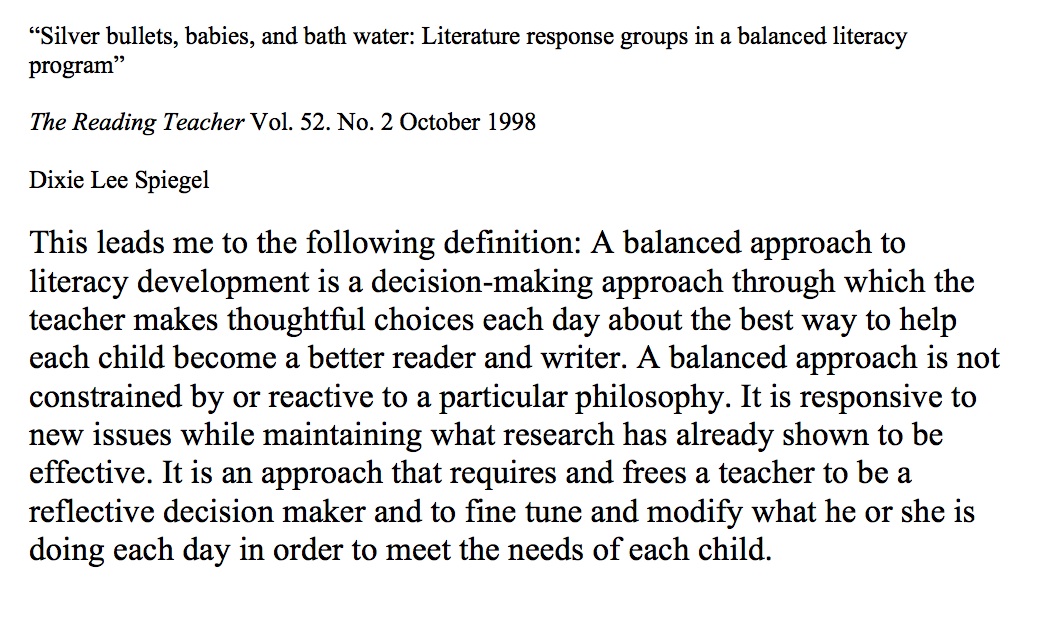
The reading wars are about almost everything except reading, but the most important lesson from this newest version of the same old thing is that if we start with what balanced literacy is, we begin to see just what those who attack balanced literacy believe:

Spiegel 3

Spiegel’s definition shows that the term “balanced literacy” is about the professional autonomy of the teacher, the wide range of research on how children acquire literacy, and honoring individual student needs (those who need direct instruction and those who do not).

Like “whole language,” balanced literacy does not reject any practice that is needed or effective, and does not prescribe practices either.

When Pondiscio and others, then, reject balanced literacy, they reject…

View original post 23 more words

The Hard Part of Teaching by Peter Greene

Our last few blog posts have focused on teaching. I (Clare) found this amazing article by Peter Greene on Huff Post. Greene really gets it about teaching. Thought you might find this interesting. http://www.huffingtonpost.com/peter-greene/the-hardest-part-teaching_b_5554448.html?utm_hp_ref=tw

The Hard Part by Peter Greene

They never tell you in teacher school, and it’s rarely discussed elsewhere. It is never, ever portrayed in movies and tv shows about teaching. Teachers rarely bring it up around non-teachers for fear it will make us look weak or inadequate.

Valerie Strauss in the Washington Post once put together a series of quotes to answer the question “How hard is teaching?” and asked for more in the comments section. My rant didn’t entirely fit there, so I’m putting it here, because it is on the list of Top Ten Things They Never Tell You in Teacher School.

The hard part of teaching is coming to grips with this:

There is never enough.

There is never enough time. There are never enough resources. There is never enough you.

As a teacher, you can see what a perfect job in your classroom would look like. You know all the assignments you should be giving. You know all the feedback you should be providing your students. You know all the individual crafting that should provide for each individual’s instruction. You know all the material you should be covering. You know all the ways in which, when the teachable moment emerges (unannounced as always), you can greet it with a smile and drop everything to make it grow and blossom.

You know all this, but you can also do the math. 110 papers about the view of death in American Romantic writing times 15 minutes to respond with thoughtful written comments equals — wait! what?! That CAN’T be right! Plus quizzes to assess where we are in the grammar unit in order to design a new remedial unit before we craft the final test on that unit (five minutes each to grade). And that was before Chris made that comment about Poe that offered us a perfect chance to talk about the gothic influences, and then Alex and Pat started a great discussion of gothic influences today. And I know that if my students are really going to get good at writing, they should be composing something at least once a week. And if I am going to prepare my students for life in the real world, I need to have one of my own to be credible.

If you are going to take any control of your professional life, you have to make some hard, conscious decisions. What is it that I know I should be doing that I am not going to do?

Every year you get better. You get faster, you learn tricks, you learn which corners can more safely be cut, you get better at predicting where the student-based bumps in the road will appear. A good administrative team can provide a great deal of help.

But every day is still educational triage. You will pick and choose your battles, and you will always be at best bothered, at worst haunted, by the things you know you should have done but didn’t. Show me a teacher who thinks she’s got everything all under control and doesn’t need to fix a thing for next year, and I will show you a lousy teacher. The best teachers I’ve ever known can give you a list of exactly what they don’t do well enough yet.

Not everybody can deal with this. I had a colleague years ago who was a great classroom teacher. But she gave every assignment that she knew she should, and so once a grading period, she took a personal day to sit at home and grade papers for 18 hours straight. She was awesome, but she left teaching, because doing triage broke her heart.

So if you show up at my door saying, “Here’s a box from Pearson. Open it up, hand out the materials, read the script, and stick to the daily schedule. Do that, and your classroom will work perfectly,” I will look you in your beady eyes and ask, “Are you high? Are you stupid?” Because you have to be one of those. Maybe both.

Here’s your metaphor for the day.

Teaching is like painting a huge Victorian mansion. And you don’t actually have enough paint. And when you get to some sections of the house it turns out the wood is a little rotten or not ready for the paint. And about every hour some supervisor comes around and asks you to get down off the ladder and explain why you aren’t making faster progress. And some days the weather is terrible. So it takes all your art and skill and experience to do a job where the house still ends up looking good.

Where are school reformy folks in this metaphor? They’re the ones who show up and tell you that having a ladder is making you lazy, and you should work without. They’re the ones who take a cup of your paint every day to paint test strips on scrap wood, just to make sure the paint is okay (but now you have less of it). They’re the ones who show up after the work is done and tell passersby, “See that one good-looking part? That turned out good because the painters followed my instructions.” And they’re most especially the ones who turn up after the job is complete to say, “Hey, you missed a spot right there on that one board under the eaves.”

There isn’t much discussion of the not-enough problem. Movie and tv teachers never have it (high school teachers on television only ever teach one class a day). And teachers hate to bring it up because we know it just sounds like whiny complaining.

But all the other hard parts of teaching — the technical issues of instruction and planning and individualization and being our own “administrative assistants” and acquiring materials and designing unit plans and assessment — all of those issues rest solidly on the foundation of Not Enough.

Trust us. We will suck it up. We will make do. We will Find A Way. We will even do that when the state and federal people tasked with helping us do all that instead try to make it harder. Even though we can’t get to perfect, we can steer toward it. But if you ask me what the hard part of teaching is, hands down, this wins.

There’s not enough.

Originally posted at Curmudgucation

A call to adopt Balanced Literacy

An article in the New York Times caught my eye, it highlights New York schools chancellor Carmen Fariña’s proposal to adopt a balanced literacy approach in more New York City classrooms (link to article provided below). The article reports that, “during her almost six months as chancellor, Ms. Fariña, a veteran of the school system, has reduced the role of standardized tests, increased collaboration among schools and shepherded through a new contract for teachers that includes more training and more communication with parents. But her push for a revival of balanced literacy may have some of the most far-reaching implications in the classroom.” Proponents of the Common Core academic standards have however, voiced resistance to implementation of a balanced literacy approach, arguing that it is at odds with the learning goals emphasized in the core standards, which have been adopted by more than 40 states. What do you think are the pros and cons of a balanced literacy approach?

http://mobile.nytimes.com/2014/06/27/nyregion/new-york-schools-chancellor-carmen-farina-advocates-more-balanced-literacy.html


Maya Angelou’s Influence on Hip-Hop

Each year, Clare and I (Lydia) invite student teachers in the P/J and J/I literacy methods courses to explore the rich pedagogical possibilities available when poetry is included as an integral part of a literacy program. We consciously include the work of a variety of poets in an effort to provide student teachers with multiple entry points into the teaching of poetry. The recent passing of celebrated poet Maya Angelou brought to light once again the dynamic and influential nature of poetry. Angelou’s powerful poetry inspired a generation of Hip Hop artists who appreciated the beauty and complexity of her work. Upon hearing the news of her death, rapper-producer Q-Tip acknowledged the deep impact Angelou’s poetry had on him. In a twitter post he recalled trying to copy her voice during his early days with A Tribe Called Quest. He noted, “I tried to copy Maya’s fluid voice early on but failed miserably. But because of her I found my own… RIP Maya Angelou and thank u.”

Maya Angelou’s Legacy in Hip-Hop: www.slate.com/blogs/browbeat/2014/05/28/maya_angelou_s_legacy_in_hip_hop_poet_leaves_behind_a_history_of_appearances.html

album-A-Tribe-Called-Quest-Midnight-Marauders

What Influences How Teachers Teach?

Monica McGlynn-StewartAs a former elementary teacher, I (Monica) know that there are many things that influence how teachers teach in their classrooms. In our longitudinal study of teachers, Teacher change: patterns, factors, and implications for professional education, we have been learning from teachers about the kinds of formal and informal professional development that they find most relevant and helpful. One of the factors that intrigued me early on in the study was the influence that the teachers’ own early schooling had on their teaching. I interviewed 6 of our participants over the first three years of their teaching and discovered that they all use one or two teachers from their own childhood as role models for their teaching. My research has just been published in Language and Literacy: A Canadian e-Journal. Here’s the link: http://ejournals.library.ualberta.ca/index.php/langandlit/article/view/20426/16419

Love that Dog: A touching book and useful pedagogical resource

In both my experience teaching pre-service literacy courses and my current research with student teachers I (Lydia) have witnessed the sense of anxiety and discomfort many student teachers voice when they are faced with the prospect of teaching poetry during their practice teaching placements. Often, their associate teachers are themselves not comfortable with poetry and therefore, they have difficulty scaffolding the teaching of poetry or providing supportive resources for student teachers. This awareness has motivated Clare and I to delve into poetry within the first few weeks of the P/J and J/I literacy courses, in an effort to ease some of the initial anxiety student teachers experience in anticipation of teaching poetry. We attempt to provide multiple entry points into the teaching of poetry by presenting student teachers with various forms of poetry, and by highlighting the creative expression and emotive potential offered by this medium. We also provide them with a number of resources and pedagogical strategies they can utilize during their practice teaching placement. I recently picked up a copy of the book Love that Dog by Sharon Creech, which I hope to use in the literacy methods courses this year because the insight provided into how students might feel about reading and writing poetry is useful for both teachers and students. Throughout the book, the main character a young boy named Jack journals back and forth with his teacher Ms. Stretchberry, cleverly expressing his initial resist and eventual connection to poetry. Jack initially pronounces, “I don’t want to because boys don’t write poetry. Girls do”; however, through his ongoing dialogue with his teacher Jack experiments with word choice, sounds, and rhythm as he is engages with various poetic formats. My favorite entry in the book is “November 22.” Hopefully the student teachers in the literacy courses this year will enjoy this touching book as much as I did.lovethatdog

Because of Mr. Terupt- I was touched

I’ve been striking it lucky with my pick of children’s literature lately. Because of Mr. Terupt is a juvenile fiction novel well worth reading to a junior level class. Also perfect as a sample novel for student teachers experiencing literature circles. This touching story, by Rob Buyea, brings up many discussion points regarding what makes a good teacher, plus many other school issues: diversity, inclusion, forgiveness, and bullying just to name a few. Terrific resource for ‘hot seat’ /role playing explorations.  A must read for children’s literature fanatics like me!

Mr terupt

Full Day Kindergarten in Full Swing

Tis the season for parents  with children turning 4 years old to become acquainted with formal schooling and the Full Day Kindergarten (FDK) expectations. Ontario, Canada has implemented full day Kindergarten for all students across the province.  I (Yiola) am experiencing first-hand the excitement and apprehension of sending my child, a darling, vulnerable, sensitive, sweet girl (Sylvia Clare), to school for 6.5 hours a day, 5 days a week.

Jumping online, I have read reviews — some for and some against — FDK and many focusing on children’s language and literacy development.  See below for some examples:

Full-day kindergarten children score highest in vocabulary, self-regulation

http://www.theglobeandmail.com/news/national/education/full-day-kindergarten-offers-no-academic-advantage-study-says/article17715532/

As a parent, my worry is not so much if my Sylvia Clare’s academic achievement will be more or less. As a parent, my worries are related to her well-being. Will she be happy? Will she love herself even more? Will she make friends and learn how to work/play with others well? Will she come home each day and share stories of interesting things she did and learned.   I most certainly want to her read and write, but in good time. I feel there is no rush and I want a pressure-free learning environment for her.

In a recent article  http://www.mykawartha.com/news-story/4397024-why-full-day-kindergarten-has-better-prepared-our-kids-for-grade-1/,  educational consultant Joan Ruf comments:

“One of the wonderfully positive things about full-day kindergarten is the appreciation of the whole child,” she said, explaining the program is successfully marrying the concepts of academic and emotional growth. “So it’s not just about reading and math. It’s about how are they doing. What are they doing for themselves.”     This statement gives me some comfort.

Schools in Ontario are now inviting parents to attend FDK information sessions in order to prepare ‘us’ for the year ahead.  I will be writing about my experiences going through this process and journaling Sylvia Clare’s experiences as she begins FDK in September.

As a professor of education, through the researching and teaching and writing and sharing,   what lies at the centre of my work  are the children and their development as happy, healthy, thoughtful, literate human beings.

The issues surrounding FDK: its purpose, process, and outcomes are vast. With a political election looming the topic of FDK is front and centre and how it will be managed and maintained is up in the air.

The Canadian Society for the Study of Education

conference

This week The Canadian Society for  the Study of Education (CSSE) is being held in St. Catharines, Ontario at Brock University.

The team, Clare, Clive, Lydia, Cathy, Pooja, and me (Yiola) will be sharing a number of presentations over the course of the week. Some of these presentations include the following titles:

Teachers’ Professional Identity Development Over Their First 8 Years, With Implications for Preservice and Inservice Teacher Education

Teachers’ Ongoing Learning over Their First 8 Years, with Implications for In-Service Professional Education

Exploring literacy teacher educators’ negotiations of a critical stance in pre-service teacher education

Teachers’ critical literacy practices in the early years classroom

Instructional Practices of Critical Literacy within an Inquiry-Based Learning Environment

Presenting at conferences is a great way to share research with the community.  For more information about the CSSE conference click here:  

Conference


Wonder is Wonderful

I (Cathy) download audio books from audible.com onto my Ipod nano and listen while I walk, garden or cook. I just finished the book Wonder by R. J. Palacio. It is a very touching juvenile fiction novel about a ten year old boy with severe syndromes that dramatically alter his facial features. The story takes us on his journey surviving his first year in a public school as a grade five student. I cried a lot. This wasn’t so bad when I was in the kitchen cooking or even in my own back yard planting and digging. But walking?   Hmmm. People notice. Oh well. When people asked me if I was all right, I just said, “It’s the power of great literature,” smiled and thanked them for their concern. This is a must read my friends, but keep the Kleenex handy and warn the family in case they ‘wonder’ about you!

wonder