We are just back from New York and New Jersey where we interviewed a number of teachers who are part of our longitudinal study. Since we have been following these teachers for 7 years, I (Clare) feel I know them well. These are very able educators who are now working in very difficult conditions because of external constraints. I heard stories of them having to submit DETAILED lesson plans regularly (for the following two weeks), being observed/assessed five times per year, having to change their programs in order to comply with the Common Core, assessing the children an excessive amount, having to forgo pedagogies/books/activities they know are what the children need, and tying their teacher evaluations to student performance on standardized tests. All of these supposed measures to improve education in fact are undermining education. These teachers are spending so much time testing and writing lesson plans, they do not have time to actually work with the children. And they know what needs to be done and how to do it! All reported HIGH levels of stress. They are being deprofessionalized as these overbearing compliance methods are imposed on them. The phrase, lack of respect, was uttered over and over again by them. When asked the question — If you had to do it over again, would you become a teacher? – the responses were disheartening. Most said no and many said they are actively thinking about other careers. What has happened to education in the U.S.?
Category Archives: classroom teachers
Multifaceted Role of the Professor: Conducting Research Includes ….
As mentioned in a previous blog post, Clive and I (Clare) are interviewing teachers who are part of our longitudinal study of teachers. Many of our teachers have had life-changing events – including becoming a parent. The teacher we were interviewing in northeast US this past week is a new Mom and is home on maternity leave. We did a division of labour: while I was interviewing the teacher, Clive babysat the new baby who is four months old. The question is: who had more fun? Me doing the interview with an amazing teacher or Clive babysitting an adorable youngster? It was a toss up because we both had a great time. So for budding researchers …. Do not be surprised that your role includes some unexpected duties (which no one told you about in grad school) – such as babysitting.
On a more serious note, a number of teachers in our study over the last 7-10 years have become parents (including adopting a child). It is interesting to see how they change once they become moms or dads:
- Juggling being a new parent and a teacher has led to changes in practices and views. All have found the dual role draining.
- New parents definitely have to shorten their work days! Working morning, noon, and night and all weekend which many had done as new teachers was no longer feasible.
- They developed a number of strategies to streamline planning and marking.
- When we asked how their views and/or values changed now that they are a parent many have commented they have become more compassionate. They appreciate how much parents have to trust teachers to care for their child (as they would) and how vulnerable children are. Their views towards parents in many cases have becoming more understanding while with the students they say are more flexible.
- Interestingly, a number have commented that now as a parent, they are not as focused on covering the curriculum (standards or expectations); rather, they have become more focused on the individual child to ensure he/she is happy and thriving.
- Some have said they have become less critical of themselves. They can only do so much and do not feel so guilty putting boundaries around their personal life.
There is so much more to being a teacher than covering the curriculum. There is so much more to being a researcher than just working with the data. You have to be flexible and be willing to assume some untraditional duties – just ask Clive.
A Lack of Diversity in Higher Education Leadership
An interesting article was published last week about the lack of diversity to be found in university leadership. When looking at full-time faculty at universities across the U.S., 79% were white. The lack of diversity was found most among higher ranking faculty (tenure-track; leadership roles; presidents). For example, “while 44 percent of full-time faculty at degree-granting institutions are women, they hold only 29 percent of tenure-tracked positions at doctoral institutions — even though women outperform men 56 to 40 percent in national research grant awards.”
An excerpt from the article:
Thus, university leadership increasingly reflects neither the student body being led nor the world in which graduates will need to operate, a situation that engenders disadvantages and lost opportunities. Students benefit from having mentors and role models from their own racial, ethnic, or gender group — as do faculty who aspire to leadership positions. Institutional leaders can strongly influence institutional culture; having leaders from a wide range of backgrounds and experiences enriches the intellectual and cultural climate in which students learn. And exposure to and experience working with people from different cultural backgrounds better prepares students for the real-world working environment of their futures.
The excerpt above describes much of what is happening in the K-12 teaching force in North America. Although efforts are being made to diversify the teaching force, white female teachers remain the majority of K-12 teachers.
Read the entire blog here:
Mental Health Education in Teacher Education
Earlier this week I (Yiola) participated in a Webinar on the teaching of mental health in teacher education. The webinar was called: Reading, Writing, Resiliency: A Briefing on the State of Teacher Education Toward Positive Mental Health.
This post is connected to Shelley’s recent post on Supporting Student Well-being through Mindfulness Practices as it looks closely at what Teacher Education programs are doing to prepare teachers to teach about Mental Health and Wellness. It was interesting to read Shelley’s blog and learn about what she does and how mindfulness as a form of mental health practices are developed in her course on Special Education. I would love to hear what other teacher educators and classroom teachers do to promote and teach about well-being.
During the webinar I learned some interesting facts:
– parents are concerned and interested to learn more about in 2 key areas related to mental health education: 1) Abuse and its effects on mental health (bullying, emotional abuse, exclusion); 2) Health (depression, substance abuse)
– after (parents and) doctors, teachers are the next care professionals in line who are expected to address children’s mental health
– There is a gap between the strong perception of teachers responsibilities for addressing issues of mental health and their preparedness to do so
In a study conducted on mental health teaching in teacher education in Canada, over 400 courses in 66 teacher education programs were examined against 4 criteria. The 4 criteria were related to the following: course title, words in the course description, topics in the course outlines, practices and relationships. The findings showed that only 2 of the 400 courses met all 4 criteria for the inclusion of mental health learning; 23 courses met 3 of the 4 criteria, 84 courses met 2 of the criteria and 104 courses met just 1 criteria. This finding suggests that there is very little by way of teaching mental health issues in teacher education programs.
From the study 5 recommendations were made: 1) all teacher education programs should include at least 1 course that focuses on fostering postive mental health and resiliency; 2) classroom management courses reflect proactive resiliency oriented strategies; 3) in-service opportunities need to be available to practicing classroom teachers; 4) provincial curriculum should identify outcomes for health education; and, 5) mental health and resiliency outcomes should be in grades K-12 curriculum.
The webinar was helpful in outlining where we stand today in teacher education and mental health teaching. I am very keen on thinking about how to move forward in teacher education programming. Mental health and resiliency content can and should in included in many courses including but not limited to: all curriculum areas (i.e. literacy, social studies, math, health and physical education); special education, methods (i.e. classroom environment, classroom management, collaborative practices). There needs to be a shift in foci, moving beyond the traditional Health and Physical Education curriculum (i.e. the Healthy Living strand) into a more comprehensive way of thinking about well-being and resiliency.
A Comic For Today

Striving for Equal Digital Opportunity
 An article by Kristin Rushowy in the Toronto Star on April 1 reported that almost 60% of Toronto schools allow students to BYOD (bring your own device). http://www.thestar.com/yourtoronto/education/2014/04/01/byod_bring_your_own_device_now_in_most_ontario_schools_survey_finds.html
This indicates a trend. Not long ago the debate was whether it was “safe” for students to bring their smartphones or tablets: what if they did inappropriate things with them? Also, would students be distracted by their devices? At AERA two years ago I (Clive) attended a roundtable on just these issues.
What teachers have found (and many in our longitudinal study report this) is that, if rules are laid down and habits established, the potential problems can largely be overcome. Moreover, this process provides opportunities to teach students about digital responsibility, etiquette, etc.
The Star article focused rather on the question of equity: does BYOD increase the disparity between rich and poor students, or potentially reduce it? People for Education research director Kelly Gallagher-Mackay argues for the latter position, “as long as (boards) realize it’s not a level playing field, and consciously address that.”
While most school districts can’t afford to buy devices for everyone, they can make up the difference for students who don’t have them; and tech firms are often willing to help out. Rushowy reported: “Last year, the Peel board arranged for $55 tablets for families, and last month began a pilot project giving low-income families discounted refurbished computers.”
There will always be a stigma attached to needing help of this kind. But it seems better to tackle it head-on in the classroom rather than ignoring an inequality everyone knows about anyway. It’s also better to have devices in the classroom, provided we can find ways to make it work. The investigation continues.

John Harris’s ‘Inside the A* Factory’

A feature in the Guardian on the 15th March, by left-wing journalist John Harris, aroused a good deal of interest among teachers (still going if last Saturday’s letters page is anything to go by). But ‘Inside the A* Factory’ received little coverage elsewhere in the media and the underlying issues (teacher workload, teacher morale and the factory model of schooling) also continue to be ignored by the press and broadcasters. There is a national teacher strike this coming week and a lay reader would be hard-pressed to know it was happening let alone why it was happening.
The article was essentially a collection of stories of different teachers’ experiences of working in schools over the last 20 years or so. The age of the teachers reflected that but the majority of Harris’s sample seemed to be 30 or under and talking about the last five or six years. The picture…
View original post 486 more words
Assessing Multimodal Projects
You may remember, in a former post on Mar. 21, 2014, I (Cathy) shared some of my pre-service students’ multimodal projects. The dilemma facing me after these wonderful creations were submitted, was how to assess them. As these were only part of a larger assignment, I already had a rubric in place for whole project, but after seeing the brilliance of the multimodal aspect, I felt these alone warranted more thought and introspection on my part. Having a background in the arts, I was used to assessing creative process and final product, but this was different. Although artistic and expressive, this wasn’t “art”. Hence, I looked up a number of sources on assessing multimodal work and discovered a few different opinions.
Kalantzis, Cope & Harvey (2003) argued that a multimodal assessment needs to measure the creative process and the collaborative skills demonstrated. Jacobs(2013) suggested it wasn’t about the final product, but “watching and noticing what students are doing and then using that information to guide the students toward new skills and knowledge”. In the end I sought out the opinion of Gunther Kress, the founder of the Multimodalities Theory. Kress (2003) explained that representation and communication were an affective/cognitive semiotic process and this must be taken into account in the assessment. He suggested that I, as the teacher [educator] should not ask “How does this project match what I wanted or expected?”, but instead should ask, “How does this project give me insight into the interests and motivations of my learner?” I found this question quite insightful. In the end, I used Kress’ question to guide my feedback, which will hopefully guide the students toward new insights and knowledge. The required ‘grade’ was based on a combination of the learners’ expressed interests from within the context of the whole project (which was on diversity), the creative process and the collaborative nature of the work.
Through this process I discovered that assessing in the new age of multimodality demands mindfulness, insight and the ability to make many connections. To be effective, it also requires that the teacher educator, or teacher, know his/her students well. This type of assessment takes time, but it is much more meaningful. I have to admit, as much as the students loved doing these multimodal projects, I loved assessing them in this “new” way. We all got more out of the process. Below is a link to one more student project expressed as POW TOON digital creation. How would you assess it?
POW TOON Link
http://www.youtube.com/watch?v=9uM68P2rk24&feature=share&list=UUdKEvJ3G8Z-W-geAhhsX9IA
Strategies for Maintaining Motivation and Satisfaction as a Teacher (and Teacher Educator)
Teaching is challenging. As David Labaree (2004) says:
“[T]eaching is an extraordinarily difficult form of professional practice. It is grounded in the necessity of motivating cognitive, moral, and behavioral change in a group of involuntary and frequently resistant clients.” (pp. 55-56)
In our study of teachers, we (Clive and Clare) have been struck BOTH by the many challenges the teachers face AND how well they maintain their morale despite the challenges. Of the original cohort of 22 who began in 2004, none have quit teaching (though 2 have left the study) and none have experienced a substantial, permanent decline in motivation, though they have their ups and downs. When in 2012 we asked them explicitly about their motivation over the years, their responses were as follows:
Average Motivation of Cohort 1 (18 interviewed) Over Their First Eight Years (Scale 1-5)
| Year 1 | Year 2 | Year 3 | Year 4 | Year 5 | Year 6 | Year 7 | Year 8 |
| 4.7 | 4.4 | 4.4 | 4.4 | 4.1 | 3.8 | 3.8 | 4.2 |
Interestingly, their highest motivation was in year 1. Though they were stressed and exhausted, they were excited to be doing what they had dreamed of for so long.
As for the strategies they used to keep up their morale, we noted the following:
- Acknowledging the inherent challenges and limits of teaching – “it’s not just you”
- Taking a broad approach to teaching, so it’s more social, meaningful, enjoyable
- Becoming more skilled and effective as a teacher
- Maintaining a work-life balance: having a life beyond teaching
- Remembering why you became a teacher in the first place (see quotes below)
“Teaching is getting harder, and I’ve changed in that I would no longer recommend it to everyone…. However, I like it because I’m a doer, I enjoy being creative, and I like being challenged.” (Felicity, year 7)
“I’m happy to go to school [because] you just never know what’s going to happen; it’s always a new day.” (Jody, year 8)
“When things were going in a wrong direction [recently] with my school administration and in the school district, it brought me back to why I was there, why I wanted to be a teacher: working with the kids, dealing with their issues, getting down to the fundamentals of teaching them.” (John, year 8)
Great strategies! Good for teachers – and teacher educators too!
Multimodal Literacy
My (Cathy) pre-service students were assigned a multimodal aspect to a major assignment this year. If you are not familiar with the Theory of Multimodality, it is Gunther Kress’ alternative to Linguistic Theory (which only privileges reading and writing as the main modes of communication in a school curriculum). The Multimodal Theory contests that in our new age of multiple literacies, students need to be communicating, responding and expressing through many different modes of communication (e.g. speaking, music, moving, gesturing, image, and digital technology).
When I first introduced the multimodal assignment to my students, there was some trepidation and even some anger. It was suggested I did not have the right to be marking them on their artistry or on creativity. Hence, I had to teach the concepts behind Multimodality Theory so they could better understand what we need to be offering students of the 21st century. They needed to see that it would allow them the freedom to express in modes of their own choosing; that it was not graded as art but as a production of design; and, that the work could be symbolic or interpretive depending on the meaning they were portraying. The multimodal projects would also be shared in class so all could learn from them. This project was not just them regurgitating information for me, it was them designing and producing personally meaningful projects that express what they learned and what they deemed significant.
This week we finished viewing the projects. They were amazing, and the student response to these projects was encouraging. My students (concurrent students just finishing a five year educational degree) had never been given this kind of an assignment before. They loved the element of choice; working together; taking a risk; pushing their boundaries; feeling creative; and, doing something they were interested in. The modes they selected to express themselves though were sometimes more traditional (dancing, rapping, singing, writing and reciting poetry, creating 3D sculptures, puppetry, multi-sensory art installation pieces); sometimes digital (iMovies, pod-casts, prezis, Pow Toons, popplets, infographics); and, were often a combination of both.
Collectively, we were all blown away by the results. We were moved. We were inspired. My students all said they would definitely use multimodality now as teachers. Below are a few images of my students presenting their projects:
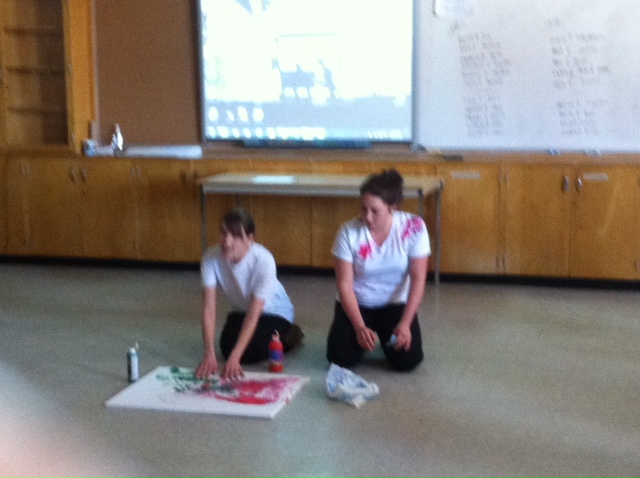

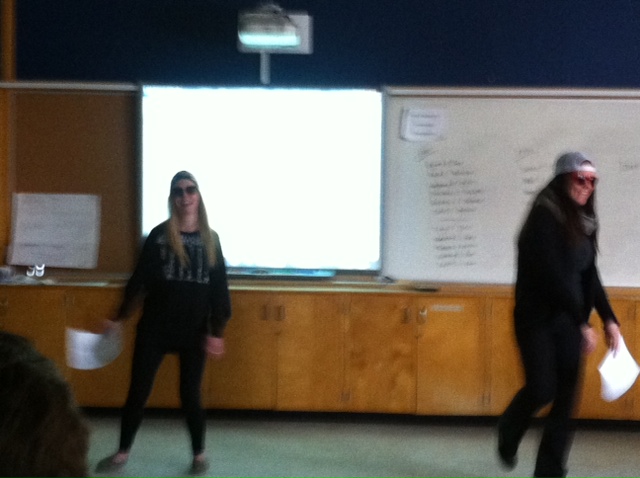

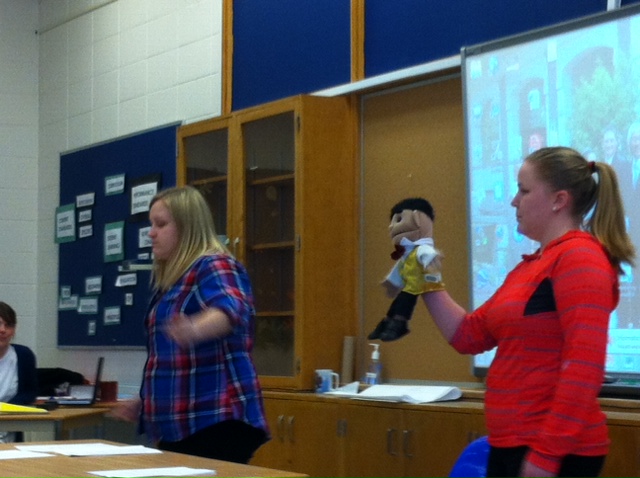
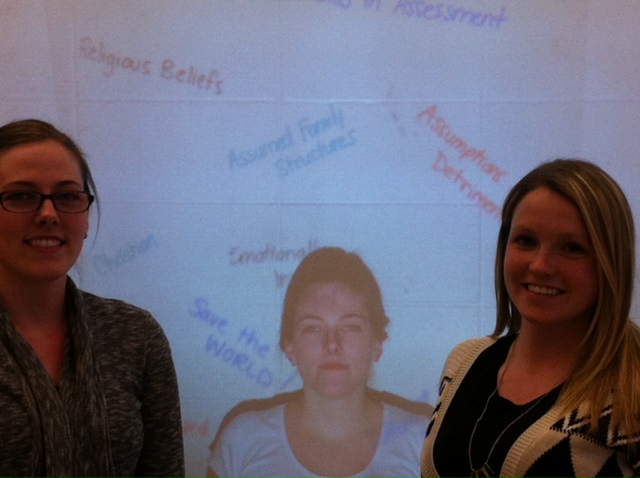
Now, I have to assess these designs… but that, dear reader, is for another blog.
 Literacy Teaching and Teacher Education