Category Archives: literacy

Language and power: A well “articulated” analysis

It is  a rewarding feeling when a student teacher from years past emails a link to an article, a video, or an image that is reflective of the messages we discussed in our teacher education class. The message it sends me is this, “I remember you. I remember your teachings. I learned and am still thinking about what it means to be a teacher and what it means to teach literacy”.  Today I (Yiola) received a short email from a student of four years ago. She sent the following link:

The link takes us to a spoken word presentation entitled “3 Ways to Speak English” shared on TED during a theme based session called “Examining Prejudice”.  Her talk as part of the series is described as:

Educator Jamila Lyiscott delivered an incredible poem called “Broken English,” in which she showed that she is a “Trilingual orator” able to speak fluently at home, with Caribbean parents, at school in “proper English,” and with her friends in a language that is as formal and rules-based as the other two. The poem raised a big laugh when she pointed out, “You may think it is ignorant to speak Broken English, but even articulate Americans sound foolish to the British.”

My favourite part is when she says:

So I may not always come before you with excellency of speech

But do not judge me by my language and assume

That I’m too ignorant to teach

‘Cause I speak three tongues

One for each:

Home, school and friends

I’m a tri-lingual orator

What stands out for me about the poem and what I will share with my students in class this week:

1) The power of language and how we associate language with power

2) Language and how it informs our identities — how many languages do you speak?

3) Linguistic profiling: the racial identification and discrimination of an individual or group of people based on their speech  and how that plays out in society and in the classroom

4) History — and how it influences our use of language

I was moved by her words as Lsyiscott describes:

These words are spoken

By someone who is simply fed up with the Eurocentric ideals of this season

And the reason I speak a composite version of your language

Is because mines was raped away along with my history

I speak broken English so the profusing gashes can remind us

That our current state is not a mystery

I’m so tired of the negative images that are driving my people mad

So unless you’ve seen it rob a bank stop calling my hair bad

I’m so sick of this nonsensical racial disparity

5) Awareness, ourselves and teaching — what do we as educators do with this knowledge?

Here is a link to a prezi that Lysicott has used at presentations:

http://prezi.com/_htjpqeom2js/how-broken-english-made-me-whole/

6) How to take our linguistic diversity and turn it into power:

This is a linguistic celebration

That’s why I put “tri-lingual” on my last job application

I can help to diversify your consumer market is all I wanted them to know

And when they call me for the interview I’ll be more than happy to show that

I can say:

“What’s good”

“Whatagwan”

And of course …“Hello”

Because I’m “articulate”

I look forward to my class on Friday and to sharing thoughts, feelings and ideas about what all of this means to children, their families and the learning environment in our elementary school classrooms.



All About Me Texts

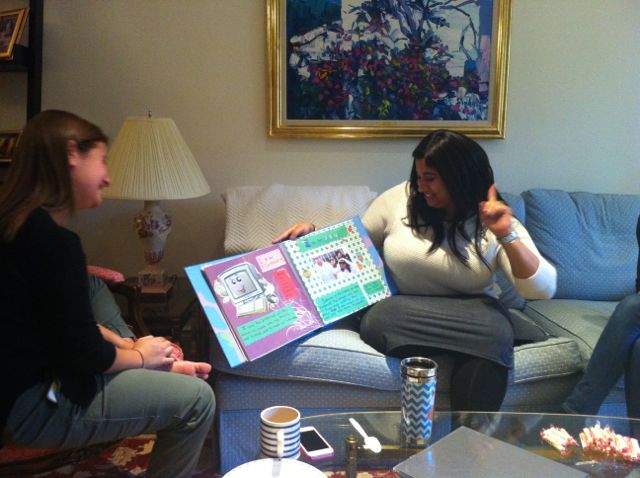
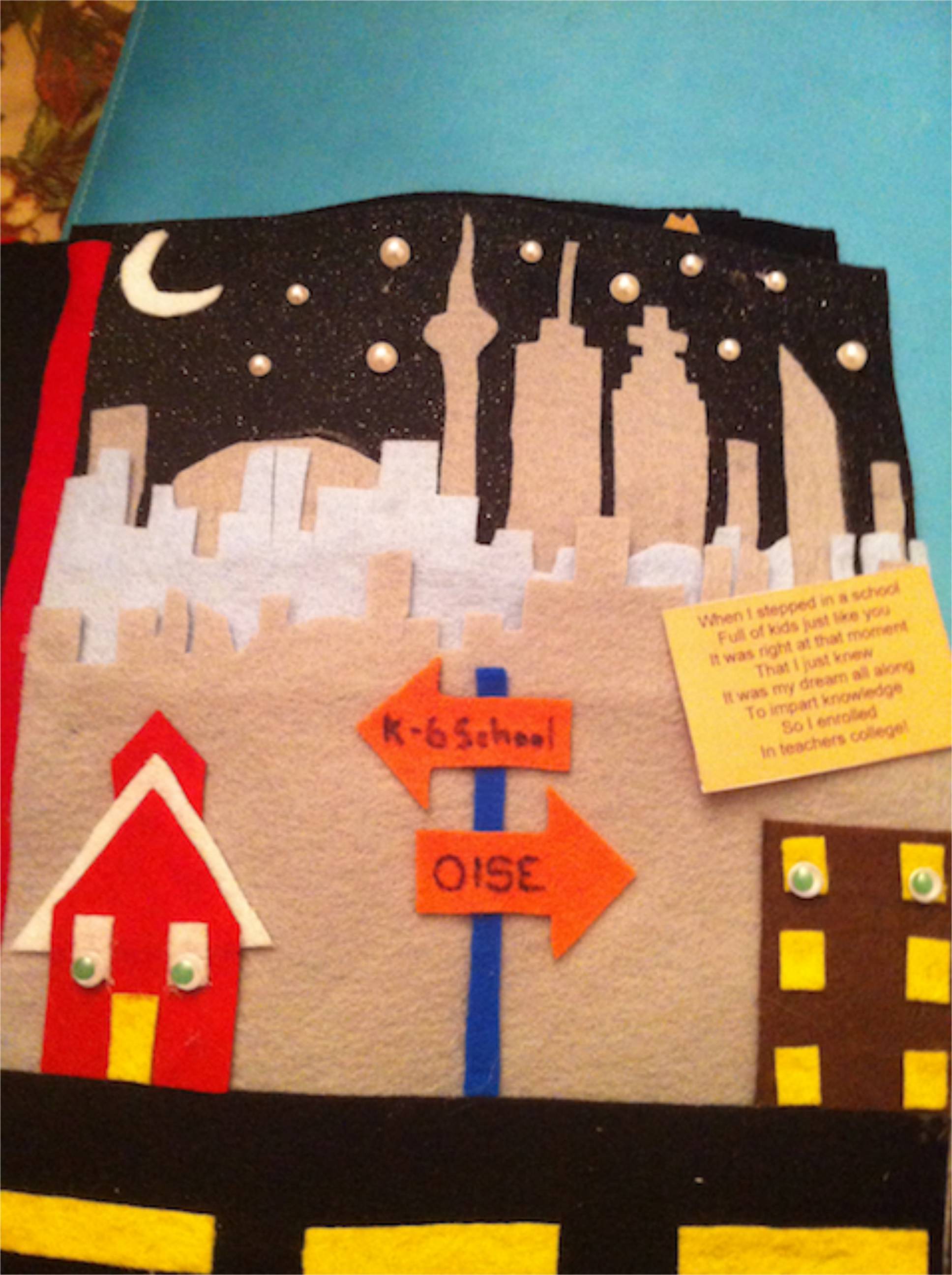
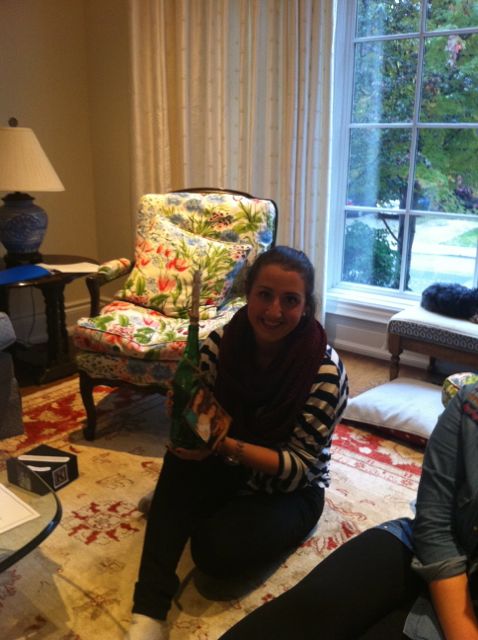
We had an amazing literacy class yesterday. We (Clare and Lydia) along with the student teachers in our P/J and J/I literacy courses shared our All About Me texts. As a class we meet weekly in a designated classroom on campus, but this week class was extra special, as Clare graciously invited us into her home to share our texts in a more personal space. The student teachers engaged a rich array of storytelling formats including – playbills, a message in a bottle, interactive ABC books, puzzles, dual language texts, a personal timeline plotted out with illustrated cityscapes, e-books, comic strips, Pokémon cards, nesting boxes housing artifacts documenting developmental milestone – to share aspects of themselves to an attentive audience of their peers. The depth of thought and creativity communicated through their texts was truly impressive and inspiring. I’m sure the children/youth they’ll be teaching in their upcoming placements will enjoy these texts as much as we all did. It was a truly enjoyable day. Thank you to all the student teachers in our literacy community!!


IMG_1357IMG_1344IMG_1349IMG_1343IMG_1348IMG_3148

Stephen King on Teaching Writing

In an interview with the Atlantic Stephen King discussed his time as a high school English teacher. As a teacher of writing King recalled, “it went best for me when I could communicate my own enthusiasm. I can remember teaching Dracula to sophomores and practically screaming, ‘Look at all the different voices in this book! Stoker’s a ventriloquist! I love that!’ I don’t have much use for teachers who “perform,” like they’re onstage, but kids respond to enthusiasm. You can’t command a kid to have fun, but you can make the classroom a place that feels safe, where interesting things happen.” The link to the article is provided below:

http://m.theatlantic.com/education/archive/2014/09/writing-secrets-with-stephen-king/379870/

‘H’ints and ‘H’appiness: Literacy learning in FDK

With the first month of school soon behind us I (Yiola) want to share some examples of my 4 year old daughter’s (Sylvia Clare) literacy learning in Full Day Kindergarten (FDK).

Example 1:  Phonemic awareness.  Sylvia Clare must be learning about the letter H.  On more than one occasion she has demonstrated her understanding of phonemes and phoneme isolation.  I said, “Sylvia Clare you must be hungry”. Sylvia Clare paused and responded, “Mommy, is hungry like Henry? huh huh huh.” I paused in surprise of her observation and connection and simply said, “Yes”.   Later in the evening I said, “Hendrix and Orion are going to visit soon” and Sylvia Clare responded, “Hendrix is like hungry and Henry, right mommy?”

Example 2:  Letter recognition.  One night earlier this week while tucking Sylvia Clare in bed I noticed she was curled in the most unusual position. I observed but said nothing. Just as I was about to pull the bed sheets up Sylvia Clare said, “Mommy, what letter do I look like?”   I respond, “hmmmm, interesting. I’m thinking you look like an I?”  Sylvia Clare laughs, “Noooooo. What letter do I look like mommy?”

She is also taking objects and forming letters. For example, while playing outside, she took two twigs and  placed them together to form the letter “V” and asked, “Does this look like a letter mommy? What letter is this?”

Example 3: Vocabulary development and comprehension.  More and more Sylvia Clare comes home with stories. Vivid stories. Curious stories.  Each day her stories grow in detail and description. The other day she explained she went on a trip to the forest in search of an oak tree. She shared,  “On the way to the forest, I held a boy’s hand [she paused and blushed]. His name is *Sam (changed) and he is in SK (senior kindergarten) so he is bigger.  I fell down on my way to the forest but I did not get hurt and the teacher gave me a bandaid. The forest close to the park mommy, you know the one we always go to.  We went into the forest just a little, not deep in the forest, only at the entrance. There we found a humungous oak tree. It had 4 trunks and they went out like this (uses her arms and points in four different directions). So it really looked like four trees stuck together. We looked at the bark”.  I asked if it was an angel oak tree. She was not sure but she continued to share news about her experience.

Example 4: Confidence.  Sylvia Clare drew a map of the world at home, wrapped it up and took it to school. I thought nothing of this as I dropped her off in the morning. Then I realized I left her lunch bag at home! I scrambled home and rushed back to the school to bring her  lunch.  By the time I returned to the school the children were engaged in outdoor play/education/inquiry.  I saw Sylvia Clare standing with one of her teachers, her map open and making reference to it. The teacher saw me and smiled, “Sylvia Clare is reading her map and we are now trying to find the treasure”.  How wonderful to see play and literacy in harmony. A reader is a person who reads. Sylvia Clare was demonstrating she is a reader. Then, at the end of the day when I went to pick her up she had another paper in hand. I asked, “What did you work on today?” and Sylvia Clare explained that she lost her map so she made another one – she developed a graphic organizer, a way to read, understand and appreciate the world. My thoughts:  thank you teachers, for providing the time and space for Sylvia Clare to engage in what interests her and thank you for appreciating those interests.

On her own, without probe, Sylvia Clare is offering hints of literacy teaching and learning.  With sly enthusiasm she is sharing her learning with me, in subtle, whimsical ways. She is sharing her achievements and understandings and I can tell she is proud that she is learning new things.  What excites me is that her learning is evident; in her sharing, practice and happiness. It is not coming home by way of worksheets or alphabet books.  I look forward to seeing and sharing what the upcoming months hold.


Power of Reading

I (Clare) am getting ready to start teaching my literacy methods courses. I came across these great quotes on the power of reading. I will use them in my first class as a way to “kick start” the discussion of the importance of reading. I especially like Frank Serafini’s quote –  “There is no such thing as a child who hates to read; there are only children who have not found the right book.” As a child I did not learn to ready easily or at an early age. I can totally relate to Serafini’s position. Once I found books on topics I like, I have not stopped reading. If you want the link to these quotes here it is: http://bilingualmonkeys.com/43-great-quotes-on-the-power-and-importance-of-reading/

children reading1. A book is a gift you can open again and again. —Garrison Keillor
2. Literacy is a bridge from misery to hope. —Kofi Annan
3. Once you learn to read, you will be forever free. —Frederick Douglass
4. Any book that helps a child to form a habit of reading, to make reading one of his needs, is good for him. —Maya Angelou
5. There is no such thing as a child who hates to read; there are only children who have not found the right book. —Frank Serafini
6. Children are made readers on the laps of their parents. —Emilie Buchwald
7. One of the greatest gifts adults can give—to their offspring and to their society—is to read to children. —Carl Sagan
8. You may have tangible wealth untold; caskets of jewels and coffers of gold. Richer than I you can never be. I had a mother who read to me. —Strickland Gillian
9. Reading should not be presented to children as a chore or Library book shelvesduty. It should be offered to them as a precious gift. —Kate DiCamillo
10. Whenever you read a good book, somewhere in the world a door opens to allow in more light. —Vera Nazarian
11. Outside of a dog, a book is a man’s best friend. Inside of a dog, it’s too dark to read. —Groucho Marx
12. There is no substitute for books in the life of a child. —May Ellen Chase
13. To learn to read is to light a fire; every syllable that is spelled out is a spark. —Victor Hugo
14. It is not enough to simply teach children to read; we have to give them something worth reading. Something that will stretch their imaginations—something that will help them make sense of their own lives and encourage them to reach out toward people whose lives are quite different from their own. —Katherine Patterson
15. When you learn to read you will be born again…and you will never be quite so alone again. —Rumer Godden
16. We read to know we are not alone. —C.S. Lewis
17. So it is with children who learn to read fluently and well: They begin to take flight into whole new worlds as effortlessly as young birds take to the sky. —William James
18. There are many little ways to enlarge your child’s world. Love of books is the best of all. —Jacqueline Kennedy
19. The greatest gift is a passion for reading. —Elizabeth Hardwick
20. There are perhaps no days of our childhood we lived so fully as those we spent with a favorite book. —Marcel Proust
9d21d-thekeepingquilt21. Fairy tales in childhood are stepping stones throughout life, leading the way through trouble and trial. The value of fairy tales lies not in a brief literary escape from reality, but in the gift of hope that goodness truly is more powerful than evil and that even the darkest reality can lead to a Happily Ever After. Do not take that gift of hope lightly. It has the power to conquer despair in the midst of sorrow, to light the darkness in the valleys of life, to whisper “One more time” in the face of failure. Hope is what gives life to dreams, making the fairy tale the reality. —L.R. Knost
22. Read, read, read. —William Faulkner
23. Read. Everything you can get your hands on. Read until words become your friends. Then when you need to find one, they will jump into your mind, waving their hands for you to pick them. And you can select whichever you like, just like a captain choosing a stickball team. —Karen Witemeyer
24. Books are a uniquely portable magic. —Stephen King
25. Books are lighthouses erected in the great sea of time. —E.P. Whipple
26. A lot of people ask me if I were shipwrecked and could only have one book, what would it be? I always say, “How to Build a Boat.” —Stephen Wright
27. Reading is to the mind what exercise is to the body. —Richard Steele
28. There is a wonder in reading Braille that the sighted will never know: to touch words and have them touch you back. —Jim Fiebig
29. A book is made from a tree. It is an assemblage of flat, flexible parts (still called “leaves”) imprinted with dark pigmented squiggles. One glance at it and you hear the voice of another person, perhaps someone dead for thousands of years. Across the millennia, the author is speaking, clearly and silently, inside your head, directly to you. Writing is perhaps the greatest of human inventions, binding together people, citizens of distant epochs, who never knew one another. Books break the shackles of time—proof that humans can work magic. —Carl Sagan
30. A house without books is like a room without windows. —Heinrich Mannwonder
31. A parent or a teacher has only his lifetime; a good book can teach forever. —Louis L’Amour
32. Reading is important, because if you can read, you can learn anything about everything and everything about anything. —Tomie dePaola
33. It is books that are the key to the wide world; if you can’t do anything else, read all that you can. —Jane Hamilton
34. I would be most content if my children grew up to be the kind of people who think decorating consists mostly of building enough bookshelves. —Anna Quindlen
35. A person who won’t read has no advantage over one who can’t read. —Mark Twain
36. Comics are a gateway drug to literacy. —Art Spiegelman
37. He that loves reading has everything within his reach. —William Godwin
38. Let us read and let us dance—two amusements that will never do any harm to the world. —Voltaire
39. Wear the old coat and buy the new book. —Austin Phelps
40. I will defend the importance of bedtime stories to my last gasp. —JK Rowling
41. Just the knowledge that a good book is awaiting one at the end of a long day makes that day happier. —Kathleen Norris
42. It is not true that we have only one life to live; if we can read, we can live as many more lives and as many kinds of lives as we wish. —S.I. Hayakawa
43. I have always imagined that paradise will be a kind of library. —Jorge Luis Borges

Creativity and the Curriculum

I (yiola) will admit that as a classroom teacher  – while I thought I was a good teacher of student  learning – I lacked creativity both in content and pedagogy. Recently, I came across this link:

30 Dad Jokes That Are So Bad, They’re Great

and now, as a more experienced (teacher) educator and reflective practitioner  what came to mind was, “wow… so many interesting ways to use this link and these beautiful images with the mandated Ontario curriculum”. For example, any grade and topic in the Social Studies curriculum could be applied: Grade 2: Communities Around the World; Grade 3: Living and Working in Ontario (a perfect opportunity to explore the various regions and compare and contrast their beauty); Grade 4: Physical Regions in Canada (exploring photography to “unearth” physical landscapes); Grade 6: Canada’s interactions with the Global Community (moving beyond the political and economic).  Social studies can be seamlessly linked to literacy and the more I explore multiliteracies the more inspired  I am to employ the visual and the aesthetic to develop meaning and understanding… and communication.  Imagine the Visual Arts lessons and opportunities front these images — ‘Hello group of 7″ — and colour, and perspective, and line and emotion.  And to grasp onto the beauty of what may be unfamiliar to students living in urban centres or familiar to those living in more remote regions to discuss lifestyles and Healthy Living from the Health and Physical Education curriculum.

Which ever way children chose to inquire,  creative opportunities and aesthetic resources may offer new and exciting opportunities for seeing the world and themselves.  This concept for teaching is more inspiring than how I recall teaching and learning (i.e. comparison worksheets of city life vs. rural life).

PS — I thought of my good friend Clive Beck as I enjoyed these beautiful images! I hope you enjoy them too.


Reading Choices

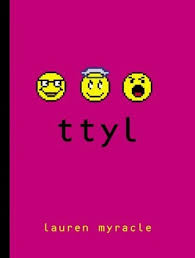
In general terms, my (Lydia) dissertation research examines the ways in which student teachers construct conceptions of literacy and enact literacy pedagogy when they view themselves as in conversation with a broader field of literacy (e.g. Multiple Literacies, New Literacy Studies). One aspect of this research considers how student teachers’ personal literacy practices inform their approach to literacy pedagogy. In some cases student teachers’ personal reading practices have been influenced by the interests and reading choices of the pupils they teach. These student teachers have often engaged with texts recommended by their pupils (e.g. graphic novels, young adult literature), and these shared texts become a space within which teacher and pupil connect. One of the student teachers participating in this research discussed the text ttyl written by Lauren Myracle, who has been referred to as a modern day Judy Blume. This young adult novel, which is part of a series, is written entirely in instant messages. Interesting, this best selling novel has been on the annual list of the “Most Challenged Books” released by the American Library Association. In other words, people have requested that this book be ban from libraries and schools “due to sexually explicit material and offensive language.” I plan to share this text with the student teachers in our literacy courses this year. I think it could contribute to an interesting conversation about text structure, style, controversies, and pupils’ diverse reading interests.

ttyl

What Influences How Teachers Teach?

Monica McGlynn-StewartAs a former elementary teacher, I (Monica) know that there are many things that influence how teachers teach in their classrooms. In our longitudinal study of teachers, Teacher change: patterns, factors, and implications for professional education, we have been learning from teachers about the kinds of formal and informal professional development that they find most relevant and helpful. One of the factors that intrigued me early on in the study was the influence that the teachers’ own early schooling had on their teaching. I interviewed 6 of our participants over the first three years of their teaching and discovered that they all use one or two teachers from their own childhood as role models for their teaching. My research has just been published in Language and Literacy: A Canadian e-Journal. Here’s the link: http://ejournals.library.ualberta.ca/index.php/langandlit/article/view/20426/16419
The Canadian Society for the Study of Education

conference

This week The Canadian Society for  the Study of Education (CSSE) is being held in St. Catharines, Ontario at Brock University.

The team, Clare, Clive, Lydia, Cathy, Pooja, and me (Yiola) will be sharing a number of presentations over the course of the week. Some of these presentations include the following titles:

Teachers’ Professional Identity Development Over Their First 8 Years, With Implications for Preservice and Inservice Teacher Education

Teachers’ Ongoing Learning over Their First 8 Years, with Implications for In-Service Professional Education

Exploring literacy teacher educators’ negotiations of a critical stance in pre-service teacher education

Teachers’ critical literacy practices in the early years classroom

Instructional Practices of Critical Literacy within an Inquiry-Based Learning Environment

Presenting at conferences is a great way to share research with the community.  For more information about the CSSE conference click here:  

Conference


A Mighty Girl

mightygirl

My twin niece and nephew are 4 years old. They both have loved books for as long as I can remember. They are currently learning how to string together sounds from the alphabet. As a super-involved aunt and literacy teacher, I try to expose them to a wide variety of texts. I want them to be exposed to texts which promote inclusivity, challenge stereotypes, and inspire creativity. For this reason I was delighted to find out about the Mighty Girl website.

“A Mighty Girl is the world’s largest collection of books, toys, and movies for parents, teachers, and others dedicated to raising smart, confident, and courageous girls.”

The Mighty Girl collection of books aims to disrupt the status quo of how girls are represented in fairytales. The collection of books strives to break the ‘damsel in distress’ mold, and so feature girls in alternative fairytales who are courageous, smart, and daring! I know I’ll be picking up a few of these books to read with my four-year-old niece and nephew! Some of the book titles include:

  • Not All Princesses Dress in Pink (Yolen & Stemple, 2010)
  • Dangerously Ever After (Slater, 2012)
  • Thunder Rose (Nolen, 2007)
  • The Seven Chinese Sisters (Tucker, 2003)

A full list of fairy/folktales on the Might Girl site:

http://www.amightygirl.com/books/fiction/fairy-tales-folktales