Category Archives: literacy

Conversational Competence

“Is there any 21st-century skill more important than being able to sustain confident, coherent conversation?”conversation

 As I watched my class struggle, I came to realize that conversational competence might be the single-most overlooked skill we fail to teach students. Kids spend hours each day engaging with ideas and one another through screens—but rarely do they have an opportunity to truly hone their interpersonal communication skills. Admittedly, teenage awkwardness and nerves play a role in difficult conversations. But students’ reliance on screens for communication is detracting—and distracting—from their engagement in real-time talk. (Paul Barnwell, 2014)

The author of this article, teacher Paul Barnwell, worries that without solid conversational skills our students won’t be able to manage important life conversations (e.g., job interviews, discssions with employers about salary negotiations, conversations with their partners, etc.) in their future which rely on them thinking on their feet (without access to Google!).

 MIT professor, Sherry Turkle, spends her time researching people’s relationship with technology. She wrote in the New York Times about the impact of tech-overload: “Face-to-face conversation unfolds slowly. It teaches patience. When we communicate on our digital devices, we learn different habits … we start to expect faster answers. To get these, we ask one another simpler questions. We dumb down our communications, even on the most important matters.”

I couldn’t agree more with Barnwell and Turkle. Teaching our students how communicate to solve problems, deal with emotions, and build meaningful relationships through conversations  is an essential skill which may need to be explicitly taught.

Read the entire article from The Atlantic below:

http://www.theatlantic.com/education/archive/2014/04/my-students-dont-know-how-to-have-a-conversation/360993/

Our New Book! Growing as a Teacher: Goals and Pathways of Ongoing Teacher Learning

Growing as a Teacher book cover

Clare and I (Clive) are glad to announce the release of our new book Growing as a Teacher, published by Sense. https://www.sensepublishers.com/catalogs/bookseries/professional-learning-1/growing-as-a-teacher/

It’s based on the first 8 years of our longitudinal study of 42 teachers, teaching mainly in Ontario but also New York and New Jersey.
Our central finding was that teachers learn a great deal informally, especially through classroom experience. This is in line with Donald Schon’s (1983) notion of “reflection in practice”: teachers learn through “experimental research, then and there, in the classroom” (p. 66). Similarly, Chris Day (1999) speaks of “the largely private, unaided learning from experience through which most teachers learn to survive, become competent, and develop” (p. 2).
Over their first 8 years, our teachers learned about: program planning, assessment, individualization, teaching for relevance, classroom organization, community building, work-life balance, and many other topics. In varying degrees, they developed a comprehensive, integrated vision of effective teaching, going well beyond their initial understanding.
In the book we discuss key implications of these findings:

  • Teachers should see themselves as major “experts” on teaching, with abundant opportunities to inquire into teaching over the years. They should be willing to make decisions in the classroom and take a firm stance in adapting system initiatives.
  • ITE instructors should promote this strong conception of teacher learning and expertise, and see themselves largely as “laying a foundation…preparing novices to learn in and from their practice” (Feiman-Nemser, 2001, p. 1016).
  • PD facilitators should dialogue with teachers and build on their emerging vision and approach, rather than imposing system mandates in top-down fashion.
  • Principals should support teachers in their learning, providing frequent opportunities for them to watch each other teach and share their developing insights.

Teachers can benefit greatly from external input, but not if it’s imposed “top-down” without reference to their views and experiences.
We have greatly enjoyed listening to the teachers in our study and will continue to do so into the future. We hope their voices and experiences will be helpful to teachers, teacher candidates, ITE instructors, and all those responsible for school policies and ongoing teacher learning.


The Power of Children’s Literature and its Omissions

While I (Yiola) knew there was a lack of representation of  “people of colour” in children’s literature, I was surprised to read the statistics. The chart below shows the number of books published last year and the number written ‘by’ and ‘about’ the different groups defined as ‘people of colour’.


Year

Total Number
of Books
Published (Est.)

Number of Books
Received
at CCBC


African / 
African Americans


American Indians

Asian Pacifics/
Asian Pacific Americans


Latinos


By

About

By

About

By

About

By

About

2013

5,000

3,200

67

93

18

34

90

69

48

57

Two fantastic articles in the New York Times last week prompted me to write this blog:

http://www.nytimes.com/2014/03/16/opinion/sunday/the-apartheid-of-childrens-literature.html?ref=contributors&_r=0

http://www.nytimes.com/2014/03/16/opinion/sunday/where-are-the-people-of-color-in-childrens-books.html?ref=contributors&_r=0

The articles share the stark realities and implications of the statistics represented above from the experiences of African American men, writers themselves. Reading the articles echo and confirm what I believe to be the realities and consequences of our publishing marketplace.  And yet, what to do about it?

The other day I was speaking to a high school educator (a behavior specialist, child and youth worker) who shared stories with me about boys in her school who are misbehaving, who are rude and disrespectful.  I shared with her the ideas that their behaviours must stem from something much bigger than an attitude problem… that they may feel oppressed, misrepresented or not represented at all by the school and broader society.  I do not think she was buying my argument.

My role as a teacher educator is to inform future teachers of the realities of teaching, learning and schooling.  Part of that role includes understanding how systems work for and against particular groups and individual students. One concrete area for exploring such systems is children’s literature.

Christoper Myers, author of “The apartheid of children’s literature”, describes books as maps to identity and ways of being:

[Children] see books less as mirrors and more as maps. They are indeed searching for their place in the world, but they are also deciding where they want to go. They create, through the stories they’re given, an atlas of their world, of their relationships to others, of their possible destinations.

The consequences of excluding certain groups:

what it means is that when kids today face the realities of our world, our global economies, our integrations and overlappings, they all do so without a proper map. They are navigating the streets and avenues of their lives with an inadequate, outdated chart, and we wonder why they feel lost.

Alternatively, Walter Dean Myers, author of the second article, explains what happened to him when he connected to a text: 

Then I read a story by James Baldwin: “Sonny’s Blues.” I didn’t love the story, but I was lifted by it, for it took place in Harlem, and it was a story concerned with black people like those I knew. By humanizing the people who were like me, Baldwin’s story also humanized me. The story gave me a permission that I didn’t know I needed, the permission to write about my own landscape, my own map.

And so, how do we as teacher educators empower teachers so they empower students to realize the flawed systems we live in but and to move beyond them to ensure each child can navigate and negotiate their personalized, broad, rich landscape of possibilities?  I suggest: we ourselves develop a critical stance and what Noddings calls a culture of care; we are explicit about the realities of the systems we currently work in; and we work hard to search out texts and materials that share rich stories of all of our students and beyond.  More so, I suggest we move to change the marketplace by publishing texts that begin to close the gaps in representation in children’s literature.

Grade Two Flash Mob

I (Cathy) love Flash Mobs.  Someday, I hope to be lucky enough to be in the right place at the right time to witness one. Members of a symphony orchestra  in Sabadell, Spain clearly excel at creating them.  There are many clips to be found on Youtube by this group, but my favorite is the one set up for a grade two classroom.  In the link below, the classroom flash mob is embedded with several others.  Just keep watching.  I love the look on the children’s faces; their reactions as they get lost in the music; and, their ability to conduct!  Ah, the joy of it.  I wonder how many of these children will dabble in music after this experience. 

http://www.youtube.com/watch?v=y0-2d__wi7k

Experimenting with Collaborative Discussion Strategies

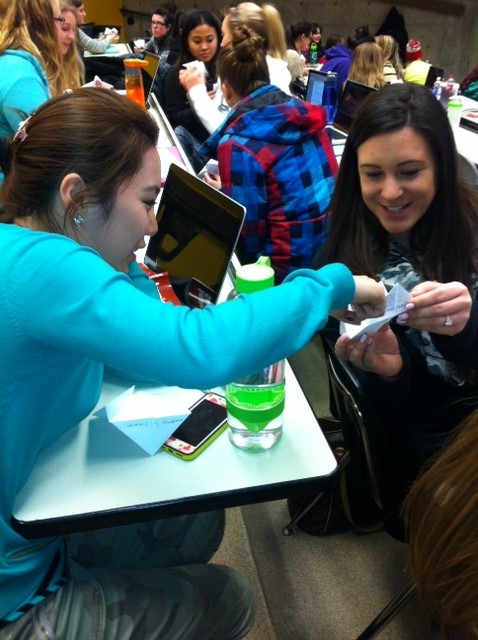
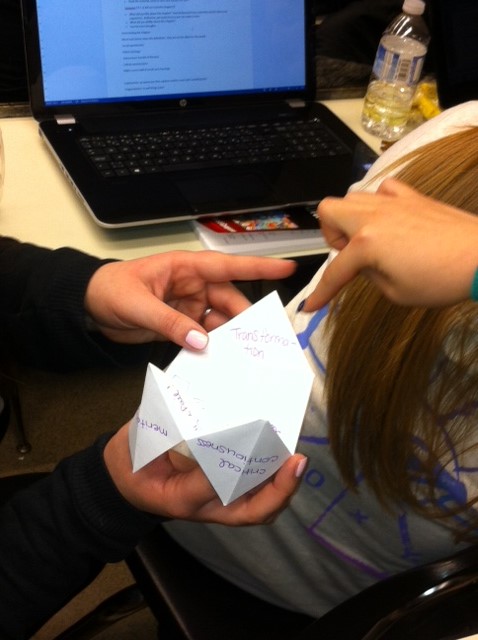
The class I (Cathy) teach for the Bachelor of Early Childhood Education program is from 7-10 in the evening.  I feel for my students as this is a demanding time to be learning something new.  To make matters worse, many of the students arrive rather fatigued having just left another class that is strictly lecture format.  I need to wake them up and get them thinking again.  So, capitalizing on my belief in a dialogical approach, for part of each class I implement a different collaborative discussion strategy (e.g. gallery walk, expert groups, four corners, placemat).  Our last class, however, was rather unique.  I was looking for a way to explore chapter summary and discussion.  Plus, I wanted to incorporate our ongoing work on metaphors in education.  Suddenly, the strangest memory came to mind… cootie catchers.   I wasn’t even sure that was the name until I found it online.  Traditionally, this is Japanese origami work, known in the paper folding world as the ‘Fortune Teller’.  How, I wondered, could I use this to motivate discussion and review?  After some tinkering with my objectives, I had the students place new/significant vocabulary from the chapter on the outside, which the origami maker had to define and spell to move the sections around.  Images representing significant ideas and concepts were drawn on the inside, which the player had to identify from the chapter.  Guesses were confirmed in writing which were under the hidden flap.  Guess what?  They loved it and played it many times with many partners, hence reviewing key concepts in the chapter with several people.  Then we discussed what happened.  Some said now they will never forget their selected words/phrases (e.g. critical consciousness, diaspora, social reproduction and juxtaposition).  They were a challenge to spell, too!  Others said the images were hard but made them think carefully about the chapter content. The most challenging images I drew on the board at the front of the lecture hall and collectively we tried to guess what they represented.  Sometimes we had to get clues from the image maker and we cheered or groaned when we finally got it.  At the conclusion of the class we left rather refreshed and interestingly, nostalgic.  Every student, no matter what the cultural background or gender, reminisced about playing this game as a child.  This was as diverse a literacy event as I have ever encountered and I don’t think I have ever enjoyed a collaborative review more.  Below is the website I used to remind the students how to create the origami form.  yes ori oop

http://www.origamiway.com/how-to-make-a-paper-fortuneteller.shtml

Family Literacy Day

Today is Family Literacy Day in Canada. http://abclifeliteracy.ca/fld/family-literacy-day
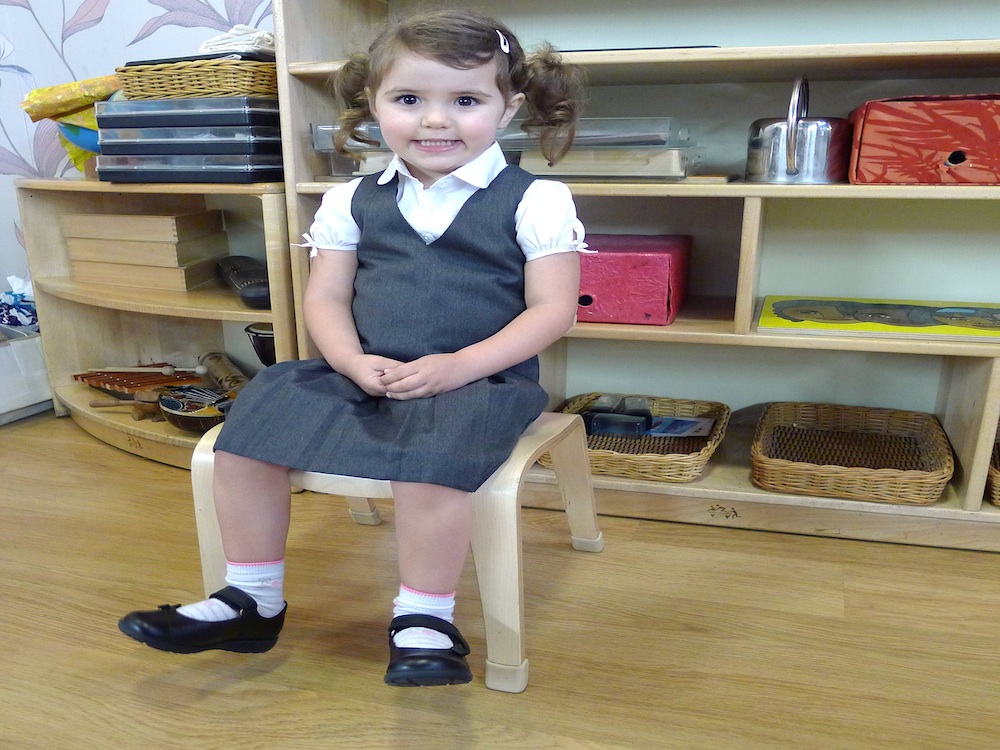
It is a day that recognizes the importance of families building literacy skills together.  Looking back, what did family literacy look like in your household? In what capacity did Young girl in schoolliteracy development occur? In my home I (Yiola) taught my parents the language of English and my parents taught me the value of English.
I find Family Literacy Day to be a very well intentioned initiative.  The ideas presented in the link on family literacy are interesting.  As a Teacher Educator who teaches from a critical perspective I cannot help but ask, how can the concept of family literacy be made accessible for all families? How do we make the concept more inclusive?  When thinking about ‘Daily Literacy Activities’ I wonder, what can we add to the list found on the website?
See: http://abclifeliteracy.ca/files/Daily_literacy_activities.pdf
I plan to share this list with my student teachers and ask them for additional activities to include that may draw in a variety of families.  I’m thinking of multilingual processes, digital opportunities, oral traditions.
Happy Family Literacy Day!
Yiola

Critical Literacy vs Language Acquisition

Critical literacy and Language acquisition.  I (Yiola) have pondered these two concepts — what they mean, what they entail, and why they are important.  In much of the literature I have read, there appears to be distinct 2 camps:  those who study language acquisition that is, how we learn to read and write: how we develop phonemic awareness, and learn to decode, and develop syntax and those who study critical literacy: a newer approach to learning how to analyze and understand texts in a socially conscious way.  I have asked myself, are they in two distinct domains of Language discourse? They appear to be. Do you agree?  Yet, when I think about teaching literacy to children in the context of schooling and what readers and communicators need to know, then critical literacy is a form of language acquisition. Children must know how to read and analyze texts, and they must know how to read and analyze the world. Children acquire language through critical literacy. Critical literacy is then a significant part of language acquisition. In teacher education literacy courses, is the concept of critical literacy taught with the same importance and priority as the more traditional methods and means for language acquisition? Ultimately I’m wondering, what are the essential components of literacy curriculum for 21st century teacher education programs?

Classroom Teachers and Critical Literacy

Yiola CleovoulouI am fascinated with classroom teachers’ pedagogy. In particular, how elementary school teachers teach critical literacy to young children.  How teachers plan, what materials they choose and the discussions they facilitate in the classroom were some of the areas I asked classroom teachers in relation to their efforts to build critically literate students. My research team spent half of the  school year observing classroom teachers` daily practices with a special focus on  critical literacy. We also interviewed the teachers to gain an understanding of their thinking about their practice. One interesting finding is the close connection between content (often driven by narrative texts) and pedagogy. That is, teachers (in the early primary grades) focused heavily on narrative texts to relay information about critical social issues and designed learning opportunities (discussions, extensions) based on the texts. This process resulted in children sharing their own stories and understandings of the critical social issues (i.e. identity and exclusion,  inequitable distribution of resources, class).  Understanding teachers` classroom practices is connected to phase two of our study on literacy teacher educators.  I want to know how the two sets of pedagogical practices connect: how does the pedagogy of literacy teacher educators who have a critical stance transfer to classroom teachers’ practices?

By: Yiola Cleovoulou