Category Archives: literacy

Self-portraits and sparkling feet: Communication & representation in the early years

It seems my (yiola’s) blog posts run parallel to the foci in my life. This makes good sense as it seems the blog genre, whether an MAB or personal, pulls from the writer their interests, latest happenings and experiences. This past month I have had the privilege of  spending a great deal of time with my two young children; hence the sharing of teaching and learning and literacy in the early years in many of my posts.

My four year old has been busy communicating, sharing and representing. Through her drawings she expresses her feelings and is able to share stories and ideas.

In March she drew and spoke about our family:

family

Her most recent self portrait:

selfportait

Note the addition of the ears and arms that are now present in every drawing she creates.

For me, these developments are huge; for ECE researchers and educators these drawings are nothing new:

http://www.learningdesign.com/Portfolio/DrawDev/kiddrawing.html

And yet, I still marvel at my child’s ability to communicate and represent in such meaningful ways.  My daughter expressed the other day  “momma, my feet are sparkling”… I did not bother to explain that wasn’t the case, that instead, her “feet fell asleep” because really, is one expression more accurate than the other?

An interesting and short description of stages of art development:  http://www.artjunction.org/young_in_art.pdf

What caught my attention from the article was the statement below:

Of course, what children seem to do naturally and what they are capable of doing are entirely different matters. It is likely that teachers will find that students within their classrooms are at varied points in their graphic development since some have had abundant prior experiences with art, whereas others, may have had limited creative opportunities. Thus, teachers should avoid the temptation to place children at a particular stage simply because of their age or grade level.

… and how true this is of exposure to all subject/school related matter.

As I read about child development and literacy I appreciate  the stages of development. As a teacher (and now parent) I have seen the stages unfold; however, as I read and observe the effects of providing opportunities for creative development and the use of multi literacies with young children I am more excited about the possibilities for language and literacy development  in areas such as: creative thinking, communication, problem solving and representation.

In keeping with ‘you teach who you are’, I cannot help but think about these areas of interest for my work.  As I prepare my courses for the coming year I am searching for readings and experiences for student teachers that will encourage discussion about creative thinking/problem solving and the implementation of various kinds of opportunities for pupil’s acquiring literacy both in and out of classrooms.

 

Can you find your cat?

An article from the Toronto Star caught my attention it features the website I Know Where Your Cat Lives. Owen Mundy, an associate professor in digital media art at Florida State University, developed the website in an effort to highlight potential privacy concerns related to the use of public websites. Mundy collected one million cat photos with geographic data embedded from public photo sharing sites (e.g. Instagram, Flickr) and placed the photos on a world map. The motivation behind the project came about when Mundy realized that photos of his young daughter had been posted online with embedded geographic co-ordinates pinpointing the location of his backyard. He then thought “What’s the closest thing people have to them that they photograph that’s like a child, but not as scary as mapping someone’s child? That’s a cat.” Mundy’s web project is meant to illustrate the substantial amount of personal data individuals share, often unwittingly, when they post photos on social media sites.

Link to Toronto Star Article:

m.thestar.com/#/article/life/2014/08/01/how_curiosity_killed_your_cats_privacy.html

A Book on Critical Literacy and Teacher Education

I (Pooja) am currently re-reading Negotiating critical literacies with teachers: Theoretical foundations and pedagogical resources for pre-service and in-service contexts (Vasquez, V.M., Tate, S.L, & Harste, J.C., 2013). This book suggests a theoretical framework, provides insightful examples, and offers pedagogical resources when incorporating critical literacy practices into pre-service and in-service teacher education.

I share some moments in the book which really stood out for me during my second reading:

1. Vasquez et al. suggest this book fills a gap in the literature about critical literacy and teacher education. Specifically,

 This book speaks to what Dozier et al. (2006) observe as a profession that has not publicly articulated the nature of the alignment between our expectations for our [teacher educators’] own literate lives and our expectations for our students as literacy learners.

 2. As I was more closely re-reading the final chapter of this text, a section on “Dealing with Accountability and Standards” really stood out for me. This section dealt what our critical literacy participants in our SSHRC study have expressed to be a tension in their work. Vasquez et al. (2013) take the following stance on dealing with accountability and standards as teacher educators,

A question that often arises for us is how to get beyond the hurdles of incorporating a critical stance when we live in a world of accountability and standards….we have found that these difficulties become easier with teachers who have a concrete philosophy about their pedagogy and can demonstrate how this type of pedagogy has changed their own academic and personal lives as well as that of their students.

3. They go on to provide insights into how best practice critical literacy in teacher education,

We have also found that you cannot do this work alone. Having other to think with and reflect with, even if they are not in your workplace makes all the difference in whether you continue to create more and more spaces for critical literacy in your setting or whether you throw in the towel.

Creativity and the Curriculum

I (yiola) will admit that as a classroom teacher  – while I thought I was a good teacher of student  learning – I lacked creativity both in content and pedagogy. Recently, I came across this link:

30 Dad Jokes That Are So Bad, They’re Great

and now, as a more experienced (teacher) educator and reflective practitioner  what came to mind was, “wow… so many interesting ways to use this link and these beautiful images with the mandated Ontario curriculum”. For example, any grade and topic in the Social Studies curriculum could be applied: Grade 2: Communities Around the World; Grade 3: Living and Working in Ontario (a perfect opportunity to explore the various regions and compare and contrast their beauty); Grade 4: Physical Regions in Canada (exploring photography to “unearth” physical landscapes); Grade 6: Canada’s interactions with the Global Community (moving beyond the political and economic).  Social studies can be seamlessly linked to literacy and the more I explore multiliteracies the more inspired  I am to employ the visual and the aesthetic to develop meaning and understanding… and communication.  Imagine the Visual Arts lessons and opportunities front these images — ‘Hello group of 7″ — and colour, and perspective, and line and emotion.  And to grasp onto the beauty of what may be unfamiliar to students living in urban centres or familiar to those living in more remote regions to discuss lifestyles and Healthy Living from the Health and Physical Education curriculum.

Which ever way children chose to inquire,  creative opportunities and aesthetic resources may offer new and exciting opportunities for seeing the world and themselves.  This concept for teaching is more inspiring than how I recall teaching and learning (i.e. comparison worksheets of city life vs. rural life).

PS — I thought of my good friend Clive Beck as I enjoyed these beautiful images! I hope you enjoy them too.


Reading Choices

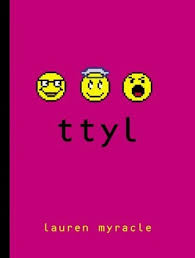
In general terms, my (Lydia) dissertation research examines the ways in which student teachers construct conceptions of literacy and enact literacy pedagogy when they view themselves as in conversation with a broader field of literacy (e.g. Multiple Literacies, New Literacy Studies). One aspect of this research considers how student teachers’ personal literacy practices inform their approach to literacy pedagogy. In some cases student teachers’ personal reading practices have been influenced by the interests and reading choices of the pupils they teach. These student teachers have often engaged with texts recommended by their pupils (e.g. graphic novels, young adult literature), and these shared texts become a space within which teacher and pupil connect. One of the student teachers participating in this research discussed the text ttyl written by Lauren Myracle, who has been referred to as a modern day Judy Blume. This young adult novel, which is part of a series, is written entirely in instant messages. Interesting, this best selling novel has been on the annual list of the “Most Challenged Books” released by the American Library Association. In other words, people have requested that this book be ban from libraries and schools “due to sexually explicit material and offensive language.” I plan to share this text with the student teachers in our literacy courses this year. I think it could contribute to an interesting conversation about text structure, style, controversies, and pupils’ diverse reading interests.

ttyl

Teachers’ Contribution to Educational Inquiry

This past week I (Clive) had intense discussions with students in my Foundations of Curriculum graduate course; the topic was educational research and classroom-based teacher learning. Several were reluctant to accept that teachers are “researchers” and “knowledge generators” in an important sense.

I argued that teachers are in an excellent position to conduct inquiry because they are immersed in the classroom for ten full months, year after year: rarely do academics have such a rich context for educational research. They argued that teachers’ research methodology is not rigorous enough to produce genuine knowledge.

Thinking it over, I’ve decided to offer a compromise. I agree that education academics often have much to contribute because they are aware of other disciplines and other real-world contexts. Although they rarely have the same depth of educational experience as teachers, they often have greater breadth of knowledge in certain areas.

However, I will offer this compromise with three provisos:

(i)    Teachers’ inquiry is just as rigorous as that of academics, since they observe so carefully the processes and outcomes of their teaching: they have a vested interest in doing so.

(ii)  Teachers and academics have equal but somewhat different contributions to make to educational research.

(iii) Accordingly, the relationship between the two must be one of dialogue as equals, rather than “laying down the law” by one party or the other.

Of course, it is true that teachers could enhance their inquiry in certain ways; but the same is true of academics.

Teachers are not always conscious of what they have discovered through experience; it is often “implicit” knowledge. Hence, a major role of education academics is to study teachers and help make their insights explicit and available to others. But it is the teachers who discovered these insights and who must be given the credit.

I’ll try out this compromise on my students next week and see what they think!


How do you Know What To Blog About?

I (Clare) recently did a presentation to a group of teachers on a self-study I conducted with Connecting PeopleLydia Menna and Shawn Bullock on our efforts to integrate digital technology into my literacy methods courses. (Here is the powerpoint from that presentation. BERA + ECER-DT 2013in Dropbox) I talked about my initiatives which led to me showing how my efforts in my literacy teaching led to a greater use of digital technology in other parts of my life (e.g., using NVivo for data analysis). The success of my initiatives with my teaching gave me the confidence to take the plunge to do a website. My technical skills had improved and my identity shifted so that I now see myself as “digitally competent.” During the presentation I showed our website and one of the participants raised an interesting question: How do you get ideas for your blog? He recounted how he wanted to do a blog but did not know what to write about. I told him to just start! I believe that writing a blog is a different genre – it requires different writing skills than other forms of writing. Since we started this blog, I feel that my blog-writing skills have improved. I now focus on one topic in a blog; I am more comfortable sharing my insights; I will raise questions; I make links to other resources; and I no longer feel the blog needs to be perfect  (so what if there is a typo. We will survive.)  Blogging seems to have captured my interest and is a good match for me ( I have lots to say about education) and it is fun.  I keep a Word document with blog ideas which is always plentiful and when I come across something “interesting” one of my first thoughts is – Would that make an interesting blog? This thought is followed by – Would others be interested in this topic/issue? Doing our blog as a “team” has truly been the way to go. I have learned so much from the posts by my team (Cathy, Lydia, Pooja, Clive and our guest bloggers) about them personally and professionally. And their blogs give me ideas about what to write about.

I really see our blog as connecting with the broader education community which is social media at its best. Blogging is good for me because it gets me thinking critically and hopefully, our posts are of use to our readers.

Facing Reality: New Teachers Working in Very Politicized Contexts

Those of us in education are feeling the pressure from external bodies to improve test Deakin Logoscores while teaching a standard curriculum (developed by “some” external body). This pressure is especially acute for new teachers who are trying to sort out teaching in general while figuring out their style, their particular goals, coming to terms with their changing identity … . In this politicized era trying to balance standards with what students actually need is a challenge for the most experienced and able teachers. I (Clare) read a fabulous article Professional knowledge and standards-based reforms: Learning from the experiences of early career teachers by Andrea Allard and Brenton Doecke. It is in English Teaching: Practice and Critique May, 2014, Volume 13, Number 1 pp. 39-54

http://education.waikato.ac.nz/research/files/etpc/files/2014v13n1art3.pdf

For those of use involved in teacher education this article gives voice to new teachers who find themselves in teaching situations that are a mismatch between the practices advocated in teacher education and the culture in their schools. It shows how these teachers try to negotiate the demands and come to terms with practices they feel are effective. It also raises questions about what we should be doing in teacher education to prepare student teachers for what they will face as teachers.

Here is the abstract:

This article explores the paradoxical situation of early career teachers in this era of standards-based reforms, beginning with the experiences of an English teacher working in a state school in Queensland, Australia and expanding to consider the viewpoints of her colleagues. Our goal is to trace the ways she and the other early career teachers at this particular school negotiate the tensions between the current emphases on standardisation of curricula, testing regimes and teaching standards and their burgeoning sense of their identities as teachers. We shall raise questions about the status of the professional knowledge that these early career teachers bring to their work, showing examples of how this knowledge puts them at odds with standards-based reforms, including the professional standards recently introduced by the Australian Institute for Teaching and School Leadership (AITSL) and the National Assessment Program –Literacy and Numeracy (NAPLAN).

I found this quote from a new teacher, Nola, about her first few weeks at this school fascinating and distressing.

We did not do enough NAPLAN stuff [in the teacher education course] …Holy moley! –Coming into this school and it’s so NAPLAN focussed. Oh, it was like “What the heck? Yeah, I’ve heard about NAPLAN but — !” Everyone is like “NAPLAN, NAPLAN, NAPLAN” and I am just like–holy moley! I was not prepared for it. I did not know how to read the results or anything. I didn’t know what it meant. I was like “NAPLAN?” I didn’t know that NAPLAN was.”

Her distress is palpable!

Teaching as a Relational Practice

The Chronicle of Higher Education reporting on a survey of 30,000 college graduates, noted that graduates “had double the chances of being engaged in their work and were three times as likely to be thriving in their well-being if they connected with a professor on the campus who stimulated them, cared about them, and encouraged their hopes and dreams.” The article also highlighted both the sceptical responses to the survey as well as the potential value the findings could offer institutions of higher education.

See more at: http://m.chronicle.com/article/A-Caring-Professor-May-Be-Key/146409/

Teaching

Good-bye Michael Gove!

Michael Gove Although I (Clare) live in Canada I am well aware of the challenges teachers and teacher educators in England are facing. We have a number of literacy/English teacher educators in our study of teacher educators who have recounted the  challenges they are facing (e.g., funding reduction, stringent/ridiculous accountability measures). At our Symposium on teacher education in London participants recounted how demoralized teacher educators felt.

The Secretary of State for Education, Michael Gove, who was instrumental in bringing in a number of draconian measures in education has been demoted to Chief Whip. http://www.theguardian.com/commentisfree/cartoon/2014/jul/17/steve-bell-cartoon-michael-gove-first-day-chief-whip He wanted to reshape education based on his own experiences in elite private schools – or as I see it, drag education back to the 19th century. He seemed to be waging war on schools of education by creating so many alternative routes into teaching that he was stripping teacher educators of their place in preparing teachers. His inability or unwillingness to listen to reason and research led to him implementing a number of measures that are so wrong headed it is mind-boggling. He was never a teacher nor did he do research on teaching and teacher education so how did he think that he knew how to prepare teachers?  When you compare his approach to the one used in Finland (see blog post on Thursday, July 17) the contrast is glaring. Respect and trust were not his modus operandi.

On his first day of his new job as party whip he got stuck in the toilet! Hmmmmm…….. Read into that what you like!

Let’s hope that the path he set for education will be altered by his successor so that education and teacher education can get back on track and become relevant and appropriate for the 21st century. There is a growing body of research on teacher education which should guide policy. It is time for policy-makers in England to refer to it.