Category Archives: literacy

Literacy from Day 1

The New York Times reinforces the importance of reading to babies from the day they are born:

I value the point in the article – read to your babies –  but dismay set in as I read the end.  The suggestions it makes about low income families and radicalized families was unsettling, perhaps an even small analysis as to WHY the statistic are what they are would be helpful.

Low-income children are often exposed little to reading before entering formal child care settings. “We have had families who do not read to their children and where there are no books in the home,”

The undertone of the above statement does not sit well with me. While implicit, the message I read is that parents with low-income do not care to read to their children or do not know the value of doing so…  is it just me that reads the tone in this way?  It would be helpful to read about why that is: parents with low-income struggle to find the time to read to their children because they are working shift work, or 2-3 jobs to make ends meet, or have such intense stresses in their lives, or have difficulty affording books and are unable to get to libraries with ease… Is it a choice to read or not read to children? Or is the suggestion an imposition of wealthy class values? The realities of low-income versus wealthy families go beyond simple statements of what they do or not do.


Are Public Libraries a thing of the past?

As a girl, I (Cathy) used to walk to the library regularly.  It was a good two mile walk and I usually went alone because no one I knew was as passionate about books as I was.  I never minded.  I loved the library.  It was a treasure chest for me.  I find I don’t go very often any more because I can often find what I need on line.  But I still like the actual feel of a book.  Guess it’s comfort food for the eye and hand.  I wonder how many young children actually still go?  library card

What Influences How Teachers Teach?

Monica McGlynn-StewartAs a former elementary teacher, I (Monica) know that there are many things that influence how teachers teach in their classrooms. In our longitudinal study of teachers, Teacher change: patterns, factors, and implications for professional education, we have been learning from teachers about the kinds of formal and informal professional development that they find most relevant and helpful. One of the factors that intrigued me early on in the study was the influence that the teachers’ own early schooling had on their teaching. I interviewed 6 of our participants over the first three years of their teaching and discovered that they all use one or two teachers from their own childhood as role models for their teaching. My research has just been published in Language and Literacy: A Canadian e-Journal. Here’s the link: http://ejournals.library.ualberta.ca/index.php/langandlit/article/view/20426/16419

Love that Dog: A touching book and useful pedagogical resource

In both my experience teaching pre-service literacy courses and my current research with student teachers I (Lydia) have witnessed the sense of anxiety and discomfort many student teachers voice when they are faced with the prospect of teaching poetry during their practice teaching placements. Often, their associate teachers are themselves not comfortable with poetry and therefore, they have difficulty scaffolding the teaching of poetry or providing supportive resources for student teachers. This awareness has motivated Clare and I to delve into poetry within the first few weeks of the P/J and J/I literacy courses, in an effort to ease some of the initial anxiety student teachers experience in anticipation of teaching poetry. We attempt to provide multiple entry points into the teaching of poetry by presenting student teachers with various forms of poetry, and by highlighting the creative expression and emotive potential offered by this medium. We also provide them with a number of resources and pedagogical strategies they can utilize during their practice teaching placement. I recently picked up a copy of the book Love that Dog by Sharon Creech, which I hope to use in the literacy methods courses this year because the insight provided into how students might feel about reading and writing poetry is useful for both teachers and students. Throughout the book, the main character a young boy named Jack journals back and forth with his teacher Ms. Stretchberry, cleverly expressing his initial resist and eventual connection to poetry. Jack initially pronounces, “I don’t want to because boys don’t write poetry. Girls do”; however, through his ongoing dialogue with his teacher Jack experiments with word choice, sounds, and rhythm as he is engages with various poetic formats. My favorite entry in the book is “November 22.” Hopefully the student teachers in the literacy courses this year will enjoy this touching book as much as I did.lovethatdog

Because of Mr. Terupt- I was touched

I’ve been striking it lucky with my pick of children’s literature lately. Because of Mr. Terupt is a juvenile fiction novel well worth reading to a junior level class. Also perfect as a sample novel for student teachers experiencing literature circles. This touching story, by Rob Buyea, brings up many discussion points regarding what makes a good teacher, plus many other school issues: diversity, inclusion, forgiveness, and bullying just to name a few. Terrific resource for ‘hot seat’ /role playing explorations.  A must read for children’s literature fanatics like me!

Mr terupt

Challenges with Travelling Digitally

While packing for a recent trip , I (Cathy) noticed a change in my travel necessities.  Here is what was on the top of my list:

Iphone & charger  (for photographs, facebook, texting& directions)

Ipad & charger   (for Skype, games and bill payments)

Ipod & charger, earphones  (for novels and music)

Camera & charger (the Iphone only goes so far!)

Portable battery and cable (what if there is no outlet in the airport???)

As little as one and one half  years ago I never would have listed such items.  Times have changed.  As convenient as these items may be to bring, I discovered  a glitch in travelling digitally…5 devices but only one electrical adapter.  Which one needs to be charged first?  Now I have to prioritize my necessities!

digital

Reflecting on my time at the International Symposium for Digital Technology and Literacy/English Teacher Education

I (Lydia) feel fortunate to have had the opportunity to participate in the symposium last week as many of the issues raised resonated with my current research examining student teachers’ experiences with contemporary literacy teaching and learning. The issues highlighted during the individual presentations and accompanying discussions offered rich insights into the status of teacher educational internationally.

IMG_2590

I’d like to share a few of the questions raised during the symposium that remained with me and will continue to inform my research in literacy teacher education: What should a curriculum of contemporary teacher education include? In what ways can a curriculum of teacher education provide the space and quality time necessary for student teachers to truly engage as learners? How does power continue to operate in the curriculum? How do digital tools and social media spaces construct reading and writing? What do these digital spaces permit and what do they restrict? How is knowledge constructed, represented, and distributed within digital spaces? What are the pedagogical consequences as students engage with different modes within digital spaces? These are just a few of the questions I continue to consider upon my return from the symposium. Having the opportunity to consider the complexities and issues relevant to teacher education with international scholars was truly inspiring. I look forward to continuing our rich conversations.

IMG_2560

International Symposium on Literacy/English Teacher Education: A Focus on Digital Technology

With the symposium a few days behind us, I (Pooja) have had some time to reflect on what was discussed in London, England. Clare wrote a reflection post on day one of the symposium (https://literacyteaching.net/2014/06/06/symposium-day-1-reflections/), so I want to reflect a bit on day two. Day two started off with mini-presentations which asked presenters to focus on a central question: What is happening with digital technology in your context?

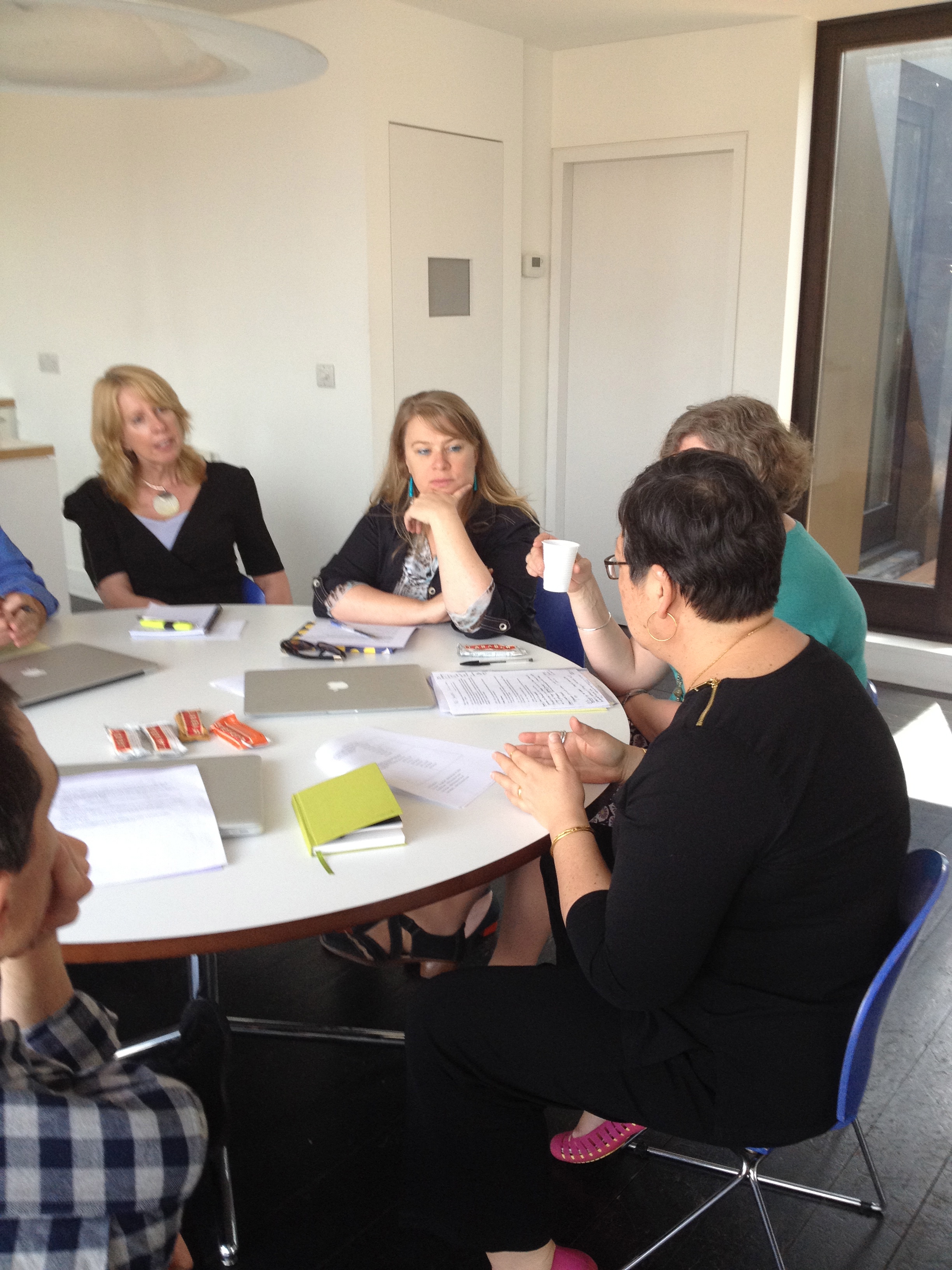
IMG_2564

Shawn Bullock, assistant professor at Simon Fraser University, raised some interesting issues related to digital technology and education:

  • Technological Determinism: A theory which asserts we need to stay current with technology to stay relevant in society; technology determines cultural values and society’s structures
  • Digital Publics: The theory that the nature of public space has changed significantly over the past years. The nature of public space has gone from persistent to replicable to searchable in the past few decades:

o   Persistent- recording (video, audio) events changed the nature of public space;

o   Replicable- recordings became replicable;

o   Searchable- today we can search for any recording

(danah boyd)

Understanding how the nature of public space has drastically changed over the years, Shawn posed an important question to the group: What is the role of education in theorizing privacy in the digital age?

IMG_2582

As the symposium was coming to a close, we were guided to reflect on the past two days. Many people realized that the rapid increase of standardization and data driven initiatives was happening across all contexts. However, many individuals commented that the conversations over the past two days were “energizing.” Being in conversation about big issues across international contexts made many teacher educators realize they were not alone. In fact, many commented they wanted to keep up the momentum by further collaborating and “making some noise” in teacher education.


IMG_2617


Once again, we’d like to thank TUG Agency for so graciously hosting us. TUG provided a vibrant and exciting atmosphere for our symposium to take place. Check out their website at: http://www.tugagency.com

Thank you!!!

Learning and Handwriting and the 21st Century

I (Yiola) have shared a number of posts that consider the changes and loss of  all that 21st century literacies bring.  I have shared media clips and links to spoken word poetry on the demise of social media.

It’s funny because I myself am an avid user of new literacies; most digital, critical, social… you name it, I  engage with it.  Yet, I strongly feel a sense of loss in communication, social consideration, and a certain kind of creativity and thinking.  Then, I came across this article:

An interesting article that reports handwriting — traditional handwriting – has benefits far surpassing penmanship. I am interested in the art of handwriting… its skill building potential… its power to foster literacy, communication and creative thinking. I am inspired.  For developing my children’s language and literacy I will use iPad Apps for building phonemic awareness but I will also continue to encourage and be excited about handwriting well into their young adult years and I will encourage my student teachers to do the same. What do you think?

Symposium: Day One Reflections

Lin GoodwinThe first day of our Symposium was a smashing success! The large group discussion of “where we are” revealed the extreme pressure on teachers and teacher educators. We heard about the fast and furious rate of reform in some countries – non-stop initiatives coming from the government. These are so prolific that there are often contradictory messages (e.g., be inquiry-based but focus on skills development). The mini presentations addressed a range of issues: what happens when standards are implemented; student teacher expectations for courses versus the teacher Lydia and Cliveeducators’ goals; problems of teacher retention; the vast number of pathways into teaching creates confusion; and teacher educators having different emphases in their courses even when there is a common syllabus. A problem that arose is lack of control over the implementation of standardization. It can take a very different form from the envisaged use of the standards. The place of digital technology in literacy/English education still eludes and needs much more discussion of what to do and how to do it so that technology is used to support learning.
Cathy MiyataThe discussion was rich and far-ranging. A number of participants commented that we rarely have an opportunity to discuss “big issues” in education and teacher education.
Today promises to be another day full of lively discussion.