Category Archives: literacy

Social Media 101

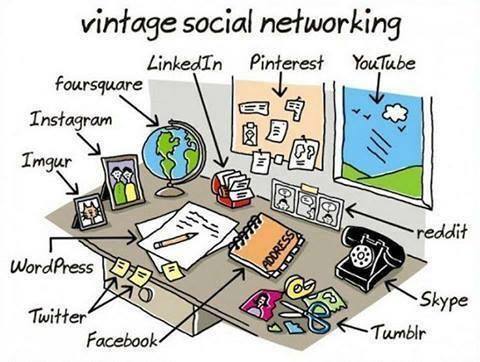
I (Yiola) came across this while on social media and found it playful… and true!

10259931_10152488203689175_8001628699976626381_n copy


A great explanation of social media and their functions.   I often think about the degree of necessity of each of these forms of communication — what they offer and their implications for communication and social interactions.  I am contemplating the pros and cons and beginning to explore literature that shares findings of the implications of our newer forms of communication.

Multifaceted Role of the Professor: Conducting Research Includes ….

As mentioned in a previous blog post, Clive and I (Clare) are interviewing teachers who are part of our longitudinal study of teachers. Many of our teachers have had life-changing events – including becoming a parent. The teacher we were interviewing in northeast US this past week is a new Mom and is home on maternity leave. We did a division of labour: while I was interviewing the teacher, Clive babysat the new baby who is four months old.  The question is: who had more fun? Me doing the interview with an amazing teacher or Clive babysitting an adorable youngster? It was a toss up because we both had a great time. So for budding researchers …. Do not be surprised that your role includes some unexpected duties (which no one told you about in grad school) – such as babysitting.
On a more serious note, a number of teachers in our study over the last 7-10 years have become parents (including adopting a child). It is interesting to see how they change once they become moms or dads:

  • Juggling being a new parent and a teacher has led to changes in practices and views. All have found the dual role draining.
  • New parents definitely have to shorten their work days! Working morning, noon, and night and all weekend which many had done as new teachers was no longer feasible.
  • They developed a number of strategies to streamline planning and marking.
  • When we asked how their views and/or values changed now that they are a parent many have commented they have become more compassionate. They appreciate how much parents have to trust teachers to care for their child (as they would) and how vulnerable children are. Their views towards parents in many cases have becoming more understanding while with the students they say are more flexible.
  • Interestingly, a number have commented that now as a parent, they are not as focused on covering the curriculum (standards or expectations); rather, they have become more focused on the individual child to ensure he/she is happy and thriving.
  • Some have said they have become less critical of themselves. They can only do so much and do not feel so guilty putting boundaries around their personal life.

There is so much more to being a teacher than covering the curriculum. There is so much more to being a researcher than just working with the data. You have to be flexible and be willing to assume some untraditional duties – just ask Clive.

Consequences for our Fast Communication Mistakes

The recent phenomena of quick texting is providing us with accelerated communication opportunities, but is it always working to the best of our advantage? I (Cathy) brought this up at a dinner party the other day and was amazed at how many had experienced major communication faux pas. One colleague confessed to texting his boss instead of his intended friend- about the boss. Luckily, there were no consequences as he still has his job.

Another colleague- a writer- sent a text off to her publisher inquiring about her overdue contract. She received a text back that was intended for another editor in the publishing house stating they should hold off sending the contract so they could “offer her less”. She consequently forwarded the text to her agent and luckily she was not “offered less”.

And then there was my own experience. I texted my son suggesting I pick up a few work shirts for him while at Costco. Shortly afterward I received a text from him- intended for his sister- complaining about my taste in clothes. I texted him back that I would not pick up the shirts after all. He thought this mistake was hilarious and immediately sent a text to his sister telling her what he had done. Many LOL texts followed to which I was included. This incident became a family joke and I have consequently learned to refrain from buying clothes for my son. Luckily, I just buy something for myself instead!

Longitudinal Study of Teachers: A Highly Rewarding Experience

Clive and ClareClive and I (Clare) are in NYC and NJ to interview teachers we have been following for 7 years. Conducting this longitudinal research has been an amazing experience because we have seen how these teachers change over the years. The first year of the study was stressful for both the participants and me. As brand new teachers, they were sharing with a virtual stranger (me, the researcher) their experiences as new teachers which included both highs and lows. As a researcher I was keenly aware of the challenges new teachers face so I did not want them to feel uncomfortable and I was unsure that the interview questions were appropriate for first year teachers. Over the years, I have gotten to know these remarkable women who often are teaching in very difficult settings. Interestingly, I have seen how their lives changed: getting married, having a baby, losing a spouse …. All life-changing experiences which have impacted their teaching. I am truly grateful that many years ago these young teachers opened their doors to me and have continued to be part of this study. Our interview questions for this year of the study are available. Click on the Link About Our Research then click on the drop down menu tab Instruments.

Some of the findings from this longitudinal research can be found in our new book, Growing as a Teacher https://www.sensepublishers.com/catalogs/bookseries/professional-learning-1/growing-as-a-teacher/

Engaging with Suffixes

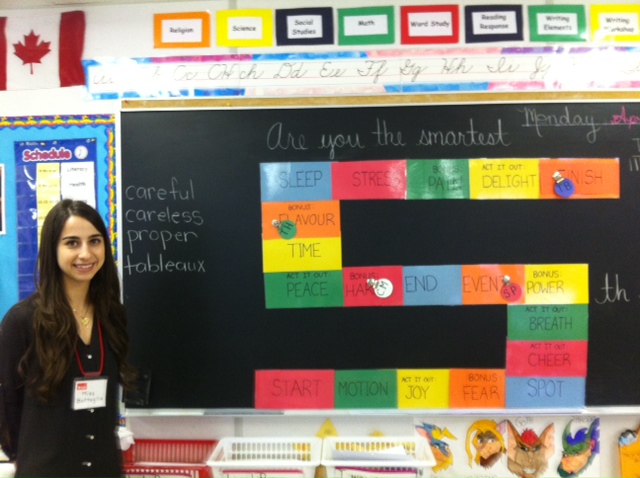
“How to engage students in the understanding and use of suffixes?” was the pressing question on my (Cathy’s) student teacher’s mind. Erica told me she mulled this over for several days, trying to get the pieces to fit together just right.    Her final creation – a suffix game. The wonderfully large, colourful game board alone was enough to grab her grade five students’ attention. Played in teams, each group had to role a gigantic die to move their magnetic counter on the board.   Some spaces on the game board depicted words (e.g. effort, bonus, time) which each team had to add either the suffix ‘less’ or ‘full’ to, and then write each word correctly in a sentence. Small white boards were provided to each team for this task.   Other spaces on the board instructed the teams to create a tableaux depicting the new meaning of the word once the correct suffix was added. A few  spaces on the board provided bonus points.

I have always had a concern about student teachers being focused on ‘fun’ over learning and wondered about the level  of learning these students would experience with this game. This concern, however, was mollified when I witnessed the mistakes the teams were making which forced them to rethink their answers.  The animated group discussions regarding which was correct were very interesting to observe.  When the nutrition bell rang and the grammar lesson came to an end, there were groans and moans of protest. Imagine, grade fives liking grammar. Erica wisely told them they could play again soon.

Erica's Game


Sharing Our Research

Today the research group will be presenting work from the project Literacy Teacher Educators: Their Backgrounds, Visions and Practices, at the Ministry of Education/Faculties of Education Forum – Research Practice: Nurturing relationships for teaching, learning and well-being. It will be an interesting and exciting day.

Literacy Teacher Educators: Preparing Teachers for a Changing World (Book Cover)
Literacy Teacher Educators: Preparing Teachers for a Changing World

A Mighty Girl

mightygirl

My twin niece and nephew are 4 years old. They both have loved books for as long as I can remember. They are currently learning how to string together sounds from the alphabet. As a super-involved aunt and literacy teacher, I try to expose them to a wide variety of texts. I want them to be exposed to texts which promote inclusivity, challenge stereotypes, and inspire creativity. For this reason I was delighted to find out about the Mighty Girl website.

“A Mighty Girl is the world’s largest collection of books, toys, and movies for parents, teachers, and others dedicated to raising smart, confident, and courageous girls.”

The Mighty Girl collection of books aims to disrupt the status quo of how girls are represented in fairytales. The collection of books strives to break the ‘damsel in distress’ mold, and so feature girls in alternative fairytales who are courageous, smart, and daring! I know I’ll be picking up a few of these books to read with my four-year-old niece and nephew! Some of the book titles include:

  • Not All Princesses Dress in Pink (Yolen & Stemple, 2010)
  • Dangerously Ever After (Slater, 2012)
  • Thunder Rose (Nolen, 2007)
  • The Seven Chinese Sisters (Tucker, 2003)

A full list of fairy/folktales on the Might Girl site:

http://www.amightygirl.com/books/fiction/fairy-tales-folktales

Conversational Competence

“Is there any 21st-century skill more important than being able to sustain confident, coherent conversation?”conversation

 As I watched my class struggle, I came to realize that conversational competence might be the single-most overlooked skill we fail to teach students. Kids spend hours each day engaging with ideas and one another through screens—but rarely do they have an opportunity to truly hone their interpersonal communication skills. Admittedly, teenage awkwardness and nerves play a role in difficult conversations. But students’ reliance on screens for communication is detracting—and distracting—from their engagement in real-time talk. (Paul Barnwell, 2014)

The author of this article, teacher Paul Barnwell, worries that without solid conversational skills our students won’t be able to manage important life conversations (e.g., job interviews, discssions with employers about salary negotiations, conversations with their partners, etc.) in their future which rely on them thinking on their feet (without access to Google!).

 MIT professor, Sherry Turkle, spends her time researching people’s relationship with technology. She wrote in the New York Times about the impact of tech-overload: “Face-to-face conversation unfolds slowly. It teaches patience. When we communicate on our digital devices, we learn different habits … we start to expect faster answers. To get these, we ask one another simpler questions. We dumb down our communications, even on the most important matters.”

I couldn’t agree more with Barnwell and Turkle. Teaching our students how communicate to solve problems, deal with emotions, and build meaningful relationships through conversations  is an essential skill which may need to be explicitly taught.

Read the entire article from The Atlantic below:

http://www.theatlantic.com/education/archive/2014/04/my-students-dont-know-how-to-have-a-conversation/360993/

Spoken Word: Life, Literacy and Communications

I (Yiola)  remember watching the news  in the mid ’80s and listening to the news anchors describe the possibilities and implications of the internet.  I had no idea of the magnitude of change this new form of literacy would bring. Could anyone really imagine the changes we would experience in our daily interactions?  Online communication, information sharing, cellular technology and social media have completely changed the way we operate in the world today.

I came across this interesting link — a spoken word (poem) — about the impact new literacies  has on our lives.

The message I find most powerful is the irony that social media connects us  and yet in some ways we have never been more isolated or at a loss for opportunity… community companionship a sense of inclusion yet when you step away from this device of delusion… you awaken to see a world of confusion… 

From an educator and parents point of view the poem’s message that struck a cord: We’re surrounded by children who since they were born, watched us living like robots and think its the norm.  What is our cultural norm? Compared to pre-online technology are we behaving like robots?

I tend to agree with much of what the poet shares and enjoyed this spoken word. I hope you enjoy it too.


A Lack of Diversity in Higher Education Leadership

An interesting article was published last week about the lack of    diversity to be found in university leadership. When looking at full-time faculty at universities across the U.S., 79% were white. The lack of diversity was found most among higher ranking faculty (tenure-track; leadership roles; presidents).  For example, while 44 percent of full-time faculty at degree-granting institutions are women, they hold only 29 percent of tenure-tracked positions at doctoral institutions — even though women outperform men 56 to 40 percent in national research grant awards.”

An excerpt from the article:

Thus, university leadership increasingly reflects neither the student body being led nor the world in which graduates will need to operate, a situation that engenders disadvantages and lost opportunities. Students benefit from having mentors and role models from their own racial, ethnic, or gender group — as do faculty who aspire to leadership positions. Institutional leaders can strongly influence institutional culture; having leaders from a wide range of backgrounds and experiences enriches the intellectual and cultural climate in which students learn. And exposure to and experience working with people from different cultural backgrounds better prepares students for the real-world working environment of their futures.

The excerpt above describes much of what is happening in the K-12 teaching force in North America. Although efforts are being made to diversify the teaching force, white female teachers remain the majority of K-12 teachers.

Read the entire blog here:

http://www.huffingtonpost.com/dr-ricardo-azziz/back-to-the-future-college-presidents_b_5200573.html?utm_hp_ref=education&ir=Education