 Reading the New York Times Book Review section on Sunday, I (Clive) was reminded of the rather negative view of life frequently presented in “good literature.” In books reviewed, life was portrayed as hard to fathom, mainly painful, and ultimately tragic. Of one collection the reviewer said: “These stories know suffering, loneliness, lust, confinement, defeat.” (Lust was the one bright spot.)
This recalled my own education at school and university, where tragic literature was the good kind and comedy was mainly fluff. A “comic” life vision, emphasizing pleasure, happiness, and good relationships, was seen as shallow and naïve.
Certainly, some people find sad and violent books more entertaining than comedies; and a well written tragedy can be absorbing. But as Northrop Frye maintained, literature is supposed to educate as well as entertain. So we have to face the question: How well does tragic fiction educate about life? My view is that it helps, but a more balanced picture is needed.
Based on my own fiction choices, I’m coming to the conclusion that entertainment is a major purpose of fiction. You want something you can enjoy on a plane to offset the cramped conditions and bad food; or that you’re glad to read in the evening when you’re feeling tired. So I usually go for David Lodge, P. D. James, Jane Austen and the like, where there’s plenty of entertainment and a fairly positive worldview.
However, there’s no accounting for taste. The main thing is that we discuss the purpose of various types of fiction with our students, helping them figure out for themselves what to read, when, and why.
Category Archives: literacy
Dialogic Talk
It’s a powerful statement about a book when while reading it, you implement a suggested strategy the next day in class. That’s exactly what happened while I was reading Classroom Talk: Understanding dialogue, pedagogy and practice, by Edwards-Groves, Anstey and Bull (2014). The premise- talk is the foundation to all learning- is not new, but the connections made to multiple theories (e.g. Theory of Practice Architectures, Theory of Multimodality, Social Semiotic Theory) makes this book very current.

I particularly enjoyed the section on conversation vs dialogic talk. I do believe in “vacating the floor” as is suggested in the book and letting the students discuss issues in small groups. In one particular class I teach, I always allowed my students to select their own discussion groups, as these are university students and felt they needed to make their own choices. However, many of the groups were not focused, they veered way off topic (or never addressed the topic at all) and some students were still not voicing their opinion (even after much community building). The section on dialogic talk prompted me to reframe my concept of small group discussion. It suggested conversation is an informal discourse where direction and end point of the talk are unclear. This was pretty much where my students were with their discussions. Dialogic talk, however, sought to engage all listeners and had more purpose. Plus, dialogic talk was not as relaxed as conversation, it was driven. I needed driven. I wanted more engagement.
As a result, I immediately set up ‘Dialogue Groups’ with an assigned moderator, who ensured everyone’s opinion was invited and heard. I decided who would go into each group (which I thought they might resent and discovered they preferred!). For each discussion I provided prompt questions to get the talk started. I also assigned a time keeper who kept the dialogue to the time limit and a recorder who kept general notes about what was discussed. I honestly didn’t think this would be necessary at the university level, but the difference was incredible. There was thoughtfulness in the answers. The discussants were suddenly animated and energetic. They were really listening to each other. This was a small change, but it made a world of difference in how they were hearing and responding to each other.
Of course there are many other interesting and practical suggestions in the book. The connections between theory and practice are very strong. I highly recommend it. This book was published by the Primary English Teaching Association of Australia (PETAA). Check out their web site!
What’s in a word?
Sheryl Sandberg, the Chief Operating Officer of Facebook, has teamed up with the Girls Scouts USA to start a campaign that calls for a ban on the use of the word bossy in everyday language. Sandberg suggests that referring to girls as “bossy” can limit their full leadership potential. The website of Sandberg’s non-profit organization LeanIn.Org states,
“When a little boy asserts himself, he’s called a “leader.” Yet when a little girl does the same, she risks being branded bossy. Words like bossy send a message: don’t raise your hand or speak up. By middle school, girls are less interested in leading than boys—a trend that continues into adulthood. Together we can encourage girls to lead. Pledge to Ban Bossy”.
Sandberg’s “Ban Bossy” initiative has recruited an ensemble of spokeswomen, including Condoleezza Rice, Diane von Furstenberg, Jennifer Garner, Jane Lynch, and perhaps most notably megastar Beyoncé.
The Ban Bossy project highlights how a word can come to signify particular social and cultural dynamics. While I do understand the goals driving this initiative it makes me uneasy when a group advocates for the banning of words no matter how well intentioned their motivations might be. Words carry with them a history, at times a history of injustice and painful disparities, but an awareness of history is critical if we hope to effect systemic change. Perhaps, an alternative to “banning” is reclaiming words in an attempt to shift the negative connotations associated with a particular word.
The Danger of a Single Story
When engaging with students about Media Literacy, I (Pooja) often like to begin with novelist Chimamanda Ngozi Adiche’s powerful TED talk entitled The Danger of a Single Story. Through the use of her own narrative, Adiche speaks about the prevalence of a “single story” or the dominant culture portrayed throughout most school curriculums. Adiche shares the following memory of being taught a single story:
At about the age of seven … I wrote exactly the kinds of stories I was reading: All my characters were white and blue-eyed, they played in the snow, they ate apples, and they talked a lot about the weather: how lovely it was that the sun had come out. This despite the fact that I lived in Nigeria; we didn’t have snow, we ate mangoes, and we never talked about the weather, because there was no need to.
Adiche speaks about the impacts the single story has on an individual, on a community, and on society at large. While a young school girl in Nigeria, Adiche recalls only reading authors from the West. Having never encountered the works of an African author or seeing people like her appear in books, she believed she could not (or should not) be a writer. She asserts that when we receive only one perspective on anything it creates stereotypes, “and the problem with stereotypes is not that they are untrue, but that they are incomplete. They make one story become the only story.”
This TED talk sparks lively discussion in the classroom. Students often think back to their early schooling and many recall “single stories” they experienced. As a class, we capture all of these experiences on a large poster. As new text is introduced in the course we often refer back to this “single story” poster and discuss who’s stories are being represented in what we read/hear/see.
Grade Two Flash Mob
I (Cathy) love Flash Mobs. Someday, I hope to be lucky enough to be in the right place at the right time to witness one. Members of a symphony orchestra in Sabadell, Spain clearly excel at creating them. There are many clips to be found on Youtube by this group, but my favorite is the one set up for a grade two classroom. In the link below, the classroom flash mob is embedded with several others. Just keep watching. I love the look on the children’s faces; their reactions as they get lost in the music; and, their ability to conduct! Ah, the joy of it. I wonder how many of these children will dabble in music after this experience.
Congratulations Tiffany Harris

Congratulations to Tiffany Harris (member of our research team) who successfully defended her PhD thesis yesterday. The thesis, Multiliteracies Theory into Practice: An Inquiry into Junior-level Literacy Classrooms, was a study of classroom teachers (grades 4 – 6) which examined their understanding and use of a multiliteracies approach in their teaching. The thesis is outstanding because Tiffany closely studied her participants’ views of literacy, their practices, and the challenges they face. The analysis is outstanding because Tiffany is both a very accomplished classroom teachers and an excellent researcher. She brought to bear on her work her understanding of the work of teachers and her extensive knowledge of multiliteracies theory. As a result, her work will definitely contribute to our understanding of how literacy is evolving and how teachers are adjusting their teaching. It is rare to have a study that moves so effectively between theory and practice. Her thesis will soon be available through the Proquest Dissertation Database. Congratulations Dr. Harris. Attached is a picture of Tiffany and me (Clare) after her thesis defense.
A Daily Reminder
I (Pooja) work at a higher ed. institute with a population that is very diverse. I have many mature students, with a history of interrupted education, who are looking to make a fresh start with school after work many years in unfulfilling jobs. Even though school has failed them in the past, they come in hoping to form a new relationship with school. This cartoon and this quote are taped up above the photocopier in our office. It is a daily reminder of my work and the students I serve.

Everybody is a Genius. But If You Judge a Fish by Its Ability to Climb a Tree, It Will Live Its Whole Life Believing that It is Stupid. –Einstein
The Power of Introverts
“In a gentle way, you can shake the world.” – Gandhi
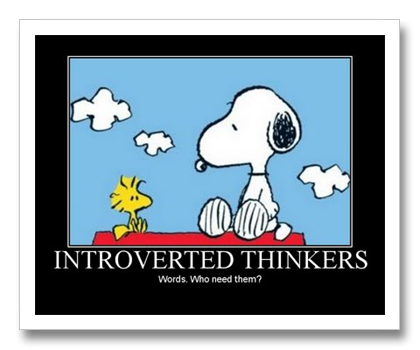
At a professional development session I (Pooja) attended this week, I joined a conversation about the power of introverts. The conversation was framed around Susan Cain’s book entitled Quiet: The Power of Introverts in a World That Can’t Stop Talking. We live in a society where extroverts are the ideal; we value personality over character. This presentation, given by some of my quieter colleagues, was powerful because it forced me to reflect on ways I engage and include introverts in the classroom. The presenters explained that introversion and extraversion is not a black or white matter; rather we all fall somewhere along the continuum depending on the situation we find ourselves in. I also learned that introversion is not to be confused with shyness- a mistake many people (including myself) make when speaking about introverts.

I mostly identify as an extrovert. Knowing this is important because it can influence how I design my course to be more inclusive for all my students. As a more extroverted person, I walked out of the session with practices to consider revising in my classroom. Here are a few of the things I’ve been thinking about:
- Mindful of airtime- I often become uncomfortable in silence, and so I will fill in silent moments with talking or engaging only the most vocal members of the class in discussion. Silence can be a powerful thing; these are the moments where reflection occurs.
- Independent Work vs. Group Work- I try and put my students into pairs and/or groups every chance I get. I now am beginning to realize this is not the optimal working condition for all. I need to find a balance of group work and independent work.
Learn more about the power of the introverts here:
Walking for the Brain
To further our theme from earlier posts on well-being and schooling, I (Cathy) looked up the right time to exercise to help your brain. These tips were suggested:
- In general, anything that is good for your heart is great for your brain.
- Aerobic exercise is great for body and brain: not only does it improve brain function, but it also acts as a “first aid kit” on damaged brain cells.
- Exercising in the morning before going to work not only spikes brain activity and prepares you for mental stresses for the rest of the day, but also produces increased retention of new information, and better reaction to complex situations.
- When looking to change up your work out, look for an activity that incorporates coordination along with cardiovascular exercise, such as a dance class.
http://www.positscience.com/brain-resources/everyday-brain-fitness/physical-exercise
These all made sense, but none of them identified when or why I like to exercise for my brain. When my mind is somewhat numb after a few hours of academic writing, I need to push the refresh button. I achieve this walking by the lake. I am sure it is good for my lungs, my joints and my heart, but I really head to the water to recharge my neuro cells and feast my eyes. The scenery renews me as much or more than the exercise. Maybe just seeing what I saw yesterday will refresh your neurons…




Teaching Music Literacy – It Ain’t Easy but Must be Done
Young people spend so much of their day listening to music, yet it’s barely addressed in school. Something needs to be done about that – but it won’t be easy. I remember my (Clive’s) grade 5 teacher telling us that Bing Crosby couldn’t sing, he was just a crooner. He probably thought he was “educating” us about music, but he fed into my early prejudice against popular music.
In France there’s a lot of “music appreciation” in schools, which is great because music-making shouldn’t be all we teach. However, again the stress is on classical music.
One of the teachers in our longitudinal study (Candice) recently became a music specialist in her school and established a wonderful approach. In her seventh year she said:
I’ve become keen on the Orff method: it emphasizes improvisation and creating your own music, and leads in the teen years and adulthood to more of a jazz approach…. My focus is on teaching children in such a way that they can create music, understand it, and participate in it. So when they’re listening to pop music they understand what instruments are used, how the music is made, and what mood it creates.
But is there still too much emphasis here on performance?
A respected Toronto columnist recently wrote a rather negative article about popular music. He asked how much of interest could come from a genre where everything is a sentimental song about 3 minutes long in 4/4 time? I asked a musician in my ITE class about this and he said there’s an enormous variety and depth of structure and rhythm in popular songs. We noted that a similar argument could be made against English literature on the ground that it uses just 26 letters and a few punctuation marks (see the quote form Neil Gaiman in Lydia’s recent blog).
Teaching music literacy in schools has many pitfalls. Like the Fiddler on the Roof, teachers will have difficulty keeping their balance. But a way must be found – in many subject areas – if schooling is to be relevant.
 Literacy Teaching and Teacher Education