Category Archives: literacy

Is School Making Our Children Ill?

In the New York Times on January 3, I (Clive) came across a fascinating column by Vicki Abeles (Sunday Review section) about the negative impact current school “reforms” are having on children. According to her, they are undermining the health of students, both rich and poor and from kindergarten to high school.

Abeles has written a book (which I plan to get asap) aptly titled “Beyond Measure: Rescuing an Overscheduled, Overtested, Underestimated Generation,” and has produced documentaries “Race to Nowhere” (as distinct from Race to the Top) and “Beyond Measure.” But in the column her focus is on research conducted by Stuart Slavin at Irvington High School in Fremont, California, “a once-working-class city that is increasingly in Silicon Valley’s orbit.” In cooperation with the school, he anonymously surveyed two-thirds of Irvington’s 2,100 students and found that “54 percent of students showed moderate to severe symptoms of depression [and] 80 percent suffered moderate to severe symptoms of anxiety.” The school is trying to address the problem, for example by re-examining homework demands and counseling students on achieving a manageable course load.

Based on her own inquiries and reflections, Abeles attributes much of this anxiety and depression to the enormous pressure young people are under today to climb the ladder of schooling, with a view to getting into a good college and/or job. “Even those not bound for college are ground down by the constant measurement in schools under pressure to push through mountains of rote, impersonal material as early as preschool.” Apart from opposing this general approach to schooling, Abeles sees practical lessons that can be learned from Irvington’s approach. Toward the end of the article she suggests:

“Working together, parents, educators and students can make small but important changes: instituting everyday homework limits and weekend and holiday homework bans, adding advisory periods for student support, and providing students opportunities to show their growth in creative ways beyond conventional tests.”


Literacies Gaming

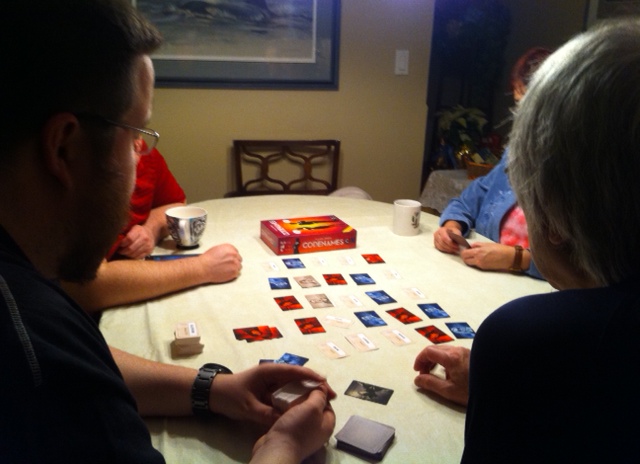
I (Cathy), my family, and friends have been playing many different kinds of ‘party’ games as of late . Some have boards, in some you create the board as you play, and with others there are just cards. One of my favorites is a game called Codenames.

group

This game intrigues me because it is similar to coding data in a study as it’s about making associations between words, categorizing, and/or generalizing. (There is a narrative component to the game where everyone is considered a spy, but we just ignore all that). It can be played in teams or individually.

In this game many word cards are laid out in a grid across the table (25). One person is designated the clue giver and gives his/her team (or other person) a word and a number. The clue word might be ‘flight’ and the number might be ‘2’. The team then has to identify two words in the word grid they think are associated with flight. The challenge for the clue giver is they may not pick just any words they want in the grid to associate. They may only use certain assigned words and sometimes it is very difficult to make associations. The challenge for the team is, if they pick the wrong word, the point goes to the opposition.

Let’s have a trial run… Your clue is ‘weapons, 2”

again

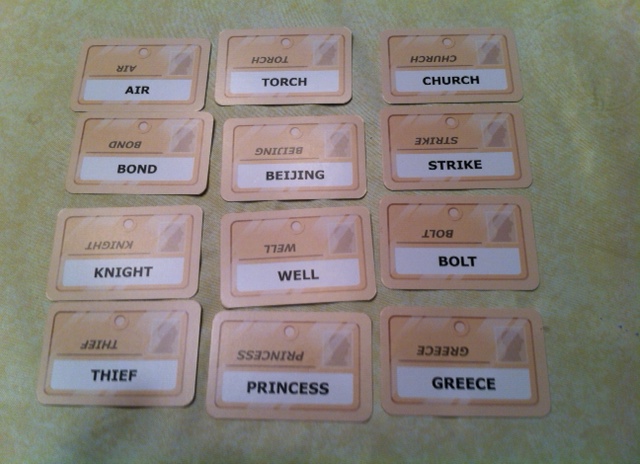
If you guessed pistol and missile, you just won two points for your team. Let’s try one more, but a little bit more challenging this time! Your clue is ‘Olympics, 3’

third try

If you guessed Bolt, Greece, and Beijing, you earned another three points. (If this is mystifying to you, Usain Bolt set the world record for the 100 m dash at the Beijing Olympics, and Greece is the birth place of the Olympics).

This is a wonderful means of exploring word meanings and associations. It is also interesting how so many words can be both verbs and nouns, or connected as possible compound words, or have special meaning depending on culture and context. (Knowing your teammates well also helps, as I find I can understand my husband’s clues better than other people can). On many levels it is a great pass time with friends and also a great language game for the classroom. It is also, on many levels, literacies in action!

*****


5 More Years for Our Longitudinal Study of Teachers

In mid-December, I (Clive) received a nice holiday gift: word came that we had ethical approval from the University of Toronto to continue our longitudinal study of teachers for another 5 years (news of the extended funding by SSHRC came earlier). This is not a “high risk” study, but it is always a relief when the approval comes. We can now look forward to following the first cohort of 20 participants into their 16th year of teaching and the second cohort, also of 20, into their 13th year. This is a welcome development, as a longitudinal study obviously becomes more significant as the years pass.

Clive BeckThis study, co-directed by Clare Kosnik (who also directs her SSHRC study of 28 teacher educators) – and involving a wonderful team of researchers – began in 2004 with 22 new teachers; the second cohort of 23 was added in 2007. Over the years, 3 participants have left the study but are still teaching, while another 2 have left teaching and hence the study; so the total is now 40. This is an unusually high retention rate both for teaching and for a longitudinal study.

It is likely the high retention is due in part to the teachers’ participation in the study itself, which they often tell us is very beneficial to them; sometimes they say it is the most useful PD they experience all year! This is a limitation of the study, since it means they are a relatively motivated group (although it is not something we could have avoided). However, it is interesting that teachers would find it so helpful to have someone listen to their experiences and views about teaching for an hour of so once a year. Perhaps it is a form of “PD” that should be used more often, as an alternative to top-down lectures by “experts” on how to teach!


A Book Printing Machine at Toronto Library!

books.jpeg

The CBC reported that this past weekend the Toronto Reference Library unveiled book printing machine which allows individuals to walk away with store-quality books. As of now, authors can print 10 copies of  their books (150 pgs) for $145. A bit pricey in my opinion, but definitely unique with a lot of great potential for students, writers, educators, etc. CBC reports that “What’s new is the ability to self-publish books – whether your own piece of literature, a cook book, dissertation or whatever you choose for a relatively.” The Toronto Reference Library will soon be offering courses on how to best format books for professional looking books.

Read CBC article here:

http://www.cbc.ca/news/canada/toronto/toronto-library-offers-store-quality-book-printing-to-customers-1.2670661


The Future of Education?

I (Cathy) recently read a blog posted on the The Huffington Post.  If you are not familiar with the Huffington Post, it is an American online news aggregator and blog, that has been public for 10 years.   In 2012, The Huffington Post became the first commercially run United States digital media enterprise to win a Pulitzer Prize.

I qualify the source only because I am always suspect of individuals or groups that make claims or forecasts about education, yet  know little about the systems. As I consider The Huffington Post a relatively reliable and informative source, I gave the claims made by , a guest blogger who was the Former President for the  Society for Quality Education a second look.

In this blog, Dare proposes that all education systems are cartels  (an association of manufacturers or suppliers with the purpose of maintaining prices at a high level and restricting competition) and these cartels will be disrupted by the world of technology.  Dare suggests:

A software company might put together a complete online curriculum, with built-in testing and reporting, that allows students to progress at their own speed using tablet computers. Already much of this software exists, although it is not yet well organized. Another (or the same) software company might make it possible for parents to access individuals, or groups of individuals, who are willing to coach a group of other people’s children, possibly in their own homes or in a community centre, for a reasonable fee. Part of the software company’s services could be to vet the coaches and ensure they pass health and safety checks.

Dare uses Uber and Airbnb as examples of disrupters to systems and claims educational systems are next.  He goes on to say:

In fact, disruption is already taking place in the post-secondary sector — see UoPeople, the world’s first non-profit, near tuition-free, accredited online university. Currently, students can earn an undergraduate degree in business administration and computer science for $4,000 US, and more programs are being added.

I am fascinated by this blog for a number of reasons.  First, Dare assumes that a young adults  seeking to educate themselves  are comparable to young child who are learning to read and learning to socialize. I have taught children to read (and socialize) and I simply do not  think a  computer can do it.  There is a lot more to education than just text book learning!  Secondly,  Dare implies in the blog that teachers are oblivious to the affordances of technology and reject it for fear it will disrupt the “cartel” in which they participate.   Every teacher I know (from K to HE) incorporates (in degrees) technology into the teaching and learning in their classroom.  They are also aware that students can go online and teach themselves many things. They even encourage it.  The Khan Academy was designed for such learning and is largely responsible for the premise of flipped classrooms which are very popular right now  in Canadian colleges.  I do not think technology will disrupt the educational system.  I think it will just continue to enhance both teaching and learning. Technology and education will evolve together.

Lastly, Dare is completely oblivious to the most significant aspect of education – the relationship.  Countless studies have suggested a caring, attentive teacher can do more for a student than any other factor. Personally, I just can’t see technology completely replacing a good teacher, especially in the education of the young. People simply need people.

Thoughts?

http://www.huffingtonpost.ca/malkin-dare/ontario-education-future_b_8916284.html

Supporting Students With Autism Spectrum Disorder

In my (Clare) course on Current Issues in Teacher Education one of the Image_Karastudents, Kara Dymond, did her final project on autism. She is a member of the Autism Team Program to Assist Social Thinking in the Toronto Catholic District School Board. I learned so much about autism in particular how to help children that I asked Kara if I could post some of suggestions on our blog. I know that teachers would find them useful and teacher educators may want to share them with their student teachers. Thank you Kara for letting me share your work with the wider education community.

An Autism Spectrum Disorder (Autism/ASD) is a complex neurological condition which has implications for many aspects of functioning, including learning. The education system needs to be increasingly prepared to meet the diverse needs of these students, as Autism is the fastest-growing developmental disability in the United States (Safran & Safran, 2001; Sansosti, 2010). Last year, the US Centers for Disease Control and Prevention reported that, as of 2010, rates of ASD were 1 in 68 children. Only ten years before, the prevalence was reported as 1 in 150 children. In this paper, rates from the US are reported, as Canada does not have a comparable federal ASD surveillance system at this time, though one is in development (Health Canada, 2012).

HOW TEACHERS CAN SUPPORT LEARNING IN THE CLASSROOM (for high functioning autistic students)

Establish a Rapport

When a teacher has a positive relationship with a child with HFA, it decreases the child’s anxiety and rigidity. It also increases their receptivity to feedback and their willingness to try what is being asked. This is the most important strategy to employ when working with a student with HFA. Some methods to improve your relationship include:

  • Ask them questions about and listen to them talk about their interests
  • Include their interests in word problems, tasks, and books available in the room
  • Have them present as an expert to the class on their interests
  • Reinforce the positive behaviours you see with praise and rewards when possible
  • Use humour with them (but avoid or explain sarcasm, which may be confusing)

Understand Their Need for Safety

  • Make things predictable by having a posted schedule and routines that are consistent
  • When changes happen, explain why they are happening and what is expected, as early in advance as possible
  • Follow up challenging activities with something calming for that student
  • Make your expectations for work and behaviour clear
  • Speak in a calm tone of voice and be consistent with what you say
  • Use clear language or explain language that is complicated or idiomatic

Manage the Environment

  • Help the child to know what they can do if they need a break (e.g. a safe spot to go to for a certain length of time, break options such as getting a drink, pacing in the back of the class, etc.) and what your expectations are regarding when and for how long they can take a break
  • Offer them a quiet place to work, such as a desk carrel, if needed
  • Start the day with a task they like to decrease any anxiety upon arrival, if possible
  • Seat them in an area facing a section of the class with fewer visuals to decrease distraction
  • Seat them with supportive classmates
  • Pay attention to sensory stimuli that distract or agitate them and do what you can to minimize these. Create a plan with the student on what to do if there is a factor (e.g. heat) that you cannot control (e.g. they have permission to go to the bathroom and splash cool water on their face at any point, and they can sit near a window)

See from Their Perspective

  • Monitor their understanding of different situations and relationships
  • When you notice a behaviour or thinking pattern that is different from same-age peers, consider its long-term impact and what skills need to be taught instead
  • Have private check-ins with the child to discuss misunderstandings and help them to see the perspective of others and how their choices can affect how others feel
  • Explain things logically
  • Include them in problem-solving and making a plan for how to cope when they are stressed
  • Recognize that when they are stressed, you will have to reduce your expectations

Be Specific

  • Explain logically and clearly what is expected or not expected
  • Give genuine, specific praise that lets them know what you liked about what they did (they may not know what you are referring to if you simply tell them “good job”. Instead say, “I like how you raised your hand – good job!”)
  • Give specific constructive feedback (e.g. “Please stop tapping your pencil. It is distracting.”) so they know what to do and why
  • If you want to see a skill again, remind them to do it again, before the lesson or activity when they are expected to exhibit the skill

Explicitly Teach Their Areas of Need

  • Point out the hidden curriculum when you notice they do not know it.
  • Consider teaching them about the hidden curriculum of tests. This includes what concepts are most important; how to tell what questions require a more in-depth answer (e.g. how much space is there to write in and how many points is the answer worth); how to determine what a question is really asking (e.g. short-answer questions beginning with “What is …” often mean “Tell me everything you know about…”)
  • Draw their attention to intentions and feelings of others – both students and characters in books. (e.g. “How does that character feel when…” and “how do you know?”)

Structure Opportunities for Interaction

  • Help send them out to recess with a plan of what to do and who to play with
  • Engage peers to invite them to talk or play a game they like at certain recesses
  • Teach recess games at gym time so they know the rules and can practice
  • For longer recesses, consider having them be office monitors or library assistants with other peers
  • Highlight their strengths in front of peers and in group projects

Re-Conceptualize Challenging Behaviours

  • Try to understand why a child might be feeling overwhelmed
  • Remember that behaviours signal a lack of skills and can improve with teaching
  • Prevention is key. Recognize you may have to change your approach or things in the environment to set the child up for success next time
  • Anxiety is like a teeter-totter. Your reaction can either bring them gently down or send them flying into a meltdown or complete withdrawal
  • Know your student. Learn their body language so you know when they are in the early stages of frustration and you can prompt them to take a break or reduce task demands
  • Always de-brief after a challenging moment, once the child is calm (this may be the next day). Find out what was upsetting them – they may share important insights that can help you create a plan for next time
  • Stop talking. Children with HFA cannot process language when they are upset

Teach Them Organizational Skills

  • Provide time each day or week to clean their desk and describe your expectations
  • If packing up is problematic, have them pack up what is needed from the morning before lunch and what is needed from the afternoon at the end of the day
  • Instead of the agenda, create a daily homework checklist where subjects are prewritten and materials needed for home can be circled. The only writing needed will be page numbers and questions required
  • Instead of numerous duotangs and notebooks, provide students with a binder for all subjects, divided by subject, and with pockets for loose sheets to be filed later. This may improve students’ ability to locate what is needed and to be ready for each lesson
  • Take and print small photos of subject materials (e.g. textbooks, notebooks) and put them up on the board as a visual reference for what is needed for that subject

Increase Their Productivity & Output

  • Whenever possible, reduce the writing requirement as writing can be laborious for students with HFA. Use visual organizers, fill-in-the-blanks, true or false, or circle the correct answer
  • Task instructions should be given one by one, with exemplars if possible
  • For large tasks, give students with HFA broken-down components of a task to do one at a time. Sometimes too much work on one page can seem overwhelming
  • Change how work or tests look on the page by increasing the font, reducing the number of questions, and having more space on the page
  • Giving some options can help with open-ended tasks (but not too many options!)
  • Give time countdowns so students know when they are expected to transition to another task. This can be difficult for students with HFA
  • Give processing time. Ask a question once and wait. You may have to ask again in a different way. Too much talking might mean they have to re-start their thinking process all over again. (Too many prompts can also be frustrating for a child who is trying to process the first instruction you gave)
  • Consider alternative ways of expressing knowledge. Most students with HFA are visual thinkers, so can express their knowledge better in comic strips than orally or in writing
  • Consider allowing them to type
  • Consider a break schedule to increase motivation and productivity
  • Harness their interests, especially if they are going to elect to do them anyway. If it is a half-hour work period and you know they tend to only be productive for ten minutes and then get distracted by doodling or reading their favourite book, give them a special interest break when they are at their productivity limit. Pair it with praise and tell them they have earned five minutes of their interest for working so hard. Breaks help to free up working memory and re-focus the child, and giving them a special interest break (rather than taking it away) builds your relationship. After their time is up, ask them to get back to work
  • Consider providing breaks during tests. More time does not help without giving breaks to free up working memory
  • Implement a reward system if they are still struggling to meet your expectations. They may need motivation to attempt something that is very difficult for them (your school board’s Autism Support Team can help you to design a successful model)

Respect, Support, & Develop Their Independence

  • Give students help when they need it, but also give them time and space to try work on their own. Give an instruction and then circulate around the room, returning later to see what they can do independently
  • Gradually increase in your expectations for their independence
  • Reward trying to do something that is hard for them
  • Encourage them to take on positions of responsibility in the classroom and around the school (but do not surprise them with this – ask in advance what they would like to do from a list of options)

A New Book on Participatory Culture and Digital Technologies

pcul

I (Pooja) have long been interested in the notions of participatory culture. Often considered  the opposite of consumer culture, participatory culture is defined by Henry Jenkins (2009, p. 5-6) as a culture in which there are:

1. relatively low barriers to artistic expression and civic engagement

2. strong support for creating and sharing creations with others

3. some type of informal mentorship whereby what is known by the most experienced is passed along to novices

4. members who believe that their contributions matter

5. members who feel some degree of social connection with one another (at the least, they care what other people think about what they have created).

I was excited when I learned authors Henry Jenkins, Mizuko Ito, and danah boyd authored a new book titled: Participatory Culture in a Networked Era: A Conversation on Youth, Learning, Commerce, and Politics (2015). I have provided the blurb on  the back of the book for those potentially interested in learning more about participatory culture in the 21st century like I am:

In the last two decades, both the conception and the practice of participatory culture have been transformed by the new affordances enabled by digital, networked, and mobile technologies. This exciting new book explores that transformation by bringing together three leading figures in conversation. Jenkins, Ito and boyd examine the ways in which our personal and professional lives are shaped by experiences interacting with and around emerging media.

Stressing the social and cultural contexts of participation, the authors describe the process of diversification and mainstreaming that has transformed participatory culture. They advocate a move beyond individualized personal expression and argue for an ethos of “doing it together” in addition to “doing it yourself.”

Participatory Culture in a Networked Era will interest students and scholars of digital media and their impact on society and will engage readers in a broader dialogue and conversation about their own participatory practices in this digital age.


Golden Rules for Engaging Students in Learning Activities | Edutopia

I (Clare) read this article and thought it had some really useful strategies.

Six key rules for student engagement include making it meaningful, fostering efficacy, autonomy support, collaborative learning, establishing positive teacher-student relationships, and mastery orientations.

Click on the link below for the entire article.

Source: Golden Rules for Engaging Students in Learning Activities | Edutopia

Teaching Students to Skim

51aB27q7fZL._BO2,204,203,200_PIsitb-sticker-v3-big,TopRight,0,-55_SX324_SY324_PIkin4,BottomRight,1,22_AA346_SH20_OU15_Over the holidays I (Clive) have had a chance to do some novel reading, and have read murder mysteries by J. K. Rowling (The Silkworm) and Elizabeth George (For the Sake of Elena). I enjoyed these novels, especially the first, but these authors – bless their hearts – like to put in a lot of social commentary, ideas about life, personal interest, etc. This can be very interesting and educational or quite aggravating, depending on one’s interests – so I did a lot of skimming (especially in Elena).

This made me think that in schooling and even university we don’t spend enough time teaching students to skim. We need to encourage them to “take charge” of their studies and reading life, rather than seeing complete coverage as the ideal. Smith and Wilhelm in their wonderful 2002 book Reading don’t fix no Chevys note that working class teenage boys often don’t like to read because the books we assign are too long. Skimming could help solve this problem. Similarly, doctoral students often take far too long on their literature review because they still don’t realize that one can and often must skim.

So let’s skim more – even in reading the daily news, in print or online – and encourage our students to do the same. It can make your day, and your holidays!


The Children’s Books That Took Our Breath Away in 2015 by Devon Corneal

I (Clare) was reading the Huffington Post education section and it listed some of the top books of 2015. I want to read them all! Here is the link: http://www.readbrightly.com/best-childrens-books-2015/?ref=72E6CF384C67

ImageHenkesWaiting

by Kevin Henkes

It seems funny to choose Kevin Henkes’s Waiting as the book that blew me away in 2015. Waiting is a quiet, gentle picture book about a group of toys on a windowsill looking at the window, each one waiting for something to happen. Henkes’s pastel illustrations and crystalline prose are enchanting. This is the perfect before-bedtime book. I can’t wait to read it to my 6-month-old niece.

Polar Bear’s Underwear

by Tupera Tupera

Image_PolarBearUnderwearPolar Bear’s Underwear shocked me by being a book about underwear I was actually willing to read to my children. It was so cute, clever, and fun without being crass or gross. I didn’t even know it was possible!

All the Lost Things

by Kelly Canby

A young girl follows her heart and changes the world she lives in. The gorgeous illustrations and hope-filled message are what make this one of my favorite books of 2015.

The Penderwicks in Spring

by Jeanne Birdsall

The Penderwicks in Spring is the fourth book in Jeanne Birdsall’s charming series about the adventures of four sisters. Nana gave my Penderwick-crazy 8-year-old a copy, and she promptly disappeared until she devoured the whole thing. My daughter bubbled over with desire to tell me what’s happening to all her favorite characters, and I shushed her right back, because I love them too, and I want my own turn to sit back and get my Penderwick fix.

·

Lockwood & Co.: The Hollow Boy

by Jonathan Stroud

Jonathan Stroud books make me happy. I hoard them like a miser, waiting, just waiting until I can share them with my daughter and slowly but surely blow her mind. Stroud’s best works fall into the category of “supernatural YA,” which might be one of the most over-saturated genres in literary history, but his stories are so good, his worldbuilding so confident, his characters so vivid that they stand above the rest. In Stroud’s latest series, we follow a group of pre-teen ghost hunters trying to make a difference in a spirit-plagued London and, with the newest volume, The Hollow Boy, I have become as invested in this story as I have been for any beloved TV series that I’ve ever binged on Netflix or Hulu. I can’t wait for the next one.

The Jumbies

by Tracey Baptiste

My daughter was thrilled when Baptiste held a reading at a local bookshop — meeting a Black woman writer reminds her that she has the power to tell the stories she wants to tell. Then she heard an excerpt from this book about a courageous girl who takes on supernatural forces with flair, and that was it! She dove into the story (to the point where I was saying that “Put that book down NOW and eat/do your homework/go to bed” type of thing I’d thought I’d never say) and devoured it in what seemed like minutes. Then she hounded me to read it too — she wanted to talk about the chills and magic, yes, but was especially intrigued by the nuanced story of power, culture, and ownership that Baptiste tells. I loved that my daughter wanted to talk about the book with me; I picked it up, and yep, could NOT put it down. Left me breathless for sure, and thinking … and left both of us absolutely itching for a sequel!

The War That Saved My Life

by Kimberly Brubaker Bradley

Image_WarThatSavedThis wonderful historical fiction novel is a page-turning adventure set in England in World War II. The story centers on Ada, a 10-year-old girl born with a clubfoot who has been hidden away in a cupboard her whole life and led to believe she is worthless. When she escapes her apartment in London with other children being sent to the countryside due to the impending attacks from Hitler’s German army, a new world unfolds to her. There are so many important themes that come alive in this story — from what’s it like to live with a disability to what defines a family to the impact of war on our society. The many layers of this story, coupled with the intriguing characters and perfectly paced plot, took my breath away. I’ve been recommending this book to mature fourth graders and up who loved Number the Stars or other historical adventure stories.

Every Last Word

by Tamara Ireland Stone

Every Last Word by Tamara Ireland Stone is a beautifully written story of a girl struggling to find herself and her own voice (literally and figuratively) while working through her OCD. Stone’s empathy toward the subject of OCD comes shining through in this gem of contemporary young adult literature.

Orbiting Jupiter

by Gary D. Schmidt

Orbiting Jupiter by Gary D. Schmidt is a heartbreaking story that still lingers with me months after reading it. It made me weep. It made me think. It made me see love in a new way. It also reminded me that each of us have a story, even a 14-year-old foster boy on a dairy farm, desperate to see the child he fathered by the only love he ever knew, a love that is now gone.

The Thing About Jellyfish

by Ali Benjamin

And me? I’m having a hard time choosing between The Thing About Jellyfish and The Marvels and since I get to compile the list this year, I don’t have to! The Thing About Jellyfish is a rare middle grade novel that realistically captures the emotional conflict of late elementary school and provides readers with a protagonist they can really relate to. Handling death and survivor’s guilt in a developmentally appropriate and compassionate way is no small feat, but Ali Benjamin manages it beautifully.

The Marvels

by Brian Selznick

In The Marvels, Brian Selznick continues to highlight his talents as both an author and an illustrator in a tale that covers generations of a single family and their adventures on sea and on the stage. The illustrations alone are extraordinary, but the story is equally engaging.