Category Archives: research

“The Long Shadow”: The fortification of socio-economic class

A mere 4 percent of the first-graders Alexander and Entwisle had classified as the “urban disadvantaged” had by the end of the study completed the college degree that’s become more valuable than ever in the modern economy. A related reality: Just 33 of 314 had left the low-income socioeconomic status of their parents for the middle class by age 28.

A 25 year long study named The Beginning School Study out of John Hopkins University explores “disadvantaged” populations in Baltimore. The researchers observed and interviewed first graders into their adult lives over the course of twenty-five years. The evidence shows there is little upward mobility.

http://www.washingtonpost.com/blogs/wonkblog/wp/2014/12/27/what-your-first-grade-life-says-about-the-rest-of-it/

I am troubled by a comment made in the article: The families and neighborhoods these children were born into cast a heavy influence over the rest of their lives, from how they fared in the first grade to what they became as grownups. 

In my (Yiola) opinion, the perspective of family and community as the influence and determinant of health and success is short sighted. How a society and government collectively and resourcefully (or not) engage with families and neighbourhoods is by far the greater influence as is illustrated when the journalist explains:

The findings, meanwhile, accumulated in dozens of journal articles. Alexander and Entwisle helped establish that young children make valuable subjects, that their first-grade foundations predict their later success, that more privileged families are better able to leverage the promise of education. Also, disadvantaged children often fall even further back over the summer, without the aid of activities and summer camps.

These findings are not about the influence of family or neighbourhood; they seem more the result of the influence of quality of education, resources, opportunities that are available to populations, all of which surround socio-economic class. The structures and systemic values and institutions in place are not equal between those of high and low economic status: for example, inner city schools do not have the same resources as the schools in affluent areas – this is not the fault of the families nor the neighbourhoods nor the teachers.

We like to think that education is an equalizer — that through it, children may receive the tools to become entrepreneurs when their parents were unemployed, lawyers when their single moms had 10th-grade educations. But Alexander and Entwisle kept coming back to one data point: the 4 percent of disadvantaged children who earned college degrees by age 28.

“We hold that out to them as what they should work toward,” Alexander says. Yet in their data, education did not appear to provide a dependable path to stable jobs and good incomes for the worst off.  

My question then become  WHAT CAN BE DONE WITHIN EDUCATION and POLICY to allow education to be a dependable pathway?

It is not only a question of class but race certainly factors into the discussion as the researchers also discovered the following:

Alexander and Entwisle found one exception: Low-income white boys attained some of the lowest levels of education. But they earned the highest incomes among the urban disadvantaged.

They were able, Alexander and Entwisle realized, to tap into what remains of the good blue-collar jobs in Baltimore. These are the skilled crafts, the union gigs, jobs in trades traditionally passed from one generation to the next and historically withheld from blacks. These children did not inherit college expectations. But they inherited job networks. And these are the two paths to success in the Beginning School Study.

The findings confirm what we have known all along, that is classism and racism are an integral and embedded piece of our policies and existence. The idea that families and neighbourhoods are the influence is not accurate. Families and neighbourhoods are the circumstances caused because of the structures/policies/beliefs of society.

I cannot help but think of the book “The Short and Tragic Life of Robert Peace” a biography that Clare recommended some time ago here on the blog. Robert Peace grew up much like the urban youth in Baltimore. He was a genius and thrived in school so much so that he found himself a Yale graduate. However, he could not escape the drug-dealing life and was ultimately murdered in the neighbourhood where he grew up. Moving upward in socio-class is not only a matter of doing well in school or acquiring money (although these elements too are extremely difficult today). Education and money are not indicators of moving outside one’s class. There seems to be fortress like walls around different classes of our given society and only with extreme leaps and bounds and circumstances can one truly cross the borders.

The research methodology of this study is fascinating. 25 years of observation and interviews, of relationship building and reporting. The work of the researchers is exciting and so very interesting.

Reading Choices

In general terms, my (Lydia) dissertation research examines the ways in which student teachers construct conceptions of literacy and enact literacy pedagogy when they view themselves as in conversation with a broader field of literacy (e.g. Multiple Literacies, New Literacy Studies). One aspect of this research considers how student teachers’ personal literacy practices inform their approach to literacy pedagogy. In some cases student teachers’ personal reading practices have been influenced by the interests and reading choices of the pupils they teach. These student teachers have often engaged with texts recommended by their pupils (e.g. graphic novels, young adult literature), and these shared texts become a space within which teacher and pupil connect. One of the student teachers participating in this research discussed the text ttyl written by Lauren Myracle, who has been referred to as a modern day Judy Blume. This young adult novel, which is part of a series, is written entirely in instant messages. Interesting, this best selling novel has been on the annual list of the “Most Challenged Books” released by the American Library Association. In other words, people have requested that this book be ban from libraries and schools “due to sexually explicit material and offensive language.” I plan to share this text with the student teachers in our literacy courses this year. I think it could contribute to an interesting conversation about text structure, style, controversies, and pupils’ diverse reading interests.

ttyl

Teaching as a Relational Practice

The Chronicle of Higher Education reporting on a survey of 30,000 college graduates, noted that graduates “had double the chances of being engaged in their work and were three times as likely to be thriving in their well-being if they connected with a professor on the campus who stimulated them, cared about them, and encouraged their hopes and dreams.” The article also highlighted both the sceptical responses to the survey as well as the potential value the findings could offer institutions of higher education.

See more at: http://m.chronicle.com/article/A-Caring-Professor-May-Be-Key/146409/

Teaching

What Influences How Teachers Teach?

Monica McGlynn-StewartAs a former elementary teacher, I (Monica) know that there are many things that influence how teachers teach in their classrooms. In our longitudinal study of teachers, Teacher change: patterns, factors, and implications for professional education, we have been learning from teachers about the kinds of formal and informal professional development that they find most relevant and helpful. One of the factors that intrigued me early on in the study was the influence that the teachers’ own early schooling had on their teaching. I interviewed 6 of our participants over the first three years of their teaching and discovered that they all use one or two teachers from their own childhood as role models for their teaching. My research has just been published in Language and Literacy: A Canadian e-Journal. Here’s the link: http://ejournals.library.ualberta.ca/index.php/langandlit/article/view/20426/16419
The Canadian Society for the Study of Education

conference

This week The Canadian Society for  the Study of Education (CSSE) is being held in St. Catharines, Ontario at Brock University.

The team, Clare, Clive, Lydia, Cathy, Pooja, and me (Yiola) will be sharing a number of presentations over the course of the week. Some of these presentations include the following titles:

Teachers’ Professional Identity Development Over Their First 8 Years, With Implications for Preservice and Inservice Teacher Education

Teachers’ Ongoing Learning over Their First 8 Years, with Implications for In-Service Professional Education

Exploring literacy teacher educators’ negotiations of a critical stance in pre-service teacher education

Teachers’ critical literacy practices in the early years classroom

Instructional Practices of Critical Literacy within an Inquiry-Based Learning Environment

Presenting at conferences is a great way to share research with the community.  For more information about the CSSE conference click here:  

Conference


Multifaceted Role of the Professor: Conducting Research Includes ….

As mentioned in a previous blog post, Clive and I (Clare) are interviewing teachers who are part of our longitudinal study of teachers. Many of our teachers have had life-changing events – including becoming a parent. The teacher we were interviewing in northeast US this past week is a new Mom and is home on maternity leave. We did a division of labour: while I was interviewing the teacher, Clive babysat the new baby who is four months old.  The question is: who had more fun? Me doing the interview with an amazing teacher or Clive babysitting an adorable youngster? It was a toss up because we both had a great time. So for budding researchers …. Do not be surprised that your role includes some unexpected duties (which no one told you about in grad school) – such as babysitting.
On a more serious note, a number of teachers in our study over the last 7-10 years have become parents (including adopting a child). It is interesting to see how they change once they become moms or dads:

  • Juggling being a new parent and a teacher has led to changes in practices and views. All have found the dual role draining.
  • New parents definitely have to shorten their work days! Working morning, noon, and night and all weekend which many had done as new teachers was no longer feasible.
  • They developed a number of strategies to streamline planning and marking.
  • When we asked how their views and/or values changed now that they are a parent many have commented they have become more compassionate. They appreciate how much parents have to trust teachers to care for their child (as they would) and how vulnerable children are. Their views towards parents in many cases have becoming more understanding while with the students they say are more flexible.
  • Interestingly, a number have commented that now as a parent, they are not as focused on covering the curriculum (standards or expectations); rather, they have become more focused on the individual child to ensure he/she is happy and thriving.
  • Some have said they have become less critical of themselves. They can only do so much and do not feel so guilty putting boundaries around their personal life.

There is so much more to being a teacher than covering the curriculum. There is so much more to being a researcher than just working with the data. You have to be flexible and be willing to assume some untraditional duties – just ask Clive.

Sharing Our Research

Today the research group will be presenting work from the project Literacy Teacher Educators: Their Backgrounds, Visions and Practices, at the Ministry of Education/Faculties of Education Forum – Research Practice: Nurturing relationships for teaching, learning and well-being. It will be an interesting and exciting day.

Literacy Teacher Educators: Preparing Teachers for a Changing World (Book Cover)
Literacy Teacher Educators: Preparing Teachers for a Changing World

Our New Book! Growing as a Teacher: Goals and Pathways of Ongoing Teacher Learning

Growing as a Teacher book cover

Clare and I (Clive) are glad to announce the release of our new book Growing as a Teacher, published by Sense. https://www.sensepublishers.com/catalogs/bookseries/professional-learning-1/growing-as-a-teacher/

It’s based on the first 8 years of our longitudinal study of 42 teachers, teaching mainly in Ontario but also New York and New Jersey.
Our central finding was that teachers learn a great deal informally, especially through classroom experience. This is in line with Donald Schon’s (1983) notion of “reflection in practice”: teachers learn through “experimental research, then and there, in the classroom” (p. 66). Similarly, Chris Day (1999) speaks of “the largely private, unaided learning from experience through which most teachers learn to survive, become competent, and develop” (p. 2).
Over their first 8 years, our teachers learned about: program planning, assessment, individualization, teaching for relevance, classroom organization, community building, work-life balance, and many other topics. In varying degrees, they developed a comprehensive, integrated vision of effective teaching, going well beyond their initial understanding.
In the book we discuss key implications of these findings:

  • Teachers should see themselves as major “experts” on teaching, with abundant opportunities to inquire into teaching over the years. They should be willing to make decisions in the classroom and take a firm stance in adapting system initiatives.
  • ITE instructors should promote this strong conception of teacher learning and expertise, and see themselves largely as “laying a foundation…preparing novices to learn in and from their practice” (Feiman-Nemser, 2001, p. 1016).
  • PD facilitators should dialogue with teachers and build on their emerging vision and approach, rather than imposing system mandates in top-down fashion.
  • Principals should support teachers in their learning, providing frequent opportunities for them to watch each other teach and share their developing insights.

Teachers can benefit greatly from external input, but not if it’s imposed “top-down” without reference to their views and experiences.
We have greatly enjoyed listening to the teachers in our study and will continue to do so into the future. We hope their voices and experiences will be helpful to teachers, teacher candidates, ITE instructors, and all those responsible for school policies and ongoing teacher learning.


Semiotic Linguistic Quiz

Saussure   Ferdinand de Saussure (1857-1913)

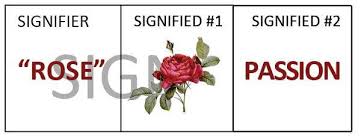
As of late, I (Cathy) have been exploring semiotic linguistics to further  my understanding of multimodality (Jewitt & Kress, 2003). Ferdinand de Saussure is considered to be one of two fathers of 20th century semiotic linguistics.  He described semiotics a as a system of signs that are created within a cultural context.  Sausuure defined a sign as being composed of:

        • a ‘signifier’ – the form which the sign takes; and
        • the ‘signified’ – the concept it represents.

On the internet I stumbled upon these diagrams which are intended to illustrate the meaning of signifier and signified.  Do you think they are both correct?

tree

rose

A multitude of communication resources

cartoon_newliteracies

When I saw this comic it made me chuckle.  I enjoyed the comic’s gentle reminder that children/youth routinely engage with and expertly navigate a variety of communication tools. Clare and I (Lydia) conducted a two-year collaborative self-study of our efforts to incorporate various technological resources (e.g. a wiki) into our pre-service literacy methods courses. This research helped us identify both the challenges and successes we encountered along the way.  Our research efforts also made us more mindful of why we chose to incorporate certain technological resources into our pedagogical practice — questioning for what purpose and to what end.   Through the analysis of our efforts we realized that we had initially seen technology as an end in itself, not as a tool to support learning. In the second year of the study, we focused much more on student learning and became more systematic in our efforts. Over the two years of the study, our identities as teacher educators shifted as our pedagogies became richer, our use of technology more fully integrated into our literacy courses, and we received validation from others and from each other.