Category Archives: schooling

Conversational Competence

“Is there any 21st-century skill more important than being able to sustain confident, coherent conversation?”conversation
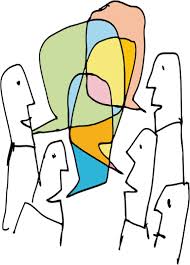
 As I watched my class struggle, I came to realize that conversational competence might be the single-most overlooked skill we fail to teach students. Kids spend hours each day engaging with ideas and one another through screens—but rarely do they have an opportunity to truly hone their interpersonal communication skills. Admittedly, teenage awkwardness and nerves play a role in difficult conversations. But students’ reliance on screens for communication is detracting—and distracting—from their engagement in real-time talk. (Paul Barnwell, 2014)

The author of this article, teacher Paul Barnwell, worries that without solid conversational skills our students won’t be able to manage important life conversations (e.g., job interviews, discssions with employers about salary negotiations, conversations with their partners, etc.) in their future which rely on them thinking on their feet (without access to Google!).

 MIT professor, Sherry Turkle, spends her time researching people’s relationship with technology. She wrote in the New York Times about the impact of tech-overload: “Face-to-face conversation unfolds slowly. It teaches patience. When we communicate on our digital devices, we learn different habits … we start to expect faster answers. To get these, we ask one another simpler questions. We dumb down our communications, even on the most important matters.”

I couldn’t agree more with Barnwell and Turkle. Teaching our students how communicate to solve problems, deal with emotions, and build meaningful relationships through conversations  is an essential skill which may need to be explicitly taught.

Read the entire article from The Atlantic below:

http://www.theatlantic.com/education/archive/2014/04/my-students-dont-know-how-to-have-a-conversation/360993/

Victoria Embraces FDELK

FDELK is the acronym for the new Full Day Early Learning Kindergarten program in Ontario and it represents much, much more than just going to school all day. The program is based on the Reggio Emilia Inquiry approach to learning, which has been in existence in Italy for over 50 years. It is a new teaching/learning approach for Ontario, however, and some teachers are still working out a few of the kinks. It is well worth the effort, though, as the results I am seeing in the schools are very exciting.

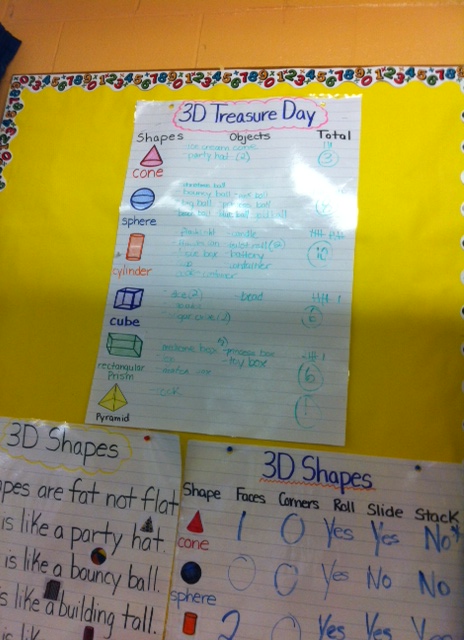
Imagine how delighted I (Cathy) was when I visited one of my practicum schools to observe a student teacher working in a FDELK placement and discovered not only had she embraced the inquiry learning process, she was sometimes leading the teachers in the approach. Her mentor teacher proudly showed me some of the things our student teacher, Victoria, had created for the class. While exploring 3D shapes, Victoria created for an with the students a: 3-D Bingo game; 3-D shape story; 3-D treasure hunt ; 3-D survey; and, 3-D art.

I knew the 3-D exploration was working too. As I watched a small group of K’s make sets of counters to add up to ten, one of the boys suddenly exclaimed, “Look! I made a rhombus !” Ahhh, to be so smart at 5. But it takes good teaching to guide them there.

VictoriaVictorias anchor

Dilemma for Educators: Focus on Pisa Scores or Improve Quality of Education

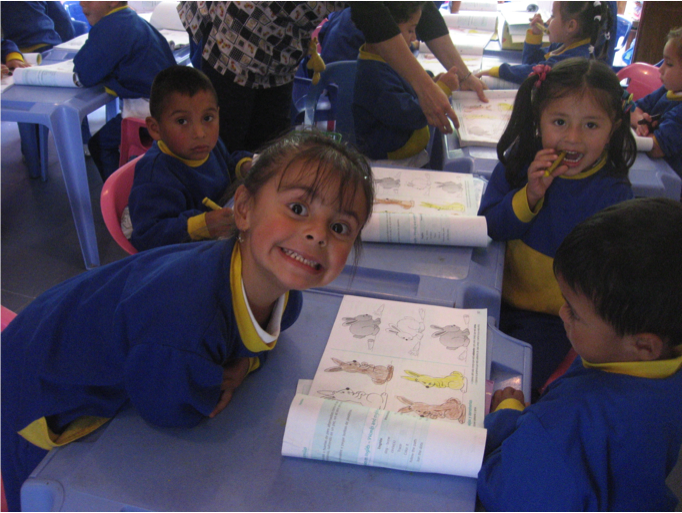
Colombian FlagClive and I (Clare) are going to Bogota and Cartagena to present at two conferences: one for teacher educators and one for teacChildren in Colombiahers. (More about our experience to follow.) In our correspondence with our Colombian hosts, who have been incredibly gracious, we get the impression they are very focused on improving Pisa scores. From our reading about Colombia we recognize there is grinding poverty yet they have made huge strides in improving literacy rates. We appreciate the dilemma faced by the Colombians –improve test scores on international measures yet education is under resourced. Being inspired by Pasi Sahlberg (and in keeping with the findings from our research as described in our new book Growing as a Teacher), the focus should not be unilaterally on improving Pisa scores but should be broader — provide quality education. Good teaching will improve literacy achievement and which in turn improve scores on Pisa. As Sahlberg’s data shows, the countries focused on controlling the curriculum and on teaching to the test have declining achievement on Pisa. (See April 19th blog post on this topic.) Drills and mindless worksheets will not engaged those children who do not see themselves as readers. So our message will be – let’s support teachers so they know how to provide relevant, engaging, and appropriate curriculum. The scores on Pisa will take care of themselves. We would love to hear from others who have worked in Colombia.
Our New Book! Growing as a Teacher: Goals and Pathways of Ongoing Teacher Learning

Growing as a Teacher book cover

Clare and I (Clive) are glad to announce the release of our new book Growing as a Teacher, published by Sense. https://www.sensepublishers.com/catalogs/bookseries/professional-learning-1/growing-as-a-teacher/

It’s based on the first 8 years of our longitudinal study of 42 teachers, teaching mainly in Ontario but also New York and New Jersey.
Our central finding was that teachers learn a great deal informally, especially through classroom experience. This is in line with Donald Schon’s (1983) notion of “reflection in practice”: teachers learn through “experimental research, then and there, in the classroom” (p. 66). Similarly, Chris Day (1999) speaks of “the largely private, unaided learning from experience through which most teachers learn to survive, become competent, and develop” (p. 2).
Over their first 8 years, our teachers learned about: program planning, assessment, individualization, teaching for relevance, classroom organization, community building, work-life balance, and many other topics. In varying degrees, they developed a comprehensive, integrated vision of effective teaching, going well beyond their initial understanding.
In the book we discuss key implications of these findings:

  • Teachers should see themselves as major “experts” on teaching, with abundant opportunities to inquire into teaching over the years. They should be willing to make decisions in the classroom and take a firm stance in adapting system initiatives.
  • ITE instructors should promote this strong conception of teacher learning and expertise, and see themselves largely as “laying a foundation…preparing novices to learn in and from their practice” (Feiman-Nemser, 2001, p. 1016).
  • PD facilitators should dialogue with teachers and build on their emerging vision and approach, rather than imposing system mandates in top-down fashion.
  • Principals should support teachers in their learning, providing frequent opportunities for them to watch each other teach and share their developing insights.

Teachers can benefit greatly from external input, but not if it’s imposed “top-down” without reference to their views and experiences.
We have greatly enjoyed listening to the teachers in our study and will continue to do so into the future. We hope their voices and experiences will be helpful to teachers, teacher candidates, ITE instructors, and all those responsible for school policies and ongoing teacher learning.


21st Century Learning and the Need to Shift Our Thinking

Several of our posts refer to 21st century learning, technology, multi-literacies and thinking about today’s student and world. I (Yiola) found this article from the Huffington post called: The Global Search for Education: Education and Jobs quite interesting. The article talks about the need for drastic changes to our Educational systems in order to meet the growing demands of the market place in the 21st century. Bottom line, technology is taking over many of the jobs people currently do and so we need to reconsider the skills we are providing to students. The article goes on to say that our traditional and current systems continue to develop linear thinkers and producers but what we really need to develop are individuals with:

the ability to initiate, discern, persevere, collaborate, and to solve problems creatively are the qualities most in demand today and will be increasingly important in the future. The problem is that our education system was designed, primarily, to teach the three R’s and to transmit content knowledge. We need to create schools that coach students for skill and will, in addition to teaching content. If we don’t make this transition quickly, a growing number of our youth will be unemployable at the same time that employers complain that they cannot find new hires that have the skills they need.

I tend to agree with the article however I raise two points for discussion:
1)   Teacher education programs do teach to the creative, inquiry-based modes of pedagogy. I certainly cannot speak for all programs but I am familiar with several and teacher educators do work hard to teach pedagogies that meet the needs of today’s learners. So, why then are classroom teachers not teaching in these ways? Or, are they?
2)   I have seen time and time again policies and actual changes take place at the Government level but once changes happen in schools it is often society at large that is in an uproar. For example, here in Ontario we have implemented Full Day Kindergarten (early years) and the program is designed to develop higher level thinking right from the start. This transition, while happening, has not been without significant reluctance from the general public. What then do we do?

For more considerations here is the full article:  http://www.huffingtonpost.com/c-m-rubin/the-global-search-for-edu_b_5084761.html?utm_hp_ref=email_share


Public Education vs Charter Schools: The Battle in NYC

I (Clare) was watching Chris Hayes’ show (MSNBC – All in with Chris Hayes) the other New York City Buildingsnight. He had a really interesting segment on charter schools in NYC. His two guests (Brian Jones, NYC teacher, and James Merriman, NYC Charter School Center) had a “lively” discussion on the battle in NYC between the city and the charter school supporters. The teacher, Brian Jones, who argued passionately and articulately for public schools was outstanding. He laid out the reasons why we need to fully support public schools and the dangers of charter schools. Chris Hayes started the segment with a slick ad that is being used to support charter schools; this was cringe-worthy but it showed how all of us who support public education, need to stand up and make our voices heard. There are powerful (business) interests supporting charter schools which in itself raises a red flag for me.

Here is a link to the segment from Chris Hayes’ show: http://www.msnbc.com/all-in/watch/battle-wages-on-over-nyc-charter-schools-190737987700

Brian JonesIf you want to know more about Brian Jones check out:

·      The video The Inconvenient Truth Behind Waiting for Superman which he co-narrated http://vimeo.com/41994760

·      You Tube clip on the dangers of testing. https://www.youtube.com/watch?v=A73_keoCWo8

·      Or this Tumblr feed: http://brianpjones.tumblr.com/BrianJones