I (Clare) always love watching the Olympics but this year is different.  Actually, I was not even sure what day they began. The travesty of the Putin Games has really been off-putting: the $50 billion cost, the impact on the environment, the anti-homophobia rants and …. The cost of the games is staggering when you think of the millions of Russians living below the poverty line. Is this a good way to spend so much money? I saw a little feature on the Olympic Village that left me shaking my head. The beds for the athletes are only cots. The athletes have devoted years to preparing for the games and have sacrificed so much but they will not even have a proper bed. Sorry to sound so simplistic but I think the focus should be on the athletes. I watched a few minutes of the parade of athletes in the opening ceremonies that further cemented my view that the focus of the games seems a bit misplaced. The women leading in each contingent are dressed in skin-tight white outfits with a very revealing slit. I live in a cold climate and you do not see women parading around in such revealing outfits. Do we really need sexy, hot babes at the opening ceremony? All that said, I hope these games go off without any incidents and each athlete has a personal best. Clare
Category Archives: Social Justice
A Model Blog: Nick Burbules
 My (Clive) recent experiences writing blogs and discussing them with my ITE class have made me think more about blogging as a writing and communication form. This in turn has led me to look more closely at the blogs posted at Progressive Blog Digest by my friend Nick Burbules, who I know through the Philosophy of Education Society. http://pbd.blogspot.ca/2014_02_01_archive.html
So far as I know, Nick established this site – and maintains it – on his own. (I’ll try to entice him to give us some back story.) It must take up a great deal of his time: it appears almost every day and is extraordinarily informative. It focuses mainly on US politics, taking a “progressive” approach to issues, while not avoiding all criticism of Democratic icons such as President Obama. The tone reminds me of Rachel Madow of MSNBC. http://www.msnbc.com/rachel-maddow-show
What is distinctive and so valuable about the site is that while Nick obviously has strong views, he doesn’t use it as a soap-box. His one-liners (often one-worders) are clever, funny and pointed. But they are followed by anywhere from one to half-a-dozen links that give followers immediate access to relevant information, examples and articles. I can imagine people spending a lot of time at this site, loving it, and learning a great deal. Which presumably is just what Nick wants.
Just Call Me Paul: The Ethnicity Saga Continues
On Monday I (Clive) shared my previous blog on multicultural education and stereotyping with my social foundations class. This proved to be a great literacy activity on blogging as a writing form that both teachers and students need to master, one that helps us clarify our ideas and make our communication more precise. It also renewed our conversation about how to approach ethnicity in the classroom. We went round the whole class, each person commenting in turn on the blog. No one chose to pass and everyone was interested in what others had to say. A couple were struck by my profile of “Mike”: they had no idea that people of Irish and Scots background might look down on each other. On the whole people liked the blog, but they continued to refine points and add personal stories.
We heard a new story of complex ethnicity from a class member of Indian ancestry who grew up in Madagascar, lived in a French-speaking environment for several years and became fluent in French, spent time in India where she was told she spoke Hindi with an accent, and then moved to Canada where she hopes to teach French as a second language. What is her ethnicity?
Then on Tuesday the wonderful personal essay “Just Call Me Paul” appeared in one of our local newspapers. http://www.theglobeandmail.com/life/facts-and-arguments/changing-my-name-doesnt-mean-im-betraying-my-identity/article16406166/
G. Paul Sileika’s grandparents migrated to Canada from Lithuania over 50 years ago. In the 1970s when multiculturalism was on the rise his parents decided to give him a name that “reflected their ancestral origins.” They named him Gintaras and called him Gint for short. With rich humor, no self-pity, and trenchant common-sense he talks about the impact of this decision on his life. The whole article is well worth reading.
What struck me especially was how he felt his identity was lost. “Before I can even begin to build rapport with someone or connect on a common interest, my name catches his or her attention. Before I can share my personal story one is already written for me.” Because the name was unfamiliar and difficult to pronounce correctly (the “G” is hard), many called him “you” or simply nothing. Long after finishing university he finally decided to switch to using his middle name – Paul – and hasn’t looked back. He says he believes in multiculturalism and is proud of his heritage, but wants to go by Paul in informal contexts and G. Paul in formal ones; if anyone asks what the G. stands for, he’s “happy to tell them.”
Of course, although you can change your name you can’t change your accent or physical appearance. But Paul’s story illustrates well how we should often move beyond such markers, rather than dwelling on them unduly – as so often happens in multiculturalism classes. While prejudice and discrimination must be studied in depth and actively opposed, there’s so much more to a person than the ethnicity of their parents and grandparents. We must also explore and celebrate their constantly emerging individual identity, of which their complex ethnic identity is just one part. Otherwise, like Paul, much of their identity may be lost.
If You Build It: Documentary on Making Teaching Relevant
If you live anywhere in the Toronto region you might be interested in this documentary, IF YOU BUILD IT. The film is a captivating look at a radically innovative approach to education. The film follows designer-activists Emily Pilloton and Matthew Miller to rural Bertie County, the poorest in North Carolina, where they work with local high school students to help transform both their community and their lives. Living on credit and grant money, and fighting a change-resistant school board, Pilloton and Miller lead their students through a year-long, full-scale design and build project that does much more than just teach basic construction skills—it shows ten teenagers the power of design-thinking to reinvent their town and their own sense of what’s possible. IF YOU BUILD IT offers a compelling and hopeful vision for a new kind of classroom in which students learn the tools to design their futures. Here is the link to a clip from the movie: http://www.hotdocs.ca/docsoup/doc_soup_toronto/
The documentary is being shown in a number of cities in Canada. To find out where click on this link: http://www.hotdocs.ca/docsoup/doc_soup_toronto/ and it is probably being shown in cities world-wide. Even if you cannot attend the documentary, watching a clip of the movie is fascinating.
Hot Docs is pleased to announce that February’s Doc Soup will present the Canadian premiere of IF YOU BUILD IT (D: Patrick Creadon, USA, 85 min.) An official selection of the 2013 Full Frame Documentary Festival, IF YOU BUILD IT will screen on Wednesday, February 5, at 6:30 p.m. and 9:15 p.m., and on Thursday, February 6, at 6:45 p.m. at the Bloor Hot Docs Cinema (506 Bloor St. West).
Filmmaker Patrick Creadon will be in attendance to introduce the film and answer questions following the screenings. For more information please visit: http://www.hotdocs.ca/docsoup/doc_soup_toronto/
We look forward to seeing you at the Bloor Hot Docs Cinema on Wednesday, February 5, and Thursday, February 6 for IF YOU BUILD IT!
If you have any questions regarding your tickets or any questions or comments about Doc Soup, please email our box office bloorboxoffice@hotdoc s.ca, or call 416.637.5150.
Multicultural Education that Avoids Stereotyping
Stereotypes are the main basis of prejudice and discrimination; yet multicultural education often reinforces stereotypes. How to resolve this problem?
My (Clive) social foundations ITE class this year is a dream come true: bursting with talent; an extremely diverse group but with a strong sense of camaraderie; full of fun but serious about learning to teach well. On Monday we had the second of three classes on inclusive education, with a focus that day on multicultural education. It was a wonderful session. Every student participated, and many spoke openly about their own racial and ethnic background. For example:
- Jim: Identifies as Black, born in Canada, of Caribbean ancestry, not tall enough to play basketball well, doesn’t like rap music.
- Janni: Born in Canada; her parents are of South Asian ancestry but grew up in South Africa and talk often about their life in that country.
- Sandi: Parents of Indian background, most of her schooling in Germany, often refers to herself as Tamil Canadian.
- Ali: Identified by others as Black, ½ Somali, ¼ Italian, lived much of his early life in Saudi Arabia before his family moved to Canada, family is Muslin but he isn’t really religious.
- Mike: Born in Canada but of ¾ Irish and ¼ Scots ancestry, classical musician, worried in school that when teachers saw his Irish name they would look down on him.
Given this ethnic complexity in today’s world, how can we take the common approach of talking about ethnic groups and resolving to respect the people who belong to them? In what sense do students have an ethnic identity? True, people differ a lot, but their differences rarely run along ethnic, racial, or religious lines. The differences within such categories are much greater than between them. A large proportion of a person’s identity comes from individual qualities, as advocates of differentiation and multiple intelligences have said for some time. Ethnicity is important and should be respected, but individuals have complex ethnicities and draw on each facet in distinctive ways.
As the discussion unfolded, we came to the conclusion that in school we should focus largely on: (a) historical and current cases of bias and discrimination and their enormous human cost; (b) the positives of being inclusive; (c) the limits to ethnic and racial labelling; (d) commonalities that cut across sub-groups; and (e) the importance of individual identity.
At a personal level, many students seemed relieved at the thought that they could develop their own identity and didn’t have to fit a standard ethnic identity. I think many school students would feel the same way, and adopting this approach in the classroom would strengthen community and individual self-esteem.

IB schooling in Mumbai
While in Mumbai, I (Pooja) had some candid conversations with my cousins (who now have school-aged children) about schooling. The International Baccalaureate (IB) has quickly become the new standard. My cousins spoke highly about the IB curriculum, noting that it encouraged students to view themselves as “global citizens.” The curriculum, they commented, deviated away from that of traditional schooling in India. The skills were now focused on: critical thinking; intercultural awareness; independent learning; evaluating and constructing arguments; and independent learning.
The pressures to get their children into an International Baccalaureate (IB) program were high. My cousins already had aspirations of sending their young children to top-performing universities outside of India (mostly in the U.S., Canada, and U.K.). A major concern I heard was that if they did not get into an IB program, how would they compete in this highly globalized world? I understood this to mean that in order to be competitive one had to be complete their formal education outside of India. This was concerning because competition aside, IB schools are extremely expensive, and so, not available to the vast majority of families in India. While very few are privileged to apply and possibly attend IB schools in India, most school children in India still attend public school. I am interested in learning more about the public school curriculum in Mumbai? How are public schools currently preparing their students to be “global citizens?” or is this a notion that is still intangible for most? Pooja
Unsung: Behind the Glee: A MUST Watch Video
There is an amazing documentary, Unsung: Behind the Glee, which chronicles the journey of two rival Toronto high school glee clubs as they gear up for a musical showdown at the annual Show Choir Canada National Championship.
http://ww3.tvo.org/video/196690/unsung-behind-glee
This documentary is fascinating because
· it has incredible music and dance;
· shows the value of the arts in the lives of some adolescents;
· and clearly demonstrates the commitment of teachers.
Yes it is a competition (and many of the students are elite singers/dancers) but it is an inside look at the work and enthusiasm of teachers and students alike. For some students their involvement in music and dance literally “saved” them. For some of the teachers, their music/dance groups are like their family (they scold, praise, encourage, laugh, cry). There are powerful stories of kids overcoming huge adversity through their involvement in these musical groups.
Clive and I watched it last night and I was moved to tears. It is only available until January 27th so give yourself an hour (stop preparing for class or marking or doing housework ….) and watch it.
For those of you not in the arts (like me) it was very informative. For those of you in the arts you will probably relate to the stories and unfolding events. Whether students are elite or just enjoy music and dance (for appreciation), the arts have a very important place in the curriculum and should be well funded. The arts are not a frill but are part of the basics of life.
Clare
Winter Clothing is a Basic
 Many of us in North America are enduring the coldest weather in decades. This morning it is -39 Celsius (= -40 F). Bone chilling does not even begin to describe the experience of being out in this weather. Whenever we have frigid weather like this I recall my time as a classroom teacher. I taught in very high needs schools and when winter roared in, many of the children suffered terribly because they did not have adequate winter clothing. Last night on Chris Matthews’ show, Hardball, on MSNBC http://www.msnbc.com/hardball/watch/the-need-to-sustain-the-social-safety-net-108521539760
there was talk about the American Congress wanting to end welfare benefits. All those politicians who vote to end or reduce welfare benefits they should visit an urban school in the depths of winter and tell some children that they do not deserve a winter coat and mittens.
When I was a teacher, every year I would go to children’s clothing stores and beg for winter gear (coats, mittens, boots) for my students who were so inadequately dressed. Never once did I leave a store empty-handed. Many of the teachers on staff engaged in similar missions and many who were moms or dads would bring in winter clothes that their own children had out-grown. So those politicians who want to micro-manage teachers and impose an array of standards should accompany those teachers to children’s stores to beg for donations. I am sure this reality-check would have a real influence because they would learn what teaching is all about. Their view that teachers need to be told what to do and should be penalized for not focusing solely on the “basics” might change. Aren’t winter clothes a basic? I think so. Stay warm! Clare
Social Justice through Activism in Mumbai
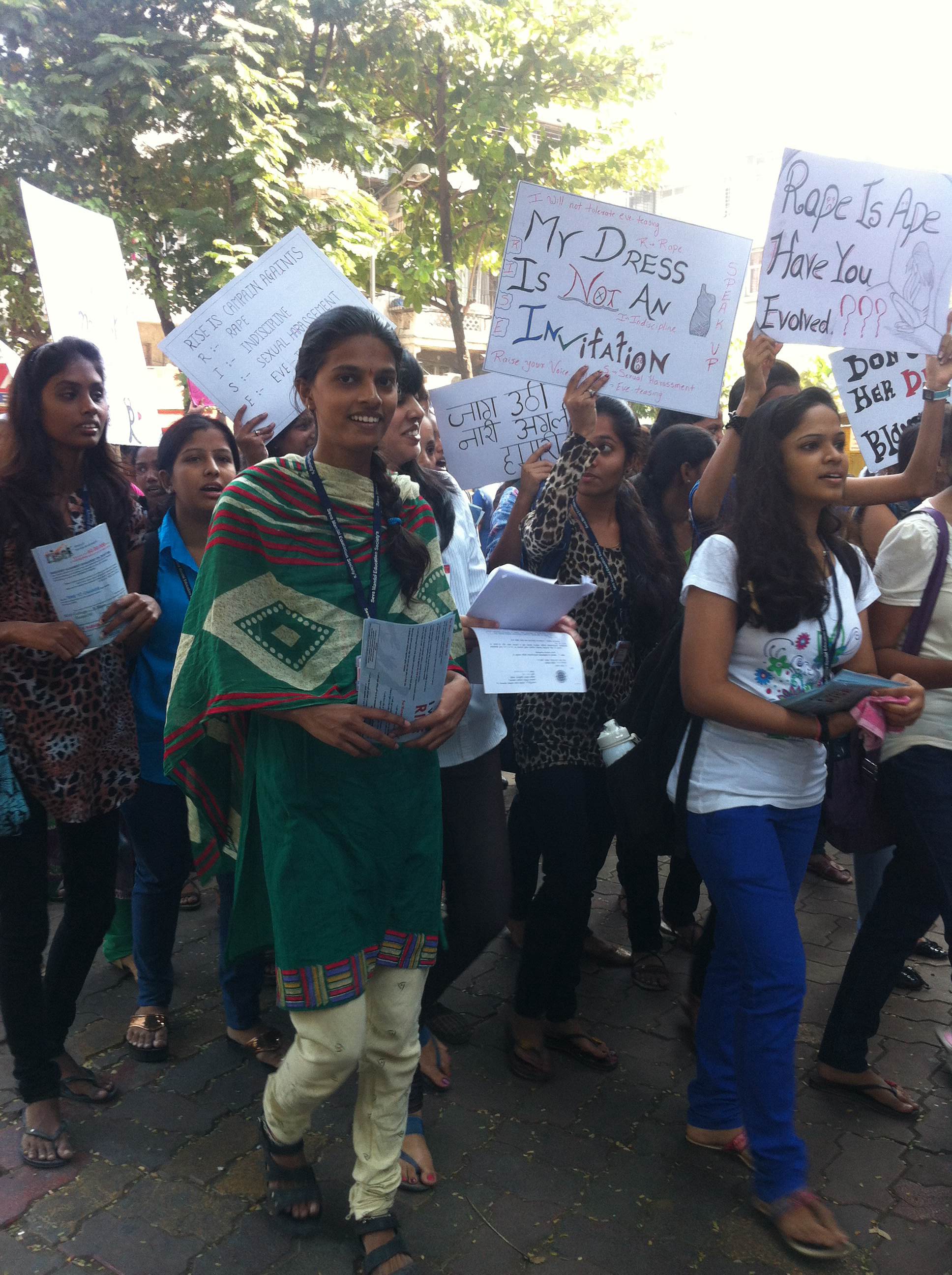 While I (Pooja) was only in Mumbai, India for two short weeks, I was able to observe (and participate in!) acts of social justice through activism. I was pleased to notice so many young women in organizational and leadership roles.
A week before I had arrived the Indian Supreme Court had reinstated a law criminalizing acts of homosexuality (Section 377 in the Indian Penal Code). I, along with many others, was shocked. This was a huge step backwards for India and its people, in my opinion. Within a matter of days rallies were organized all over India to protest. One of the major rallies was held in the park around the corner from where I was staying. Although the news of Section 377 was truly saddening, I was uplifted to see the youth organize themselves so poignantly. This rally received a lot of coverage and gave hope back to many who had been personally affected by this decision. Below is a link with some images capturing the spirit of the protest in Matunga, Mumbai:
A few days later, while taking a morning walk, I passed by a large group of young girls  protesting against the treatment of women in India. Over the past year, media sources in India had shed light on a few horrific rape cases from around India. I asked one of the young women protesting what had inspired them to take this injustice upon themselves. She told me they had organized themselves because they wanted to have their voices heard and their message conveyed: “We are not going to stand for the mistreatment of any woman, anywhere.” For the past week they got together, outside of school hours, to make signs and spread the word. In total there were about 100 young women protesting. They had made there message clear. They stood in solidarity with women all across India. Pooja
 Literacy Teaching and Teacher Education