Category Archives: Teacher education

Guest Blog: Susan Elliott-Johns

I (Clare) am very pleased to share information about Susan Elliott-Johns’ recently published book.  I have read the entire book and found it fascinating. There is so little written from the perspective of Deans of Education this text will fill a void in the literature. Congratulations Susan. (Susan is an Associate Professor at Nipissing University Canada.)

In a recently published book, Leadership for Change in Teacher Education: Voices of DIVS-Elliott_PB_firstproof.inddCanadian Deans of Education I (Susan) have compiled a rich sampling of diverse perspectives on this topic in a unique collection of reflections contributed by deans of education across Canada. The focus of my inquiry, “What would we hear from deans of education invited to share their perspectives on leadership for change in contemporary teacher education?” invited deans of education to reflect on the research, policies and practices currently informing their leadership. In the current era of teacher education reform, I thought it would be informative and illuminating to explore insights deans of education might share to assist others in understanding their role as leaders of teacher education and change today. In other words, what does it mean to be a dean of education in the 21st century?

The results, fourteen engaging and provocative essays, offer emic perspectives and increased understandings of the complex nature of deans’ work. Their reflections explore significant concerns in relation to lived experience and the multi-faceted processes of leading change for teacher education in contemporary contexts – the transitions, change, and uncertainties inherent in these contexts. What really struck me about the reflections in these short essays is how clearly they underscore the critical role of deans in provoking, supporting and championing new ideas and approaches to pedagogy for teacher education. Their voices clarify many of the complexities involved in leading the change, but they also resonate with optimism and determination. That said, the limited scope of related research available also suggests urgent attention needs to be paid, in both research and practice, to better understandings of this increasingly complex role, and support for more coherent approaches to the preparation of deans and their sustainable leadership. More than anything else, I hope this project will inspire others to truly listen to the voices of these Canadian deans of education.

Further information, including the Table of Contents and a sample of the first three chapters, is available at:

https://www.sensepublishers.com/catalogs/bookseries/other-books/leadership-for-change-in-teacher-education/

The First of the last: Happy December

Today is December 1st, the first day of the last month of the year.  I (yiola) have finished teaching for the term as courses have ended and student teachers are wrapping up their final week of classroom teaching placements. I have papers to read and evaluate and grades to report and then my thoughts move into the next term with considerations for how to make my courses and learning experience even better than the last.

It has been a wonderful term. Beyond feeling good about the term, I reflect on what I think has made my courses run smoothly. Below I list some of the elements that stand out as contributing to the making of successful learning experiences in my teacher education courses.

The Students: Hands down the most influential element for fostering successful learning experiences in my courses are the students; their preparedness, willingness to learn, participation in class, positive attitudes and approaches during class discussions, and openness to critically thinking about all they are learning.

Content and Pedagogy:  What to teach and how to teach in teacher education have always made for interesting discussions. As post-graduate education I see the courses as graduate level courses that are also part of a professional program. I ground the readings and my teaching in research and share information that is interesting, accessible, and what I will call connectable.  Connectable meaning bringing together the research with student teachers’ practical experiences and the Ministry curriculum. Research, practice, policy are the three points of my pedagogical content triangle.  The content needs to be current, relevant, accessible and grounded in research. My role is to bring the content to life; to encourage students to think about the content and how it applies to their practice and to student learning; to critique the content and think critically about it, not to criticize but rather to analyze.

Our teacher education classes are three hours long and within those three hours there are a number of pedagogical strategies used to engage and extend our learning:  what I call a lecturette is something I bring to each class ~ a short presentation that addresses and extends key issues based on research and scholarship; small group discussions; whole class discussions; student led presentations; short experiential opportunities. For example, last week as we explored program planning and cross curricular considerations I gave a short lecturette on the concept of program planning using Beck and Kosnik’s work from The Seven Priorities of Teacher Education. The literature we used was liberating in that it presented not only research-based content but also “real life” content of what it meant to consider for program planning. Student teachers were able to relate and think broadly about what it meant to program plan in the elementary classroom and this was evident through the class discussions.  We then moved into exploring some of the concepts presented in the reading and focused on integration and cross-curricular connections. I shared a read aloud Wangari’s Trees of Peace set a context for planning development. I modelled working through the beginnings of a planning process.  The students got into small groups and explored the curriculum looking at ways to integrate and build on what I started.  Students represented their thinking on chart paper which was put up for a gallery walk (that way avoiding every group presenting) and we came back and analyzed the experience of thinking about cross-curricular possibilities  and how it relates back to the broader scope of program planning.

Theory and Practice:  I teach theory. Even when I talk about practice, I am theorizing practice. As a teacher educator in my university classroom it is what I do. I can talk about my practice. I can have students talk about their practice and we can apply practical elements into the classes. These are some subtle ways of connecting theory to practice. What happens in our course that I believe really ties theory to practice is the presence of the practicum coordinator at our classes. The practicum coordinator is the person who sets up the teaching placements, consults with students about their teaching placements, visits the students at their teaching placements and brings to the program all elements of practice. This person also attends my courses. She often sits in on the classes, adds practice teaching suggestions and resources to the discussion and often extends the learning by taking twenty minutes to share insights between what we discuss in class and the teaching placements. The students share their experiences and provide concrete examples from their specific teaching placements.

Snack: Food = community. Food = nourishment. Food = caring.  The learning environment is enriched when there is time for the community to come together over a small snack during the break. This is an essential part of the class.

And then there are elements that run outside the courses  that have had such strong influence on my practice:

Mentorship:  The modelling and care my mentors have shown for teacher education has paved the way for my practice. The opportunity to be a Teaching Assistant in an exemplary teacher educators class during one’s doctoral journey holds much benefit. Clare Kosnik has been my mentor and has demonstrated excellence in teacher education that I have been able to learn. From planning, to content, to pedagogy, and community building I have received mentorship through observation, discussions, sharing, and co-teaching I have been able to extend and build on her amazing work.  Excellence does not happen at the onset of one’s practice but there is no better way to begin one’s practice than to listen, observe and work with an exemplary teacher educator.

Research:  Reading about teacher education, talking about teacher education, researching teacher education, writing about teacher education are at the core of my practice.  When I wonder how to design my assignments, I look to the literature and discuss with my mentor;  when I wonder how student teachers may respond to particular critical content areas, I look to the literature and quickly gain a clear portrait of what to expect and how to approach the potential reactions and experiences my students may face; when I prepare to teach issues of literacy teaching I look to the literature of literacy teacher educators and that allows me to consider my own practice and how to make it better for student teacher learning.

And now with December upon us, today is the first day of the last month of the year,  and the closing of a term is near I wish all teacher educators all the best.

Explaining Explain Everything (App)

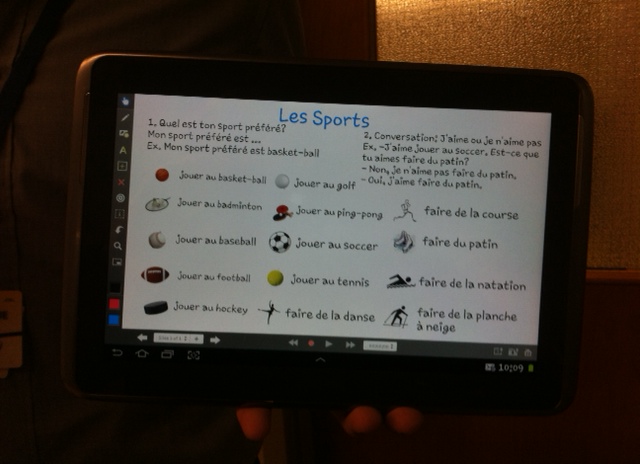
I (Cathy) find that one of the exciting aspects of teaching is learning from my students- especially about digital technology.    One of my student teachers, Drake, taught a lesson last week using Explain Everything.  With the aid of this app he successfully taught  a lesson in French which enabled his grade 6 students to engage in conversations about sports.  How he used the app was definitely key to the success of his lesson and I gave him full credit for cleverly scaffolding the sequence of the questions and answers so that that student conversations were set up for success.  Yet, Drake insisted it was the app that enabled him to teach the lesson so clearly.  Below are pictures of how Drake set up the lesson on his ipad and then mailed it to himself as a handout for his students.  Well done Drake!

Drakeipad

Intrigued, I began to play with this app myself.  I discovered it has a wide range of  applications. It feels like a cross between a power point and a smart board, but completely doable on an ipad.   Very convenient.  Below is an link to a you tube video that demonstrates how students can use the app in a classroom.


“Goodnight Moon” revisited

Many are familiar with the picture book Goodnight Moon by Margaret Wise.

Unknown

In case you are not familiar or need a refresher, here is a link to the story:

It is a lovely bedtime story, rhythmical and calming.  Originally published in the late 1940s, and still selling strong today, millions of children have enjoyed the simple tale. It is a classic.

And then came a parody, Goodnight iPad.  Amusingly written by “Ann Droyd” the book is awesome.

Unknown-1

When I (Yiola) first read the book I laughed and laughed and laughed. It is witty and clever while successfully maintaining the rhythm of the original.  It is a powerful message for 21st century learners: know when to unplug!  

Here is a link to the book.

Or for a flashier, more techy version, check out this link:

From the 1940s to today… the images and ideas that need a ‘good night’ have changed  drastically but a child’s wonder and desire to stay up has stayed the same.

I like how the traditional genre of the picture book captures the power of technology in our society so beautifully. A classic communication tool.

I plan to use this text as a closure piece on Technology Day next term.

“Goodnight gadgets everywhere”

Engaging Students in Math

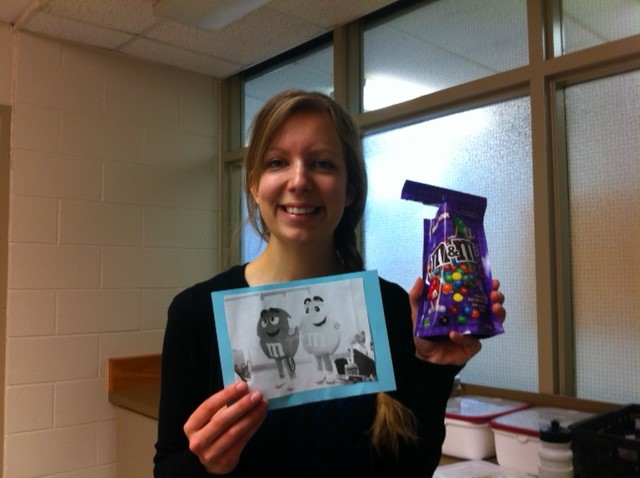
The day after Halloween, one of my (Cathy’s) student teachers, Megan, presented a wonderful lesson to a group of grade four students on probability.  She opened the lesson with a picture of herself dressed as an M&M.  (This was not really her of course, but the students didn’t know that).  She told the story of how she disguised herself as an M&M and went out trick or treating.  One nice lady gave her a whole bag of M&Ms because of her great costume.  Megan wondered aloud on the probability of pulling out red M&Ms as opposed to green M&Ms or yellow ones.  This student teacher had these children with the picture, but the M&Ms clenched it.  All of the students wanted to predict.   The students moved from large group work to small groups to independent work with ease.  Interestingly, Megan did not allow the children to eat the M&Ms.  They were data.  The children accepted this fact and made no protest.  The math remained the focus throughout the lesson.  The lesson was an absolute delight to watch.   Trouble is, I may never eat M&Ms the same way again.  I will always be calculating the probabilities of pulling that red one.

photo

Celebrating the 25th Anniversary of True Story of the Three Little Pigs

As the 25th anniversary of the picture book The True Story of the Three Little Pigs approaches author Jon Scieszka and illustrator Lane Smith recount the origins of their collaboration and the challenges of securing a publisher for the sophisticated parody. As Smith recalls, “some editors liked it but were a little confused and not sure if there was a market for it. Back at that time, children’s books were either serious, earnest books, or really funny books. But the sense of parody and irony that is rampant now didn’t really exist then…Viking put the book out very tentatively. They weren’t convinced of anything and did a small run that immediately sold out. It was all word-of-mouth from teachers, librarians and booksellers. They didn’t run ads or do a publicity push. Finally by the fourth or fifth printing the runs were more like 50,000.”

Follow the link below to read the full interview with Jon Scieszka and Lane Smith:

http://www.publishersweekly.com/pw/by-topic/childrens/childrens-book-news/article/64695-the-true-25th-anniversary-story-of-the-three-little-pigs.html?utm_source=Publishers+Weekly&utm_campaign=94f331fbd0-UA-15906914-1&utm_medium=email&utm_term=0_0bb2959cbb-94f331fbd0-305134397

ThreePigs

Literacy development and genres: The graphic novel

When I (yiola) first began teaching  (in 2008) I asked student teachers if they knew about graphic novels.  The response was that few students were familiar with the genre or how and why it may benefit learning in the classroom. With each passing year more and more student teachers indicate they are familiar with graphic novels and more and more student teachers recognize the genre inside classrooms.

Some use the term graphic novels interchangeably with comics with others differentiate the two as distinct styles. In either case there are strong arguments for why the graphic novel is a powerful genre for literacy development.

6 Reasons You Need To Start Reading Comic Books

http://neillcameron.blogspot.co.uk/2014/09/comics-and-literacy-part-1-why-reading.html

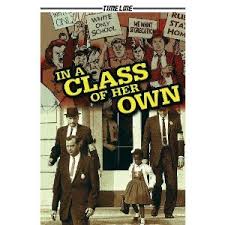
I introduce student teachers to David Booth’s book “In Graphic Detail” and I share the graphic novel “In a Class of her Own” to demonstrate how critical literacy and language acquisition can be developed in meaningful and interesting ways.

Unknown


http://www.theguardian.com/childrens-books-site/2013/mar/19/review-in-a-class-of-her-own-kathleen-gould-lundy

The sharing of the graphic novel as a useful genre in the classroom is a highlight in my course. Many student teachers become inspired to use graphic novels once they are introduced to why they are effective and how to use them in a classroom setting.

Please share any great graphic novel titles that you know to be outstanding.


Language and power: A well “articulated” analysis

It is  a rewarding feeling when a student teacher from years past emails a link to an article, a video, or an image that is reflective of the messages we discussed in our teacher education class. The message it sends me is this, “I remember you. I remember your teachings. I learned and am still thinking about what it means to be a teacher and what it means to teach literacy”.  Today I (Yiola) received a short email from a student of four years ago. She sent the following link:

The link takes us to a spoken word presentation entitled “3 Ways to Speak English” shared on TED during a theme based session called “Examining Prejudice”.  Her talk as part of the series is described as:

Educator Jamila Lyiscott delivered an incredible poem called “Broken English,” in which she showed that she is a “Trilingual orator” able to speak fluently at home, with Caribbean parents, at school in “proper English,” and with her friends in a language that is as formal and rules-based as the other two. The poem raised a big laugh when she pointed out, “You may think it is ignorant to speak Broken English, but even articulate Americans sound foolish to the British.”

My favourite part is when she says:

So I may not always come before you with excellency of speech

But do not judge me by my language and assume

That I’m too ignorant to teach

‘Cause I speak three tongues

One for each:

Home, school and friends

I’m a tri-lingual orator

What stands out for me about the poem and what I will share with my students in class this week:

1) The power of language and how we associate language with power

2) Language and how it informs our identities — how many languages do you speak?

3) Linguistic profiling: the racial identification and discrimination of an individual or group of people based on their speech  and how that plays out in society and in the classroom

4) History — and how it influences our use of language

I was moved by her words as Lsyiscott describes:

These words are spoken

By someone who is simply fed up with the Eurocentric ideals of this season

And the reason I speak a composite version of your language

Is because mines was raped away along with my history

I speak broken English so the profusing gashes can remind us

That our current state is not a mystery

I’m so tired of the negative images that are driving my people mad

So unless you’ve seen it rob a bank stop calling my hair bad

I’m so sick of this nonsensical racial disparity

5) Awareness, ourselves and teaching — what do we as educators do with this knowledge?

Here is a link to a prezi that Lysicott has used at presentations:

http://prezi.com/_htjpqeom2js/how-broken-english-made-me-whole/

6) How to take our linguistic diversity and turn it into power:

This is a linguistic celebration

That’s why I put “tri-lingual” on my last job application

I can help to diversify your consumer market is all I wanted them to know

And when they call me for the interview I’ll be more than happy to show that

I can say:

“What’s good”

“Whatagwan”

And of course …“Hello”

Because I’m “articulate”

I look forward to my class on Friday and to sharing thoughts, feelings and ideas about what all of this means to children, their families and the learning environment in our elementary school classrooms.


All About Me Texts

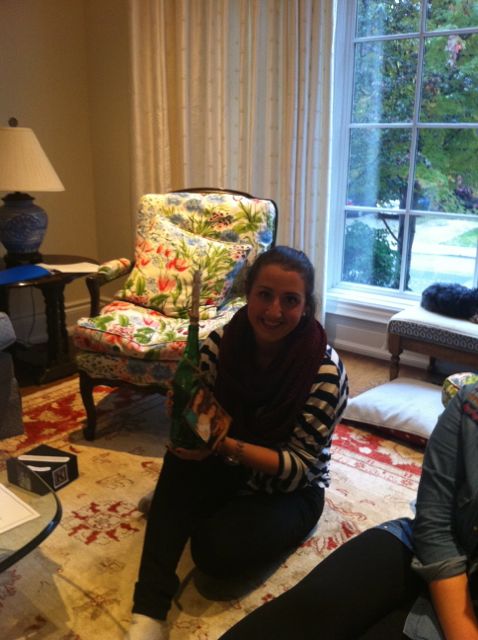
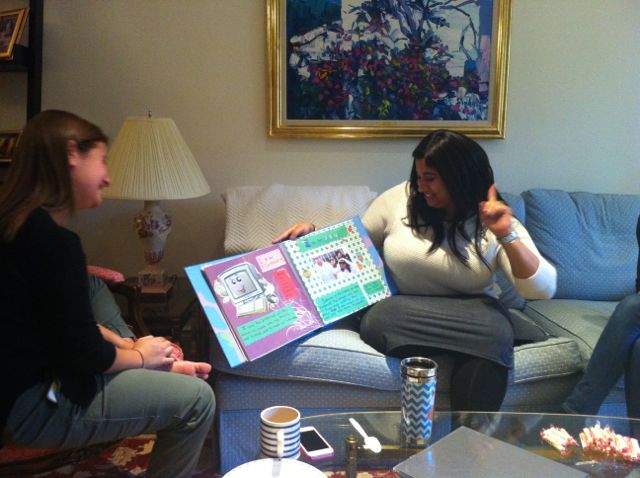
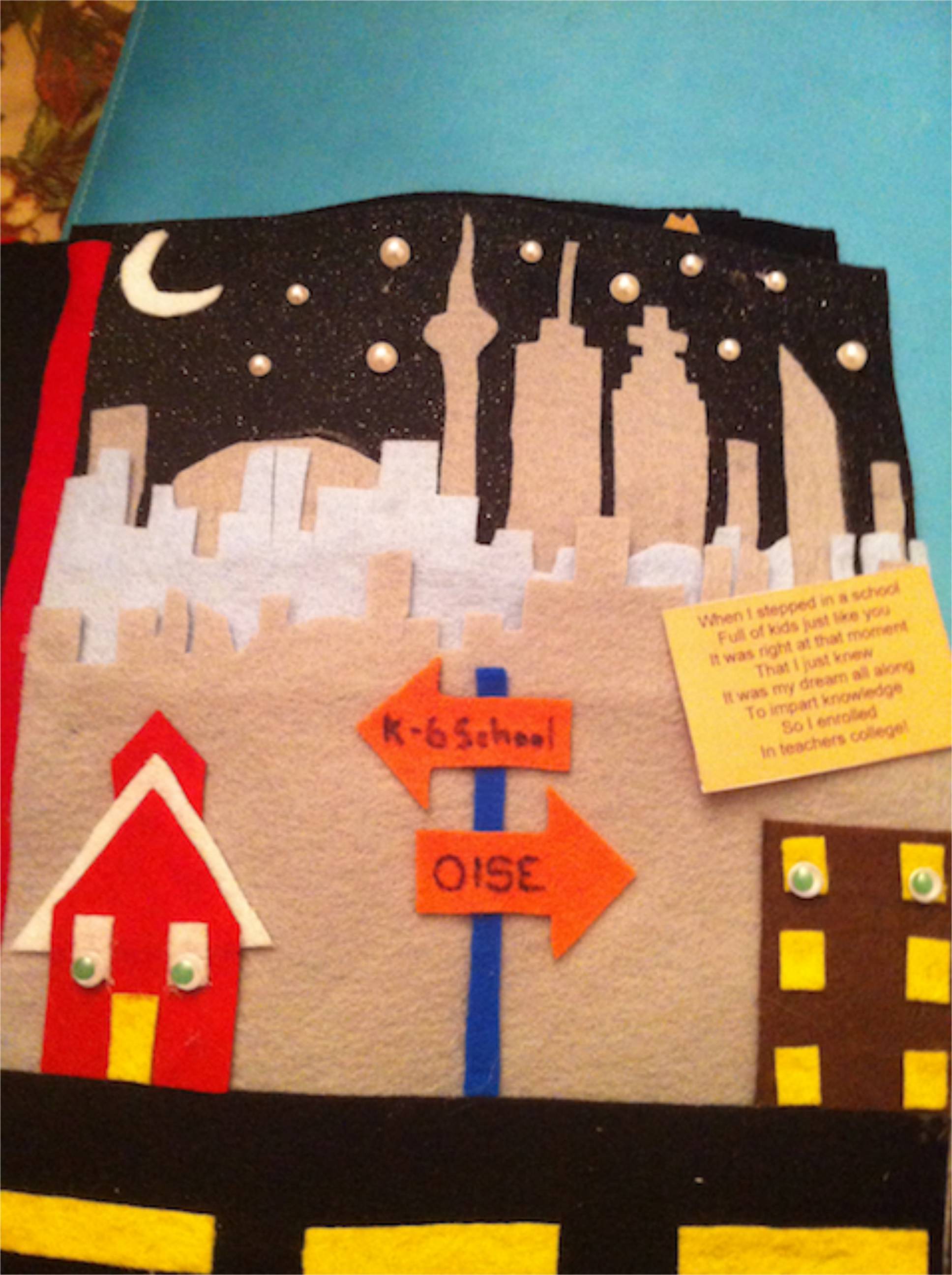
We had an amazing literacy class yesterday. We (Clare and Lydia) along with the student teachers in our P/J and J/I literacy courses shared our All About Me texts. As a class we meet weekly in a designated classroom on campus, but this week class was extra special, as Clare graciously invited us into her home to share our texts in a more personal space. The student teachers engaged a rich array of storytelling formats including – playbills, a message in a bottle, interactive ABC books, puzzles, dual language texts, a personal timeline plotted out with illustrated cityscapes, e-books, comic strips, Pokémon cards, nesting boxes housing artifacts documenting developmental milestone – to share aspects of themselves to an attentive audience of their peers. The depth of thought and creativity communicated through their texts was truly impressive and inspiring. I’m sure the children/youth they’ll be teaching in their upcoming placements will enjoy these texts as much as we all did. It was a truly enjoyable day. Thank you to all the student teachers in our literacy community!!


IMG_1357IMG_1344IMG_1349IMG_1343IMG_1348IMG_3148