Category Archives: Teacher education

Teacher collegiality: A priority in education

Teachers and Teacher Educators alike, I (Yiola) hope you have had a good start to the academic school year. By this time a productive learning environment is in the works, students are settling into routines and relationships and all wheels are in motion. Teaching and learning in classrooms is a complex enterprise. I believe we spend huge amounts of time thinking about and preparing our students for the classroom yet little time is spent on developing safe, supportive, resourceful environments for ourselves as educators.

Enter the social world of teaching for teachers. From novice classroom teachers to veteran teacher educators, research literature clearly shows that the conception that educators perform better when working together professionally is supported by organizational theory models… Such conceptions view authentic teamwork as an essential characteristic of the successful organization as its members interact regularly to share their ideas and expertise and develop common understanding of organizational goals and the means to their attainment (Shah, 2014).

See full article here:

teacher collegiality

Integrated classrooms, full day kindergarten teams, division teams, departments, staff and faculty and informal professional learning communities (PLC), require teamwork, moral support, and encouragement between educators.  What better way to engage in teacher preparation and teaching than feeling supported, appreciated and valued.  What are the key characteristics of collegial work environments?

The research literature indicates considerable consistency in the key characteristics of teacher PLCs. Participants working together regularly over an extended timeline, shared values and vision, practical activities focused on student learning, taking an inquiry stance, being reflective and collaborating and sharing experiences, are characteristics which are consistently highlighted (Susan Owen, 2014).

See full article here:

Owen

A supportive work environment, collegial atmosphere, shared vision, shared workload, appreciation and affirmation of colleague contributions, and genuine interest and commitment to the school/program make a significant difference to educators’ work. While the structure and environments are often built from the top down (i.e. principals or program leaders), much can be done within organizations to foster strong PLCs. These are messages I share with my student teachers as we consider how teachers work with early childhood educators in the kindergarten classrooms, and how the special education teacher communicates with the regular classroom teacher, and how teachers communicate with parents. Exploring how to work collaboratively and how to deal with conflict are important considerations for good teacher practice.

Teaching, service work, and research are approached with interest, enthusiasm, and care because of the collegial work environments that have been established within the PLCs. Below is a picture of wonderful colleagues and my cheering team. I am extremely grateful for the wonderful professional learning communities I am part of at OISE.

10013478_10154025542180121_1297636224_o copy

Left to right: Prof. Gisela Wajskop, me, Prof. Clare Kosnik

Front and centre: Sylvia Clare and Gallaway

Prioritising classroom community and organisation in physical education teacher education

Congratulations to Tim Fletcher and Kellie Baker on their recent publication: Prioritising Tim Fletcherclassroom community and organisation in physical education teacher education

I (Clare) know that it will be of interest to the many teachers and teacher educators who read this blog. Here is the abstract.

This research investigates how teacher candidates in a primary physical education curriculum and methods course learned about and were influenced by efforts to emphasise classroom community and organisation. Qualitative data in the
form of interviews, focus groups, and course artefacts were gathered from nine
participants throughout one academic term. Analysis of data suggested that most
teacher candidates came to recognise pedagogies that fostered a sense of community;
however, only a few were able to connect this to their developing visions
for teaching. Despite this, all participants came to view the development of a
sense of community as one of the most important aspects of their evolving teaching
practice.

Here is the link to the paper: Fletcher & Baker_2014

What’s Up at the Public Library?

The other day, Natasha a student teacher in the literacy methods course mentioned the Dial a Story program offered by the Toronto Public Library system. Her recommendation reminded us to stay in touch with the wonderful outreach programs offered by public libraries. Dial A Story is a free service that provides stories for younger children (7 and under) and for older children (up to 12) twenty-four hours a day.  Stories rotate on a daily basis and are currently available in 15 languages including: French, English, Cantonese, Gujarati, Italian, Korean, Mandarin, Polish, Portuguese, Russian, Somali, Spanish, Tamil, Tagalog, and Urdu. Occasionally, Dial A Story features special guest readers such as Toronto Blue Jays baseball players and dancers from the National Ballet of Canada.  A big thank-you to Natasha for reminding to check out the many resources our public libraries have to offer!

http://www.torontopubliclibrary.ca/services/dial-a-story.jsp

phone1phone2

Learning Flexible Program Planning in Pre-Service

Our 1-year consecutive B.Ed. program has begun and I’ve (Clive) had two meetings with my School & Society class. The student teachers are wonderful: committed, talented, experienced in many ways, worldly-wise but friendly. Where do such people come from? Why do they continue to go into teaching when it’s so hard to find a job? Anyway, I’m glad they do.

Our second class was on program development and I stressed that, when they become teachers, they will have much less teaching-time than they thought and will need to prioritize, be flexible, and make choices. This led to a discussion of the extensive unit and lesson plans they will be expected to submit during their program, and the massive long-range plan their future principal will require of them. I related how the teachers in our longitudinal study use shorter lesson and unit plans – and then very flexibly – and seldom refer to their long-range plans. They have trouble seeing the point of such detailed planning exercises.

We agreed that they have no choice – during the program and later – but to fulfill such requirements. However, it makes a big difference to see such planning as a “requirement” they don’t necessarily agree with – rooted in traditional “transmission” models – rather than a “state of the art” approach to teaching. Then they can produce the detailed plans quickly and without undue angst, and get on with the serious business of teaching.

Several students expressed relief at being able to approach it this way; and I saw it as an important window on the complexities of effective, autonomous teaching. It is true that our teaching has to be comprehensive, and we have to know where we’re going. But highly detailed lesson plans that we follow to the letter aren’t the best way to get there. What room does this leave for individualization, student construction of knowledge, and our own on the spot learning as teachers? For my own 3-hour class I usually have about 6 main topics, of which we get to 3 or 4 and often in a different order and with different time allocations than I had planned. And of course we discuss other topics that weren’t even on my list….


How do teachers learn? Guest blog by Elizabeth Rosales

What are the ways teachers learn? What kinds of professional development activities do Elizabeth Rosalesteachers participate in during their careers? What are the main supports for teacher learning in Ontario? What are the professional learning activities teachers find more helpful? What are teachers’ critiques to the current professional development activities?

These questions were in my mind when I (Elizabeth) started my Master´s thesis research at the Ontario Institute for Studies in Education at the University of Toronto. Working with Clare Kosnik and Clive Beck in the longitudinal study of teachers (https://literacyteaching.net/projects/) has been a great opportunity to learn about teachers and teaching. My Master’s thesis research was a sub-study of this longitudinal study.

The experiences of Tanya and Anita – the two teachers who participated in my study – offered me a great opportunity to gain insight into their learning experiences. Drew on interviews that were held over their first eight years in the teaching profession, my aim was to:

  • identify the kinds of professional development opportunities that were available to the teachers, and
  • describe the teachers’ perceptions of the possibilities and limits of these opportunities.

The most relevant conclusions of my study are:

–        Mentoring can be very helpful provided the mentor is well-selected, the timing is precise, and the relationship is encouraging

The findings suggest that there are three key elements for a beneficial induction process: (i) the pairing process should consider a match in the teaching assignments of the mentor and mentee, (ii) the induction should start in the first year of teaching and early in the academic year, and (iii) the relationship should respond to the emotional needs of the new teacher.

–        Collaboration can significantly enhance teacher professional learning. However, the benefits can be constrained by educational policy pressures and different visions of teaching within the collaborating group.

The teachers participated in several formal and informal opportunities to collaborate with other teachers. They valued “bouncing ideas off each other” and “talking through” their pedagogical practices in these experiences.

Nevertheless, teachers critiqued the formal opportunities sponsored by the government since they focused on specific content that was not related to their needs. The research points to the necessity of teacher input and decision-making for the design and implementation of relevant professional development programs.

Also, teachers found it challenging when different vision of teaching emerge within the collaborating group. The findings suggest the importance of conducting a discussion of visions of teaching in order to establish common ground on which to build collaboration in a community of teachers.

–        University graduate degree work can be a valuable means of teacher professional learning through fostering connections between pedagogical theory and teaching practice.

The parallel work of teaching and part-time graduate studies presented one of the teachers with several opportunities to link theory and practice. There were reciprocal gains from participation in both spaces. For instance, the readings about new theories of literacy shaped her classroom practice, and also her teaching informed her research.

Further research is needed to understand the potential benefits of graduate studies as an alternative route for teacher professional development.

If you are interested in learning more about Tanya and Anita learning experiences, you can access the following link to download my full work (for FREE!)

https://tspace.library.utoronto.ca/handle/1807/65532

Your opinions and feedback are welcome!

How was your day? And more inspiring ways to ask Children about school

We know that if we ask children, “How was your day?” Often we will hear the response “Fine”… or if we ask “What did you do at school today?” Often we will hear the ever so painful response “nothing”.

I (Yiola) came across this list of questions to ask children as a way to stimulate conversation about their schooling experience. I will be sharing this list with my student teachers this year as I find it to be a helpful tool to share with parents.

1) What was the best thing that happened at school today? (What was the worst thing that happened at school today?)

2. Tell me something that made you laugh today.

3. If you could choose, who would you like to sit by in class? (Who would you NOT want to sit by in class? Why?)

4. Where is the coolest place at the school?

5. Tell me a weird word that you heard today. (Or something weird that someone said.)

6. If I called your teacher tonight, what would she tell me about you?

7. How did you help somebody today?

8. How did somebody help you today?

9. Tell me one thing that you learned today.

10. When were you the happiest today?

11. When were you bored today?

12. If an alien spaceship came to your class and beamed someone up, who would you want them to take?

13. Who would you like to play with at recess that you’ve never played with before?

14. Tell me something good that happened today.

15. What word did your teacher say most today?

16. What do you think you should do/learn more of at school?

17. What do you think you should do/learn less of at school?

18. Who in your class do you think you could be nicer to?

19. Where do you play the most at recess?

20. Who is the funniest person in your class? Why is he/she so funny?

21. What was your favorite part of lunch?

22. If you got to be the teacher tomorrow, what would you do?

23. Is there anyone in your class who needs a time-out?

24. If you could switch seats with anyone in the class, who would you trade with? Why?

25. Tell me about three different times you used your pencil today at school.

*****

The list came from: http://www.huffingtonpost.com/liz-evans/25-ways-to-ask-your-kids-so-how-was-school-today-without-asking-them-so-how-was-school-today_b_5738338.html

Researchers in the area of parenting and parent involvement have offered the same advice to parents for speaking to their children about school.

http://www.theglobeandmail.com/life/parenting/back-to-school/how-to-help-your-kids-succeed-in-school-talk-talk-talk/article4524102/

Independent Reading

This Washington Post article features former school principal Joanne Yatvin’s thoughts on why it is important to provide students with the opportunity to self-select texts and to have designated time in the school day for independent reading. Yatvin notes that in many US schools the practice of independent reading “has been abandoned in favor of systematic programs that promise to raise student test scores.” Link to article: www.washingtonpost.com/blogs/answer-sheet/wp/2014/09/08/why-kids-should-choose-their-own-books-to-read-in-school

What are your thoughts — do you consider independent reading to be an important part of a literacy program?

OliverJeffers

10 Things Every College Professor Hates

I (Clare) read this amazing blog by Lisa Wade about “things” students do that drive students standing at a wallprofessors crazy! I particularly laughed when I read # 2 – Did I miss anything important?  I know that I will get questions like these ones this year – and plenty of other inappropriate ones (e.g., do you mind if I miss class next week?)
As many of us are gearing up for the school year, you might want to share this blog with your students. The full article can be found in the Business Insider:  http://www.businessinsider.com/10-things-every-college-professor-hates-2014-8?&platform=bi-androidapp

I got this email from an Ivy League student when I arrived to give a speech. She was responsible for making sure that I was delivered to my hotel and knew where to go the next day:

Omg you’re here! Ahh i need to get my s–t together now lol. Jk. Give me a ring when u can/want, my cell is [redacted]. I have class until 1230 but then im free! i will let the teacher she u will be there, shes a darling. Perhaps ill come to the end of the talk and meet you there after. Between the faculty lunch and your talk, we can chat! ill take make sure the rooms are all ready for u. See ya!

To say the least, this did not make me feel confident that my visit would go smoothly.

I will use this poor student to kick off this year’s list of Professors’ Pet Peeves. I reached out to my network and collected some things that really get on instructors’ nerves. Here are the results: some of the “don’ts” for how to interact with your professor or teaching assistant. For what it’s worth, No. 2 was by far the most common complaint.

  1. Don’t use unprofessional correspondence.

Your instructors are not your friends. Correspond with them as if you’re in a workplace, because you are. We’re not saying that you can’t ever write like this, but you do need to demonstrate that you know when such communication is and isn’t appropriate. You don’t wear pajamas to a job interview, right? Same thing.

  1. Don’t ask the professor if you “missed anything important” during an absence.

No, you didn’t miss anything important. We spent the whole hour watching cats play the theremin on YouTube!

Of course you missed something important! We’re college professors! Thinking everything we do is important is an occupational hazard. Here’s an alternative way to phrase it: “I’m so sorry I missed class. I’m sure it was awesome.”

If you’re concerned about what you missed, try this instead: Do the reading, get notes from a classmate (if you don’t have any friends in class, ask the professor if they’ll send an email to help you find a partner to swap notes with), read them over, and drop by office hours to discuss anything you didn’t understand.

  1. Don’t pack up your things as the class is ending.

We get it. The minute hand is closing in on the end of class, there’s a shift in the instructor’s voice, and you hear something like “For next time …” That’s the cue for the students to start putting their stuff away. Once one person does it, it’s like an avalanche of notebooks slapping closed, backpack zippers zipping, and cell phones coming out.

Don’t do it.

Just wait 10 more seconds until the class is actually over. If you don’t, it makes it seem as if you are dying to get out of there and, hey, that hurts our feelings!

  1. Don’t ask a question about the readings or assignments until checking the syllabus first.

It’s easy to send off an email asking your instructor a quick question, but that person put a lot of effort into the syllabus for a reason. Remember, each professor has dozens or hundreds of students. What seems like a small thing on your end can add up to death-by-a-thousand-paper-cuts on our end. Make a good-faith effort to figure out the answer before you ask the professor.

  1. Don’t get mad if you receive critical feedback.

If an instructor takes a red pen and massacres your writing, that’s a sign that they care. Giving negative feedback is hard work, so the red ink means that we’re taking an interest in you and your future. Moreover, we know it’s going to make some students angry with us. We do it anyway because we care enough about you to try to help you become a stronger thinker and writer. It’s counterintuitive, but lots of red ink is probably a sign that the instructor thinks you have a lot of potential.

  1. Don’t grade grub.

Definitely go into office hours to find out how to study better or improve your performance, but don’t go in expecting to change your instructor’s mind about the grade. Put your energy into studying harder on the next exam, bringing your paper idea to the professor or teaching assistant in office hours, doing the reading, and raising your hand in class. That will have more of a payoff in the long run.

  1. Don’t futz with paper formatting.

Paper isn’t long enough? Think you can make the font a teensy bit bigger or the margins a tad bit wider? Think we won’t notice if you use a 12-point font that’s just a little more widely spaced? Don’t do it. We’ve been staring at the printed page for thousands of hours. We have an eagle eye for these kinds of things. Whatever your motivation, here’s what they say to us: “Hi Prof!, I’m trying to trick you into thinking that I’m fulfilling the assignment requirements. I’m lazy and you’re stupid!” Work on the assignment, not the document settings.

  1. Don’t pad your introductions and conclusions with fluff.

Never start off a paper with the phrase, “Since the beginning of time …” “Since the beginning of time, men have engaged in war.” Wait, what? Like, the big bang? And, anyway, how the heck do you know? You better have a damn strong citation for that! “Historically,” “Traditionally,” and “Throughout history” are equally bad offenders. Strike them from your vocabulary now.

In your conclusion, say something smart. Or, barring that, just say what you said. But never say: “Hopefully someday there will be no war.” Duh. We’d all like that, but unless you’ve got ideas as to how to make it that way, such statements are simple hopefulness and inappropriate in an academic paper.

  1. Don’t misrepresent facts as opinions and opinions as facts.

Figure out the difference. Here’s an example of how not to represent a fact, via CNN:

Considering that Clinton’s departure will leave only 16 women in the Senate out of 100 senators, many feminists believe women are underrepresented on Capitol Hill.

  1. Feminists “believe”? Given that women are 51% of the population, 16 out of 100 means that women areunderrepresented on Capitol Hill. This is a social fact, yeah? Now, you can agree or disagree with feminists that this is a problem, but don’t suggest, as CNN does, that the fact itself is an opinion.

This is a common mistake, and it’s frustrating for both instructors and students to get past. Life will be much easier if you know the difference.

  1. Don’t be too cool for school.

You know the student who sits at the back of the class, hunches down in his or her chair, and makes an art of looking bored? Don’t be that person. Professors and teaching assistants are the top 3% of students. They most likely spent more than a decade in college. For better or worse, they value education. To stay on their good side, you should show them that you care, too. And, if you don’t, pretend as if you do.


Using Digital Texts in a Grade One Classroom

On twitter today I (Lydia) came across an interesting blog post from grade one teacher Kathy Cassidy from Moose Jaw Saskatchewan, in which she describes how she incorporates digital texts into her shared reading program. I hope to share some of the activities reported on Ms. Cassidy’s classroom blog with the pre-service teachers in our literacy methods courses this fall.

http://kathycassidy.com/2014/08/08/changing-face-of-early-literacy-why-digital/

Congratulations to Tim Fletcher

Congratulations to our friend and colleague Tim Fletcher on the publication of Self-Study in Physical Education Teacher Education which he co-edited Tim Fletcherwith Alan Ovens. Tim has a long-time commitment to the practice and study of health and physical education. Teaching at Brock University where he is an Assistant Professor and conducting research on the preparation of teachers to teach phys ed, he understands the complexity of the issues facing teachers and teacher educators. Helping children and youth acquire the skills and attitudes to lead a healthy and active lifestyle is not easy but is critically important. This text will help us think differently about preparing teachers to teach health and physical education.
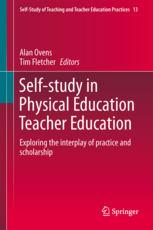
Here is a description of the book:Book cover

In this in-depth examination of self-study as a research methodology, an international selection of physical education scholars share their ideas and experiences and consider the value of self-study as a vector for highlighting the emerging conflicts, dilemmas, and debates currently developing in teaching and teacher education pedagogies. A vital new addition to Springer’s series Self-Study of Teacher Education Practices, the volume is divided into three sections assessing the significance of the approach itself, offering detailed subject-relevant case studies, and exploring the nuances and controversies attending the evolution of the methodology.
The contributors show how self-study enables reflexivity in pedagogical practice, a notable lacuna in current critical research, and at the same time they make the technique accessible to scholars of physical education wanting a practicable introduction to the subject. The analysis also explores the implications of applying self-study to pedagogy itself, to the curriculum, and to human movement and educational practice more generally. By embracing more organic, emergent notions of research practice and learning, the book achieves a broader and more inclusive survey of pedagogical work in physical education teacher education that fully acknowledges the complexities of the field. http://www.springer.com/education+%26+language/learning+%26+instruction/book/978-3-319-05662-3