Category Archives: teacher educators

Engaging Students in Math

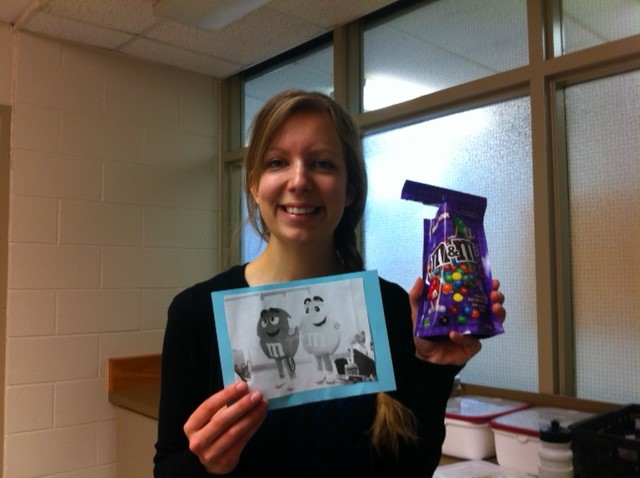
The day after Halloween, one of my (Cathy’s) student teachers, Megan, presented a wonderful lesson to a group of grade four students on probability.  She opened the lesson with a picture of herself dressed as an M&M.  (This was not really her of course, but the students didn’t know that).  She told the story of how she disguised herself as an M&M and went out trick or treating.  One nice lady gave her a whole bag of M&Ms because of her great costume.  Megan wondered aloud on the probability of pulling out red M&Ms as opposed to green M&Ms or yellow ones.  This student teacher had these children with the picture, but the M&Ms clenched it.  All of the students wanted to predict.   The students moved from large group work to small groups to independent work with ease.  Interestingly, Megan did not allow the children to eat the M&Ms.  They were data.  The children accepted this fact and made no protest.  The math remained the focus throughout the lesson.  The lesson was an absolute delight to watch.   Trouble is, I may never eat M&Ms the same way again.  I will always be calculating the probabilities of pulling that red one.

photo

Teacher collegiality: A priority in education

Teachers and Teacher Educators alike, I (Yiola) hope you have had a good start to the academic school year. By this time a productive learning environment is in the works, students are settling into routines and relationships and all wheels are in motion. Teaching and learning in classrooms is a complex enterprise. I believe we spend huge amounts of time thinking about and preparing our students for the classroom yet little time is spent on developing safe, supportive, resourceful environments for ourselves as educators.

Enter the social world of teaching for teachers. From novice classroom teachers to veteran teacher educators, research literature clearly shows that the conception that educators perform better when working together professionally is supported by organizational theory models… Such conceptions view authentic teamwork as an essential characteristic of the successful organization as its members interact regularly to share their ideas and expertise and develop common understanding of organizational goals and the means to their attainment (Shah, 2014).

See full article here:

teacher collegiality

Integrated classrooms, full day kindergarten teams, division teams, departments, staff and faculty and informal professional learning communities (PLC), require teamwork, moral support, and encouragement between educators.  What better way to engage in teacher preparation and teaching than feeling supported, appreciated and valued.  What are the key characteristics of collegial work environments?

The research literature indicates considerable consistency in the key characteristics of teacher PLCs. Participants working together regularly over an extended timeline, shared values and vision, practical activities focused on student learning, taking an inquiry stance, being reflective and collaborating and sharing experiences, are characteristics which are consistently highlighted (Susan Owen, 2014).

See full article here:

Owen

A supportive work environment, collegial atmosphere, shared vision, shared workload, appreciation and affirmation of colleague contributions, and genuine interest and commitment to the school/program make a significant difference to educators’ work. While the structure and environments are often built from the top down (i.e. principals or program leaders), much can be done within organizations to foster strong PLCs. These are messages I share with my student teachers as we consider how teachers work with early childhood educators in the kindergarten classrooms, and how the special education teacher communicates with the regular classroom teacher, and how teachers communicate with parents. Exploring how to work collaboratively and how to deal with conflict are important considerations for good teacher practice.

Teaching, service work, and research are approached with interest, enthusiasm, and care because of the collegial work environments that have been established within the PLCs. Below is a picture of wonderful colleagues and my cheering team. I am extremely grateful for the wonderful professional learning communities I am part of at OISE.

10013478_10154025542180121_1297636224_o copy

Left to right: Prof. Gisela Wajskop, me, Prof. Clare Kosnik

Front and centre: Sylvia Clare and Gallaway

Learning Flexible Program Planning in Pre-Service

Our 1-year consecutive B.Ed. program has begun and I’ve (Clive) had two meetings with my School & Society class. The student teachers are wonderful: committed, talented, experienced in many ways, worldly-wise but friendly. Where do such people come from? Why do they continue to go into teaching when it’s so hard to find a job? Anyway, I’m glad they do.

Our second class was on program development and I stressed that, when they become teachers, they will have much less teaching-time than they thought and will need to prioritize, be flexible, and make choices. This led to a discussion of the extensive unit and lesson plans they will be expected to submit during their program, and the massive long-range plan their future principal will require of them. I related how the teachers in our longitudinal study use shorter lesson and unit plans – and then very flexibly – and seldom refer to their long-range plans. They have trouble seeing the point of such detailed planning exercises.

We agreed that they have no choice – during the program and later – but to fulfill such requirements. However, it makes a big difference to see such planning as a “requirement” they don’t necessarily agree with – rooted in traditional “transmission” models – rather than a “state of the art” approach to teaching. Then they can produce the detailed plans quickly and without undue angst, and get on with the serious business of teaching.

Several students expressed relief at being able to approach it this way; and I saw it as an important window on the complexities of effective, autonomous teaching. It is true that our teaching has to be comprehensive, and we have to know where we’re going. But highly detailed lesson plans that we follow to the letter aren’t the best way to get there. What room does this leave for individualization, student construction of knowledge, and our own on the spot learning as teachers? For my own 3-hour class I usually have about 6 main topics, of which we get to 3 or 4 and often in a different order and with different time allocations than I had planned. And of course we discuss other topics that weren’t even on my list….


Independent Reading

This Washington Post article features former school principal Joanne Yatvin’s thoughts on why it is important to provide students with the opportunity to self-select texts and to have designated time in the school day for independent reading. Yatvin notes that in many US schools the practice of independent reading “has been abandoned in favor of systematic programs that promise to raise student test scores.” Link to article: www.washingtonpost.com/blogs/answer-sheet/wp/2014/09/08/why-kids-should-choose-their-own-books-to-read-in-school

What are your thoughts — do you consider independent reading to be an important part of a literacy program?

OliverJeffers

The Baby Liked the Questions: The Joys of Research on Teaching

As Clare mentioned back in May, I (Clive) had to serve as “baby whisperer” for an hour or so while she interviewed one of our New Jersey teachers, and I acquitted myself quite well. This past Thursday a similar situation arose, only this time I was on my own.
One of our tenth year Ontario teachers, Serena, had a baby girl in March and has been on mat leave since then. She kindly agreed to let me come to her home for her annual interview, and when I arrived I was pleased to see that “Sara” was to be part of the event. She is an exceptionally happy baby, but like all 5-month-olds likes to go on to new things fairly often.
Sara appreciated having a visitor in the room and bounced around on Serena’s knee for about 15 minutes, keeping an eye on the interview. Next came 10 minutes suspended in a jumper surrounded by toys, followed by a feeding time. As new distractions failed to impress, it become obvious she had to transfer to my knee. I was very comfortable with this arrangement, but after about 20 minutes the novelty of watching the interview from that perspective also wore off.
Back on the sofa next to her mother, Sara then discovered Serena’s copy of the interview questions and took great delight in them. Gleefully tearing them up and chewing on them occupied her for a full quarter hour! We were able to finish a wonderful interview and everyone was happy.


Facing Reality: New Teachers Working in Very Politicized Contexts

Those of us in education are feeling the pressure from external bodies to improve test Deakin Logoscores while teaching a standard curriculum (developed by “some” external body). This pressure is especially acute for new teachers who are trying to sort out teaching in general while figuring out their style, their particular goals, coming to terms with their changing identity … . In this politicized era trying to balance standards with what students actually need is a challenge for the most experienced and able teachers. I (Clare) read a fabulous article Professional knowledge and standards-based reforms: Learning from the experiences of early career teachers by Andrea Allard and Brenton Doecke. It is in English Teaching: Practice and Critique May, 2014, Volume 13, Number 1 pp. 39-54

http://education.waikato.ac.nz/research/files/etpc/files/2014v13n1art3.pdf

For those of use involved in teacher education this article gives voice to new teachers who find themselves in teaching situations that are a mismatch between the practices advocated in teacher education and the culture in their schools. It shows how these teachers try to negotiate the demands and come to terms with practices they feel are effective. It also raises questions about what we should be doing in teacher education to prepare student teachers for what they will face as teachers.

Here is the abstract:

This article explores the paradoxical situation of early career teachers in this era of standards-based reforms, beginning with the experiences of an English teacher working in a state school in Queensland, Australia and expanding to consider the viewpoints of her colleagues. Our goal is to trace the ways she and the other early career teachers at this particular school negotiate the tensions between the current emphases on standardisation of curricula, testing regimes and teaching standards and their burgeoning sense of their identities as teachers. We shall raise questions about the status of the professional knowledge that these early career teachers bring to their work, showing examples of how this knowledge puts them at odds with standards-based reforms, including the professional standards recently introduced by the Australian Institute for Teaching and School Leadership (AITSL) and the National Assessment Program –Literacy and Numeracy (NAPLAN).

I found this quote from a new teacher, Nola, about her first few weeks at this school fascinating and distressing.

We did not do enough NAPLAN stuff [in the teacher education course] …Holy moley! –Coming into this school and it’s so NAPLAN focussed. Oh, it was like “What the heck? Yeah, I’ve heard about NAPLAN but — !” Everyone is like “NAPLAN, NAPLAN, NAPLAN” and I am just like–holy moley! I was not prepared for it. I did not know how to read the results or anything. I didn’t know what it meant. I was like “NAPLAN?” I didn’t know that NAPLAN was.”

Her distress is palpable!
Giving Voice to All Students: Jigsaw

In an earlier posting I (Clive) DSCN0710advocated giving students a lot of “air time” in class, and outlined several techniques for ensuring that all students are heard. I’ve just (re)discovered a further technique – “Jigsaw” – and am using it in my summer courses. I can’t believe I took so long to see its potential! IMG_0038

In Jigsaw the readings for a class are assigned beforehand to different students, and when they go into small groups each has to speak to “their” reading. This reduces the reading load and gives each student a chance to speak to their item. It also decreases the likelihood of one student dominating the small group. Moreover, it takes some pressure off the teacher to expound all the readings themselves.

I used to employ Jigsaw but stopped because it seemed as if I was forcing students to read the articles; also it seemed to require having the same groups for every class, a practice I’ve moved away from.

What I do now is give every student a permanent Jigsaw number – either 1 or 2 – and assign just 2 articles for small group discussion. This means I can form new groups each class. Another advantage is that with more than one student speaking to an article, the pressure on individual students is reduced and the discussion becomes more collaborative.

As with any group work, of course, the topic has to be interesting to the students so they approach the discussion with enthusiasm rather than just going through the motions. So far, it seems to working!

Because of Mr. Terupt- I was touched

I’ve been striking it lucky with my pick of children’s literature lately. Because of Mr. Terupt is a juvenile fiction novel well worth reading to a junior level class. Also perfect as a sample novel for student teachers experiencing literature circles. This touching story, by Rob Buyea, brings up many discussion points regarding what makes a good teacher, plus many other school issues: diversity, inclusion, forgiveness, and bullying just to name a few. Terrific resource for ‘hot seat’ /role playing explorations.  A must read for children’s literature fanatics like me!

Mr terupt

Our Symposium: A Model for Teacher Educator and Policy Development

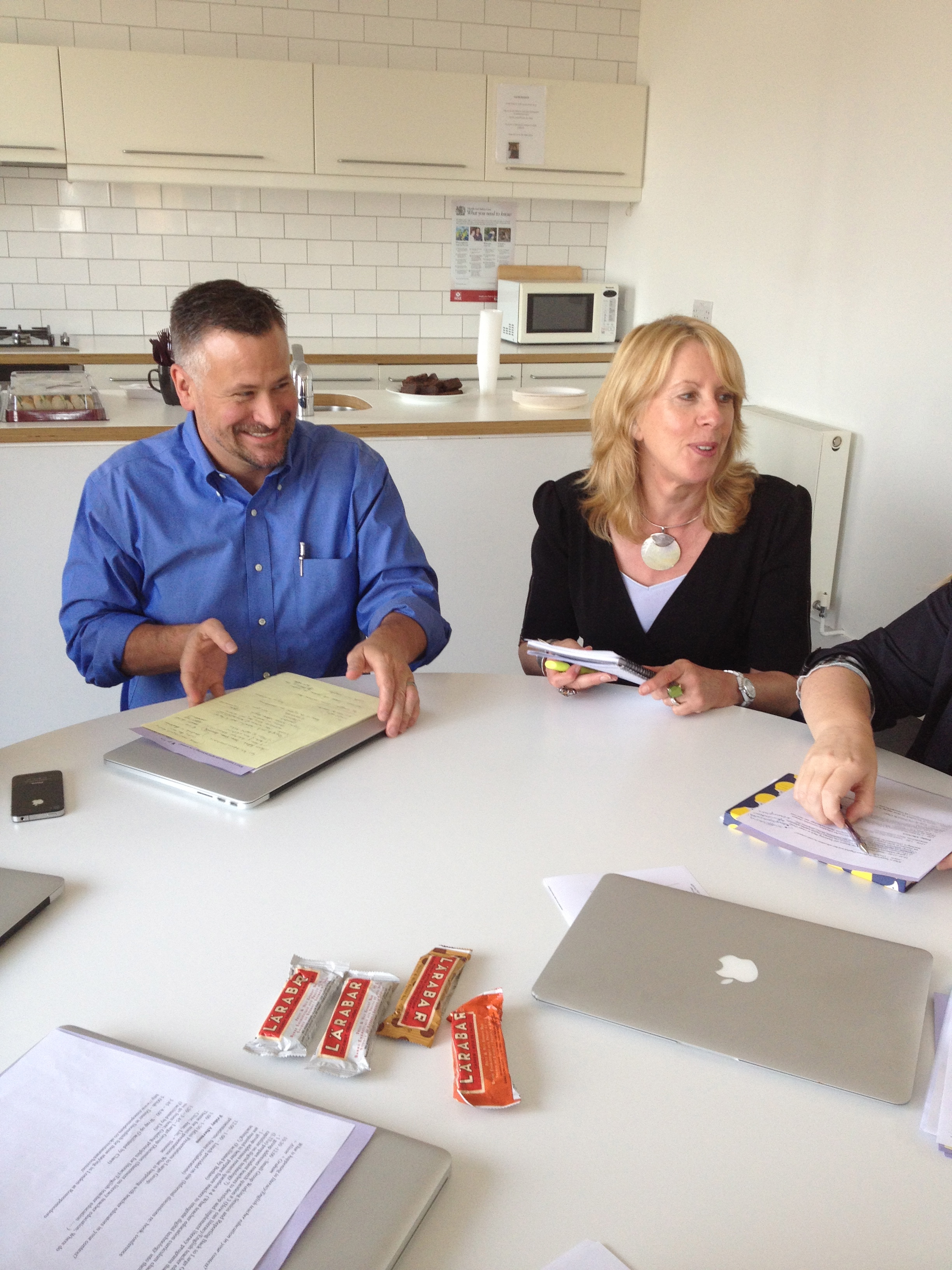
Clare Kosnik and Peter WilliamsonOur Symposium was amazing. For those who have read the blog postsIMG_2609 about it, I (Clare) am sure you got the sense that it was very interesting and productive. One of the words I would use to describe it is dynamic. There was such enthusiasm to discuss and grapple with the issues that we moved so beyond where we started (how to integrate digital technology into teacher education). Given that most people did not know each other, came from different countries, and had different areas of specialization (digital technology, teacher educators, teachers, policy) these differences did not divide us but they somehow brought us together to form a community. Not wanting to sound sentimental or superficial, I feel that something “magical” happened at the Symposium. The barriers melted away instantly and learning happened. Jean Murray’s “speed dating” opening activity immediately got us talking to each other. The laughter as we discovered interesting facts each other (e.g., John was fired as a gravedigger) raised the noise level to a crescendo. From there the Symposium developed into a committed group of educators focused on learning.Participants

Lin GoodwinThe two-day event was not like anything I have never experienced in my life – there was no posturing, there was careful listening, comments were relevant, questions were thoughtfully phrased, and there was commitment to something larger than individual research agendas. The interactions were respectful and genuine. I had assumed we would learn much about each other’s research and national contexts, I did not think that we would become a little community of teacher educators looking at the larger questions of education within a changing world. The level of enthusiasm was still sky high at the end of two intense days. There was no rush to leave or end the discussion.

Alyson BakerSo often in academia, department meetings are monopolized by issues such as timetabling. Conferences presentations are often more monologues that discussion. We need time to talk about the issues. The structure of the Symposium worked well – mini presentations by each person and time for large and small group discussion. This Connection Grant was not extravagant – we did it on a shoe-string budget. A number of universities contributed small amounts and we stretched our dollars. Given the money spent on university and government-based initiatives there is money for these kinds of events. Governments and universities need to spend their money thoughtfully and carefully – I would say, let’s use our Symposium as a Graham Parr and Scott Bulfinmodel of professional development for teacher educators and for policy development – bring the researchers together, devise a format for sharing and discussion, and let them proceed. I suspect the guidelines for education that they develop will be sensible and feasible.
Pooja Dharamshi Securing the grant and organizing the logistics were demanding. Our challenge now is to build on what we built and experienced. It is not just that I have much to learn from the amazing colleagues at the Symposium, but I also know that we are much stronger as a group. Teacher education is under siege. Individuals cannot resolve the challenges we face in teacher education but as a group perhaps we can do “something.” There has never been greater need to work together. I feel gratified — all of the work was so worth it. Thank you to the 16 participants who made this unique experience one I will never forget. I am eager to continue our collaborations. This website and blog will provide updates on our continued work together.
Reflecting on my time at the International Symposium for Digital Technology and Literacy/English Teacher Education

I (Lydia) feel fortunate to have had the opportunity to participate in the symposium last week as many of the issues raised resonated with my current research examining student teachers’ experiences with contemporary literacy teaching and learning. The issues highlighted during the individual presentations and accompanying discussions offered rich insights into the status of teacher educational internationally.

IMG_2590

I’d like to share a few of the questions raised during the symposium that remained with me and will continue to inform my research in literacy teacher education: What should a curriculum of contemporary teacher education include? In what ways can a curriculum of teacher education provide the space and quality time necessary for student teachers to truly engage as learners? How does power continue to operate in the curriculum? How do digital tools and social media spaces construct reading and writing? What do these digital spaces permit and what do they restrict? How is knowledge constructed, represented, and distributed within digital spaces? What are the pedagogical consequences as students engage with different modes within digital spaces? These are just a few of the questions I continue to consider upon my return from the symposium. Having the opportunity to consider the complexities and issues relevant to teacher education with international scholars was truly inspiring. I look forward to continuing our rich conversations.

IMG_2560