Category Archives: teaching

Inspiration from Pinterest

I (Cathy) find one of the most popular social media sites used by my student teachers is Pinterest.  They rave about the interesting and engaging ideas they find on the site for lessons.  I saw evidence of this just recently while visiting a school.   My student teacher, Melissa, had found a writing exercise on the site entitled, If I Was  Trapped in a Snow Globe.  It involved the students creating a snow globe scene inside of a white plastic container and then describing the adventure in writing.   The associate teacher was so excited by the results, she lead me into the hallway to see what  her young students had accomplished.  The associate declared, “This student never writes anything, but look at this!  Two pages!  They loved this writing assignment.”

Often, good writing results by students are the results of a good inspirational ideas. Luckily educators have many more resources to access now, due to social media.  I highly recommend Pinterest for many ideas in variety of subjects.

http://primarypunch.blogspot.ca/2013/01/thank-you-pinterest.html

globesstory

Ontario Grade 8 Students are “Computer-Savvy”

An article in the Toronto Star reported that Ontario students rank among the most computer-savvy according to an international survey of approximately 60,000 Grade 8 students in 20 countries. The survey evaluated various aspects of computer use including how well students could collect, create and share information. The EQAO (Education Quality and Accountability Office) coordinated the Ontario portion of the survey and jointly issued the report with the Council of Ministers of Education Canada (CMEC). The report suggests that Ontario students scored an average of 547 points out of a possible 600.

Link to the article:

http://www.thestar.com/news/gta/2014/11/20/ontario_students_among_the_most_computersavvy_in_international_study.html?utm_medium=twitter&utm_source=twitterfeed&app=noRedirect


FDK Update: Assessment and Communication

Full Day Kindergarten (FDK) Blog #4  tells the literacy teaching story from the perspective of a first time Full Day Kindergarten parent (Yiola).   In this post I share elements of the assessment process and how my child’s development has been communicated.

Here in Ontario it is “Parent-Teacher Interview” time. First term report cards have been written and parents and teachers, and sometimes students, are meeting to discuss student progress.  There are a number of ways the interviews are conducted: student-led conferences are now quite popular processes and the more traditional teacher-led conference sans student are still in effect.

When I received the school newsletter and read that report cards and interviews were about to take place I was surprised and a little anxious; I felt it was too early to have the teachers share my child’s development… I knew my Sylvia Clare was learning a lot but to put in writing her ‘levels’  or acquired learning after 8 short weeks of school seemed far too soon.  Well, I was right. The report cards and formal interviews were meant for students in grades 1 and up, not for kindergarten. Phew! That made more sense to me. As a parent of a child in kindergarten it makes good sense that children in the early years are not formally assessed … well, too early.  From a parent’s perspective, I wonder  if I would feel the same way if my children were in first or second or third grade?

What the FDK program has established is an “observation” time where each parent/guardian is invited to visit the classroom in action, to observe the daily life of the classroom and their child in the classroom. During the observation time the teacher offers some time to discuss questions or concerns with the parents/guardians. I was thrilled with the sounds of process as I was feeling so very curious about the sounds and vibes of the classroom and how Sylvia Clare got on inside that environment. A first hand eye-witness makes such good sense.

A short note arrived home a week before the observation. We were assigned a half hour observation time the following Monday morning.  This worked well for me, but I did wonder, how do full-time working parents without flexible schedules manage the observation?

Monday morning arrived and off I went to visit the classroom. Alive with children’s voices, questions, and energy I walked into a vibrant room filled with learning. I was welcomed by the Teacher and Early Childhood Educator. Sylvia Clare’s face lit up when she spotted me as she hustled over with excitement. I quickly slid into the flow of the room and began to learn what it was my child did in the FDK room. Sylvia Clare was working with another student building the 100s chart on the huge carpet area. She had the 70s cards and while the Senior Kindergarten student was building from the 40s, she watched and waited patiently for the 70s to turn up so she could add to the massive chart… a wonderful, collaborative learning experience.  When done, she showed me around the room:  building centres, reading nooks, sand table, art table, writing table, snack table and well organized low rise shelves embodied the room. The room was as I remembered it back in August (neutral colours, natural light, natural materials) but now evidence of student learning lined the walls; drawings, colourings, writings were on display and I could see Sylvia Clare’s work.

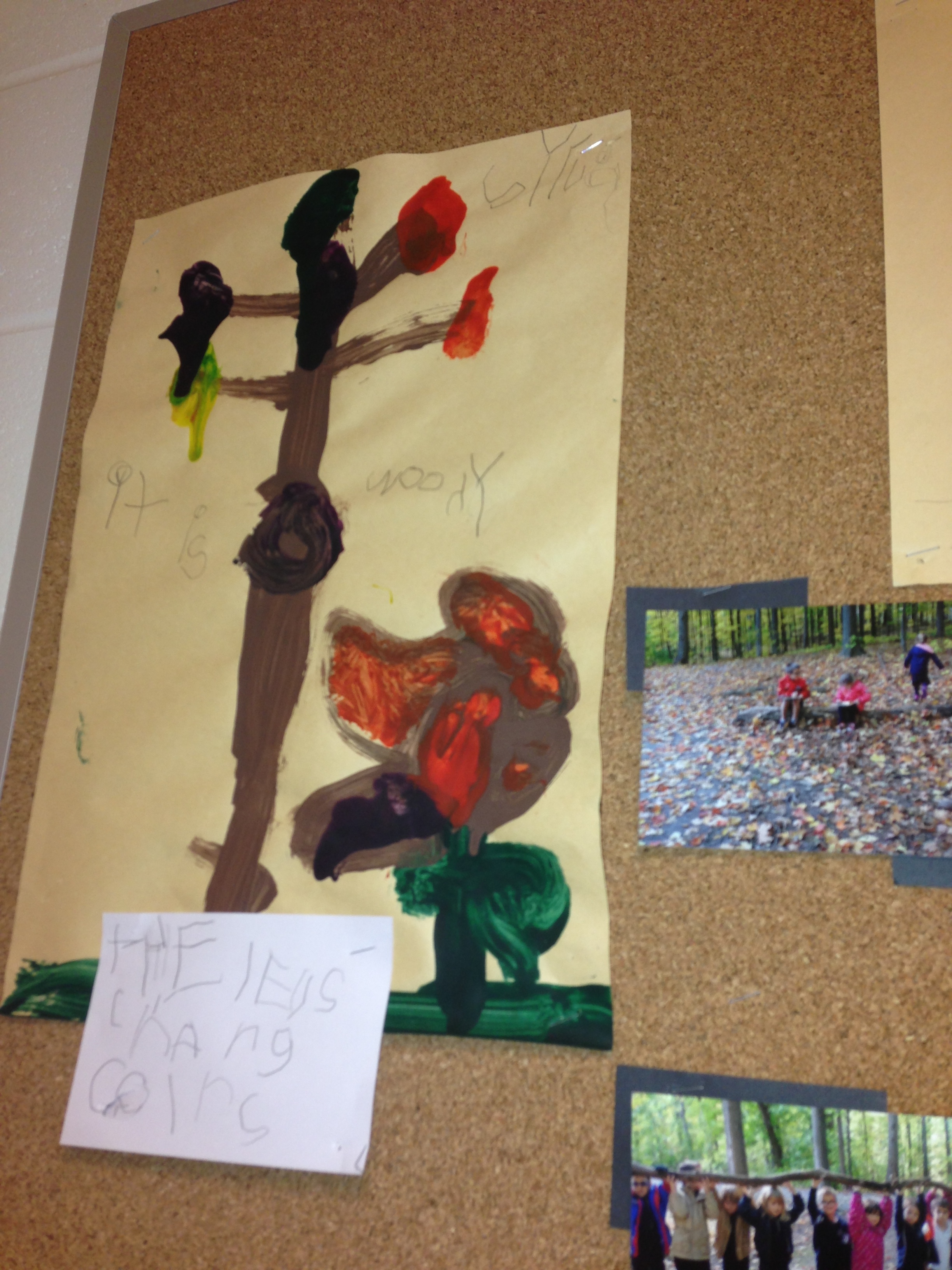
Sylvia Clare's portrait of "Woody", the tree the class adopted from the neighbourhood forest.
Sylvia Clare’s portrait of “Woody”, the tree the class adopted from the neighbourhood forest.

Children working in pairs, in small groups, independently on a variety of tasks throughout the room. The room was bustling yet highly organized. The room was loud but not noisy. I was thrilled to see so many “languages” brought to life (Reggio Emilia’s notion of the 100 languages in the classroom) ~ art opportunities everywhere; all purposeful and engaging. Everyone, including my Sylvia Clare had a place in the space and was engaged in the life of the room. The teachers encouraged Sylvia Clare to show me her portfolio (a binder with evidence of her work). Then Sylvia Clare led me to her interests where we explored and worked together.  Once well settled into the observation, the teacher sat down next to me and asked, “Do you have any questions or concerns?”  This was such an open and  welcoming way to start our discussion. My questions:

Is Sylvia Clare happy at school?

Does she have friends and is she social? Who does she play with the most?

Where does she spend most of her time in the room?

I see she is learning a lot from all that she shares at home. What do you think?

The teacher provided specific description of Sylvia Clare’s work in the classroom: what she talks about, who she plays with, what she enjoys doing, and how she interacts in the classroom. It was clear to me the teachers have a good sense of who Sylvia Clare is, what she likes, areas she has shown significant growth already and areas for improvement. Then I asked:

What can we work on at home to support her learning? 

Continued literacy development, focusing on sound/letter recognition.  I realize now, as a parent of a child who is developing their reading skills just how complex the process is for children. It takes time. Some children acquire skills faster than others; some struggle  but all children need time, exposure, practice to basic skill development. In theory, I knew this. To witness it through the lens of a parent however is somewhat different.  Experiencing literacy development in one young child in live time, watching her gain letter recognition, one letter at a time, one sound at a time, is quite fascinating.  Sylvia Clare is getting there. Beyond the daily read alouds and story telling I need to work through phonic games and drills with Sylvia Clare.

After our brief conversation I felt comfortable and confident that my child has adjusted to full day schooling and getting along well.  Sylvia Clare then ushered me over to the snack table and we chatted while  some of her friends came over to meet me. Shortly after, I said my goodbyes and was on my way.

It was remarkable observing my child in this setting; a setting outside our home, a setting in which I am but an observer and Sylvia Clare is the participant. The observation experience provided very clear, detailed description of my child’s work at school, far more than I would have gathered from a formal report card.


Teaching Between The Lines

A group of us just had a proposal accepted for AERA on teacher resistance, as part of a symposium on that topic. Our paper will be on how the teachers we are studying “teach between the lines,” finding ways to “live with” system mandates and teach (in varying degrees) in a holistic, constructivist manner.

I (Clive) just came across a very relevant quote in Nel Noddings’ 2013 book Education and Democracy in the 21st Century that will help us as we write the paper. She says:

“[In this book] we will consider how schools can help students to achieve satisfying lives in three great domains: home, occupation, and civic life…. [H]owever, I want to make it clear that I do not foresee dramatic changes in the basic structure of curriculum in America. We have to work within that basic structure. Sadly, I think we will go right on with English, mathematics, social studies, science, and foreign languages as the backbone of our curriculum. Indeed, if we continue in the direction we are now headed, the curriculum will become even more isolated from real life and its subjects more carefully separated from one another. It is this tendency that we should resist, and effective resistance will require collaboration, critical thinking, and creativity.” (p. 11, my italics)

Wow! While talking strongly of resistance Noddings says we have to work within the system, which if anything will get worse. What then does resistance mean?

It can mean campaigning publically against the retrograde measures; or negotiating at the school level to modify their implementation. Or it can mean finding holes – or “interstices” as the post-structuralists say – within the system that enable teachers to teach the way they believe in, to the extent possible.

This third approach is important because it allows teachers to keep their jobs and continue to be there for their students. We mustn’t dismiss this type of resistance as mere compromise. Rather, we must join with teachers in looking for ways to teach well within the system. And teacher educators must discuss the challenges and possible strategies at length with their students, so they come to teaching prepared to teach between the lines, rather than having to figure it out on their own.


Explaining Explain Everything (App)

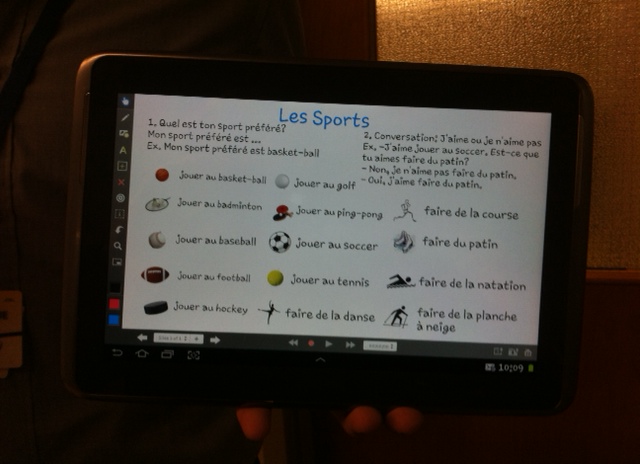
I (Cathy) find that one of the exciting aspects of teaching is learning from my students- especially about digital technology.    One of my student teachers, Drake, taught a lesson last week using Explain Everything.  With the aid of this app he successfully taught  a lesson in French which enabled his grade 6 students to engage in conversations about sports.  How he used the app was definitely key to the success of his lesson and I gave him full credit for cleverly scaffolding the sequence of the questions and answers so that that student conversations were set up for success.  Yet, Drake insisted it was the app that enabled him to teach the lesson so clearly.  Below are pictures of how Drake set up the lesson on his ipad and then mailed it to himself as a handout for his students.  Well done Drake!

Drakeipad

Intrigued, I began to play with this app myself.  I discovered it has a wide range of  applications. It feels like a cross between a power point and a smart board, but completely doable on an ipad.   Very convenient.  Below is an link to a you tube video that demonstrates how students can use the app in a classroom.


Celebrating the 25th Anniversary of True Story of the Three Little Pigs

As the 25th anniversary of the picture book The True Story of the Three Little Pigs approaches author Jon Scieszka and illustrator Lane Smith recount the origins of their collaboration and the challenges of securing a publisher for the sophisticated parody. As Smith recalls, “some editors liked it but were a little confused and not sure if there was a market for it. Back at that time, children’s books were either serious, earnest books, or really funny books. But the sense of parody and irony that is rampant now didn’t really exist then…Viking put the book out very tentatively. They weren’t convinced of anything and did a small run that immediately sold out. It was all word-of-mouth from teachers, librarians and booksellers. They didn’t run ads or do a publicity push. Finally by the fourth or fifth printing the runs were more like 50,000.”

Follow the link below to read the full interview with Jon Scieszka and Lane Smith:

http://www.publishersweekly.com/pw/by-topic/childrens/childrens-book-news/article/64695-the-true-25th-anniversary-story-of-the-three-little-pigs.html?utm_source=Publishers+Weekly&utm_campaign=94f331fbd0-UA-15906914-1&utm_medium=email&utm_term=0_0bb2959cbb-94f331fbd0-305134397

ThreePigs

Responding Critically to Azalea’s ‘Bounce’

In class this week my (Cathy’s) teacher education students were exploring indirect  instruction through learning centers.  One of the centers featured Iggy Azalea’s music video, Bounce, and the instructions to discuss the work through a critical literacy lens.   (E.g. What message do you think the artist wants us to get from this video? Based on the artist’s thoughts and actions (expressed in the song), how would you say she is portraying herself to the world?)

Most of the students had heard of the video but never actually viewed it until arriving at the literacy center.  (Perhaps you haven’t either).  Without revealing the content, I will reiterate the general tone of the reactions.   Most students were annoyed by the video content.  One student said she was disgusted (and this is not sexual content).  One group, however,  tried to take a broader view.  They said they could not judge the work until they understood Azalea’s intent.  So they took it upon themselves to look up an interview in which Azalea discusses her purpose for portraying her song the way she did.  After viewing the interview, they were angry.  Azalea explained that she portrayed herself thusly so she would be seen as “flashy”.  No message, just glamour.  After this insight, some wonderful discussion ensued about cultural ethics and hegemony.

One student spoke to me at the conclusion of class and confessed that she was surprised by her own reaction.  In her words, “I have changed.    Studying literacy education has given me a different perspective.  I see the world differently, especially things like music videos.”

Below is the link so you can view this content for yourself and decide.  The second link is the video in which Azalea discusses her purpose for making the video.

Happy critical viewing!

10 things your child’s teacher wants to say to you

I (Clare) came across this “open letter” to parents by by Lyndsi Frandsen which I found very interesting. As many schools gear up for Curriculum Night where teachers meet the parents of their students for the first time, I thought this article very relevant. As teachers we so often are misunderstood.Below is the full letter and here is a link to the website>

http://www.ksl.com/?nid=1009&sid=31768239#h1KcVQ2c2uGwgOcx.01

SALT LAKE CITY — Teachers can be a misunderstood breed. A lot of times we find ourselves taking the blame for anything and everything. Your child failed a test? Blame the teacher. Your child got pushed down on the playground? Blame the teacher. You’re having a bad hair day? Blame the teacher.

But have you ever thought about what your child’s teacher would say if the teacher could speak openly and honestly, without any backlash? I interviewed dozens of my fellow teachers and colleagues. Using their comments, I compiled what I hope will be a helpful list of suggestions to improve the parent-teacher dynamic.

Now, before you call an emergency neighborhood meeting and start writing “1,000 things parents wish they could say to their child’s idiotic teacher,” take a step back. Give these teachers the benefit of the doubt, and know the educators who weighed in on this are wonderfully talented, kind, educated, adoring teachers who love what they do.

(On a side note: As I was reaching out to teachers, I felt like I should title this “The help: teacher edition.” It took a lot of coaxing and reassurance in order to get them to talk.)

“Thank you for sharing your child with me each day. … Thank you for trusting me with your most prized possessions. Thank you for helping me create the “magic” that is learning, educating and inspiring.”

1. I can’t do it alone

I am here to tell you that whatever is accomplished during the long school day can be completely undone in just a few hours at home. I am only human. I can’t snap my fingers and get your child to the target reading level. Will I try my hardest? Yes. Will I ever stop trying? No. But if you aren’t actively engaging with your child and reinforcing learning at home, you are robbing your child of opportunities otherwise. I am giving your child the best hours of my day. Please be willing to give your child minutes of your day to spend on homework, reading, etc.

2. I never stop thinking about your child

Even when I am finally home and able to focus on my own little ones, I am still thinking about yours. I am constantly thinking about how to help them overcome educational barriers. I am continuously brainstorming how I can cater to their various learning styles. But it doesn’t end there. I lose sleep thinking about the much-too-heavy-burdens of life their tiny shoulders carry around. I worry about their future and the scary world they will grow up in. I love them fiercely and they are always on my mind.

3. Yes, I am saying your child is lying

I am an adult. I am not a mean, petty, immature teenager who makes up rumors to make your child look bad. If I tell you your child called a classmate a name — then your child did. If I tell you your child refused to complete work — then your child did. Please believe the 30-year-old adult and not your 8-year-old child.

4. We are all cheering for the same team

I know this may come as a surprise to you, but I am not the enemy. Like you, I love your child. Like you, most days I invest more time and money in the children, than I do in myself. Like you, I want what’s best for them. So, when you feel tempted to tell me all the reasons why I treat your child unfairly, or am out to get your child, please remember that. When I hold your child accountable, I’m not treating your child unfairly. When I challenge your child academically, I am not out to get your child. The end.

5. We really don’t think every child needs medication

One teacher (and mother) I talked to learned this lesson firsthand. After her own child was diagnosed with a processing disorder, she realized he just might need medication to help him focus. It was a hard fact to swallow: that the medication she had been so against was the missing piece of the puzzle. Her words: “You would not consider keeping a child from their asthma medication because it would change who they are, so why would you consider keeping a child from medicine that would help them to be their best self?

Medication is not a death sentence. It does not mean that they are dumb or out of control. It does not mean they are ‘one of those kids.’ ” Teachers observe every type of child on a daily basis. Being receptive to their observations and opinions just may pay off for your child. Parents need to advocate for their children. Sometimes, they don’t know how or where to begin. And that’s where we come in.

6. The way you speak about education directly influences your child’s opinion

If you place great value on learning, your children will. If you speak kindly about their teacher, they will. If you tell them they have test anxiety, they will. If you treat school as a chore, they will. If you have high expectations for them, they will.

7. Your child doesn’t have any friends because he is unkind

I understand this isn’t a fact 100 percent of the time. But generally speaking, if your child is kind, compassionate and friendly, then other children will want to be your child’s friend. Funny how that works, isn’t it? It is your responsibility to teach your child how to be a good friend. If your children are hearing you gossip, belittle and exclude others, chances are they will be the same kind of friend you are.

8. It’s OK to let your child struggle

This is how we learn and grow. I understand your overwhelming desire to intervene at the drop of a hat. I understand it is hard to watch your child go through hard things and sometimes fail. I don’t like to watch your child struggle either. But if we do everything for them, they will never be able to do anything for themselves.

9. Your appreciation goes a long way

We don’t want you to feel bad for us. We chose this profession, and if we could go back and do it again … we would be doctors. Just kidding. We would do it all over again. Teachers just want to feel valued and appreciated. Our payoff (clearly) doesn’t come in the form of a check. It comes with watching your child grow and develop a love of learning. Parents who express their gratitude underestimate how far that really goes. So, write a thank-you note every now and again, tell us what a good job we are doing, and spoil the living daylights out of us during teacher appreciation week. (Kidding … sort of.)

10. Thank you

A well-known teacher that has a wonderful reputation with students, parents and colleagues said it perfectly:

“Thank you for sharing your child with me each day. Thank you for taking an interest in what he/she is doing. Thank you for caring about your child enough to let them fail from time to time, but being there to pick them up, brush them off, and help them grow from the experience. Thank you for investing time in your child. It is the most valuable gift you can give them. Thank you for taking time away from your phone or your computer to really be there for them. Thank you for teaching your child responsibility. Thank you for helping them realize that the choices they make are their choices and the consequences, good or bad, are not because of someone else. Thank you for letting me be a part of the ‘village’ that gets to help raise your child. Thank you for the opportunity I get to make a difference in their life. Thank you for trusting me with your most prized possessions. Thank you for helping me create the “magic” that is learning, educating and inspiring.”

Lyndsi Frandsen is the creator of the Facebook page For All Momkind and author of the For All Momkind blog. She has many titles, including wife, kindergarten teacher, sister and her favorite title, Mom.

Prioritising classroom community and organisation in physical education teacher education

Congratulations to Tim Fletcher and Kellie Baker on their recent publication: Prioritising Tim Fletcherclassroom community and organisation in physical education teacher education

I (Clare) know that it will be of interest to the many teachers and teacher educators who read this blog. Here is the abstract.

This research investigates how teacher candidates in a primary physical education curriculum and methods course learned about and were influenced by efforts to emphasise classroom community and organisation. Qualitative data in the
form of interviews, focus groups, and course artefacts were gathered from nine
participants throughout one academic term. Analysis of data suggested that most
teacher candidates came to recognise pedagogies that fostered a sense of community;
however, only a few were able to connect this to their developing visions
for teaching. Despite this, all participants came to view the development of a
sense of community as one of the most important aspects of their evolving teaching
practice.

Here is the link to the paper: Fletcher & Baker_2014