 Congratulations to Dr. Tim Fletcher for being awarded the 2014 AIESEP (International Association for Physical Education in Higher Education) Young Scholar Award. Tim is the first Canadian to receive this award. Tim is doing cutting-edge research on health and physical education (including self-studies of his own practices as a teacher educator). Tim is an Assistant Professor at Brock University. Check out his faculty page for a partial list of his publications. http://www.brocku.ca/applied-health-sciences/faculty-directory/kinesiology/tim-fletcher
Tim has been part of both of our research projects (Clive’s longitudinal study of teachers and Clare’s study of literacy/English teacher educators). He is an outstanding young scholar who is so worthy of this award.
This attached picture is of Tim and Shawn Bullock, another outstanding young Canadian scholar with whom Tim has collaborated. Check out Shawn’s website for a list of some of his publications. Shawn’s work is making a real difference in how we understand teacher education. http://shawnbullock.ca/wp/
Send us pictures from the award ceremony at the AIESEP World Congress being held in Auckland next month.
Clare
Category Archives: team members
Social Justice through Activism in Mumbai
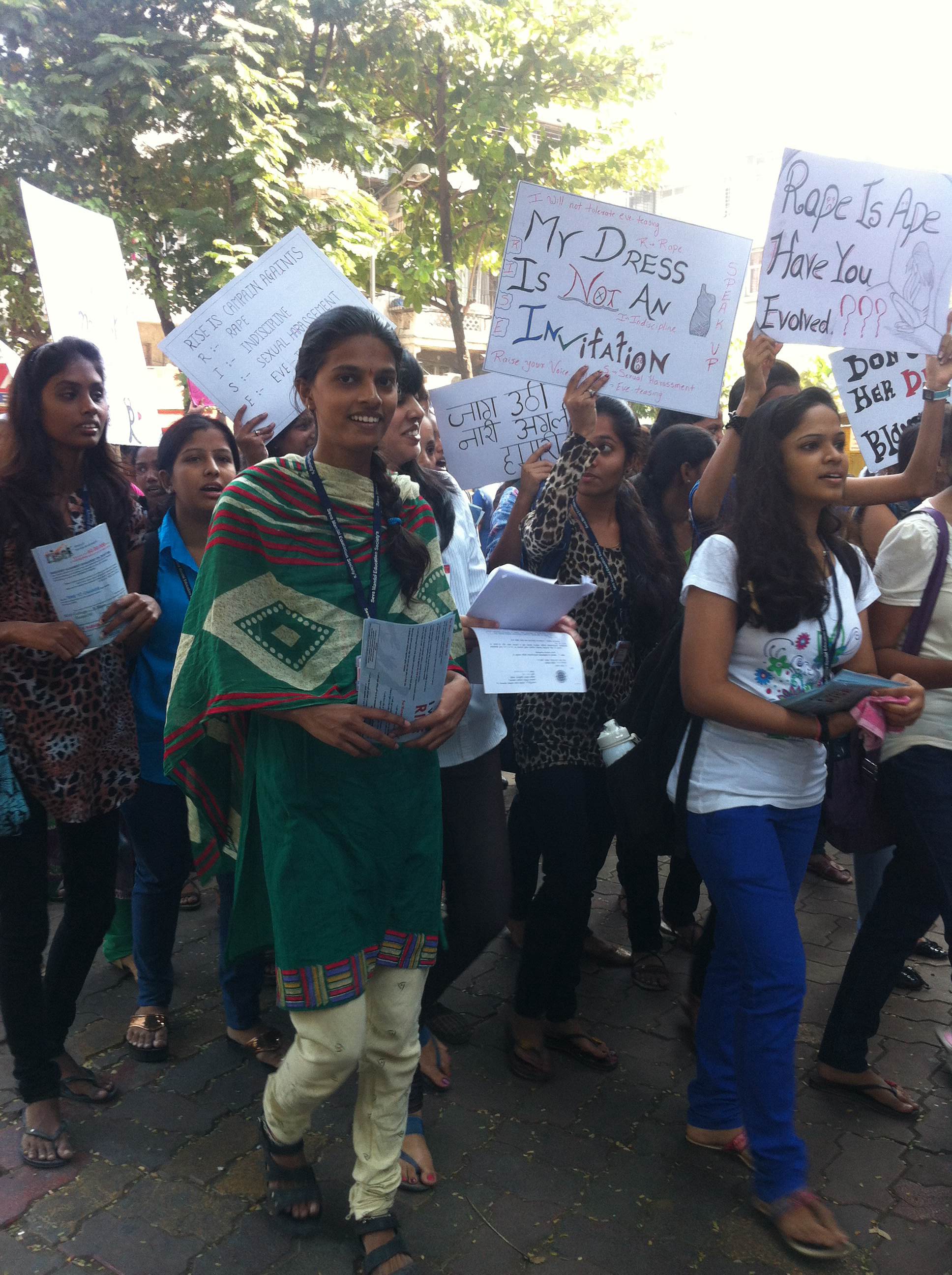 While I (Pooja) was only in Mumbai, India for two short weeks, I was able to observe (and participate in!) acts of social justice through activism. I was pleased to notice so many young women in organizational and leadership roles.
A week before I had arrived the Indian Supreme Court had reinstated a law criminalizing acts of homosexuality (Section 377 in the Indian Penal Code). I, along with many others, was shocked. This was a huge step backwards for India and its people, in my opinion. Within a matter of days rallies were organized all over India to protest. One of the major rallies was held in the park around the corner from where I was staying. Although the news of Section 377 was truly saddening, I was uplifted to see the youth organize themselves so poignantly. This rally received a lot of coverage and gave hope back to many who had been personally affected by this decision. Below is a link with some images capturing the spirit of the protest in Matunga, Mumbai:
A few days later, while taking a morning walk, I passed by a large group of young girls  protesting against the treatment of women in India. Over the past year, media sources in India had shed light on a few horrific rape cases from around India. I asked one of the young women protesting what had inspired them to take this injustice upon themselves. She told me they had organized themselves because they wanted to have their voices heard and their message conveyed: “We are not going to stand for the mistreatment of any woman, anywhere.” For the past week they got together, outside of school hours, to make signs and spread the word. In total there were about 100 young women protesting. They had made there message clear. They stood in solidarity with women all across India. Pooja
Happy Birthday Clive

Perils of Proofreading
We had a wonderful Christmas and now back to work. Clive and I have the proofs for our upcoming t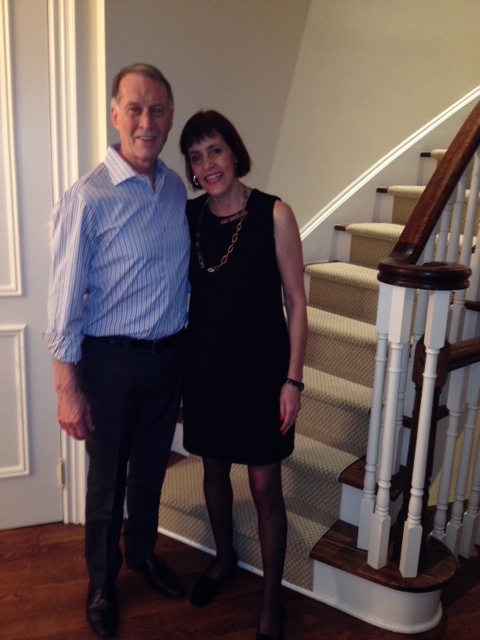 ext Growing as a Teacher: Goals and Pathways of Ongoing Teacher Learning. This step of the publishing process is mixed: it is so exciting to see the page proofs but then there is the painstaking step of proofreading. Clive is the best proofreader – me, I am the worst. I think this is because I read so quickly that I skim over the mistakes. I just do not pick them up. When I was a classroom teacher, I used to teach my students strategies for proofreading knowing full well that there are readers like me who just do not see the errors. Thankfully Clive is such a careful reader that he spots each one. Next we will place electronic post-it notes on the manuscript flagging each correction. This step I find nerve-wracking because this process is quite finicky. Sometimes I get the post-it note placed in the exact spot, other times, I fiddle and fiddle with the placement of it.
We want to give a shout-out to Sense Publishers https://www.sensepublishers.com/catalogs/authors/auth-clare-kosnik-/who are publishing this book. This is the third book that I have done with them and they are an absolute joy with whom to work. Consistently, they have great project managers and the page proofs tend to be fairly clean. Wish us luck! Clare
Writing = Thinking
 As a doctoral student, learning to write academically has been a challenging process. My doctoral supervisor shared a piece of wisdom, but it was not until I began writing on a daily basis that I understood what she meant. “Writing is thinking,” she often said. As a novice writer, a blank page was a daunting and, often, an overwhelming sight. Through practice, I have learned that getting my ideas out on paper as soon as possible (without worrying about style, grammar, or clarity) is an invaluable strategy for me as it kick-starts the writing process. Once I see my ideas on the page, I begin to make more sense of them and begin the revision process. I have come across two helpful books related to academic writing: 1) Style: Lessons in clarity and grace (Williams, M. & Colomb, G., 2010) and 2) The clockwork muse: A practical guide to writing theses, dissertations, and books (Zerubavel, 2001). Both booka emphasize and articulate my supervisor’s advice that writing is thinking. Zerubavel notes: “One of the most common misconceptions inexperienced writers have of writing is that it is simply a mechanical process of reproducing already-formed ideas on paper. Nothing could be farther from the truth. In reality, writing is virtually inseparable from the process if developing our ideas.” (p. 48). Pooja
Classroom Teachers and Critical Literacy
 I am fascinated with classroom teachers’ pedagogy. In particular, how elementary school teachers teach critical literacy to young children. How teachers plan, what materials they choose and the discussions they facilitate in the classroom were some of the areas I asked classroom teachers in relation to their efforts to build critically literate students. My research team spent half of the school year observing classroom teachers` daily practices with a special focus on critical literacy. We also interviewed the teachers to gain an understanding of their thinking about their practice. One interesting finding is the close connection between content (often driven by narrative texts) and pedagogy. That is, teachers (in the early primary grades) focused heavily on narrative texts to relay information about critical social issues and designed learning opportunities (discussions, extensions) based on the texts. This process resulted in children sharing their own stories and understandings of the critical social issues (i.e. identity and exclusion, inequitable distribution of resources, class). Understanding teachers` classroom practices is connected to phase two of our study on literacy teacher educators. I want to know how the two sets of pedagogical practices connect: how does the pedagogy of literacy teacher educators who have a critical stance transfer to classroom teachers’ practices?
By: Yiola Cleovoulou
Research Team Celebration
Our research team had a holiday celebration last night. Our team for the study of literacy/English teacher educators works so well. Building a research team is much more than organizing meetings; a research team has to be more like a community of practice where the personal and the professional overlap. Our team meetings include: updates on personal issues (e.g., health of an ill parent), an agenda of work to be done in the given time, space to talk about professional issues (e.g., should I submit a proposal for a specific conference), and snack. Each meeting is punctuated with laughter (as we battle with NVivo) but we always accomplish “something.” I doubt that anyone ever leaves a meeting thinking that we did not get anything done or that their time was wasted. It takes time for a team to develop a rhythm and to develop a set of group norms. No one told me about how to develop a research team when I was a new professor. Discussing how to build a research team should be part induction programs for new faculty. Clare
AERA Here we come
Clare and Clive’s research teams submitted 21 proposals to AERA. Our success rate was outstanding – 16 were accepted! The two research teams will be well represented in Philadelphia.
Congratulations Elizabeth
 Congratulations to Elizabeth Rosales Cordova who has completed her MA thesis: Opportunities for Teacher Professional Learning: Two Case Studies of Experienced Teachers in Ontario. She did two qualitative case studies of mid-career teachers to obtain insights into their teacher development experiences over their first eights years in the teaching profession. Elizabeth works on Clive’s research team.
 Literacy Teaching and Teacher Education