Category Archives: Uncategorized

“How boring school is” for certain students

Paul Tough, educational writer and broadcaster, has recently published a new book entitled Helping Children Learn: What Works and Why. In this book he explores recent research around trends in low-income schools in the U.S., as well as what is working and what is not. What he discovers is  that students who attend schools in low-income neighbourhoods are often “bored.”

My experiences both in the classroom and with research have revealed a similar finding. Students from low-income neighbourhoods tend to do a lot of remedial work, test prep, and fill out an immeasurable amount of worksheets. Often lacking are opportunities for students to explore and discuss topics of interest, move around the classroom, and extend the classroom into the community.

In an interview with Salon.com Tough comments on how “boring” classrooms often are  for students in low-income neighbouhoods:

Some of the basic principles we have, in terms of discipline, in terms of pedagogy and how we run our schools are not advantageous to kids who are growing up in adversity. This research on just how boring school is really resonated with me, especially the research about how when you’re growing up in a low-income community, school is more likely to be repetitive, boring and unmotivating. I hadn’t really picked up on that as being a significant problem before doing this reporting, but this research was really persuasive to me, not only that it’s true for a lot of kids but that it really matters in terms of their motivation. 

Classrooms are often boring and worksheet driven in low-income schools because the perceived need for classroom management is high. From my own experiences teaching in an urban school, the expectations were that our students were always quiet in the classrooms, walking down the halls, and even outside. Students were expected to walk down the hall from class to class in a line organized by size, shortest to tallest. This school-wide norm was always a tension for me. I thought it felt so militaristic and so unnecessary. I felt it made the assumption that our students needed more discipline that their counterparts in more affluent neighbourhoods. Tough comments on behavioral management approaches in low-income schools:

There is a lot about the way we punish and discipline kids that the research increasingly shows just doesn’t work, especially for non-violent offenses. The idea that all kids need is no excuses schools and strong discipline to succeed is clearly not supported in the research.

I haven’t read Tough’s new book yet, but I do look forward to reading it this summer.

Thinking about Reading Recovery

I (Yiola) am interested in early literacy for a number of reasons: my area of expertise is elementary  education; I was an early years teacher for ten years; my own children are now in early years programs; and, I believe that understanding literacy in the early years is  foundational for understanding teaching and learning.

With recent discussions going on about early years literacy programs and talk of play versus direct instruction; and, exploration and social development versus academic rigour (neither of which I believe are true binaries but instead call for a thoughtful consideration of a developmental and critically rich fusion) I am compelled to think about reading in the early years. You see, it seems to me parents are often in a panic if their child is not reading and more and more I am hearing of excited parents proudly sharing that their child was reading at 3 or 4 while other parents are silently panicking if their child is not reading by 6 years of age.

I often think back to when I was a classroom teacher and I recall the complex yet carefully crafted time sensitive processes for reading acquisition. I also clearly remember having a Reading Recovery Program at our school and watching our first and second graders enter and exit the program with a good degree of improvement and development. Most children would come out of reading recovery with gains. The very few who did not required further testing and support that went beyond the readiness phenomenon.

In my readings I came across this interesting article about Reading Recovery and the relevance of levelled texts, phonological processing AND comprehension as all significant  components of early reading development.

Here is the article in full: http://onlinelibrary.wiley.com/doi/10.1111/1467-9817.12041/epdf

This reading reminded me that there needs to be an amalgamation of approaches and strategies in the early years classroom. More and more I think that the programming and planning of early years teachers is by far their greatest challenge – not deciding upon play versus directed learning – knowing how to plan in ways that are engaging, that tap into curiosities and children’s questions and that allow for literacy rich exploration while also ensuring time for literacy focused experienced.


A Chinese alternative to the Global Research University

Posted on May 10, 2016 by creso.sa in International Dialogue

By Ruth Hayhoe

Our (Clive and Clare) good friend Ruth Hayhoe posted this blog on https://ciheblog.wordpress.com/2016/05/10/a-chinese-alternative-to-the-global-research-university/ We found it very interesting because it presents an alternative to the research-intensive focus of so many North American universities.  Ruth has a long history of involvement in China and knows the country well. Here is a link to her homepage on the OISE website: http://www.oise.utoronto.ca/lhae/Faculty_Staff/384/Ruth_Hayhoe.html

Southwest University in Chongqing, a city of  30 million in West China, celebrated a Image Ruth 2history of 110 years on April 17 and 18. It has been a major normal university for the Southwest region since 1952 but ten years ago it was allowed to merge with its neighbouring agricultural university and drop the word “normal” from its name. Teacher education is still a strong focus and the celebration was combined with a conference on reciprocal learning in teacher education, where teacher candidates from schools in Canada and China reported on their valuable learning in exchange programs.

School principals from Windsor, Chongqing and Shanghai shared the rich results of mutual learning in school partnerships. Three OISE doctoral students who have facilitated some of these partnerships gave papers as well as doctoral students from Windsor, Southwest University and other partner universities in Shanghai, Beijing and Changchun. All have been working together under a major SSHRC-supported partnership grant led by Shijing Xu of the University of Windsor and OISE’s Michael Connelly.

It was my privilege to give a keynote lecture at this conference and it was amazing to have nine presidents or vice presidents of normal universities from all parts of China in the audience. They had come to celebrate SWU’s 110th anniversary.

Image Ruth 1

I have become convinced in recent years that the normal university created by France after the Revolution is a model capable of blending rich values of China’s Confucian tradition with important elements of the European tradition of education. These  were never well supported by the European university model,  now the “global research university”, which dominates the ranking game and gives much greater importance to research than pedagogy or the student learning experience.

My talk was a preview of the keynote lecture I am working on for the 16th World Congress of Comparative Education to be hosted by Beijing Normal University from August 22-28 of this year. It will be the first time for the Congress to be held in China at a symbolic moment when China is seen as having moved from the periphery to the centre in both economic and geopolitic terms.

I will challenge China’s educators to explain the normal university to an Anglo-American world that has forgotten what it means, and bring China’s rich educational civilization into global discourse in ways that balance the overweening dominance of the global research university.

Problematizing the “Word Gap”

mind the gap

We, as educators, know there isn’t a single magic bullet solution to any of the issues related to education. Equitably educating all of our young people is a big, complex, and often messy process.

I (Pooja) recently read an interesting article in The Atlantic which aims to complicate the notion of the “word gap.” The word gap refers to the disparity of words heard by children at the age of four years old in affluent households (approximately 45 millions words) versus low-income households (13 million words). The author of this article, Amy Rothschild, uncovers how the “word gap” may oversimplify issues around opportunity gaps (disparity in access to quality education and resources needed for all learners to be successful) apparent between children from affluent household versus those from low-income households. Oscar Barbarin, a child psychologist from the African American Studies department at the University of Maryland  asserts the word gap serves as a miracle solution, which doesn’t take into account several of the sociopolitical issues which play a role in word acquisition. Barbarin suggests focusing on the word gap doesn’t address the root of the opportunity gap issue: “If the problem facing low-income children of color is simply a question of parents saying more words and longer words, it would be much easier to fix than poverty and access to education for adults.”

A professor from Harvard, Richard Weissbourd, argues real obstacles must be addressed to begin to close the opportunity gap.  He says “…there are these very serious obstacles low-income families face.” For example, the article’s author, Rothschild, points out “lower-earning workers are more likely than others to work overnight and on weekends, and have irregular schedules without paid time off. Their hours require them to find childcare for hours that many centers are closed and commute when public transportation may not be available.”

Addressing the “word gap” may be a start in closing the opportunity gap for young learners, but we certainly cannot stop there.

Read the entire article here: http://www.theatlantic.com/education/archive/2016/04/beyond-the-word-gap/479448/

A Constructivist Approach Requires Being Courageous

When we hear the term “courage” we often think of someone dashing into a burning building to save a child or an unarmed individual wrestling to the ground someone with a gun. Yes these are courageous acts but I (Clare) want to talk about an unsung group who I feel have the fortitude and tenacity to be courageous.

In our study of literacy teacher educators which we have written about on this blog we Image Courageous LTEshared some of our findings showing many examples of truly exemplary teaching. We are currently working on a paper about 6 literacy teacher educators who use a constructivist approach to their literacy courses. In this era where education is highly politicized with mandated national curriculum and oversight by external bodies it takes “guts” to adopt an approach that includes: knowledge is constructed by learners; knowledge is experience based; learning is social; all aspects of a person are connected; and learning communities should be inclusive and equitable.

Ahsan and Smith (2016) who advocate a social constructivist approach have identified practices that support learning based on the social constructivist theory

  • Social interaction and dialogue
  • Environment deeply rooted in culture
  • More Knowledgeable Others (MKOs) helping students
  • Scaffolding
  • Progressing through the zone of proximal development (ZPD)
  • Constructive and timely feedback
  • Collaboration among students (p. 134)

Constructivism does not mean that you discard traditional forms of teaching (lectures, assignments, and readings) but it requires the teacher educator to have an inquiry-orientation; not just model good teaching but unpack it with their student teachers often revealing their own vulnerabilities; willingly to admit that they learn from their student teachers; have courses that are organic because they respond to student teachers’ needs; and build a social and intellectual community — often blurring the traditional lines between professor and student teacher. Yes their courses can be somewhat messy because they create space for discussion which often veers off from the plan but they are addressing student teachers’ needs.

To teach in this way takes courage because they are teaching in a way that they most likely did not experience as a student. A constructivist framework which is both a philosophy and a pedagogy may be a more useful approach to reform than the endless lists of expectations. These literacy teacher educators trusted themselves and their student teachers. The next step is for governments to trust teacher educators. And we need to applaud their courage to think outside the box and truly focus on their student teachers.

FDK Update:Literacy happenings and the like

I (Yiola) having been sharing my experiences with the Full Day Kindergarten (FDK) program from a parent’s point of view and here is another update.  My wee ones, Sylvia Clare (Senior Kindergarten) and Gallaway (Junior Kindergarten) are trekking merrily along in their kindergarten programs.  They are happy — and this makes me very happy. Some updates and observations about FDK and literacy.

  1. Sylvia Clare got into French Immersion. In our province, not all school board’s hold the same policy on French Immersion. This makes understanding the program less clear.  Some school boards/districts give every child the opportunity to go into French Immersion while others (like the one we are in) have a first come/first serve system.  The online database opened at 12pm on a set date and by 12:01 Sylvia Clare was 63rd on the list. 42 students are admitted into the program… We were notified last Monday that Sylvia Clare has been admitted and on Tuesday I registered her into the program. What does this mean? Beginning in first grade 50% of her learning will happen in French. She will have 2 classrooms teachers plus a “prep” teacher.  Big questions arise: How will this impact her language development in the short term/long term?  How will this impact her social development? Will this slow down her reading development?  Will this alter her level of engagement? So many questions and uncertainties and I’m not entirely convinced yet much of the literature AND community feedback suggests to go for the French. As a teacher educator I can speak to the general trends of French Immersion programs: students in immersion programs: acquire more vocabulary over time; catch up and often exceed reading levels of monolingual students… and yet when I look at this wee individual child, in spite of what research and theory state, only time and experience will determine if its best for her. I will keep you posted.
  2. Technology in FDK. Amazing things are happening with the whiteboard in the FDK classroom. I have observed students working individually and in groups: standing directly in front of it, touching it and manipulating shapes, words, images on the screen to solve problems. I have seen students engaged in listening activities and responding with their whole bodies to instructions provided through programs on display on the white board. I have seen attendance being tracked on the white board: all students’s names are in one row and as students enter they go up to the white board and slide their name to the other side — small details to practical use of technology in FDK.  I have seen iPads used in the FDK classroom: for gathering research, reading, listening to stories, and playing “games”. And, I have experienced communication with the teacher via REMIND technology. Oh how I love receiving a text with a pic of my son in educational action accompanied by a short text from the teacher. It makes me smile each and every time. The way digital technology is used in the classroom is meaningful, productive, and purposeful. I have also observed that it has just become a way of being in the classroom. It just is.
  3. My last update on FDK is on the idea of inquiry. I will share my understanding of inquiry in FDK with a anecdote.  Yesterday, as we drove on the Gardiner passing the CN Tower, Sylvia Clare explained Mommy we did research at school.  Harrison asked the teachers if the CN tower was the tallest building in world  and the teachers said they did not know but that it was a good question to research. So we started to research.  We looked in books and on the computer and guess what? We found out its not.  You know where the tallest building is mommy? Its not in Canada. We also learned the CN tower is a tower but not a building… and on and on she spoke about her research on towers and buildings.

These are some of the key literacy based elements that have me excited about FDK. Am I concerned about how many sight words they know? Not really. I am more concerned with their active engagement in learning and wanting to learn and this is what I see happening in the early years.

The First Year of Teaching Can Feel Like a Fraternity Hazing

One of my (Clare) students sent me this article from the Atlantic: http://www.theatlantic.com/education/archive/2016/04/first-year-teaching/477990/?utm_source=SFTwitter

As I read it my heart sank for these new teachers. I recall my first year of teaching (I lost 15 lbs. between September and December) from sheer work. Does it have to be that way? And given all that we have learned about beginning teachers I am not sure how much the situation has changed. Yes the first year of any new job is going to be a challenge but does it need to feel like “fraternity hazing)? I think no.

Brendan Hoffman / AP

This is the first story in a three-part series about teacher preparation and whether programs are doing enough to prepare new teachers to take over their own classrooms.

MIDDLE RIVER, MD—On a chilly November morning, Michael Duklewski stood outside his seventh-grade classroom as students filed in, some shoving each other playfully, others still half asleep. One by one they took a piece of paper from a bin by the front door and made their way to their seats.Image Michael Duklewski
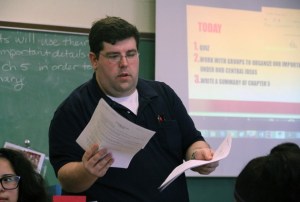
“Good morning!” Duklewski, 33, said in a loud and confident voice over the classroom chatter. He closed the door and paused. A wad of paper flew through the air.

“I’m warning you man, the next time I see someone throw something, it’s lunch detention,” Duklewski said sternly, looking at the student who had thrown the paper.

As students in this second-period English class began to work on their warmup drill—to define the terms “setting” and “mood” in literature—the chatter continued. Duklewski walked over to the chalkboard in the front of the room where he was tracking the points for good behavior that each class had earned. Next to “second period,” he erased the number 14 and changed it to 13.

“Ladies and gentlemen, I already took off a point,” he warned. He waited as the conversations slowly died down, before launching into his lesson for the day on the play A Raisin in the Sun.

Duklewski, one of a growing number of career-changers that enter the teaching profession each year, switched from political lobbying to education after volunteering at an after-school program in Baltimore. This school year is his first, and it has been even tougher than he imagined. In the second week of September, reality hit. “I was like, ‘Oh God, I don’t know what I’m doing here,’” Duklewski recalled.

Duklewski is one of three teachers The Hechinger Report, which partnered with The Atlantic to produce this story, has followed over the course of their first year to look at how training programs prepare new teachers for the classroom—or don’t. As the American education system faces a drumbeat of criticism for its stubborn achievement gaps and lackluster performance compared to other countries, education schools are under attack.

Traditional education schools are trying to reinvent themselves, and alternative fast-track routes are popping up to offer shortcuts to the classroom. Both models seek to help prospective teachers deal with rising standards, increasing student diversity, new technology and, inevitably, the gauntlet of spitballs, note passing, and, these days, illicit texting.

Michael Duklewski leads a lesson in his second-period English language-arts class. (Jackie Mader)

While aspiring educators now have more choices than ever before when it comes to launching their careers, new teachers continue to leave the profession at an alarming rate, suggesting a breakdown in training and support. At the same time, there is little evidence to show which education programs are graduating the most successful teachers or what kind of support is most helpful for rookies.

Duklewski chose the traditional route to becoming a teacher. In 2015, he graduated from Towson University, a state institution outside of Baltimore that has been training teachers for more than 150 years and graduates nearly 700 new teachers each year. He selected the school because of its strong reputation, and it helped that his mother earned her own teaching degree there in 1972. His course of study took two years, including more than 20 classes and 16 weeks of full-time student teaching—typical for traditional programs, which provide more in-depth pre-teaching training than most alternative programs.

Duklewski was hired to teach seventh-grade English language arts at the same school where he completed his student teaching experience. He was familiar with Middle River Middle School’s administration and policies and already knew many of the nearly 900 students in the sprawling, single-story brick building, located in a suburb of Baltimore.

“We’ve gotten into a habit of accepting that we treat the first year of teaching like a fraternity hazing”

Though Duklewski said surviving the initial year hasn’t been easy, many first-year teachers are so traumatized they don’t come back at all. Data on new-teacher attrition varies, but studies have found that anywhere from 17 percent to 46 percent of new teachers quit within their first five years. If teachers were trained better, more might stick around, experts say.

“We’ve gotten into a habit of accepting that we treat the first year of teaching like a fraternity hazing,” said Kate Walsh, president of the National Council on Teacher Quality (NCTQ). “People say, ‘I just don’t think you can learn this ahead of time.’ Well, you need to set up those conditions ahead of time,” she argued.

Is it possible for teacher programs to prepare educators with everything they need to know on Day 1? Maybe not everything, according to the three teachers we followed.

For Duklewski, although he’s struggled at times with unruly students, he’s not sure what else his teacher education program could have done. There’s no better way to learn how to teach, he argued, than just jumping in and doing it.

* * *

A student works on a reading assignment in Duklewski’s English language-arts class. (Jackie Mader)

Back in second period, Duklewski, wearing black dress pants and a blue polo shirt, continued to give directions for the next part of the lesson: using evidence from the A Raisin in the Sun script to draw a diagram of the set.

As he ran the discussion he moved constantly around the room, stopping the lesson abruptly—and frequently—as students talked to their neighbors. He kept an even tone as he threatened to call parents and reminded students that one of the class rules is “don’t talk while others are talking.”

Four minutes in, second period was down to 10 good behavior points. “Don’t draw on your arm,” Duklewski told one student. He ignored a student hitting himself in the face with a red folder. Duklewski stared down a chattering group of students until they started working again.

It was now 10 minutes into the period. Duklewski stepped up to the overhead projector in the front of the room and counted down from three. The class fell silent. “Our purpose is to find details about the staging of the Youngers’s home,” Duklewski said, referring to the family in the play. “What rooms are there? What things are there?” Some students raised their hands, but a few boys continued to talk to each other, or, in a couple of cases, to themselves.

“Ladies and gentleman, I’m literally asking you to do nothing when other people are talking,” Duklewski said in a calm and assertive voice. “We’re going to practice being silent for fifteen seconds. If we can do that, I’ll put a point on the board. If not, I’ll take two off.”

Duklewski set a timer for 15 seconds. Four seconds later, a student started talking.

Less than three months into his first year of teaching, Duklewski exuded the confidence of a more experienced teacher. But his second-period class was difficult compared to the other four classes he’d been teaching, a difference he attributed to several strong personalities and too many students—33, far bigger than his other classes.

For the worst behavior problems, his chosen strategy is keeping students after class for a one-on-one talk instead of addressing them in front of other students. “Some teachers come straight at a student when they have an issue with them in class,” Duklewski said. “I found that doesn’t work with them, especially not in a classroom full of their peers. They get yelled at enough.”

The ability to manage classroom behavior is one of the top concerns for every new teacher and can often lead to the undoing of a rookie. A 2014 report by the nonprofit Alliance for Excellent Education found that trouble managing student discipline is one of the many reasons teachers leave the classroom. Poor classroom management can also get in the way of learning, said Arthur Levine, the president of the Woodrow Wilson Foundation and former president of Teachers College, Columbia University. “If a teacher can’t manage a classroom, nothing they’re going to do will be successful.” (The Hechinger Report is an independent unit of Teachers College.)

Although classroom management is one of the most important topics for new teachers, it is one of the least taught in preparation programs, said NCTQ’s Walsh. “Programs swear up and down that they teach this stuff … [but] there’s little evidence that they’re being taught it,” she said.

In fact, a 2013 report by NCTQ found that many teacher-preparation programs fail to teach certain aspects of classroom management. Of 122 programs examined by NCTQ, the majority focused on the setting up of routines and rules in classrooms, an important skill. But 74 percent did not teach teachers how to use praise in their classrooms to reinforce positive behavior or other day-to-day tricks to keep classes focused and get unruly kids under control.

“If a teacher can’t manage a classroom, nothing they’re going to do will be successful.”For Duklewski, talkative students can be irritating, but they’re not enough to make him quit teaching.

By December, his second-period class was getting better; during the fall, he had started giving students the chance to earn the right to come to his classroom during lunch and watch cartoons on Fridays. (He nixed the cartoons before winter break.) He moved one particularly energetic student to the back of the classroom where he could sit on a window ledge, stand up or move around without distracting other students.

His class-points system, however, had fallen apart. Right before winter break, Duklewski switched to an individual-point system to reward students for independent behavior. Students could earn points by being on-task, finishing the class warmup first, or answering questions correctly. They could then earn small prizes, like pencil sharpeners, or larger prizes, like “renting out” his classroom for lunch with friends.

He also switched from pointing out negative behavior to pointing out positive behavior. Sometimes he found that just announcing what students were doing—“Jimmy is working on his warmup”—made a huge difference. And only a few weeks into the new system, Duklewski said that the changes were both improving student behavior and his own sanity. “I’m just happier, because I’m saying good things all the time instead of harping on bad things,” Duklewski said.

Happiness is relative for a new teacher. Since Duklewski took over his own classroom last September, it’s been nearly impossible to balance his workload with his personal life, a problem many new teachers experience.

Every morning Duklewski wakes up by 5:30 and he tries to be in bed by 9 p.m., although he often stays up late preparing lessons. He saves time by not eating breakfast in the morning and has 35 minutes to eat lunch—15 minutes of which is taken up by hall duty or checking on students in the cafeteria. After 13 to 15 hours at school each day, he drives home, eats dinner, watches a little television, and packs his lunch for the next day. His weekends are mostly filled with grading.

Moving from a role as a student teacher to a full-time classroom teacher was a bigger jump than he had expected. He realized after his first week that there were many things he didn’t know, like the exact procedure for a fire drill. Or how to balance teaching with noninstructional duties like communicating with parents, filling out attendance, and responding to each day’s barrage of emails.

“When it’s all resting on you, it’s just that much more exhausting,” Duklewski said. “Some of it you just figure out as you hit the ground running.”

On a rainy January day, Duklewski stood in front of his fourth-period class having already downed several cups of coffee to keep up his energy. At 10 p.m. the night before, he had thrown out his lesson plan on monologues, and then stayed up until 1 a.m. reworking it to include video examples.

Students were transfixed. After watching monologues from The Lion King, Harry Potter, and The Incredibles, the class discussed the purpose of a monologue. Duklewski then instructed them to write their own, using point of view and voice. On a worksheet, students answered questions about who they would be, why they were talking, and who they were talking to. Kids erupted into excited chatter as they began to plan and write their monologues.

“I’m myself, talking about sacking Tom Brady, to myself,” one student explained. He read his first line aloud. “Ohh I’m gonna sack Tom Brady!”

When the class ended, students filed out still chatting about their monologues. Oner bonus of an engaging lesson, Duklewski added, is that students stay on task and he doesn’t deal with as much misbehavior.

* * *

Duklewski was assigned a consulting teacher who observes him every two weeks. After those observations, he has a chance to discuss the lesson and receive feedback, such as on his classroom management approach or his use of tests.

The mentoring and a high level of support from his school have helped him keep a positive attitude, he said. “I feel the freedom to take risks, mess up and experiment because I don’t feel pressure. If I screw up, I screw up. They’ll help me fix it.” On his mid-year evaluation, Duklewski was rated “effective” on a scale that included the ratings “developing,” “effective” and “highly effective.”

Next year, he wants to do a better job using student data to plan lessons that touch on the skills students are lacking—something he rarely had the chance to do this year because of all the other demands of his classroom and the hours spent preparing lessons. He also wants to get better at long-term planning. And he’s learned from his challenging second-period class that it pays to set up better rules and classroom procedures from the beginning of the year.

As spring break approached, a series of snow days and holidays threw Duklewski’s students off track. He increased the number of phone calls home to parents and doubled down on his positive praise. “I think we’ve come to some sort of understanding about how we’re all going to get along in class,” Duklewski said. He was also getting the hang of balancing his schedule, and had cut his work hours down—to less than 12 hours a day. It helped that he was seeing academic growth. On standardized writing assessments, the class average had gone up by about 50 percent in most of his classes. On reading tests, scores were also rising steadily.

“Next year, I expect it to be much, much easier,” Duklewski said. “I’ve already done everything once. I’ll have stuff to fall back on.”

Although he’s starting to plan his summer vacation, including work as a counselor at a summer camp, he still has one final goal for his students as the year winds down. “By the end of the year, they will not talk over other people while they are talking,” Duklewski said with a laugh. “If I teach them nothing else, they will learn that skill.”


Self-Organized Learning Environments (SOLE)

My (Pooja) good friend and fellow educator has been traveling the world for a unique project. She is looking to get a global understanding of educational reform in the 21st century. On her blog this week she highlights the work of educator Felipe Spath from Bogota, Colombia. Spath is leading the SOLE (Self-Organized Learning Environment) initiative in Colombia. SOLE is a methodology developed by Sugata Mitra in collaboration with educators from various countries around the world, proposing self-organizing collaborative learning using the Internet spaces. Listen to what Spath has to say about collaborative learning in the 21st century.

To learn more about educational reform and this series, follow edumodels:

http://www.edumodels.ca/blog/introducing-the-spotlight-series


Why I love blogging: Take my creativity post and watch the learning grow

Writing blog posts is one of my most favourite things to do. I (Yiola) do not think I’m an entirely seasoned blogger but with time, practice, and learning I hope to become good at it one day. Why? Well, as an academic one of my goals is to share what I study and what I know with others. One way I do this is through my teaching. I am a teacher educator. My goals as a teacher educator are to prepare pre-service teachers to become excellent teachers by thinking about what they teach, how they teach and most importantly who they teach.  I am also a writer — but a very particular kind of writer. I have been taught to write in academic prose for journal articles and book chapters. Sometimes our articles and books are read by others in the field.  But… blogging… this is an entirely different genre and such a wonderful way to network and meet amazing people – some directly in the same field and others in slightly different but related fields – while sharing knowledge and information. Since writing on the academic / teaching blog I have met wonderful people and learned many things and taken away wonderful ideas. Let me share an example based on something that happened recently.

Some time ago I posted a blog about creativity in teacher education. Here is the link below:

Promoting creativity in teacher education

Last week I received an email from a person who is in the field of creativity who has also done some good work in the area. This person shared their insights on what I had written and provided supportive feedback and then also shared their work with me. What a delightful process! I am now sharing their work with you. The following link leads to a list of ways to infuse creativity into the classroom. I reviewed the link and like it for several reasons: 1. It’s foundations and theoretical underpinnings are closely linked to the work I shared with my student teachers in our classes on creativity  2. The list is very easy to view and accessible  3. I found the list inspiring and doable — so yes! I will now proceed to share this link with my student teachers and friends.

http://www.fusionyearbooks.com/blog/creative-classrooms/

This is but one example of how blogging in academia and in teacher education serves such good purpose. Yet another example of how digital technology and literacy work hand in hand to foster communication and learning. I am delighted when I receive messages with feedback, interest, and sharing. Looking forward to more connections and learning through this medium.

Edujargon


jargon.jpeg

http://www.npr.org/sections/ed/2016/04/12/473016059/a-simple-cure-for-educations-jargonitis

Anya Kamentz from NPR sat down and tried something we all should try. She attempted to make the latest  buzzwords in educational research simple and easy to understand. If you were at AERA last weekend, you probably attended sessions (like I did) which were so jargon heavy it was often difficult to follow along. As researchers and writers, our job is to communicate big, complex, and messy ideas to those who didn’t conduct the research or know as much about your particular topic as you do. Jargon often gets in the way of that. creating a divide between researchers/writers and the audience.

Kamentz set out to define some of the most popular educational jargon using only the most 1000 common words in the English Language. Here are a few of my favourite:

Authentic (learning or assessment)
What does this schoolwork have to do with my life or the real world?

Culturally responsive teaching
Do you know where your students come from and what their lives are like?

Hybrid education
Let’s use computers and people to teach students.

Implement
You have a good idea. Making it happen is the hard part.

Mastery-based
Don’t stop until you really know a thing.

Professional development
Teach the teachers too.

Project-based learning
Don’t just write words and numbers. Do something.

Reform
Schools need to change.

Scaffolding
Teaching things step by step so the student can do more and more by herself.

Stakeholders
Lots of people care what happens in schools, like students, teachers, parents and leaders. You should listen to everybody.

Teacherpreneur
A teacher should act like a businessperson.