The Power of Children’s Literature and its Omissions

While I (Yiola) knew there was a lack of representation of  “people of colour” in children’s literature, I was surprised to read the statistics. The chart below shows the number of books published last year and the number written ‘by’ and ‘about’ the different groups defined as ‘people of colour’.


Year

Total Number
of Books
Published (Est.)

Number of Books
Received
at CCBC


African / 
African Americans


American Indians

Asian Pacifics/
Asian Pacific Americans


Latinos


By

About

By

About

By

About

By

About

2013

5,000

3,200

67

93

18

34

90

69

48

57

Two fantastic articles in the New York Times last week prompted me to write this blog:

http://www.nytimes.com/2014/03/16/opinion/sunday/the-apartheid-of-childrens-literature.html?ref=contributors&_r=0

http://www.nytimes.com/2014/03/16/opinion/sunday/where-are-the-people-of-color-in-childrens-books.html?ref=contributors&_r=0

The articles share the stark realities and implications of the statistics represented above from the experiences of African American men, writers themselves. Reading the articles echo and confirm what I believe to be the realities and consequences of our publishing marketplace.  And yet, what to do about it?

The other day I was speaking to a high school educator (a behavior specialist, child and youth worker) who shared stories with me about boys in her school who are misbehaving, who are rude and disrespectful.  I shared with her the ideas that their behaviours must stem from something much bigger than an attitude problem… that they may feel oppressed, misrepresented or not represented at all by the school and broader society.  I do not think she was buying my argument.

My role as a teacher educator is to inform future teachers of the realities of teaching, learning and schooling.  Part of that role includes understanding how systems work for and against particular groups and individual students. One concrete area for exploring such systems is children’s literature.

Christoper Myers, author of “The apartheid of children’s literature”, describes books as maps to identity and ways of being:

[Children] see books less as mirrors and more as maps. They are indeed searching for their place in the world, but they are also deciding where they want to go. They create, through the stories they’re given, an atlas of their world, of their relationships to others, of their possible destinations.

The consequences of excluding certain groups:

what it means is that when kids today face the realities of our world, our global economies, our integrations and overlappings, they all do so without a proper map. They are navigating the streets and avenues of their lives with an inadequate, outdated chart, and we wonder why they feel lost.

Alternatively, Walter Dean Myers, author of the second article, explains what happened to him when he connected to a text: 

Then I read a story by James Baldwin: “Sonny’s Blues.” I didn’t love the story, but I was lifted by it, for it took place in Harlem, and it was a story concerned with black people like those I knew. By humanizing the people who were like me, Baldwin’s story also humanized me. The story gave me a permission that I didn’t know I needed, the permission to write about my own landscape, my own map.

And so, how do we as teacher educators empower teachers so they empower students to realize the flawed systems we live in but and to move beyond them to ensure each child can navigate and negotiate their personalized, broad, rich landscape of possibilities?  I suggest: we ourselves develop a critical stance and what Noddings calls a culture of care; we are explicit about the realities of the systems we currently work in; and we work hard to search out texts and materials that share rich stories of all of our students and beyond.  More so, I suggest we move to change the marketplace by publishing texts that begin to close the gaps in representation in children’s literature.

What Can I Do With a PhD?: Opening Doors to Rewarding Careers

With continued cutbacks at universities, it is becoming more and more difficult for newly graduated students to secure an academic position at a university. Is a career as an academic the only/best choice? A new report  suggests  a PhD can open many doors and during doctoral studies candidates should be exploring many option and acquiring a range of skills. The League of European Research Universities published an “advice paper” on Good Practice Elements in Doctoral Training. http://www.universityworldnews.com/article.php?story=2014020617152794

Some of the key findings of the report are:
·      PhDs are increasingly drivers of their own professional development; and the training model in which the PhD candidate is heavily dependent on one supervisor is no longer robust.
·      over and over again it demonstrates that some of the most research-intensive universities in Europe are prioritising transferable skills, which are now being built into training programmes for doctoral candidates and, most frequently it seems, as elective course options and often in collaboration with other organisations.
·      the introduction presents 29 such transferable competencies like ‘working in teams’, ‘persisting in achieving long-term goals’ and ‘understanding the working of a specific high-level research-intensive environment’.

As a doctoral supervisor, one of the first things I (Clare) want to know from my students is what do they want to do when they complete their doctorate. I want them to be honest  which is often difficult because the prevailing norm in universities is that doctoral candidates should want to be academics. Some of my former doctoral students did not want to be academics but were nervous to reveal their intentions. If I am going to support my students fully I want to know what they hope the doctoral studies will lead to. I can  report some of my students who did not want to be academics are happily employed in a range of positions:  research officer in a school district, classroom teacher, and psycho-educational consultant. During their doctoral studies I tried ensure they are set-up to get  a particular position (e.g., present at specific types of conferences). A PhD in education should open many doors. It is important for us as supervisors to know there are many doors all of which can lead to a fruitful career.

doorways

Multimodal Literacy

My (Cathy) pre-service students were assigned a multimodal aspect to a major assignment this year.  If you are not familiar with the Theory of Multimodality, it is Gunther Kress’ alternative to Linguistic Theory (which only privileges reading and writing as the main modes of communication in a school curriculum).  The Multimodal Theory contests that in our new age of multiple literacies, students need to be communicating, responding and expressing through many different modes of communication (e.g. speaking, music, moving, gesturing, image, and digital technology).

When I first introduced the multimodal assignment to my students, there was some trepidation and even some anger.  It was suggested I did not have the right to be marking them on their artistry or on creativity.  Hence, I had to teach the concepts behind Multimodality Theory so they could better understand what we need to be offering students of the 21st century.  They needed to see that it would allow them the freedom to express in modes of their own choosing; that it was not graded as art but as a production of design; and, that the work could be symbolic or interpretive depending on the meaning they were portraying.  The multimodal projects would also be shared in class so all could learn from them.  This project was not just them regurgitating information for me, it was them designing and producing personally meaningful projects that express what they learned and what they deemed significant.

This week we finished viewing the projects.  They were amazing, and the student response to these projects was encouraging.  My students (concurrent students just finishing a five year educational degree) had never been given this kind of an assignment before.  They loved the element of choice; working together; taking a risk; pushing their boundaries; feeling creative; and, doing something they were interested in.  The modes they selected  to express themselves though were sometimes more traditional (dancing, rapping, singing,  writing and reciting  poetry, creating 3D sculptures, puppetry, multi-sensory art installation pieces); sometimes digital (iMovies, pod-casts, prezis, Pow Toons, popplets, infographics);  and, were often a combination of both.

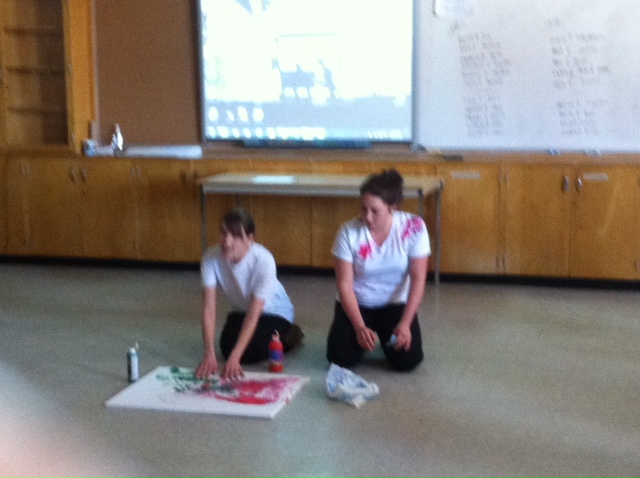
Collectively, we were all blown away by the results.  We were moved.  We were inspired.  My students all said they would definitely use multimodality now as teachers.  Below are a few images of my students presenting their projects:

role play poemfish bowlRAPguitarpuppet photo (13)

Now, I have to assess these designs… but that, dear reader, is for another blog.

What Is Fiction For? Exploring the Uses of Literature with Our Students

Pride and PrejudiceReading the New York Times Book Review section on Sunday, I (Clive) was reminded of the rather negative view of life frequently presented in “good literature.” In books reviewed, life was portrayed as hard to fathom, mainly painful, and ultimately tragic. Of one collection the reviewer said: “These stories know suffering, loneliness, lust, confinement, defeat.” (Lust was the one bright spot.)
This recalled my own education at school and university, where tragic literature was the good kind and comedy was mainly fluff. A “comic” life vision, emphasizing pleasure, happiness, and good relationships, was seen as shallow and naïve.
Certainly, some people find sad and violent books more entertaining than comedies; and a well written tragedy can be absorbing. But as Northrop Frye maintained, literature is supposed to educate as well as entertain. So we have to face the question: How well does tragic fiction educate about life? My view is that it helps, but a more balanced picture is needed.
Based on my own fiction choices, I’m coming to the conclusion that entertainment is a major purpose of fiction. You want something you can enjoy on a plane to offset the cramped conditions and bad food; or that you’re glad to read in the evening when you’re feeling tired. So I usually go for David Lodge, P. D. James, Jane Austen and the like, where there’s plenty of entertainment and a fairly positive worldview.
However, there’s no accounting for taste. The main thing is that we discuss the purpose of various types of fiction with our students, helping them figure out for themselves what to read, when, and why.

The Wikipedia Gender Gap

Wikipedia is  believed, by many, to be a democratic model of content creation because of WIKIit’s design which allows anyone to create/edit content. While listening to CBC Radio’s Spark, I (Pooja) learned that Wikipedia suffers from a severe gender gap. In fact, a study in 2011 conducted by the Wikimedia Foundation, found that only 13% of Wikipedia contributors were women, making men the overwhelming contributors to Wikipedia.

Sue Gardner, the Executive Director of the Wikimedia Foundation, uses comments posted by women on articles related to the wiki gender gap to explain reasons women do not contribute more to Wikipedia:

1)     Some women don’t edit Wikipedia because the editing interface isn’t sufficiently user-friendly.

2)     Some women don’t edit Wikipedia because they are too busy.

3)     Some women don’t edit Wikipedia because they aren’t sufficiently self-confident, and editing Wikipedia requires a lot of self-confidence.

4)     Some women don’t edit Wikipedia because they are conflict-averse and don’t like Wikipedia’s sometimes fighty culture.

5)     Some women don’t edit Wikipedia because the information they bring to Wikipedia is too likely to be reverted or deleted.

6)     Some women don’t edit Wikipedia because they find its overall atmosphere        misogynist.

7)     Some women find Wikipedia culture to be sexual in ways they find off-putting.

8)     Some women whose primary language has grammatical gender find being addressed by Wikipedia as male off-putting.

9) Some women don’t edit Wikipedia because social relationships and a welcoming tone are important to them, and Wikipedia offers fewer opportunities for that than other sites.

Like many, when I want to learn the basics about anything, Wikipedia is often the first place I go. However, before listening to the Spark radio show on Sunday, it never crossed my mind to edit or contribute to a Wikipedia page. Some of the reasons Gardner presented resonate with me, while others not at all. So what is it that’s keeping me (and you) from Wiki’ing?

Listen to CBC Radio Spark on the Wikipedia Gender Gap:

http://www.cbc.ca/spark/blog/2014/03/16/wiki-gender-gap/

Read Sue Gardner’s blog here:

http://suegardner.org/2011/02/19/nine-reasons-why-women-dont-edit-wikipedia-in-their-own-words/

St. Patrick’s Day

Today is St. Patrick’s Day – an Irish holiday. St. Patrick’s day is a significant day here in Toronto and includes a big parade, people wear Green, restaurant and pubs turning themselves into Green enterprises, classrooms talking about and celebrating all that is Green and Irish.  What began as a religious holiday is now a festive c Image Shamrock_with_Pipeelebration in many parts of the world.
St. Patrick’s Day is about St. Patrick, the Apostle of Ireland. St. Patrick is credited for bringing Christianity to Ireland. The shamrock is what St. Patrick used to illustrate the Holy trinity.  March 17th is believed to be the day St. Patrick died.
Thinking about schools and classrooms, should we teach St. Patrick’s Day from a perspective other than a festive celebration? Why is it a prominent celebration here in Canada?  How is it that Irish and other ethnicities alike rejoice in St. Patrick’s Day? When I taught in the public schools we encouraged students to dress in Green, we had a parade through the halls of the school, we read books about St. Patrick’s day and Ireland, and had several activities (arts, crafts, writing) to honour the celebration. Yet not once do I recall and inquiry or examination of what the Day represents both historically and for today.  What are the roles and responsibilities of teachers when it comes to celebrations and religious based traditions? In Toronto, Christmas has been the hotly debated and accommodated celebration for decades. What about the celebrations that are not framed in religion and yet are still entrenched in identity and power? Do we blindly and happily engage in the happiness and celebration without thought to the messages of exclusion and power we send when we honour one group and not another? Or do we engage in the often burdensome experience of exposing the inequities of such celebrations? Or, do we do nothing at all?
In an interesting article by Sallie Marston (1989), “Public rituals and community power: St. Patrick’s day parades in Lowell, Massachusetts, 1841–1874”, Marston states, “parades and other forms of mass public ritual are better characterized as demonstrations of community power and solidarity and serve as complex commentaries on the political economy of urban-industrial social relations”.  Perhaps a safe and productive space for exploring the ‘power’ of celebrations is better served in teacher education classrooms. Teacher educators who take a critical stance in their practice raise consciously engaging issues and connect social theories to classroom practice and student learning. Yiola

Academics in Picture Books: Mad Scientist Stereotype

Yiola’s post yesterday commented on the positive impact of a children’s book. Today I Mad scientist(Clare) want to talk about negative images in children’s books. I came across Melissa Terras’ fabulous research on how academics are illustrated in pictures books. Oh goodness! Academics are typically presented in a very unflattering light (old, male, a bit mad). These stereotypes do damage to our reputation with the general public and are definitely not a positive image we want to present to children. Below are some of the findings from her extensive research which I found to be frightening and discouraging. Check out Melissa’s blog for the entire article: http://melissaterras.blogspot.co.uk/2014/02/male-mad-and-muddleheaded-academics-in.html

What are academics in children’s books like?

The 108 academics found consist of 76 Professors, 21 Academic Doctors, 2 Students, 2 Lecturers, 1 Assistant Professor, 1 Child, 1 Astronomer, 1 Geographer, 1 Medical Doctor who undertakes research, 1 researcher, and 1 lab assistant. In general, the Academic Doctors tend to be crazy mad evil egotists (“It’s Dr Frankensteiner – the maddest mad scientist on mercury!”), whilst the Professors tend to be kindly, but baffled, obsessive egg-heads who dont quite function normally.
The academics are mostly (old, white) males. Out of the 108 found, only 9 are female: 90% of the identified academics are male, 8% are female, and 2% have no identifiable gender (there are therefore much fewer women in this cohort than in reality, where it is estimated that one third of senior research posts are occupied by women).  They are also nearly all caucasian: only two of those identified are people of colour: one Professor, and one child who is so smart he is called The Prof: both are male: this is scarily close to the recent statistic that only 0.4% of the UK professoriat are black. 43% of those found in this corpus are are elderly men, 33% are middle aged (comprising of 27% male and 6% female, there are no elderly female professors, as they are all middle age or younger). The women are so lacking that the denoument of one whodunnit/ solve the mystery/ choose your own adventure book for slightly older children is that the professor they have been talking about was actually a woman, and you didn’t see that coming, did you? Ha!
Most of the identified academics work in science, engineering and technology subjects. 31% work in some area of generic “science”, 10% work in biology, a few in maths, paleontology, geography, and zoology, and lone academics in rocket science, veterinary science, astronomy, computing, medical research and oceanography.
The names given to the academics are telling, with the majority being less than complimentary: Professor Dinglebat, Professor P. Brain, Professor Blabbermouth, Professor Bumblebrain, Professor Muddlehead, Professor Hogwash, Professor Bumble, Professor Dumkopf, Professor Nutter, and two different Professor Potts. There is the odd professor with a name that alludes to intelligence: Professor I.Q, Professor Inkling, Professor Wiseman, but those are in the minority.
Academics are routinely shown as individuals obsessed with one topic who are either baffled Mad scientistand harmless and ineffectual, or malicious, vindictive and psychotic, and although these can be affectionate sketches (“bless! look at the clueless/psychopathic genius!”) academics routinely come across as out of touch wierdos – and what is that teaching kids about universities?  In this age of proving academic “impact”, it might be not so bad for us to be able to show we were relevant to society? That there is more to academia than science? Or for the kids books I show my kids to have more positive and integrated representations of professors and academics? Perhaps this is not the role of kids books though, and I should just be telling my kids my own tales of academic derring-do. 

I think these images of professors can undermine our identity as academics. I certainly do not see myself as the mad professor!


“Pete the Cat” takes our home by storm!

Have you heard of Pete the Cat?  This children’s book series is a favourite in our (Yiola) Pete the Cathome. My 4 year-old daughter and my 2 year-old son love reading/singing along to the stories.

What I like about Pete the Cat ( by Eric Litwin) is its simplicity – the language is simple and the rhythm of the language is catchy. My son is able to connect to the repetition and sings along with joy.

I also like the messages in the stories – they call to issues of mental health and wellness. Pete the cat is calm and does not worry about some of life’s potential anxiety ridden experiences. For example, in “Pete the Cat Rocking in My School Shoes”, Pete is confronted with unfamiliar spatial settings, noisy lunchrooms and bustling playgrounds; common childhood circumstances that can cause anxiety. Yet Pete handles each situation with grace and confidence because, “it’s all good”.

In “Pete the Cat and His Four Groovy Buttons” Pete’s buttons keep popping off of his shirt, but Pete does not get upset because “it goes to show that stuff will come and stuff will go. But do we cry? Goodness no! We keep on singing”.

When reading “Pete the Cat: I love my white shoes”, Pete steps in a variety of ‘stuff’ that cause his white shoes, which he LOVES, to change colour but Pete does not get upset.

The moral of the story is: “no matter what you step in keep walking along singing your song because its all good.”

Check out a Pete the Cat story here:

http://www.youtube.com/watch?v=uuHzYssjjGc


Dialogic Talk

It’s a powerful statement about a book when while reading it, you implement a suggested strategy the next day in class.  That’s exactly what happened while I was reading Classroom Talk: Understanding dialogue, pedagogy and practice, by Edwards-Groves, Anstey and Bull (2014).  The premise- talk is the foundation to all learning- is not new, but the connections made to multiple theories (e.g. Theory of  Practice Architectures, Theory of Multimodality, Social Semiotic Theory) makes this book very current.

book

I particularly enjoyed the section on conversation vs dialogic talk.  I do believe in “vacating the floor” as is suggested in the book and letting the students discuss issues in small groups.  In one particular class I teach, I always allowed my students to select their own discussion groups, as these are university students and felt they needed to make their own choices.  However, many of the groups were not focused, they veered way off topic (or never addressed the topic at all) and some students were still not voicing their opinion (even after much community building).  The section on dialogic talk prompted me to reframe my concept of small group discussion.  It suggested conversation is an informal discourse where direction and end point of the talk are unclear.  This was pretty much where my students were with their discussions.  Dialogic talk, however, sought to engage all listeners and had more purpose.  Plus, dialogic talk was not as relaxed as conversation, it was driven.  I needed driven.  I wanted more engagement.

As a result, I immediately set up ‘Dialogue Groups’ with an assigned moderator, who ensured everyone’s opinion was invited and heard.  I decided who would go into each group (which I thought they might resent and discovered they preferred!).  For each discussion I provided prompt questions to get the talk started.  I also assigned a time keeper who kept the dialogue to the time limit and a recorder who kept general notes about what was discussed.  I honestly didn’t think this would be necessary at the university level, but the difference was incredible.  There was thoughtfulness in the answers.  The discussants were suddenly animated and energetic.  They were really listening to each other.   This was a small change, but it made a world of difference in how they were hearing and responding to each other.

Of course there are many other interesting and practical suggestions in the book.  The connections between theory and practice are very strong.  I highly recommend it.  This book was published by the Primary English Teaching Association of Australia (PETAA).  Check out their web site!

http://www.petaa.edu.au/