Tag Archives: literacy teacher education

Standards and Standardization in Teaching and Teacher Education

Clive BeckAs the participants in the symposium talked about the state of teacher education in our 4 countries, I (Clive) was dismayed at the rapid movement toward requiring everyone (teachers and teacher educators) to teach the same things in the same way.
The cartoon about requiring all animals – elephants, monkeys, birds, fish, etc. – to climb the same tree kept coming to mind. This is madness. In the real world, not only are people different but we need them to be different because of the diverse tasks that have to be performed.
But it’IMG_2598s problematic to publicly describe standardization as madness, since conservatives have presented their position in terms of raising or maintaining standards, and we may be seen as being soft on standards.
Two strategies have occurred to me: One is to fly under the radar, teaching in a rich and individualized way while also implementing “standards.” We have to learn to DO BOTH, as much as possible.
The other strategy is to develop and publicize the argument – noted above – that diversity is needed in all walks of life, and a society that doesn’t “let a hundred flowers bloom” will not prosper. I don’t think we have been vocal and persistent enough in pressing this Clive and Nickpoint.

Tug Agency http://www.tugagency.com was a fabulous place to hold the Symposium. The Tug Team are an example of very talented people who have gone far beyond the “standards” of education. They are very able and very creative — what can we learn from them about how to make education relevant and engaging?


Symposium: Day One Reflections

Lin GoodwinThe first day of our Symposium was a smashing success! The large group discussion of “where we are” revealed the extreme pressure on teachers and teacher educators. We heard about the fast and furious rate of reform in some countries – non-stop initiatives coming from the government. These are so prolific that there are often contradictory messages (e.g., be inquiry-based but focus on skills development). The mini presentations addressed a range of issues: what happens when standards are implemented; student teacher expectations for courses versus the teacher Lydia and Cliveeducators’ goals; problems of teacher retention; the vast number of pathways into teaching creates confusion; and teacher educators having different emphases in their courses even when there is a common syllabus. A problem that arose is lack of control over the implementation of standardization. It can take a very different form from the envisaged use of the standards. The place of digital technology in literacy/English education still eludes and needs much more discussion of what to do and how to do it so that technology is used to support learning.
Cathy MiyataThe discussion was rich and far-ranging. A number of participants commented that we rarely have an opportunity to discuss “big issues” in education and teacher education.
Today promises to be another day full of lively discussion.


International Symposium: Digital Technology and Literacy/English Teacher Education

Making ConnectionsAs many of our blog followers know we are hosting the Symposium : Rethinking Literacy Teacher Education for the Digital Era: Teacher Educators, Literacy Educators, and Digital Technology Experts Working Together. One of the main activities of the project is bringing together 17 experts from three fields and 4 countries (Canada, US, UK, and Australia) to address the following questions.
• How can literacy/English teacher educators (LTEs) prepare student teachers to develop and implement literacy programs that capitalize on digital technology (DT)?
• What teacher education curriculum changes are required to better prepare future teachers to integrate technology in their own teaching?
• What professional learning support do LTEs need to develop courses that will integrate and make greater use of DT?
The Symposium will be held over two days: June 5 and 6 in London England. We will send updates daily.

As academics we tend to work in our “silo” which although allows us to specialize it has limitations. The symposium will provide an opportunity to work in an inter-disciplinary manner which may help us move forward the field of literacy teacher education. The participants are:

Canada
Clare Kosnik (P.I.)
Clive Beck – Co-applicant – OISE/University of Toronto
Pooja Dharamshi – OISE/University of Toronto
Cathy Miyata – OISE/University of Toronto
Lydia Menna – OISE/University of Toronto
Shawn Bullock – Simon Fraser University

England
Jean Murray – Co-applicant – University of East London
Bethan Marshall – Co-applicant – King’s College
John Yandell – Institute of Education, University of London
Sue Dymoke – University of Leicester
Sam Twiselton – Sheffield Hallam University
Alison Baker – University of East London

U.S.
Lin Goodwin – Co-applicant – Teachers College
Peter Williamson – University of San Francisco

Australia
Simone White – Co-applicant – Monash University
Graham Parr – Monash University
Neil Selwyn – Monash University
Scott Bulfin – Monash University

The Symposium is being held at Tug Agency:
Tug is a search marketing led agency, specialising in pay per click
advertising, biddable display, search engine optimisation, affiliates and 
social media marketing. We’re called Tug because we believe that pull
marketing is the most cost effective way to drive traffic to our clients’ websites,
and the best way to drive ROI positive online conversions.http://www.tugagency.com

Study of Literacy Teacher Educators: Remarkable Individuals

New York City BuildingsWe (Clive and Clare) are in NYC interviewing literacy/English teacher educators who are part of our large-scale study which includes participants from four countries: Canada, US, UK, and Australia. To date, we have conducted two interviews and are now starting the third round of interviews. The first interview focused on their backgrounds and interests; the second on their pedagogy; and the third on their use of digital technology and future plans. (For the interview questions click on the tab About Our Research then on the drop down menu, click on the tab for Instruments.) To say this research has been fascinating is an understatement! I feel I have gotten to know 28 outstanding teacher educators both personally and professionally. I have learned so much through this research:

  • their approach to literacy teacher education is thoughtful and complex (e.g., consistently they believe you need to start with the student teacher’s own views of literacy and to help them “unlearn” in order to develop a more expansive view of literacy);
  • most did not plan to do a PhD or become a teacher educator (e.g., their journey to becoming a professor/lecturer were serendipitous with a key figure/mentor influencing them);
  • they have very heavy workloads in part because they are so committed to their student teachers (e.g., they develop tutoring programs in schools in order to provide student teachers with authentic experiences)
  • the political context is impacting on them in untold ways (e.g., the pressure from external credentialing agencies to conform to a narrow view of literacy – phonics – is complicating their work. They cannot always teach what they feel student teachers need to know).
  • they must hold multiple identities – as teacher educators, as teachers, and as researchers

I feel truly lucky to have had the opportunity to interview these 28 remarkable teacher educators. We as an education community can learn much from them. We have published two papers from the study so far. Click on the Link Publications then click on the Link Clare’s Publications for copies of our papers. Literacy Teacher Educators book cover

You might also be interested in our edited book on literacy teacher educators. https://www.sensepublishers.com/catalogs/bookseries/other-books/literacy-teacher-educators/

Longitudinal Study of Teachers: A Highly Rewarding Experience

Clive and ClareClive and I (Clare) are in NYC and NJ to interview teachers we have been following for 7 years. Conducting this longitudinal research has been an amazing experience because we have seen how these teachers change over the years. The first year of the study was stressful for both the participants and me. As brand new teachers, they were sharing with a virtual stranger (me, the researcher) their experiences as new teachers which included both highs and lows. As a researcher I was keenly aware of the challenges new teachers face so I did not want them to feel uncomfortable and I was unsure that the interview questions were appropriate for first year teachers. Over the years, I have gotten to know these remarkable women who often are teaching in very difficult settings. Interestingly, I have seen how their lives changed: getting married, having a baby, losing a spouse …. All life-changing experiences which have impacted their teaching. I am truly grateful that many years ago these young teachers opened their doors to me and have continued to be part of this study. Our interview questions for this year of the study are available. Click on the Link About Our Research then click on the drop down menu tab Instruments.

Some of the findings from this longitudinal research can be found in our new book, Growing as a Teacher https://www.sensepublishers.com/catalogs/bookseries/professional-learning-1/growing-as-a-teacher/

“What, exactly, is an Anchor Chart?”

I (Cathy) remember one of my student teachers asking me this at the beginning of the school year. So we made them in our university class: plastered the walls with chart paper summaries, reminders and tips about many different literacy events and grammars. I suspected my student teachers thought they may be mildly useful. But that attitude changed when they got into their first practicum. The student teachers not only saw their mentor teachers using them, they began to see how their students consistently accessed them. They reported to me after their practicum that anchor charts were practical. Their students used the charts to help them remember things and using them (instead of constantly asking the teacher for the answer) helped the students gain independence as learners.

During the second practicum, much to my delight, the anchor charts started to become somewhat of an art form. Justine, especially, excelled at them. “My anchor charts never looked like this!” her mentor teacher declared. I am not sure how much the students appreciated the visual dynamics, but they certainly used them. I watched them look things up on the walls that surrounded them. Useful? Yes! Visually exciting? Absolutely! How useful and interesting can you make yours?Justine's anchor chartsmore anchor charts

A Few Words From Oliver Jeffers

Clare and I (Lydia) have enjoyed sharing the creative and clever picture books of Oliver Jeffers with the student teachers in our literacy methods courses. Jeffers, an artist, illustrator and writer, notes, “my books are all about telling stories, and a lot of my art is about asking questions…They’re an excellent platform,” he says of picture books, “With novels, things are spelled out for you. And films, things are spelled out for you a lot more. Whereas picture books, it’s up to you how much you sit on a page, sit on an image, move at your own pace. And then you’ve got two distinct and varying sets of tools at your disposal, that weave in and out of each other to create this middle ground. That’s the secret ingredient, I think, that’s what makes them such a fantastic vehicle for storytelling.” (National Post Feb 2013). OliverJeffers

Photo Highlights from AERA 2014

The 2014 American Educational Research Association (AERA) conference took place this year in Philadelphia. I was able to attend some fascinating paper sessions, poster sessions, and symposiums during my time there. I also managed to make it to the memorable museum district area of Philadelphia. Here are some photo highlights below:

My dear friend and research colleague, Cathy Miyata, presenting her paper Negotiating Multiliteracies Pedagogy in International Preservice Teacher Education:

photo6

A fascinating panel titled Defending, Reforming and Transforming Teacher Education: The Future of Teacher Education in the United States. This panel’s members included Linda Darling-Hammond, Timothy Knowles,  Kwame Griffith, and Kenneth Zeichner.

photo3

An important symposium on ways teacher education programs around the world  are preparing preservice teachers for marginalized students. The symposium entitled Building Infrastructure and Capacity Research Innovations Worldwide That Prepare Teachers for 21st Century Schools That Service Marginalized and Poor Students in Transnational Contexts. Below is a photo of Dr. Clare Kosnik sharing findings from our international study on Literacy Teacher Educators:

photo5

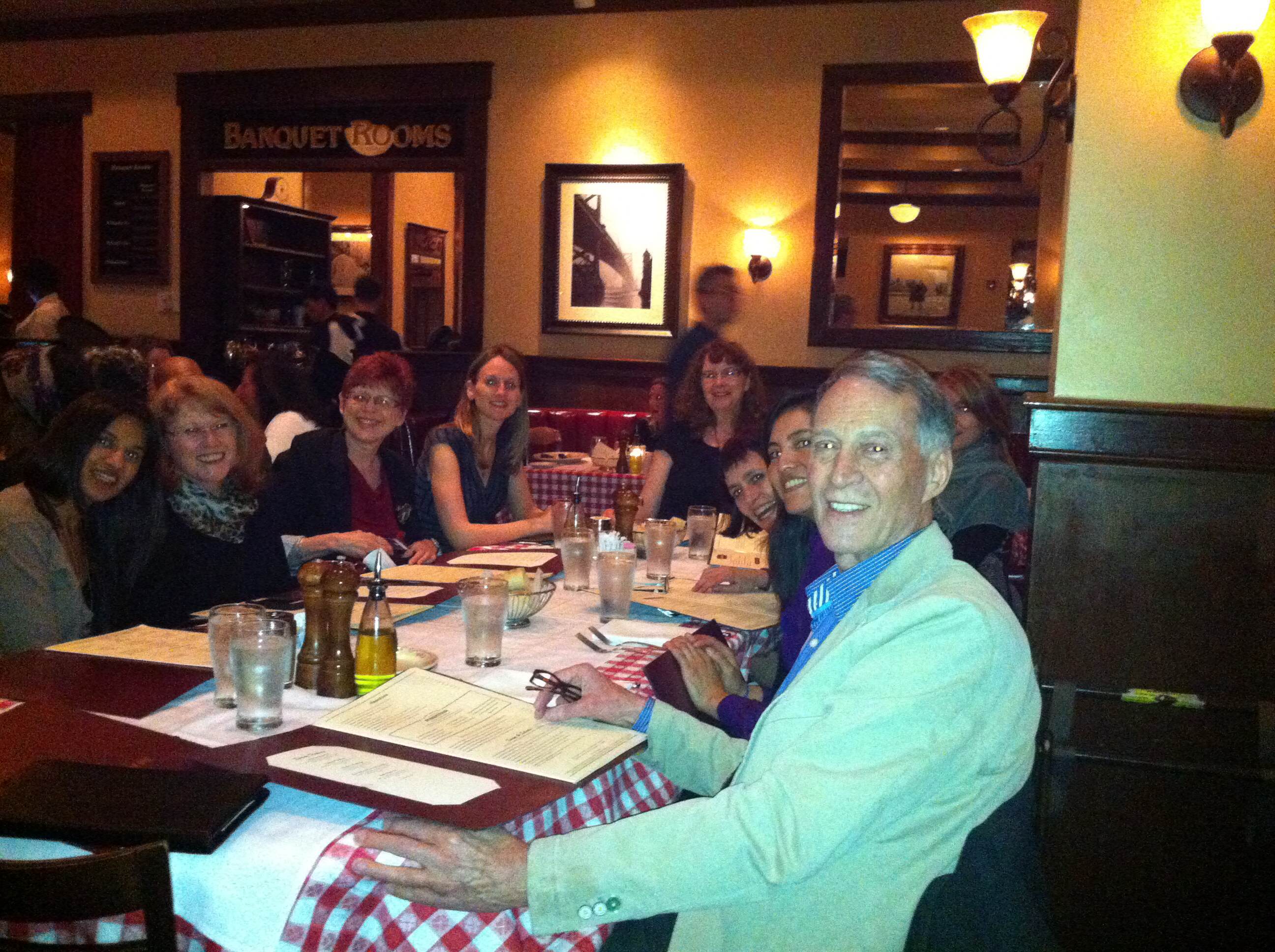
A relaxing dinner with our research group, Becoming Teacher Educators.

photo4

Finally, a photo from the museum district which is looking south on Benjamin Franklin Parkway. I was standing on the iconic steps where Rocky trained while taking this photo!

photo2-3

Assessing Multimodal Projects

You may remember, in a former post on Mar. 21, 2014, I (Cathy) shared some of my pre-service students’ multimodal projects.  The dilemma facing me after these wonderful creations were submitted, was how to assess them.  As these were only part of a larger assignment, I already had a rubric in place for whole project, but after seeing the brilliance of the multimodal aspect, I felt these alone warranted more thought and introspection on my part.  Having a background in the arts, I was used to assessing creative process and final product, but this was different.  Although artistic and expressive, this wasn’t “art”.  Hence, I looked up a number of sources on assessing multimodal work and discovered a few different opinions.

Kalantzis, Cope & Harvey (2003) argued that a multimodal assessment needs to measure the creative process and the collaborative skills demonstrated.   Jacobs(2013) suggested it wasn’t about the final product, but “watching and noticing what students are doing and then using that information to guide the students toward new skills and knowledge”.  In the end I sought out the opinion of Gunther Kress, the founder of the Multimodalities Theory.  Kress (2003) explained that representation and communication were an affective/cognitive semiotic process and this must be taken into account in the assessment. He suggested that I, as the teacher [educator] should not ask “How does this project match what I wanted or expected?”, but instead should ask, “How does this project give me insight into the interests and motivations of my learner?”  I found this question quite insightful. In the end, I used Kress’ question to guide my feedback, which will hopefully guide the students toward new insights and knowledge.  The required ‘grade’ was based on a combination of the learners’ expressed interests from within the context of the whole project (which was on diversity), the creative process and the collaborative nature of the work.

Through this process I discovered that assessing in the new age of multimodality demands mindfulness, insight and the ability to make many connections.  To be effective, it also requires that the teacher educator, or teacher, know his/her students well.  This type of assessment takes time, but it is much more meaningful. I have to admit, as much as the students loved doing these multimodal projects, I loved assessing them in this “new” way.  We all got more out of the process.  Below is a link to one more student project expressed as POW TOON digital creation.  How would you assess it?

POW TOON Link

http://www.youtube.com/watch?v=9uM68P2rk24&feature=share&list=UUdKEvJ3G8Z-W-geAhhsX9IA

Multimodal Literacy

My (Cathy) pre-service students were assigned a multimodal aspect to a major assignment this year.  If you are not familiar with the Theory of Multimodality, it is Gunther Kress’ alternative to Linguistic Theory (which only privileges reading and writing as the main modes of communication in a school curriculum).  The Multimodal Theory contests that in our new age of multiple literacies, students need to be communicating, responding and expressing through many different modes of communication (e.g. speaking, music, moving, gesturing, image, and digital technology).

When I first introduced the multimodal assignment to my students, there was some trepidation and even some anger.  It was suggested I did not have the right to be marking them on their artistry or on creativity.  Hence, I had to teach the concepts behind Multimodality Theory so they could better understand what we need to be offering students of the 21st century.  They needed to see that it would allow them the freedom to express in modes of their own choosing; that it was not graded as art but as a production of design; and, that the work could be symbolic or interpretive depending on the meaning they were portraying.  The multimodal projects would also be shared in class so all could learn from them.  This project was not just them regurgitating information for me, it was them designing and producing personally meaningful projects that express what they learned and what they deemed significant.

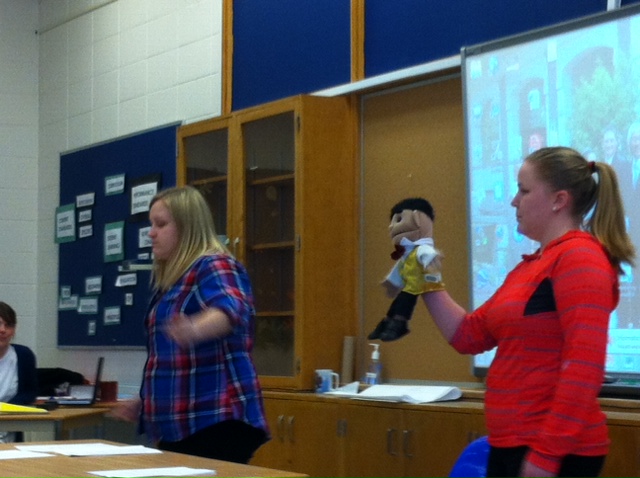
This week we finished viewing the projects.  They were amazing, and the student response to these projects was encouraging.  My students (concurrent students just finishing a five year educational degree) had never been given this kind of an assignment before.  They loved the element of choice; working together; taking a risk; pushing their boundaries; feeling creative; and, doing something they were interested in.  The modes they selected  to express themselves though were sometimes more traditional (dancing, rapping, singing,  writing and reciting  poetry, creating 3D sculptures, puppetry, multi-sensory art installation pieces); sometimes digital (iMovies, pod-casts, prezis, Pow Toons, popplets, infographics);  and, were often a combination of both.

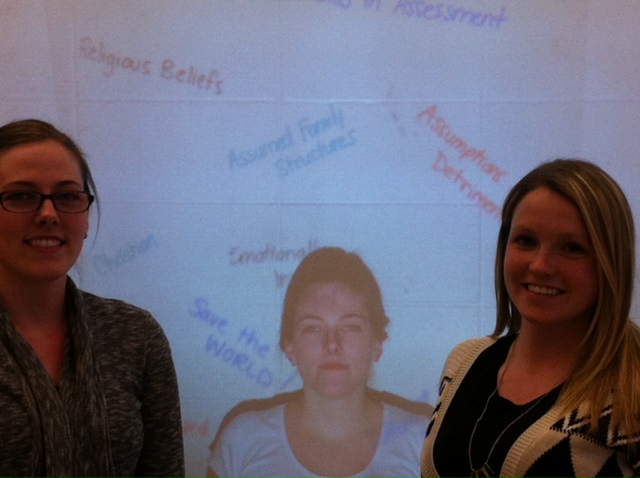
Collectively, we were all blown away by the results.  We were moved.  We were inspired.  My students all said they would definitely use multimodality now as teachers.  Below are a few images of my students presenting their projects:

role play poemfish bowlRAPguitarpuppet photo (13)

Now, I have to assess these designs… but that, dear reader, is for another blog.