
Digital Smile for the Day
“The “take a book, return a book” boxes are catching in even on places where Kindles and brick-and-mortar books abound.”
I love the concept of the Little Free Library! The Little Free Library movement operates from a universally understood “take a book, return a book” policy. The first Little Free Library was built in 2009 in Hudson, Wisconsin. Since then, Little Free Libraries have been popping up all over the world:
“There are now 18,000 of the little structures around the world, located in each of the 50 states and in 70 countries—from Ukraine to Uganda, Italy to Japan. They’re multiplying so quickly, in fact, that the understaffed and underfunded nonprofit struggle to keep its world map up to date.”
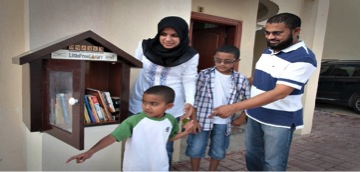
Little Free Library in Qatar

Little Free Library in Toronto (St. Clair Ave)
Find a Little Free Library near you!
http://littlefreelibrary.org/ourmap
When I (Cathy) was a grade school teacher, there were times when parents took their children out of school for a family trip. Often, a parent would ask if they could borrow a math or language text book to bring along so the child could “keep up”. I begged them not to. “Please,” I would say, “have them keep a journal. Draw what they see. Describe the people they meet. Take pictures and keep a record of them. Videotape a special event. Make a scrap book. Record the weather. Calculate the distance you travel every day. Follow the map. Plan an excursion.” In other words, I would ask the parent to use the trip as a resource. I would also suggest the child prepare to share some of their experiences with the class when they retuned, so we could all learn from the trip.
I was alarmed to think they would imprison their child in a hotel room or trailer to keep up with what we were doing in the classroom sometimes hundreds of miles away. There was so much to see and learn from the incredible world around them!
Now, the affordances available for a child to investigate, record and share a trip are so much more interesting! A colleague of mine asked a grade one student of hers, who was going to the Olympics, to Skype the class every Tuesday morning from wherever she was and share her experiences. Her class loved it. They felt like they were there with her. After the Skype meeting the class would research the people and places she talked about. That one student’s trip became a class project.
This past summer, I travelled through Greece with my husband. I was delighted to see so many children capturing the sites we visited on an tablets and smartphones. I wondered if they would share any of it with classmates. I would still encourage a parent to not use a text book on a trip. The real world is just too interesting and there are so many creative ways to explore it. It’s all learning.
Last month, I (Cathy) was invited to present a workshop on literacy and the arts in Gotha, Germany, for a group of educators. At the beginning of the workshop, one of the teachers admitted, “I really don’t know what literacy means.” I wasn’t really surprised as interpretations of literacy are so varied. When a few others also admitted they were not sure, I invited them to find a matching-shoe partner and share with them what they thought literacy meant.
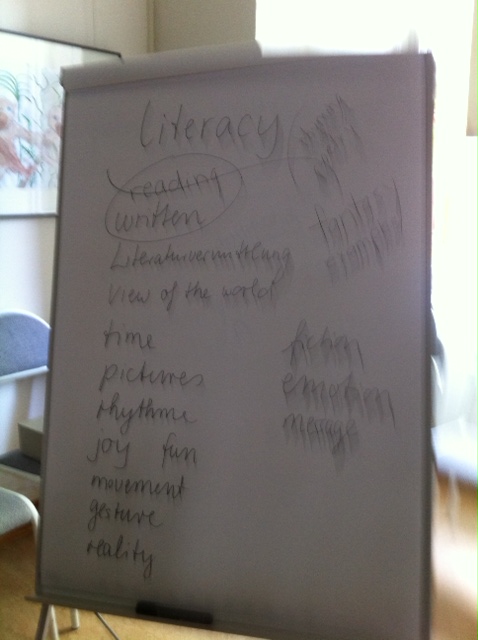
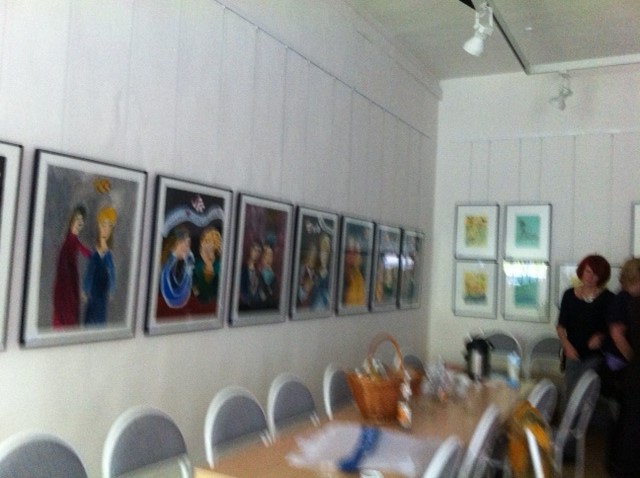
Once the discussion was opened up to the whole group, it was interesting to hear what they came up with. They started off with the traditional reading and writing interpretation and we decided together these were forms of communication. From there, the definition really expanded. One participant suggested literacy included reality, while another suggested emotion. As we probed deeper the idea literacy was a view of the world was introduced. Eventually I asked them to look around the room at the fabulous paintings hanging on the walls. They were painted by local school children and they were emoting wonderful narratives. Yes, they decided, the paintings were also literacy. Throughout the rest of the workshop we explored ways to use storytelling and drama as literacy.
It was exciting to witness the development of a deeper understanding of an enormous concept like literacy. I like to think this encounter helped these teachers to see meaning-making in a new way. I wonder how it will affect their use of literacy in their classrooms. On the chart we created together, it was also suggested literacy was fun. It was. Hope it is for their students too.
I (Clare) recently did a presentation to a group of teachers on a self-study I conducted with  Lydia Menna and Shawn Bullock on our efforts to integrate digital technology into my literacy methods courses. (Here is the powerpoint from that presentation. BERA + ECER-DT 2013in Dropbox) I talked about my initiatives which led to me showing how my efforts in my literacy teaching led to a greater use of digital technology in other parts of my life (e.g., using NVivo for data analysis). The success of my initiatives with my teaching gave me the confidence to take the plunge to do a website. My technical skills had improved and my identity shifted so that I now see myself as “digitally competent.” During the presentation I showed our website and one of the participants raised an interesting question: How do you get ideas for your blog? He recounted how he wanted to do a blog but did not know what to write about. I told him to just start! I believe that writing a blog is a different genre – it requires different writing skills than other forms of writing. Since we started this blog, I feel that my blog-writing skills have improved. I now focus on one topic in a blog; I am more comfortable sharing my insights; I will raise questions; I make links to other resources; and I no longer feel the blog needs to be perfect (so what if there is a typo. We will survive.) Blogging seems to have captured my interest and is a good match for me ( I have lots to say about education) and it is fun. I keep a Word document with blog ideas which is always plentiful and when I come across something “interesting” one of my first thoughts is – Would that make an interesting blog? This thought is followed by – Would others be interested in this topic/issue? Doing our blog as a “team” has truly been the way to go. I have learned so much from the posts by my team (Cathy, Lydia, Pooja, Clive and our guest bloggers) about them personally and professionally. And their blogs give me ideas about what to write about.
I really see our blog as connecting with the broader education community which is social media at its best. Blogging is good for me because it gets me thinking critically and hopefully, our posts are of use to our readers.
In the word search below, can you find…
1. The name of the theorist generally accredited with the origins of Social Constructivist Theory
2. The term used to identify a branch of linguistics which contends that meaning-making manifests through human interpretations of sign systems
3. The names of the two researchers accredited with constructing the four resource model
4. The term assigned to multiple modes of communication
5. The Literacy Theory that purports literacy and language are not neutral but political.
6. The name of a pedagogical approach designed by 10 scholars known as the New London Group in 1996
Scroll down for answers- but no peeking!
| Z | C | X | B | N | O | L | M | R | T | Y | Y | I | O | P | K |
| A | C | V | N | Q | W | R | U | T | U | J | L | A | S | D | F |
| B | V | M | N | W | E | F | L | A | S | D | F | G | H | H | J |
| Q | Y | W | E | M | U | L | T | I | M | O | D | A | L | O | P |
| A | G | D | G | J | K | O | I | M | N | B | V | C | X | Z | A |
| W | O | E | T | Y | P | U | L | U | K | J | H | G | F | D | S |
| Z | T | X | C | V | B | N | I | M | L | H | F | D | S | A | E |
| C | S | T | G | H | K | L | T | O | U | Y | T | E | R | W | Q |
| V | K | N | N | L | H | O | E | I | T | R | E | W | A | Q | P |
| R | Y | T | Y | U | I | P | R | I | Z | X | C | V | B | N | M |
| Z | L | U | K | E | M | V | A | O | P | U | Y | T | R | E | W |
| C | X | B | N | M | L | Q | C | R | I | T | I | C | A | L | Q |
| Q | W | E | R | T | Y | U | I | I | O | P | L | K | J | H | G |
| H | G | F | D | S | A | S | E | R | T | Y | U | I | O | M | N |
| D | F | G | H | J | K | L | S | E | M | I | O | T | I | C | S |
| Q | S | D | C | F | R | E | E | B | O | D | Y | C | A | T | Y |
Answers: 1. VYGOTSKY 2. SEMIOTICS 3. LUKE, FREEBODY 4. MULTIMODAL 5. CRITICAL 6. MULTILITERACIES
I (Cathy) teach Writer’s Workshop in my university literacy class by having my student teachers participate in one. They engage in the entire process from selecting a genre, to peer editing, to learning from descriptive feedback, to publishing their work. I am amazed every year how much the student teachers gain from the experience. They often begin the process terrified of being a writer and of teaching writing. The Writer’s Workshop structure helps them overcome much of that fear. One of the biggest challenges they must overcome is selecting a genre to write in. Every year several students are completely stymied by this. To aid these students I provide wordless picture books for which they must write the words. They love it and swear they will do this for their own students when they are teachers.
The other day I came across a new source for stimulating writing. It made me laugh out loud. Would you write it from the sea gulls point of view, or the cat’s?
I (Clare) read this article and felt it would add to the posts on this blog about teachers as decision-makers and the need for teachers to be seen professionals.
The allusion in Robert Pondiscio’s Why Johnny won’t learn to read accomplishes something different than intended. Pondiscio’s uninformed swipe at balanced literacy actually reveals that, once again, ideology trumps teacher professionalism and literacy research.
The reading wars are about almost everything except reading, but the most important lesson from this newest version of the same old thing is that if we start with what balanced literacy is, we begin to see just what those who attack balanced literacy believe:
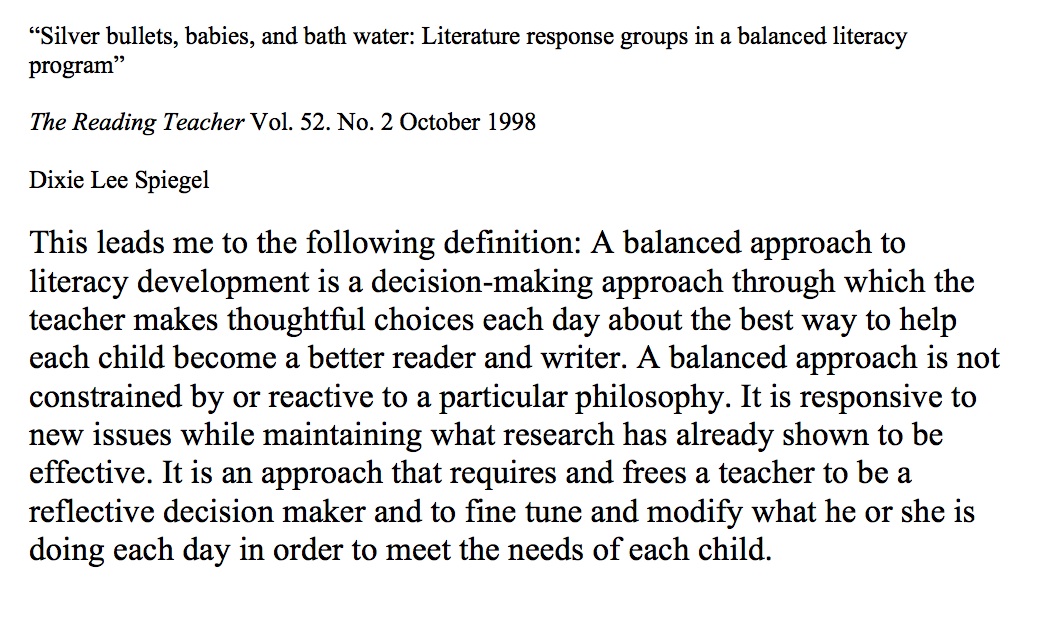
Spiegel’s definition shows that the term “balanced literacy” is about the professional autonomy of the teacher, the wide range of research on how children acquire literacy, and honoring individual student needs (those who need direct instruction and those who do not).
Like “whole language,” balanced literacy does not reject any practice that is needed or effective, and does not prescribe practices either.
When Pondiscio and others, then, reject balanced literacy, they reject…
View original post 23 more words
I (Cathy) make a point of reading a novel either about or from a country I am about to visit. As Germany is my next destination, Goethe became my author of choice. I was familiar with his now famous work, Faust, but the book I selected is known as The Sorrows of Young Werther. In all honesty, it was not the plot or the style, but the details about the book that enticed me to read it. This novel had an enormous cultural impact on Germany and surrounding countries.
Written in just six short weeks by a young Johann Wolfgang von Goethe (only 24), it was largely autobiographical. In the book, the hero, Werther, through a series of letters, describes his over-infatuation with a young woman named Charlotte. This novel was an immediate success and sold so many copies it became the first block buster novel. It even had merchandizing to support it: perfume, Werther dolls and Werther clothes. The book launched an entire literary genre, Sturm und Drang(Storm and Stress), inspired an opera, and instigated the romanticism movement. Sadly, the book was also banned in four countries because many young men imitated the tragic fate of the hero. I am intrigued that this book had such an extensive affect, long before the age of computers or mass marketing. This book was written in 1774. Such is the incredible power of literature. I am excited about going to Weimar, Germany to appreciate the monuments and museums dedicated to the work of Goethe. I may even buy a Werther doll.


Each year, Clare and I (Lydia) invite student teachers in the P/J and J/I literacy methods courses to explore the rich pedagogical possibilities available when poetry is included as an integral part of a literacy program. We consciously include the work of a variety of poets in an effort to provide student teachers with multiple entry points into the teaching of poetry. The recent passing of celebrated poet Maya Angelou brought to light once again the dynamic and influential nature of poetry. Angelou’s powerful poetry inspired a generation of Hip Hop artists who appreciated the beauty and complexity of her work. Upon hearing the news of her death, rapper-producer Q-Tip acknowledged the deep impact Angelou’s poetry had on him. In a twitter post he recalled trying to copy her voice during his early days with A Tribe Called Quest. He noted, “I tried to copy Maya’s fluid voice early on but failed miserably. But because of her I found my own… RIP Maya Angelou and thank u.”
Maya Angelou’s Legacy in Hip-Hop: www.slate.com/blogs/browbeat/2014/05/28/maya_angelou_s_legacy_in_hip_hop_poet_leaves_behind_a_history_of_appearances.html


 Literacy Teaching and Teacher Education