Tag Archives: literacy

Dialogic Talk

It’s a powerful statement about a book when while reading it, you implement a suggested strategy the next day in class.  That’s exactly what happened while I was reading Classroom Talk: Understanding dialogue, pedagogy and practice, by Edwards-Groves, Anstey and Bull (2014).  The premise- talk is the foundation to all learning- is not new, but the connections made to multiple theories (e.g. Theory of  Practice Architectures, Theory of Multimodality, Social Semiotic Theory) makes this book very current.

book

I particularly enjoyed the section on conversation vs dialogic talk.  I do believe in “vacating the floor” as is suggested in the book and letting the students discuss issues in small groups.  In one particular class I teach, I always allowed my students to select their own discussion groups, as these are university students and felt they needed to make their own choices.  However, many of the groups were not focused, they veered way off topic (or never addressed the topic at all) and some students were still not voicing their opinion (even after much community building).  The section on dialogic talk prompted me to reframe my concept of small group discussion.  It suggested conversation is an informal discourse where direction and end point of the talk are unclear.  This was pretty much where my students were with their discussions.  Dialogic talk, however, sought to engage all listeners and had more purpose.  Plus, dialogic talk was not as relaxed as conversation, it was driven.  I needed driven.  I wanted more engagement.

As a result, I immediately set up ‘Dialogue Groups’ with an assigned moderator, who ensured everyone’s opinion was invited and heard.  I decided who would go into each group (which I thought they might resent and discovered they preferred!).  For each discussion I provided prompt questions to get the talk started.  I also assigned a time keeper who kept the dialogue to the time limit and a recorder who kept general notes about what was discussed.  I honestly didn’t think this would be necessary at the university level, but the difference was incredible.  There was thoughtfulness in the answers.  The discussants were suddenly animated and energetic.  They were really listening to each other.   This was a small change, but it made a world of difference in how they were hearing and responding to each other.

Of course there are many other interesting and practical suggestions in the book.  The connections between theory and practice are very strong.  I highly recommend it.  This book was published by the Primary English Teaching Association of Australia (PETAA).  Check out their web site!

http://www.petaa.edu.au/

What’s in a word?

Sheryl Sandberg, the Chief Operating Officer of Facebook, has teamed up with the Girls Scouts USA to start a campaign that calls for a ban on the use of the word bossy in everyday language. Sandberg suggests that referring to girls as “bossy” can limit their full leadership potential.  The website of Sandberg’s non-profit organization LeanIn.Org states,

“When a little boy asserts himself, he’s called a “leader.” Yet when a little girl does the same, she risks being branded bossy. Words like bossy send a message: don’t raise your hand or speak up. By middle school, girls are less interested in leading than boys—a trend that continues into adulthood. Together we can encourage girls to lead. Pledge to Ban Bossy”. 

Sandberg’s “Ban Bossy” initiative has recruited an ensemble of spokeswomen, including Condoleezza Rice, Diane von Furstenberg, Jennifer Garner, Jane Lynch, and perhaps most notably megastar Beyoncé.

The Ban Bossy project highlights how a word can come to signify particular social and cultural dynamics.  While I do understand the goals driving this initiative it makes me uneasy when a group advocates for the banning of words no matter how well intentioned their motivations might be. Words carry with them a history, at times a history of injustice and painful disparities, but an awareness of history is critical if we hope to effect systemic change.  Perhaps, an alternative to “banning” is reclaiming words in an attempt to shift the negative connotations associated with a particular word. 

http://www.slate.com/blogs/xx_factor/2014/03/10/ban_bossy_sheryl_sandberg_and_the_girl_scouts_team_up_with_beyonc_but_miss.html

Guest Blog: Monica McGlynn-Stewart

Monica McGlynn-Stewart who is part Monica McGlynn-Stewartof our research team on the longitudinal study of teachers is our first guest blogger. For more information on Monica click on the tab About our Research then click on Meet the Team.

I (Monica) gave my 16-year-old daughter I am Malala by Malala Yousafzai for Christmas and now I am getting a chance to read it.  It is the memoir of a 16-year-old girl who was shot by the Taliban for speaking out about girls’ right to education. I find it fascinating for many reasons, not least of which is what I am learning about life in the Swat Valley in Pakistan. As an educator, I am always interested in learning about different systems of education and different pedagogical practices. Malala is the daughter of a school I am Malalaprincipal and had access to formal education except for a brief period when schools were closed by the Taliban, but many girls in the Swat Valley do not have access to education. In her descriptions of her studies, she relates how she memorized and recited religious texts, poetry, history, and even chemistry formulas. Her mother, who did not learn to read and write, can also recite many texts that she learned through hearing them. When I went to elementary school in the 70’s, we sometimes had to memorize a poem and recite it, but it was a rare occurrence. As an elementary teacher, I never asked my students to memorize texts, but they would learn many poems by authors such as Dennis Lee or Shel Silverstein because we read them out loud so often. For young students, “memory reading” a text that they had memorized was an important step in learning to read. So I am wondering, what role does memorization and recitation play in literacy learning? And can we consider someone illiterate who has memorized and can purposely refer to a large body of literature?

Walking for the Brain

To further our theme from earlier posts on well-being and schooling, I (Cathy) looked up the right time to exercise to help your brain.  These tips were suggested:

  • In general, anything that is good for your heart is great for your brain.
  • Aerobic exercise is great for body and brain: not only does it improve brain      function, but it also acts as a “first aid kit” on damaged brain      cells.
  • Exercising in the morning before going to work not only spikes brain activity and prepares you for mental stresses for the rest of the day, but also      produces increased retention of new information, and better reaction to      complex situations.
  • When looking to change up your work out, look for an activity that incorporates coordination along with cardiovascular exercise, such as a dance class.

http://www.positscience.com/brain-resources/everyday-brain-fitness/physical-exercise

These all made sense, but none of them identified when or why I like to exercise for my brain.  When my mind is somewhat numb after a few hours of academic writing, I need to push the refresh button.  I achieve this walking by the lake.  I am sure it is good for my lungs, my joints and my heart, but I really head to the water to recharge my neuro cells and feast my eyes.  The scenery renews me as much or more than the exercise.  Maybe just seeing what I saw yesterday will refresh your neurons…

photo 1 photo 2 photo 3 photo 4

Picture Books

arrival_02Clare and I (Lydia) routinely integrate picture books into our pre-service literacy methods courses. We often begin each class with a read aloud from a picture book. The feedback we have received from student teachers suggests they appreciate this practice because it introduces them to a variety of texts they can use in the classroom, and it models storytelling and read aloud techniques. We have often used the creative and compelling picture books of author Shaun Tan in our literacy courses. I wanted to share a quote from Shaun Tan in which he comments on the “visual language of illustrations”.

“the word illustration is a little misleading, because the best illustrations do not actually illustrate anything, in the sense of describing or illuminating. My own narrative images, and those of my favourite artists, are actually far more concerned with deepening the uncertainty of language, enjoying its ambiguous references, exploiting its slipperiness, and at times, confessing its inadequacy.  My own aspirations as an illustrator – using that term advisedly – is to simply present the reader with ideas that are essentially silent, unexplained, and open to very broad interpretation”.— Shaun Tan

(Quote taken from an essay originally written for ABC Radio National’s Lingua Franca.)

The Power of Believing

Building on Clare’s blog from yesterday and the notion of connecting well-­‐being to schooling, I (Yiola) feel compelled to share with you the story of Simon Marcus. He is a member of my extended family and one of Canada’s top athletes in the sport of Muay Thai. In fact, Simon is a 5 time World Champion.

http://en.wikipedia.org/wiki/Simon_Marcus

Simon’s story is not uncommon: a Black, male disengaged with traditional school. As a child, he was an active boy and excelled in sports but had very little patience and interest for learning inside the classroom. He has shared his schooling story with me numerous times and the story has been consistent, “It is not that I was not capable of doing the work, I just had no interest or motivation”. As his schooling years progressed he found himself deeper and deeper in spaces of alienation and low expectation for successful schooling. And then, he met Master Suchart, a Master teacher of Muay Thai.  Through a pedagogy that engaged him (physical literacy), a teacher that knew how to connect to his well-­‐being, and a developing belief in himself as a learner and a winner, Simon went from detentions and failure to being on top of the world. The one statement that rings in my ears about Simon’s journey to success is this turning point, “I knew Master Suchart believed in me. His belief in me made me believe in myself”. The ideas of well-­‐being, trust, care and belief paved the way to Simon’s success. A teacher’s role in the well-­‐being of a student is key: the social conditions created in a classroom, the relationships fostered and the pedagogical decisions a teacher makes are key.

From my own experiences as a Muay Thai fighter, I can say it is much easier to prepare for and pass a science test at school than it is to prepare for and step into a Muay Thai ring and yet the big questions worth exploring are: how did the teaching and learning at the Muay Thai school connect well-­‐being to schooling success? What process took place for Simon to connect with the learning, embrace the teacher and believe in himself? Perhaps the kinesthetic element of the pedagogy, perhaps the content, perhaps the teacher as role model and unconditional supporter, perhaps the challenge and, very likely the overheard whisperings of his teacher: “see that  boy over there, he’s my future champion”.

yiola

Simon’s victory in Buenos Aires, Argentina against Argentina’s #1 fighter.

yiola 2

Simon with his teacher, celebrating a victory together.

Semiotic Linguistic Quiz

Saussure   Ferdinand de Saussure (1857-1913)

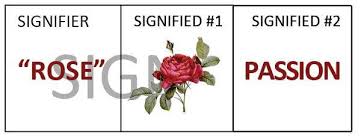
As of late, I (Cathy) have been exploring semiotic linguistics to further  my understanding of multimodality (Jewitt & Kress, 2003). Ferdinand de Saussure is considered to be one of two fathers of 20th century semiotic linguistics.  He described semiotics a as a system of signs that are created within a cultural context.  Sausuure defined a sign as being composed of:

        • a ‘signifier’ – the form which the sign takes; and
        • the ‘signified’ – the concept it represents.

On the internet I stumbled upon these diagrams which are intended to illustrate the meaning of signifier and signified.  Do you think they are both correct?

tree

rose

A multitude of communication resources

cartoon_newliteracies

When I saw this comic it made me chuckle.  I enjoyed the comic’s gentle reminder that children/youth routinely engage with and expertly navigate a variety of communication tools. Clare and I (Lydia) conducted a two-year collaborative self-study of our efforts to incorporate various technological resources (e.g. a wiki) into our pre-service literacy methods courses. This research helped us identify both the challenges and successes we encountered along the way.  Our research efforts also made us more mindful of why we chose to incorporate certain technological resources into our pedagogical practice — questioning for what purpose and to what end.   Through the analysis of our efforts we realized that we had initially seen technology as an end in itself, not as a tool to support learning. In the second year of the study, we focused much more on student learning and became more systematic in our efforts. Over the two years of the study, our identities as teacher educators shifted as our pedagogies became richer, our use of technology more fully integrated into our literacy courses, and we received validation from others and from each other.

Multimodal Valentines

I (Cathy) love special occasions.  Just give me a theme and I suddenly have an opportunity to be creative.  Lately, my outlet is a three dimensional mode of expression- cupcakes!  I can experiment with my designs using colour, texture, size, shape, and taste.  For my Valentine’s cupcakes, aside from the cake and icing choices, there were a multitude of affordances (decorative toppings) to choose from. For this dozen, I decided on a range of tastes and textures:  cinnamon heart candies, red and white jube jubes, tiny snowflake hearts, red sugar sprinkles, silver balls and message hearts.  Remember those tart tasting message hearts?  They say things like “hug me”, “I love you”, “kiss me”, and now there is one that says “text me”- so new literacies!  This is truly a multimodal sensory experience for me (the designer) and everyone that gets one (the receiver of my communication). I see this as a perfect example of my Western culture influences channeling through me to create a social semiotic representation of my caring.  But I won’t tell that to my husband.  All he will see a pretty cupcake that is “Mmmmm, delicious!”  And that’s fine too.  I am not sure if this is what Gunther Kress had in mind when he created the Centre for Multimodal Research, but it works for me.   Happy Valentine’s Day all!photo

“Everything Changes When You Read”

The Guardian published an edited version of a lecture Neil Gaiman delivered as part of the Reading Agency’s annual lecture series. In the lecture Gaiman makes an impassioned argument for the importance of libraries and the benefits of reading fiction.  He compellingly notes, “prose fiction is something you build up from 26 letters and a handful of punctuation marks, and you, and you alone, using your imagination, create a world and people it and look out through other eyes. You get to feel things, visit places and worlds you would never otherwise know. You learn that everyone else out there is a me, as well. You’re being someone else, and when you return to your own world, you’re going to be slightly changed”.

http://www.theguardian.com/books/2013/oct/15/neil-gaiman-future-libraries-reading-daydreaming?CMP=twt_gu

photo12