Tag Archives: Pooja Dharamshi

Expectations for Teachers in the 21st Century

Between working in a time of increasing digital technology, high-stakes testing, diverse classrooms, the 21st century teacher needs to wear more hats than ever before. Jeff Dunn from Edudemic.com has put together the following chart outlining 8 essential characteristics for teachers of the 21st century.

8char

Dunn emphasizes that teachers do not have to embody all of these characteristics all the time. Rather, he explains: “What you do need to do, though, is be able to pull from experience and be a leader, a collaborator, a communicator at a moment’s notice. That’s what (to me) a 21st century teacher does.”

Are there characteristics you think are not included? Is it realistic to expect all teachers to be experts in multiple areas? To be able to wear multiple hats at any time? And wear them well?

Teachers Speak Up on Work-Life Balance

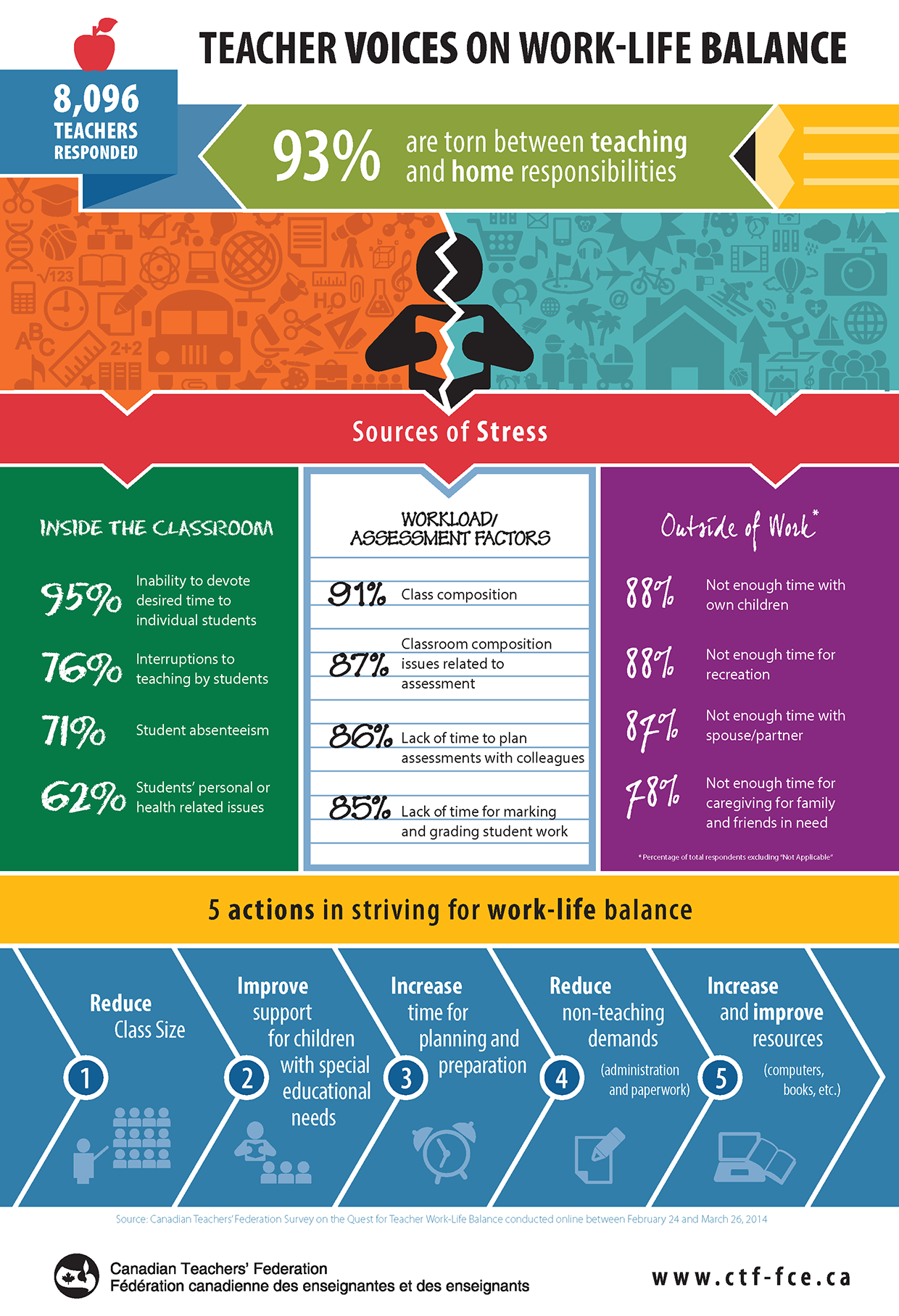
Earlier this year the Canadian Teachers’ Federation conducted a survey to gain insight into the obstacles teachers face trying to achieve a work-life balance. The survey found sources of stress for teachers both inside and outside the classroom. In total, 8,096 teachers responded.

Inside the classroom, 95% of teachers felt that they had the “inability to devote desired time to individual students.” While outside of the classroom, 88% expressed they did “not have enough time with own children.” Other school related stresses included: interruptions to teaching by students; student absenteeism; and students’ home life and health related issues.

The five actions recommended to relieve some of these stressors are familiar suggestions. Since I have been in the field of teaching I have heard demands for all of the recommendations given. They include: reduced class sizes; improve support for children with special needs; give more time for planning and preparation; reduce demand of non-teaching related activities; and improve resources. Most of these suggestions require money, and a lot of it. Are these recommendations realistic? How else can we think about promoting better work-life balance for our teachers?

Read more about this issue here:

http://educhatter.wordpress.com/2014/05/06/teacher-stress-if-class-composition-is-the-problem-is-more-money-the-answer/#comments

teacherstressctf14Take a look at this graphic which complies information gathered from the survey:

An Infographic of Finland’s Education System

Much has been said about the education system in Finland. For the past decade or so Finland’s PISA scores have been at the top in both literacy and mathematics. Many studies have been conducted on their exemplary system. Some of the characteristics which set the education system apart:

  • Student- Teacher Ratio is better than in North America
  • Standardized testing and homework is kept to a minimum
  • Teaching is a highly respected profession

Below is a beautiful infographic outlining Finland’s stance on teaching and learning (Lepi, 2014). Lepi concludes the infographic with, what she believes, is most critical to Finland’s success: “Finland knows good teachers are essential.”

http://www.edudemic.com/homework-finland-infographic/

finland

The Homework Debate

homework

As a  middle-school teacher, the issue of assigning homework was something I always grappled with. I often wondered:  When assigning homework, were my students really making the connections they were meant to be? Was the homework only helping the stronger students? Was the homework meaningful to the student’s learning? Was it at the appropriate level for them to complete independently? Was it fair to assign homework when I knew many of my students had other familial responsibilities? Would my class not be considered rigorous if I didn’t assign homework?

Alberta high school math teacher, David Martin, has grappling with some of the same issues. He feels homework seems to “buoy the strong and discourage the weak.” So, he has recently stopped assigning homework altogether.

An excerpt from the article presents common arguments for each side of the debate:

The news reinvigorated a debate about the value of homework — a conversation that has bubbled up and receded over the past five to seven years, gaining converts along the way. Even still, the issue remains divisive, with some parents campaigning hard for a homework-free experience that would give them their life back — and others worried about their children falling behind or failing to learn the discipline and time management required in high school and beyond. As one Collège de Saint-Ambroise parent said, “I’ll see how the year goes, but I’m very afraid. Homework is a way for us parents to evaluate whether things are going well, and to guide us in helping and supporting them.”

 What are your thoughts on assigning homework?

 Link to the full article:

http://news.nationalpost.com/2014/09/05/no-more-homework-growing-movement-especially-early-on-to-ban-after-school-assignments/

Using Video Games for Assessments

There has been a movement towards using gaming for educational purposes. Incorporating gaming into lessons for the purposes of engagement has been the most popular use thus far. However, now a case is being made for using games for assessments. Kamenetz (2014) writes an interesting blog explaining the benefits of this non-traditional type of assessment.

Screen Shot 2014-09-21 at 4.26.06 PM

An excerpt from the article:

Imagine you’re playing a computer game that asks you to design a poster for the school fair. You’re fiddling with fonts, changing background colors and deciding what activity to feature: Will a basketball toss appeal to more people than a pie bake-off?

Then, animal characters — maybe a panda or an ostrich — offer feedback on your design. You can choose whether to hear a compliment or a complaint: “The words are overlapping too much,” or, “I like that you put in the dates.”

You can use their critiques as guides to help you revise your poster. Finally, you get to see how many tickets your poster sold.

This little Web-based game isn’t just a game. It’s a test, too.

The article also touches on Schwartz’s theory of assessment which focuses on choice. Schwartz argues that “the ultimate goal of education is to create independent thinkers who make good decisions. And so we need assessments that test how students think, not what they happen to know at a given moment.” I wonder how this form of assessment may change a student’s relationship with test-taking. I’m curious to follow this trend and find out.

Read entire blog here:

http://blogs.kqed.org/mindshift/2014/08/could-video-games-measure-skills-that-tests-cant-capture/

Making the Most of Parent-Teacher Conferences

parentteacherconf

Now that the school year has started, parent-teacher conferences are not too far away. Often parents only get 5-10 minutes with their child’s teacher(s). Nadworny from NPR suggests that in that limited time parents should focus on three major areas: the child; the classroom; and the future. Below are excerpts from the NPR article.

  1. The Child
  • “Most experts suggest telling the teacher about your child: Describe what they’re like at home, what interests and excites them, and explain any issues at home that may be affecting your child at school.”
  1. The Classroom
  • “Ask about what’s happening in the classroom — both academically and socially.”
  • “Don’t be afraid to ask the teacher to clarify what assessment or grades actually mean.”
  • “Before the meeting is over, you should be sure you’re clear on the teacher’s expectations for your child.”
  1. The Future
  • “To get the most out of the conversation, she says, both the teacher and the parent should know what comes next. Brainstorm with the teacher to come up with ways to solve challenges your child faces. Ask for concrete examples of things you can do at home to help.”

Read the entire article here:

http://www.npr.org/blogs/ed/2014/09/18/349337543/how-to-make-the-most-of-your-10-minutes-with-teacher?utm_source=facebook.com&utm_medium=social&utm_campaign=npr&utm_term=nprnews&utm_content=20140918

More Than a Princess

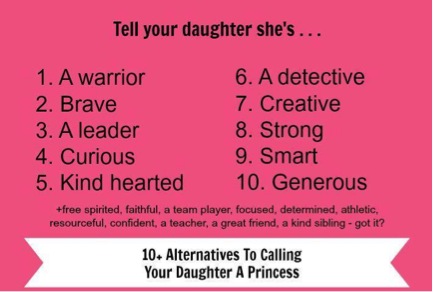
Earlier this year I (Pooja) blogged about a series of books from Mighty Girl which focus on disrupting the gender stereotypes placed on young women. The Mighty Girl site recently shared blogger Carla Molina’s blog about what to call your daughter besides (or in addition to) a ‘princess.’ In her blog, Molina notes, “we are not anti-princess in our home. We are mindfully selective of these royal ‘role models’ and how they influence our daughters.”

Check out some of the suggestions:

 notaprincess

Read the entire blog entry here:

http://allofmenow.com/2013/07/ten-alternatives-to-calling-your-daughter-a-princess/

The Interactive Resume

I have never seen something like this before, so I thought I would share it! If any of you are familiar with the Mario Brothers games, this interactive resume will seem very familiar to you. I had so much fun “reading” this resume! 

http://www.rleonardi.com/interactive-resume/

digresume

Little Free Libraries

“The “take a book, return a book” boxes are catching in even on places where Kindles and brick-and-mortar books abound.”

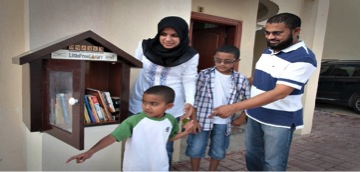
 I love the concept of the Little Free Library! The Little Free Library movement operates from a universally understood “take a book, return a book” policy. The first Little Free Library was built in 2009 in Hudson, Wisconsin. Since then, Little Free Libraries have been popping up all over the world:

There are now 18,000 of the little structures around the world, located in each of the 50 states and in 70 countries—from Ukraine to Uganda, Italy to Japan. They’re multiplying so quickly, in fact, that the understaffed and underfunded nonprofit struggle to keep its world map up to date.”

qatar

Little Free Library in Qatar

stclair

Little Free Library in Toronto (St. Clair Ave)


Find a Little Free Library near you!

 http://littlefreelibrary.org/ourmap

The Triple Focus

I (Pooja) came across a new book I am interested in reading , so I thought I’d share it with our blog community. The new book by Daniel Goleman and Peter Senge is entitled The Triple Focus: A New Approach to Education (2014) and makes a case that education should focus on three things:

  1. Self-awareness
  2. Empathy
  3. Understanding our relationship with the larger world
Triple-Focus-Cover1-300x300

This focus on self, other, and world in the classroom is something I am particularly interested in as I feel it is increasingingly necessary in today’s classrooms. Daniel Goleman explains:

 These skill sets interact very naturally. We feel that this complete inner tool kit should be a part of every child’s learning as the world they are growing into becomes more distracted, relationships more besieged, and everything more interconnected and complex.


Below is an excerpt from the new book:

Empathy and Academic Success

The key to compassion is being predisposed to help — and that can be learned.

There is an active school movement in character education and teaching ethics. But I don’t think it’s enough to have children just learn about ethical virtuosity, because we need to embody our ethical beliefs by acting on them. This begins with empathy.

There are three main kinds of empathy, each involving distinct sets of brain circuits. The first is cognitive empathy: understanding how other people see the world and how they think about it, and understanding their perspectives and mental models. This lets us put what we have to say in ways the other person will best understand.

The second is emotional empathy, a brain-to-brain linkage that gives us an instant inner sense of how the other person feels — sensing their emotions from moment to moment. This allows “chemistry” in our connections with people.

Those two are very important of course; they’re key to getting along with other people, but they’re not necessarily sufficient for caring. The third is called, technically,empathic concern — which naturally leads to empathic action.Unlike the other two kinds of empathy, this variety is based in the ancient mammalian circuitry for caring and for parenting, and it nurtures those qualities.

Read more at:

http://www.huffingtonpost.com/dan-goleman/triple-focus-excerpt_b_5638646.html?1407243583