Our 1-year consecutive B.Ed. program has begun and I’ve (Clive) had two meetings with my School & Society class. The student teachers are wonderful: committed, talented, experienced in many ways, worldly-wise but friendly. Where do such people come from? Why do they continue to go into teaching when it’s so hard to find a job? Anyway, I’m glad they do.
Our second class was on program development and I stressed that, when they become teachers, they will have much less teaching-time than they thought and will need to prioritize, be flexible, and make choices. This led to a discussion of the extensive unit and lesson plans they will be expected to submit during their program, and the massive long-range plan their future principal will require of them. I related how the teachers in our longitudinal study use shorter lesson and unit plans – and then very flexibly – and seldom refer to their long-range plans. They have trouble seeing the point of such detailed planning exercises.
We agreed that they have no choice – during the program and later – but to fulfill such requirements. However, it makes a big difference to see such planning as a “requirement” they don’t necessarily agree with – rooted in traditional “transmission” models – rather than a “state of the art” approach to teaching. Then they can produce the detailed plans quickly and without undue angst, and get on with the serious business of teaching.
Several students expressed relief at being able to approach it this way; and I saw it as an important window on the complexities of effective, autonomous teaching. It is true that our teaching has to be comprehensive, and we have to know where we’re going. But highly detailed lesson plans that we follow to the letter aren’t the best way to get there. What room does this leave for individualization, student construction of knowledge, and our own on the spot learning as teachers? For my own 3-hour class I usually have about 6 main topics, of which we get to 3 or 4 and often in a different order and with different time allocations than I had planned. And of course we discuss other topics that weren’t even on my list….

 with Alan Ovens. Tim has a long-time commitment to the practice and study of health and physical education. Teaching at Brock University where he is an Assistant Professor and conducting research on the preparation of teachers to teach phys ed, he understands the complexity of the issues facing teachers and teacher educators. Helping children and youth acquire the skills and attitudes to lead a healthy and active lifestyle is not easy but is critically important. This text will help us think differently about preparing teachers to teach health and physical education.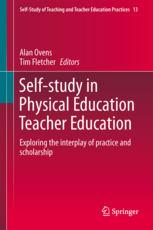
 scores while teaching a standard curriculum (developed by “some” external body). This pressure is especially acute for new teachers who are trying to sort out teaching in general while figuring out their style, their particular goals, coming to terms with their changing identity … . In this politicized era trying to balance standards with what students actually need is a challenge for the most experienced and able teachers. I (Clare) read a fabulous article Professional knowledge and standards-based reforms: Learning from the experiences of early career teachers by Andrea Allard and Brenton Doecke. It is in English Teaching: Practice and Critique May, 2014, Volume 13, Number 1 pp. 39-54
 Literacy Teaching and Teacher Education