Tag Archives: teaching

Topics and Methods for Class Debates

In previous postings, I (Clive) have recommended debates as a way to give students a voice in university and school classrooms and also introduce some variety into class activities. Of course, the topics have to be interesting to the students if they are to get really involved; and the overly combative tone of traditional debating needs to be avoided so there are no hard feelings.

This term, in my graduate class of 22, I used two debating topics that worked very well. They were: (1) Teaching Values in School and (2) Formal Professional Development for Teachers. In each case we formed 4 groups (by numbering off from 1 to 4 around the class, including myself) and then assigned “positions” to the groups as follows:

Teaching Values in School

Group 1: On the whole, teachers should keep their values to themselves

Group 2: It is often appropriate for teachers to promote the values they believe in

Group 3: On the whole, schools should advocate general “human” values (e.g., treating women and men equally) even if they conflict with the values of the family

Group 4: On the whole, schools should honor and respect the values of the family, even if they conflict with general “human” values

Formal Professional Development for Teachers

Groups 1 & 3: Formal professional development has a very important role to play in teacher learning and school improvement. Examples of effective formal PD include….

Groups 2 & 4: Formal professional development does not play a major role in teacher learning and school improvement. Examples of more important methods and factors are….

Each group spent 20 minutes preparing their case, with each person in the group proposing and outlining an argument and/or example. Then each group in turn presented their case to the whole class, with every member of the group speaking. Finally, we returned to the whole class circle and went around with each individual saying what they thought about the topic (we didn’t have time to go all the way round the class, but this final activity also proved very valuable).

Notice that the “opposing” positions were softened by using phrases such as “on the whole,” “it is often appropriate,” “not a major role” (rather than “not any role”). Also, the emphasis on giving examples to support one’s case was a big success – I hadn’t used this before.

So, this was my experience. If you have a chance to experiment with debates, let us know what topics you used and how it went – we can do a guest blog!


Making Group Work More Personal and Inclusive

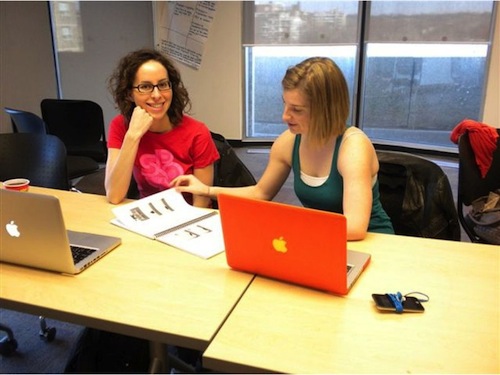
I (Clive) have posted before about the importance – in educational settings – of giving all Shawn Bullockmembers of a group a chance to speak. It now seems that similar observations are being made outside the educational realm. In Sunday’s New York Times Magazine (Feb 28, 2016), findings along these lines were noted in two studies from the world of work.

In a 2008-2010 Carnegie Mellon/M.I.T. study, a team of psychologists headed by Anita Wooley found that work teams with “pretty average members” were unusually effective when inclusive “group norms” were established. Wooley reported: “As long as everyone got a chance to talk, the team did well. But if only one person or a small group spoke all the time, the collective intelligence declined” (p. 24).

oopIn a later Google study called Project Aristotle, begun in 2012, researchers built on the Carnegie Mellon/M.I.T. study. They linked “conversational turn-taking” to a sense of “psychological safety” within a group. They found that work teams were more effective when there was a social emphasis and everyone had a chance to contribute. They reject a sharp personal/work dichotomy, stating that “no one wants to put on a ‘work face’ when they get to the office” (p. 72).

It seems hard to explain why group effectiveness and social inclusion would be connected Teachers working togetherin this way. More theory is needed in the area. But meanwhile I think we should consider these findings as we attempt to enhance our group discussion practices.


Rethinking Positive Thinking, in Life and Education

I (Clive) know that self-help books are not everyone’s cup of tea, but given the interest in well-being these days (see Clare’s February 6 posting) they appear to have an important place. Recently I came across a rather impressive one called Rethinking Positive Thinking (Current/Penguin, 2014) by psychologist Gabriele Oettingen.

Oettingen agrees that learning to think positively is essential, but feels that writers on the selfiesubject have gone too far. Just focusing on the positive can result in frustration, failure, and un-happiness. As the saying goes, perfection is the enemy of the good. She recommends instead what she calls “mental contrasting,” which involves thinking about both the positive and the negative aspects of a situation, and of life in general.

As well as being helpful at a personal level, Oettingen’s approach seems to me to have application to teaching and teacher education. It supports being realistic about the challenges of teaching – and so not caught off guard by them, as many beginning teachers are – while also reminding ourselves of its many satisfactions and rewards. It calls into question over-the-top government and school district “targets” that promise to “transform” schooling, if only teachers would adopt the latest set of edicts. Mental contrasting can keep us aware of what we need to work on in teaching while taking comfort in the current successes of the profession.

The Digital Divide Persists

dd

As educators we often believe we are living in an era post the digital divide. Everyone has access to the internet, right? If we see our students with Smartphones that must mean they are connected, right? Wrong. A distressing article from the New York Times reminds us the digital divide still persists. Although this article is written about the U.S. context,  I have to believe many claims are true for Canada as well. Cecelia Kang from the New York Times writes,

“With many educators pushing for students to use resources on the Internet with class work, the federal government is now grappling with a stark disparity in access to technology, between students who have high-speed Internet at home and an estimated five million families who are without it and who are struggling to keep up.” 

While trying to prepare students for the 21st century world, we as educators post homework and assignments online, ask students to post blog entries or participate in educational chat groups, and become active on social media in generative and meaningful ways. However, while we upgrade and innovate our pedagogies, we may inadvertently be leaving several pupils behind. How do we prepare our students for working and living in the 21st century, which is so digitally driven, while ensuring our most vulnerable students are not being left behind?

Read the full New York Times article here: http://www.nytimes.com/2016/02/23/technology/fcc-internet-access-school.html?hp&action=click&pgtype=Homepage&clickSource=story-heading&module=photo-spot-region%C2%AEion=top-news&WT.nav=top-news&_r=1&referer=http:/m.facebook.com

Mary Kennedy on Engaging Student Teachers More Deeply

As I (Clive) have said before, I’m a great fan of Mary Kennedy of Michigan State University. In earlier postings I commented on her complex vision of teaching and her incremental yet radical approach to school reform. Having read a new article of hers in the latest issue of the Journal of Teacher Education (Jan/Feb 2016), I wish to recommend it.

Ever courageous, Kennedy in this piece takes on the currently popular movement for the teaching of “core practices” in teacher education. While an improvement on earlier practice-focused teacher education approaches – in that the practices in question are medium-grained rather than too specific or too general – she believes this approach is (a) too didactic and (b) neglects the purposes of teaching. She proposes instead helping student teachers see that a variety of complex strategies are needed to achieve the purposes of schooling, and constant adjustments on their part are required along the way.

Kennedy is careful to note this is “not an either/or decision. I am not proposing that we abandon specific practices in favor of problem solving strategies. Instead I argue here for (a) less attention to bodies of knowledge, (b) less attention to specific teaching behaviors, and (c) far more attention to the persistent challenges” of achieving the purposes teaching. Her position is that in pre-service (and in-service) education we should “not recite knowledge or dictate practices to teachers, but instead engage teachers in more analysis and exploration of alternatives.” This seems to me to embody the constructivist approach to teaching that – as Kennedy has said elsewhere – most teacher educators advocate.

For those who may see this as an overly idealistic approach that will undermine pupil performance on standardized tests, Kennedy cites the findings of a review that “programs using these alternative pedagogies were generally more effective at raising student achievement than were the didactic programs that focused on either bodies of knowledge or specific teaching practices.”


Support for Teachers from the Field of Medicine

At last someone has linked the problems of inappropriate use of testing in education with Doctorthose of the prestigious profession of medicine. Robert Wachter, Professor of Medicine at UCSF, has written a book titled The Digital Doctor: Hope, Hype, and Harm at the Dawn of Medicine’s Computer Age in which he argues that measurement has gotten out of hand. In a New York Times article “How Measurement Fails Us” (Sunday Review, Jan 17, 2016, p. 5) he states:

“Two of the most vital industries, health care and education, have become increasingly subjected to metrics and measurements. Of course, we need to hold professionals accountable. But the focus on numbers has gone too far.”

In the article Wachter notes that “burnout rates for doctors top 50 percent” and he says recent research has shown that “the electronic health record was a dominant culprit.” He then draws a parallel with teaching.

“Education is experiencing its own version of measurement fatigue. Educators complain that the focus on student test performance comes at the expense of learning.”

Wachter maintains that what is needed is “thoughtful and limited assessment.” “Measurement cannot go away, but it needs to be scaled back and allowed to mature. We need more targeted measures, ones that have been vetted to ensure that they really matter.” We also need to take account of the harm excessive measurement does. Again he compares the two professions: research has shown that

“In medicine, doctors no longer made eye contact with patients as they clicked away. In education, even parents who favored more testing around Common Core standards worried about the damaging influence of all the exams.”

With this welcome support, we in education need to consider how we can keep measurement within limits and focused on key matters, so it does not undermine our profession. When is measurement useful, and when does it do more harm than good?

Short or Long Form Writing?

There is a lot of enthusiasm today about the potential of short form communication – SocialMediatweets, blogs, etc. – to facilitate inquiry and professional development. At the same time, books and long articles continue to be published in huge numbers. Which medium is likely to have greater impact? An obvious response is that we should use both; but when forced to choose (either as reader or writer), which should we opt for? In my (Clive’s) view it depends on the context and how we go about it.

Teaching is such a complex process that individual tweets or blogs about it may be of little use. However, if they are part of an ongoing conversation (literal or metaphoric) they can be very valuable. It is the same with articles and books: they must respond to the concerns and thinking in the field if they are to be helpful.

Wittgenstein once said (according to Iris Murdoch – NYT, January 24, 2016): “One conversation with a philosopher is as pointless as one piano lesson.” So much for short form communication! But it depends on the context. For a serious pianist, a single interaction with another pianist can have a big impact. And equally, if an academic is willing to dialogue rather than just lecture endlessly about their theory, one conversation can be very helpful.

Whether short or long, communication should as far as possible “keep the conversation going” (to use Rorty’s phrase) so people learn from each other and there is a cumulative effect. We cannot always have an actual conversation, but if we listen to what others are asking and thinking we can make a contribution.


Parents versus Friends

In the Toronto Globe & Mail on January 15th I (Clive) read an interesting excerpt from a book by Leonard Sax called The Collapse of Parenting. According to Sax, young people are IMG_3128increasingly looking to friends for support rather than their parents; and the problem with that is whereas parents tend to stick by their children through thick and thin, many young people just drop their friends after a dispute or perceived minor infraction. As a result, children are becoming more vulnerable and anxious (a phenomenon others have noticed).

I think teachers should discuss this set of issues with their students as part of ongoing way of life education (and also introduce them to children’s books or young adult novels that deal with friendship, family life, etc.). Why do young people turn to friends rather than parents? Are they taking this too far? Do they realize the dangers (whatever they are)? Are friends less supportive than family? Support from friends often comes at a price (loyalty, obedience, etc.), but does family support also have a price? Should we go to friends for some things and parents for others? These are tricky questions, but I think exploring issues in a safe environment is always better than leaving young people to grapple with them on their own. And we will learn a lot through the discussions too!


Is School Making Our Children Ill?

In the New York Times on January 3, I (Clive) came across a fascinating column by Vicki Abeles (Sunday Review section) about the negative impact current school “reforms” are having on children. According to her, they are undermining the health of students, both rich and poor and from kindergarten to high school.

Abeles has written a book (which I plan to get asap) aptly titled “Beyond Measure: Rescuing an Overscheduled, Overtested, Underestimated Generation,” and has produced documentaries “Race to Nowhere” (as distinct from Race to the Top) and “Beyond Measure.” But in the column her focus is on research conducted by Stuart Slavin at Irvington High School in Fremont, California, “a once-working-class city that is increasingly in Silicon Valley’s orbit.” In cooperation with the school, he anonymously surveyed two-thirds of Irvington’s 2,100 students and found that “54 percent of students showed moderate to severe symptoms of depression [and] 80 percent suffered moderate to severe symptoms of anxiety.” The school is trying to address the problem, for example by re-examining homework demands and counseling students on achieving a manageable course load.

Based on her own inquiries and reflections, Abeles attributes much of this anxiety and depression to the enormous pressure young people are under today to climb the ladder of schooling, with a view to getting into a good college and/or job. “Even those not bound for college are ground down by the constant measurement in schools under pressure to push through mountains of rote, impersonal material as early as preschool.” Apart from opposing this general approach to schooling, Abeles sees practical lessons that can be learned from Irvington’s approach. Toward the end of the article she suggests:

“Working together, parents, educators and students can make small but important changes: instituting everyday homework limits and weekend and holiday homework bans, adding advisory periods for student support, and providing students opportunities to show their growth in creative ways beyond conventional tests.”


Chimamanda Ngozi’s Book Being Distributed to ALL 16- Year-Old Students in Sweden

I have written about the powerful words of Ms. Adiche before. Her words stop us in our tracks and make us re-consider notions of identity, language, and gender. She has a new book out entitled We Should All Be Feminists. It is based on a speech she delivered at a TEDx conference a few years ago. I have already ordered it!

The most amazing thing about her new book is how it is being distributed. The Swedish Women’s Lobby has decided to distribute Adiche’s book to every 16-year-old student in Sweden. In a CBC article, publisher Johanna Haegerström believes her book will be an entry point into a larger discussion about gender roles in society. He said:

“Our hope is that the Chimamanda Ngozi Adichie text will open up a conversation about gender and gender roles, starting from young people’s own experiences”

adichie-composite

http://www.cbc.ca/books/2015/12/we-should-all-be-feminists-by-chimamanda-ngozi-adichie-is-being-given-to-every-16-year-old-in-sweden.html