Monthly Archives: May 2014

Spending Too Much Time On Your Phone?


photoLike most, I (Pooja) find myself engaged with my smart phone too much. I often make attempts to limit my usage. I tell myself things like “I won’t check Facebook until it’s time for bed”, but these promises I make myself are hardly ever kept. Perhaps a doggy cone is not such a bad idea!

Social Media 101

I (Yiola) came across this while on social media and found it playful… and true!

10259931_10152488203689175_8001628699976626381_n copy


A great explanation of social media and their functions.   I often think about the degree of necessity of each of these forms of communication — what they offer and their implications for communication and social interactions.  I am contemplating the pros and cons and beginning to explore literature that shares findings of the implications of our newer forms of communication.

Multifaceted Role of the Professor: Conducting Research Includes ….

As mentioned in a previous blog post, Clive and I (Clare) are interviewing teachers who are part of our longitudinal study of teachers. Many of our teachers have had life-changing events – including becoming a parent. The teacher we were interviewing in northeast US this past week is a new Mom and is home on maternity leave. We did a division of labour: while I was interviewing the teacher, Clive babysat the new baby who is four months old.  The question is: who had more fun? Me doing the interview with an amazing teacher or Clive babysitting an adorable youngster? It was a toss up because we both had a great time. So for budding researchers …. Do not be surprised that your role includes some unexpected duties (which no one told you about in grad school) – such as babysitting.
On a more serious note, a number of teachers in our study over the last 7-10 years have become parents (including adopting a child). It is interesting to see how they change once they become moms or dads:

  • Juggling being a new parent and a teacher has led to changes in practices and views. All have found the dual role draining.
  • New parents definitely have to shorten their work days! Working morning, noon, and night and all weekend which many had done as new teachers was no longer feasible.
  • They developed a number of strategies to streamline planning and marking.
  • When we asked how their views and/or values changed now that they are a parent many have commented they have become more compassionate. They appreciate how much parents have to trust teachers to care for their child (as they would) and how vulnerable children are. Their views towards parents in many cases have becoming more understanding while with the students they say are more flexible.
  • Interestingly, a number have commented that now as a parent, they are not as focused on covering the curriculum (standards or expectations); rather, they have become more focused on the individual child to ensure he/she is happy and thriving.
  • Some have said they have become less critical of themselves. They can only do so much and do not feel so guilty putting boundaries around their personal life.

There is so much more to being a teacher than covering the curriculum. There is so much more to being a researcher than just working with the data. You have to be flexible and be willing to assume some untraditional duties – just ask Clive.

Study of Literacy Teacher Educators: Remarkable Individuals

New York City BuildingsWe (Clive and Clare) are in NYC interviewing literacy/English teacher educators who are part of our large-scale study which includes participants from four countries: Canada, US, UK, and Australia. To date, we have conducted two interviews and are now starting the third round of interviews. The first interview focused on their backgrounds and interests; the second on their pedagogy; and the third on their use of digital technology and future plans. (For the interview questions click on the tab About Our Research then on the drop down menu, click on the tab for Instruments.) To say this research has been fascinating is an understatement! I feel I have gotten to know 28 outstanding teacher educators both personally and professionally. I have learned so much through this research:

  • their approach to literacy teacher education is thoughtful and complex (e.g., consistently they believe you need to start with the student teacher’s own views of literacy and to help them “unlearn” in order to develop a more expansive view of literacy);
  • most did not plan to do a PhD or become a teacher educator (e.g., their journey to becoming a professor/lecturer were serendipitous with a key figure/mentor influencing them);
  • they have very heavy workloads in part because they are so committed to their student teachers (e.g., they develop tutoring programs in schools in order to provide student teachers with authentic experiences)
  • the political context is impacting on them in untold ways (e.g., the pressure from external credentialing agencies to conform to a narrow view of literacy – phonics – is complicating their work. They cannot always teach what they feel student teachers need to know).
  • they must hold multiple identities – as teacher educators, as teachers, and as researchers

I feel truly lucky to have had the opportunity to interview these 28 remarkable teacher educators. We as an education community can learn much from them. We have published two papers from the study so far. Click on the Link Publications then click on the Link Clare’s Publications for copies of our papers. Literacy Teacher Educators book cover

You might also be interested in our edited book on literacy teacher educators. https://www.sensepublishers.com/catalogs/bookseries/other-books/literacy-teacher-educators/

Consequences for our Fast Communication Mistakes

The recent phenomena of quick texting is providing us with accelerated communication opportunities, but is it always working to the best of our advantage? I (Cathy) brought this up at a dinner party the other day and was amazed at how many had experienced major communication faux pas. One colleague confessed to texting his boss instead of his intended friend- about the boss. Luckily, there were no consequences as he still has his job.

Another colleague- a writer- sent a text off to her publisher inquiring about her overdue contract. She received a text back that was intended for another editor in the publishing house stating they should hold off sending the contract so they could “offer her less”. She consequently forwarded the text to her agent and luckily she was not “offered less”.

And then there was my own experience. I texted my son suggesting I pick up a few work shirts for him while at Costco. Shortly afterward I received a text from him- intended for his sister- complaining about my taste in clothes. I texted him back that I would not pick up the shirts after all. He thought this mistake was hilarious and immediately sent a text to his sister telling her what he had done. Many LOL texts followed to which I was included. This incident became a family joke and I have consequently learned to refrain from buying clothes for my son. Luckily, I just buy something for myself instead!

Longitudinal Study of Teachers: A Highly Rewarding Experience

Clive and ClareClive and I (Clare) are in NYC and NJ to interview teachers we have been following for 7 years. Conducting this longitudinal research has been an amazing experience because we have seen how these teachers change over the years. The first year of the study was stressful for both the participants and me. As brand new teachers, they were sharing with a virtual stranger (me, the researcher) their experiences as new teachers which included both highs and lows. As a researcher I was keenly aware of the challenges new teachers face so I did not want them to feel uncomfortable and I was unsure that the interview questions were appropriate for first year teachers. Over the years, I have gotten to know these remarkable women who often are teaching in very difficult settings. Interestingly, I have seen how their lives changed: getting married, having a baby, losing a spouse …. All life-changing experiences which have impacted their teaching. I am truly grateful that many years ago these young teachers opened their doors to me and have continued to be part of this study. Our interview questions for this year of the study are available. Click on the Link About Our Research then click on the drop down menu tab Instruments.

Some of the findings from this longitudinal research can be found in our new book, Growing as a Teacher https://www.sensepublishers.com/catalogs/bookseries/professional-learning-1/growing-as-a-teacher/

Engaging with Suffixes

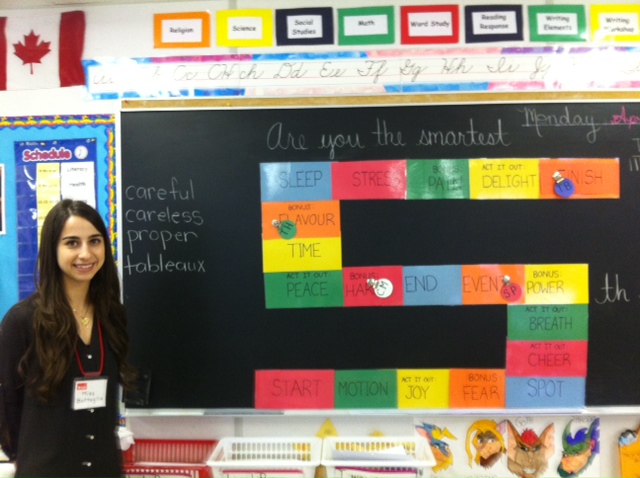
“How to engage students in the understanding and use of suffixes?” was the pressing question on my (Cathy’s) student teacher’s mind. Erica told me she mulled this over for several days, trying to get the pieces to fit together just right.    Her final creation – a suffix game. The wonderfully large, colourful game board alone was enough to grab her grade five students’ attention. Played in teams, each group had to role a gigantic die to move their magnetic counter on the board.   Some spaces on the game board depicted words (e.g. effort, bonus, time) which each team had to add either the suffix ‘less’ or ‘full’ to, and then write each word correctly in a sentence. Small white boards were provided to each team for this task.   Other spaces on the board instructed the teams to create a tableaux depicting the new meaning of the word once the correct suffix was added. A few  spaces on the board provided bonus points.

I have always had a concern about student teachers being focused on ‘fun’ over learning and wondered about the level  of learning these students would experience with this game. This concern, however, was mollified when I witnessed the mistakes the teams were making which forced them to rethink their answers.  The animated group discussions regarding which was correct were very interesting to observe.  When the nutrition bell rang and the grammar lesson came to an end, there were groans and moans of protest. Imagine, grade fives liking grammar. Erica wisely told them they could play again soon.

Erica's Game


Sharing Our Research

Today the research group will be presenting work from the project Literacy Teacher Educators: Their Backgrounds, Visions and Practices, at the Ministry of Education/Faculties of Education Forum – Research Practice: Nurturing relationships for teaching, learning and well-being. It will be an interesting and exciting day.

Literacy Teacher Educators: Preparing Teachers for a Changing World (Book Cover)
Literacy Teacher Educators: Preparing Teachers for a Changing World

A Mighty Girl

mightygirl

My twin niece and nephew are 4 years old. They both have loved books for as long as I can remember. They are currently learning how to string together sounds from the alphabet. As a super-involved aunt and literacy teacher, I try to expose them to a wide variety of texts. I want them to be exposed to texts which promote inclusivity, challenge stereotypes, and inspire creativity. For this reason I was delighted to find out about the Mighty Girl website.

“A Mighty Girl is the world’s largest collection of books, toys, and movies for parents, teachers, and others dedicated to raising smart, confident, and courageous girls.”

The Mighty Girl collection of books aims to disrupt the status quo of how girls are represented in fairytales. The collection of books strives to break the ‘damsel in distress’ mold, and so feature girls in alternative fairytales who are courageous, smart, and daring! I know I’ll be picking up a few of these books to read with my four-year-old niece and nephew! Some of the book titles include:

  • Not All Princesses Dress in Pink (Yolen & Stemple, 2010)
  • Dangerously Ever After (Slater, 2012)
  • Thunder Rose (Nolen, 2007)
  • The Seven Chinese Sisters (Tucker, 2003)

A full list of fairy/folktales on the Might Girl site:

http://www.amightygirl.com/books/fiction/fairy-tales-folktales

Celebrating Women

Clare and her MomToday in many countries Mothers are celebrated. In my (Clare) family, we celebrate all women on Mother’s Day because we believe most women tend to care and nurture  others. I am very fortunate to have had many wonderful women be part of my life. (Attached is a photo of my Mom and me.) My female friends and colleagues have supported and inspired me in so many ways (including Pooja, Cathy, and Yiola who are active bloggers on this site). So to all women, Happy Mother’s Day. You have made a difference in the lives of many.