Yearly Archives: 2014

Attack on “Balanced Literacy” Is Attack on Professional Teachers, Research

I (Clare) read this article and felt it would add to the posts on this blog about teachers as decision-makers and the need for teachers to be seen professionals.

plthomasedd's avatardr. p.l. (paul) thomas

The allusion in Robert Pondiscio’s Why Johnny won’t learn to read accomplishes something different than intended. Pondiscio’s uninformed swipe at balanced literacy actually reveals that, once again, ideology trumps teacher professionalism and literacy research.

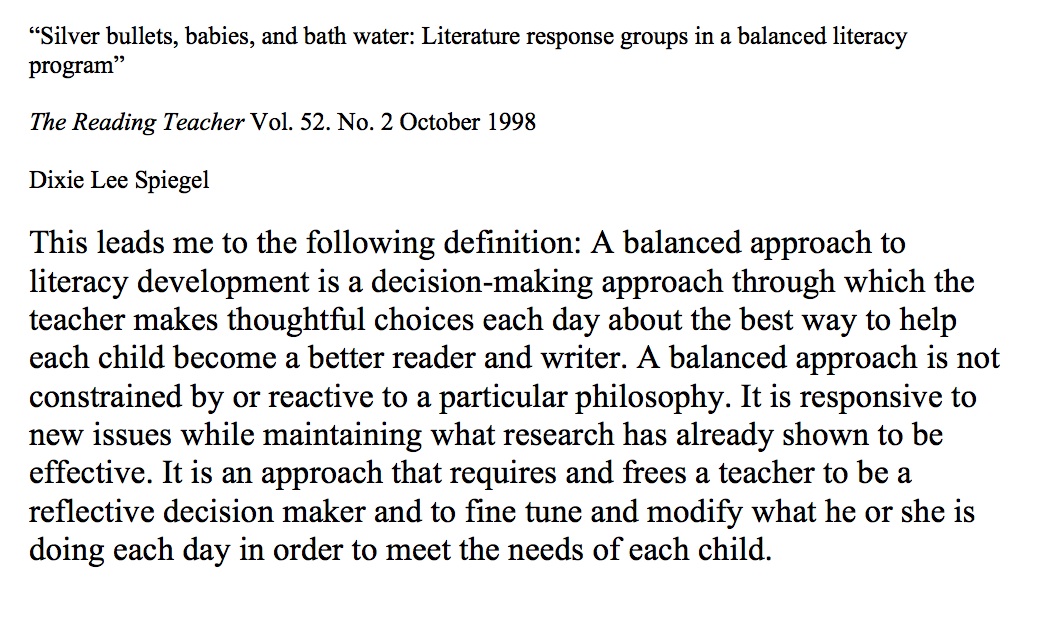
The reading wars are about almost everything except reading, but the most important lesson from this newest version of the same old thing is that if we start with what balanced literacy is, we begin to see just what those who attack balanced literacy believe:

Spiegel 3

Spiegel’s definition shows that the term “balanced literacy” is about the professional autonomy of the teacher, the wide range of research on how children acquire literacy, and honoring individual student needs (those who need direct instruction and those who do not).

Like “whole language,” balanced literacy does not reject any practice that is needed or effective, and does not prescribe practices either.

When Pondiscio and others, then, reject balanced literacy, they reject…

View original post 23 more words

Giving Voice to All Students: Jigsaw

In an earlier posting I (Clive) DSCN0710advocated giving students a lot of “air time” in class, and outlined several techniques for ensuring that all students are heard. I’ve just (re)discovered a further technique – “Jigsaw” – and am using it in my summer courses. I can’t believe I took so long to see its potential! IMG_0038

In Jigsaw the readings for a class are assigned beforehand to different students, and when they go into small groups each has to speak to “their” reading. This reduces the reading load and gives each student a chance to speak to their item. It also decreases the likelihood of one student dominating the small group. Moreover, it takes some pressure off the teacher to expound all the readings themselves.

I used to employ Jigsaw but stopped because it seemed as if I was forcing students to read the articles; also it seemed to require having the same groups for every class, a practice I’ve moved away from.

What I do now is give every student a permanent Jigsaw number – either 1 or 2 – and assign just 2 articles for small group discussion. This means I can form new groups each class. Another advantage is that with more than one student speaking to an article, the pressure on individual students is reduced and the discussion becomes more collaborative.

As with any group work, of course, the topic has to be interesting to the students so they approach the discussion with enthusiasm rather than just going through the motions. So far, it seems to working!

German Literary History

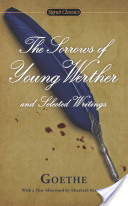
I (Cathy) make a point of reading a novel either about or from a country I am about to visit. As Germany is my next destination, Goethe became my author of choice. I was familiar with his now famous work, Faust, but the book I selected is known as The Sorrows of Young Werther. In all honesty, it was not the plot or the style, but the details about the book that enticed me to read it. This novel had an enormous cultural impact on Germany and surrounding countries.

Written in just six short weeks by a young Johann Wolfgang von Goethe (only 24), it was largely autobiographical. In the book, the hero, Werther, through a series of letters, describes his over-infatuation with a young woman named Charlotte. This novel was an immediate success and sold so many copies it became the first block buster novel. It even had merchandizing to support it: perfume, Werther dolls and Werther clothes. The book launched an entire literary genre, Sturm und Drang(Storm and Stress), inspired an opera, and instigated the romanticism movement. Sadly, the book was also banned in four countries because many young men imitated the tragic fate of the hero. I am intrigued that this book had such an extensive affect, long before the age of computers or mass marketing. This book was written in 1774. Such is the incredible power of literature. I am excited about going to Weimar, Germany to appreciate the monuments and museums dedicated to the work of Goethe. I may even buy a Werther doll.

wurther220px-Goethe_(Stieler_1828)wurther

The Hard Part of Teaching by Peter Greene

Our last few blog posts have focused on teaching. I (Clare) found this amazing article by Peter Greene on Huff Post. Greene really gets it about teaching. Thought you might find this interesting. http://www.huffingtonpost.com/peter-greene/the-hardest-part-teaching_b_5554448.html?utm_hp_ref=tw

The Hard Part by Peter Greene

They never tell you in teacher school, and it’s rarely discussed elsewhere. It is never, ever portrayed in movies and tv shows about teaching. Teachers rarely bring it up around non-teachers for fear it will make us look weak or inadequate.

Valerie Strauss in the Washington Post once put together a series of quotes to answer the question “How hard is teaching?” and asked for more in the comments section. My rant didn’t entirely fit there, so I’m putting it here, because it is on the list of Top Ten Things They Never Tell You in Teacher School.

The hard part of teaching is coming to grips with this:

There is never enough.

There is never enough time. There are never enough resources. There is never enough you.

As a teacher, you can see what a perfect job in your classroom would look like. You know all the assignments you should be giving. You know all the feedback you should be providing your students. You know all the individual crafting that should provide for each individual’s instruction. You know all the material you should be covering. You know all the ways in which, when the teachable moment emerges (unannounced as always), you can greet it with a smile and drop everything to make it grow and blossom.

You know all this, but you can also do the math. 110 papers about the view of death in American Romantic writing times 15 minutes to respond with thoughtful written comments equals — wait! what?! That CAN’T be right! Plus quizzes to assess where we are in the grammar unit in order to design a new remedial unit before we craft the final test on that unit (five minutes each to grade). And that was before Chris made that comment about Poe that offered us a perfect chance to talk about the gothic influences, and then Alex and Pat started a great discussion of gothic influences today. And I know that if my students are really going to get good at writing, they should be composing something at least once a week. And if I am going to prepare my students for life in the real world, I need to have one of my own to be credible.

If you are going to take any control of your professional life, you have to make some hard, conscious decisions. What is it that I know I should be doing that I am not going to do?

Every year you get better. You get faster, you learn tricks, you learn which corners can more safely be cut, you get better at predicting where the student-based bumps in the road will appear. A good administrative team can provide a great deal of help.

But every day is still educational triage. You will pick and choose your battles, and you will always be at best bothered, at worst haunted, by the things you know you should have done but didn’t. Show me a teacher who thinks she’s got everything all under control and doesn’t need to fix a thing for next year, and I will show you a lousy teacher. The best teachers I’ve ever known can give you a list of exactly what they don’t do well enough yet.

Not everybody can deal with this. I had a colleague years ago who was a great classroom teacher. But she gave every assignment that she knew she should, and so once a grading period, she took a personal day to sit at home and grade papers for 18 hours straight. She was awesome, but she left teaching, because doing triage broke her heart.

So if you show up at my door saying, “Here’s a box from Pearson. Open it up, hand out the materials, read the script, and stick to the daily schedule. Do that, and your classroom will work perfectly,” I will look you in your beady eyes and ask, “Are you high? Are you stupid?” Because you have to be one of those. Maybe both.

Here’s your metaphor for the day.

Teaching is like painting a huge Victorian mansion. And you don’t actually have enough paint. And when you get to some sections of the house it turns out the wood is a little rotten or not ready for the paint. And about every hour some supervisor comes around and asks you to get down off the ladder and explain why you aren’t making faster progress. And some days the weather is terrible. So it takes all your art and skill and experience to do a job where the house still ends up looking good.

Where are school reformy folks in this metaphor? They’re the ones who show up and tell you that having a ladder is making you lazy, and you should work without. They’re the ones who take a cup of your paint every day to paint test strips on scrap wood, just to make sure the paint is okay (but now you have less of it). They’re the ones who show up after the work is done and tell passersby, “See that one good-looking part? That turned out good because the painters followed my instructions.” And they’re most especially the ones who turn up after the job is complete to say, “Hey, you missed a spot right there on that one board under the eaves.”

There isn’t much discussion of the not-enough problem. Movie and tv teachers never have it (high school teachers on television only ever teach one class a day). And teachers hate to bring it up because we know it just sounds like whiny complaining.

But all the other hard parts of teaching — the technical issues of instruction and planning and individualization and being our own “administrative assistants” and acquiring materials and designing unit plans and assessment — all of those issues rest solidly on the foundation of Not Enough.

Trust us. We will suck it up. We will make do. We will Find A Way. We will even do that when the state and federal people tasked with helping us do all that instead try to make it harder. Even though we can’t get to perfect, we can steer toward it. But if you ask me what the hard part of teaching is, hands down, this wins.

There’s not enough.

Originally posted at Curmudgucation

A call to adopt Balanced Literacy

An article in the New York Times caught my eye, it highlights New York schools chancellor Carmen Fariña’s proposal to adopt a balanced literacy approach in more New York City classrooms (link to article provided below). The article reports that, “during her almost six months as chancellor, Ms. Fariña, a veteran of the school system, has reduced the role of standardized tests, increased collaboration among schools and shepherded through a new contract for teachers that includes more training and more communication with parents. But her push for a revival of balanced literacy may have some of the most far-reaching implications in the classroom.” Proponents of the Common Core academic standards have however, voiced resistance to implementation of a balanced literacy approach, arguing that it is at odds with the learning goals emphasized in the core standards, which have been adopted by more than 40 states. What do you think are the pros and cons of a balanced literacy approach?

http://mobile.nytimes.com/2014/06/27/nyregion/new-york-schools-chancellor-carmen-farina-advocates-more-balanced-literacy.html


Focus on Teaching the Student

As I continue to read the news about states exiting the Common Core standards to reclaim standard-setting autonomy, I am reminded of a quote from a participant from our SSHRC study on literacy teacher educators:

“You’re teaching the student. You’re not teaching the curriculum. The student should be in the middle and to try to stretch the curriculum to fit around that.” (Melissa)

 The Common Core Standards are national U.S. standards for English Language Arts and Mathematics grades K-12. The implementation of these standards began in 2011. However, in the past few months three states have formally withdrawn from the Common Core Standards (Indiana, Oklahoma, and South Carolina). Recently, Governor Bobby Jindal of Louisiana made public that he was also looking to formally withdraw from the Common Core Standards.

This turbulent time in the implementation of national standards reminds me of the stance several of our literacy teacher educators had on teaching directly to national mandates.  Several had lived through many curricula, and so tended to veer away from explicitly teaching the curriculum. Rather, they emphasized with their student teachers that the focus should always be on the student.

Below is a chart summarizing U.S. resisting the implementation of the Common Core:

commoncoreparticipation

Source:

http://dailysignal.com/2014/06/19/want-bobby-jindal-pulls-louisiana-common-core/

The Gift of Education

I (yiola) came across this article while surfing the net a few days ago and read it over twice in order for its news to set in.  What amazing news!

http://www.thestar.com/news/canada/2014/07/01/mystery_donor_gifts_16_million_to_leamington_grade_8_grads.html

Right here in our own backyard, in a small region of Ontario, an anonymous donor is giving many students and their families the gift of higher education and an opportunity to change their lives and make their dreams come true… “when I grow up I want to be a…”

Financial accessibility is a significant issue for so many things today, higher education is certainly a privilege.  This story is unique and very touching. Congratulations to all the students who have a wonderful opportunity for ongoing education and thank you to the anonymous donor.

Back to Values Education

WClive Becke recently had postings from Shelley on fostering student “well-being” through “mindfulness” and Yiola on “mental health” education. Both these topics are increasingly prominent today. In Ontario character education has been stressed for several years, and currently mental health education is an MOE emphasis.

I (Clive) did my PhD in moral philosophy and researched, wrote, and Lydia and Shelleytaught in values or “way of life” education for a couple of decades. I even developed grades 1-12 learning materials in the area. But finding that teachers had very little time for separate values instruction, I broadened my work to teaching and teacher education in general – and haven’t regretted the shift.
However, it’s becoming increasingly apparent to me that teaching well requires a sound set of values and approach to life, society, and the world. Educational issues are ultimately life issues, and we can’t resolve one without the other.

Fortunately, the scope for addressing life issues in subject teaching is enormous. In literacy/literature, for example, a large proportion of the discussion and project work could be on values related matters. What is needed is for teachers and teacher educators to take up this area in a systematic way in the context of promoting subject learning, which is our main occupational mandate.

This in turn requires a much deeper understanding of the nature and importance of values, and the need to have an articulated approach to life. We’ve been used to leaving values up to philosophy and religion, or to saying (especially since the 60s) that it’s just a personal thing. But the task is extensive, fundamental, and something we must all engage in – together. Each person will have their own way of life but there are important general elements, and teachers and students should work together on both.

Literacy/English Teacher Educators and Digital Technology

We (Clare) have begun the third round of interviews of for our research study of  Literacy/English teacher digitaleducators. A focus of these interviews is on their use and views of digital technology. We have learned about some very clever ways technology is being integrated into their literacy methods courses. Wow! What a range of interesting examples:

  • Blogs (student teachers do blog post on the disciplines e.g., their insights into teaching)
  • vodcasts
  • podcasts (both professionally made and student-teacher made)
  • virtual tasks (done individually and in small groups)
  • surveys (during the course to monitor student teacher learning)
  • You Tube videos
  • websites
  • student teacher-made videos of practice teacher
  • SKYPE (with authors that they are reading class)
  • discussion on BlackBoard on readings prior to class
  • cartoons
  • photos
  • PPT
  • Wikis
  • Voice Thread
  • Email (a way to remain connected to student teachers during practice teaching, especially for those working in rural areas)

Slide01Videos were used frequently. These were seen as a way for student teachers to observe and analyze exemplary practice.

When asked the question, What does digital technology provide you that you could not do decades ago?, there was overwhelming recognition that technology is supporting and enhancing teaching and learning. It provides ready access to materials, supports development of community (e.g., student teachers introduce themselves prior to the course beginning; social media connects them socially), and extends their repertoire of pedagogies. All felt that their efforts to teach with, through, and about digital technology took a huge amount of time and effort.