Yearly Archives: 2014

Victoria Embraces FDELK

FDELK is the acronym for the new Full Day Early Learning Kindergarten program in Ontario and it represents much, much more than just going to school all day. The program is based on the Reggio Emilia Inquiry approach to learning, which has been in existence in Italy for over 50 years. It is a new teaching/learning approach for Ontario, however, and some teachers are still working out a few of the kinks. It is well worth the effort, though, as the results I am seeing in the schools are very exciting.

Imagine how delighted I (Cathy) was when I visited one of my practicum schools to observe a student teacher working in a FDELK placement and discovered not only had she embraced the inquiry learning process, she was sometimes leading the teachers in the approach. Her mentor teacher proudly showed me some of the things our student teacher, Victoria, had created for the class. While exploring 3D shapes, Victoria created for an with the students a: 3-D Bingo game; 3-D shape story; 3-D treasure hunt ; 3-D survey; and, 3-D art.

I knew the 3-D exploration was working too. As I watched a small group of K’s make sets of counters to add up to ten, one of the boys suddenly exclaimed, “Look! I made a rhombus !” Ahhh, to be so smart at 5. But it takes good teaching to guide them there.

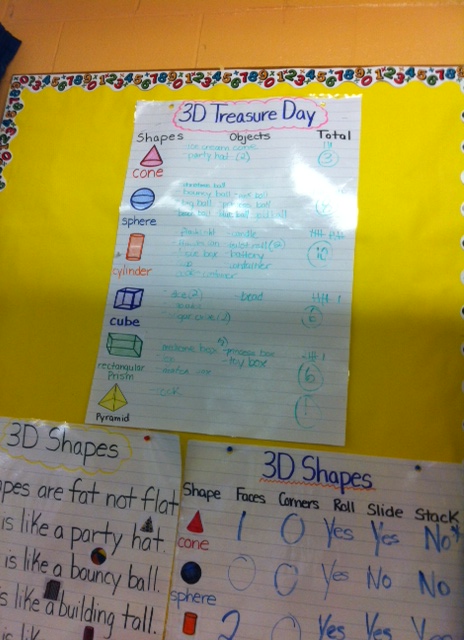
VictoriaVictorias anchor

Dilemma for Educators: Focus on Pisa Scores or Improve Quality of Education

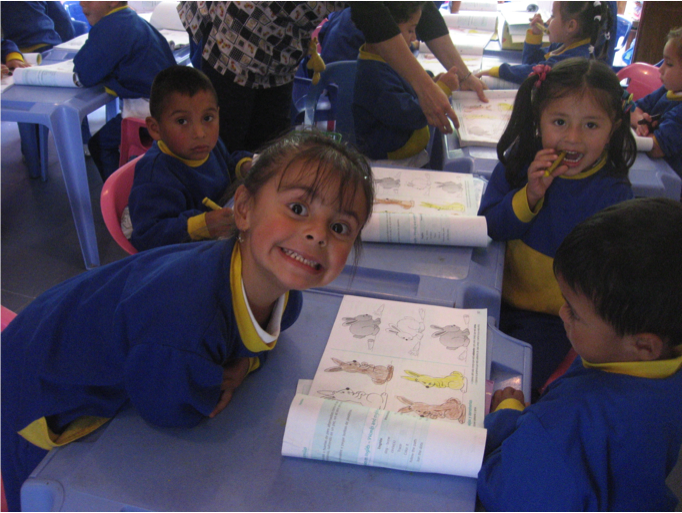
Colombian FlagClive and I (Clare) are going to Bogota and Cartagena to present at two conferences: one for teacher educators and one for teacChildren in Colombiahers. (More about our experience to follow.) In our correspondence with our Colombian hosts, who have been incredibly gracious, we get the impression they are very focused on improving Pisa scores. From our reading about Colombia we recognize there is grinding poverty yet they have made huge strides in improving literacy rates. We appreciate the dilemma faced by the Colombians –improve test scores on international measures yet education is under resourced. Being inspired by Pasi Sahlberg (and in keeping with the findings from our research as described in our new book Growing as a Teacher), the focus should not be unilaterally on improving Pisa scores but should be broader — provide quality education. Good teaching will improve literacy achievement and which in turn improve scores on Pisa. As Sahlberg’s data shows, the countries focused on controlling the curriculum and on teaching to the test have declining achievement on Pisa. (See April 19th blog post on this topic.) Drills and mindless worksheets will not engaged those children who do not see themselves as readers. So our message will be – let’s support teachers so they know how to provide relevant, engaging, and appropriate curriculum. The scores on Pisa will take care of themselves. We would love to hear from others who have worked in Colombia.
Our New Book! Growing as a Teacher: Goals and Pathways of Ongoing Teacher Learning

Growing as a Teacher book cover

Clare and I (Clive) are glad to announce the release of our new book Growing as a Teacher, published by Sense. https://www.sensepublishers.com/catalogs/bookseries/professional-learning-1/growing-as-a-teacher/

It’s based on the first 8 years of our longitudinal study of 42 teachers, teaching mainly in Ontario but also New York and New Jersey.
Our central finding was that teachers learn a great deal informally, especially through classroom experience. This is in line with Donald Schon’s (1983) notion of “reflection in practice”: teachers learn through “experimental research, then and there, in the classroom” (p. 66). Similarly, Chris Day (1999) speaks of “the largely private, unaided learning from experience through which most teachers learn to survive, become competent, and develop” (p. 2).
Over their first 8 years, our teachers learned about: program planning, assessment, individualization, teaching for relevance, classroom organization, community building, work-life balance, and many other topics. In varying degrees, they developed a comprehensive, integrated vision of effective teaching, going well beyond their initial understanding.
In the book we discuss key implications of these findings:

  • Teachers should see themselves as major “experts” on teaching, with abundant opportunities to inquire into teaching over the years. They should be willing to make decisions in the classroom and take a firm stance in adapting system initiatives.
  • ITE instructors should promote this strong conception of teacher learning and expertise, and see themselves largely as “laying a foundation…preparing novices to learn in and from their practice” (Feiman-Nemser, 2001, p. 1016).
  • PD facilitators should dialogue with teachers and build on their emerging vision and approach, rather than imposing system mandates in top-down fashion.
  • Principals should support teachers in their learning, providing frequent opportunities for them to watch each other teach and share their developing insights.

Teachers can benefit greatly from external input, but not if it’s imposed “top-down” without reference to their views and experiences.
We have greatly enjoyed listening to the teachers in our study and will continue to do so into the future. We hope their voices and experiences will be helpful to teachers, teacher candidates, ITE instructors, and all those responsible for school policies and ongoing teacher learning.


Celebrating Easter in a Multicultural Society

Literacy development is evident in all areas of our school curriculum. I (Yiola) have been thinking about the Ontario Curriculum, particularly the new Social Studies curriculum and how much it has evolved over the years. The latest Ministry policy for teaching Social Studies has made significant gains in developing critical literacy and culturally relevant pedagogy.

http://www.edu.gov.on.ca/eng/curriculum/elementary/sshg18curr2013.pdf

This weekend while I was celebrating the Easter holiday with my family I wondered how this culturally significant event could be included in the curriculum without alienating those students who do not observe Easter.

The Grade 2 social studies curriculum has a strand: Changing Family and Community Traditions. When I taught Grade 2 the strand was called: Traditions and Celebrations. By the heading alone one can see the conceptual shift that has taken place in how we think about traditions. Then it dawned on me, must we compartmentalize units of study to blocks of time? Why not open the unit of study and have students throughout the year share the community traditions they observe? And of course, they needn’t be limited to formal holidays. They can be as significant as the family tradition of quilting or playing music.

Children making flaounesThen I began to think about how important this particular family tradition is for my children and how I would like for it to be affirmed in school; not for its religious value; but for the importance it holds in our family. What if Sylvia Clare wrote a procedural piece on making “flaounes” with her Papou (see image)? She could talk about, experience, and write about how to make traditional Cypriot flaounes. And, if this opportunity were open throughout the year for all children to share at any time a special community/family tradition in a way that was meaningful to them (through writing, speaking, doing) so much knowledge, information and appreciation could be shared. Just one small example of how literacy and social studies could work together.

Clash of Values: What to Do?

Leah McLarenThe many religious celebrations this month remind me that we live a very diverse society. In this blog over the last few months we have discussed some of the challenges of living/working/teaching in a multicultural society. I (Clare) read Leah McLaren’s fascinating article When Multiculturalism Tests Our Moral Relativism in the Globe and Mail. http://v1.theglobeandmail.com/servlet/HTMLTemplate?cf=common/MiniHub.cfg&configFileLoc=config&hub=leahMcLaren&tf=columnists/Summary.html&title=Leah_McLaren
McLaren writes about an incident with her neighbor when her stepson oversteps the best friend’s family’s values. (The incident between the two little boys involves bum bums.) She talks about the problem of “parenting in a multicultural environment” which “tests our moral relativism. It reveals the wildly different ways most of us struggle to make sure our children end up as good people. The question is, good according to whose rules?” McLaren and the neighbor eventually achieve “an uneasy truce over tea and biscuits.” She says “privately, we will each adhere to our own rules. And in public we will try our best to get along.”
Like McLaren I faced the clash of values when I was a classroom teacher. The first time one of my first grade pupils told that he was not going to clean up the paint centre because that was women’s work I became painfully aware of the difference between my values and his family’s values. (I also had a flash of anger!) As a classroom teacher I had my class rules – everyone is responsible for the smooth running of the classroom. What do we do as teachers do when a parent tells us that education is not for girls? Or boys do not need to help with maintaining the classroom. As a new professor a student teacher announced to the class that as teachers we should tell our pupils that homosexuality is a sin and that gays are going to hell. (That was truly one of the most difficult teaching moments in my long career.) Responding to others who hold very different views from my own is not easy. McLaren does a great job of finding a solution but as a society we need to keep exploring “solutions.” Tea and biscuits are a good place to start the discussion but working through the next knotty steps requires imagination, flexibility, openness to others, patience, knowledge, and a sense of humour. (I highly recommend McLaren’s excellent article.)


Pasi Sahlberg: An Inspiring Educator

I (Clare) attended the BEST lecture by Pasi Sahlberg. http://pasisahlberg.com/ He was Finnish Lessonsinspiring and informative. His talk was based on his bestselling book, Finnish Lessons: What Can the World Learn from Educational Change in Finland? http://www.amazon.ca/Finnish-Lessons-Educational-Change-Finland-ebook/dp/B00CDSTBG6/ref=sr_1_1?ie=UTF8&qid=1397850067&sr=8-1&keywords=pasi+sahlberg

His talk went far beyond the book. A few highlights from were:

  • The Finnish public trust teachers.
  • Teachers are respected.
  • We cannot take the Finnish model and transplant it to another context but we can learn from HOW the Finnish people reconceptualized and approached education reform. (The main goal was not to improve PISA scores.)
  • Global Educational Reform Movement (GERM) which has infected countries like the US, UK, Netherland, NZ, and Australia emphasize competition, standardization, test-based accountability, school choice, and human capital. He showed slides of student performance in these countries illustrating that performance on standardized tests has actually gone DOWN – the draconian measures the governments have imposed on teachers have not improved student performance (and probably not student engagement).
  • Finland has a common vision for education that includes great schools for each and every child.
  • The success of Finnish education is not simply a result of improved education initiatives but a whole agenda for society.
  • In Finland if a teacher is struggling, someone helps him/her.

For a copy of ppt presentation (which was amazing) click here: http://pasisahlberg.com/wp-content/uploads/2013/07/OISE-RWB-Jackson-2014.pdf  

Pasi SahlbergI have read his text and highly recommend it to others interested in true reform of education.  Quick fixes do not work but a sustained, comprehensive approach to education is the way we should be going.

Electricity and the Joy of Learning

One of the greatest joys of my (Cathy’s) job is observing student teachers in their teaching practicums. In my next few blogs I will be happily sharing some of the highlights from these visits.

Yesterday I was observing a student teacher instruct a grade six science class exploring electrical currents. The student teacher wisely arranged his students into collegial groups and then gave each group a paper bag full of various parts (batteries, wires, light bulbs, switches etc.). The students were expected to find a way to put the put the parts together that would create an electrical current, hence lighting up the light bulb. It was fascinating watching the students trouble shoot their way through the process. They were so engaged. I was proud of the student teacher for setting up the investigation so well. Suddenly there was a squeal from the corner group. One of the boys was holding up a lit light bulb. His smile was brighter than the bulb. “What did you do?” I asked him. He was silent for a few seconds, staring in amazement at the lit bulb. Then he said, “I have no idea.” Everyone laughed. The process of deduction then began as the group tried to figure out why it worked. And next week I get to observe completely different classes, making entirely new discoveries. Lucky me.

circuit


A Few Words From Oliver Jeffers

Clare and I (Lydia) have enjoyed sharing the creative and clever picture books of Oliver Jeffers with the student teachers in our literacy methods courses. Jeffers, an artist, illustrator and writer, notes, “my books are all about telling stories, and a lot of my art is about asking questions…They’re an excellent platform,” he says of picture books, “With novels, things are spelled out for you. And films, things are spelled out for you a lot more. Whereas picture books, it’s up to you how much you sit on a page, sit on an image, move at your own pace. And then you’ve got two distinct and varying sets of tools at your disposal, that weave in and out of each other to create this middle ground. That’s the secret ingredient, I think, that’s what makes them such a fantastic vehicle for storytelling.” (National Post Feb 2013). OliverJeffers