I (Clare) always love watching the Olympics but this year is different.  Actually, I was not even sure what day they began. The travesty of the Putin Games has really been off-putting: the $50 billion cost, the impact on the environment, the anti-homophobia rants and …. The cost of the games is staggering when you think of the millions of Russians living below the poverty line. Is this a good way to spend so much money? I saw a little feature on the Olympic Village that left me shaking my head. The beds for the athletes are only cots. The athletes have devoted years to preparing for the games and have sacrificed so much but they will not even have a proper bed. Sorry to sound so simplistic but I think the focus should be on the athletes. I watched a few minutes of the parade of athletes in the opening ceremonies that further cemented my view that the focus of the games seems a bit misplaced. The women leading in each contingent are dressed in skin-tight white outfits with a very revealing slit. I live in a cold climate and you do not see women parading around in such revealing outfits. Do we really need sexy, hot babes at the opening ceremony? All that said, I hope these games go off without any incidents and each athlete has a personal best. Clare
Yearly Archives: 2014
Reflecting on Our Strengths and Weaknesses
I (Cathy) was reading a literacy newsletter yesterday and was intrigued by an article by literacy educator, Clare Landrigan. She reminisced about a saying her father used to share with her, “Everyone’s greatest strength is their greatest weakness and their greatest weakness is their greatest strength.” I have heard this before and tend to agree with it. I have referred to it often while exploring Brookfield’s critical incidences with my student teachers. We would reflect on the possibility of how our greatest strength could be holding us from recognizing our own literacy assumptions.
What intrigued me about Landrigan’s article was the educational perspective she introduced that I simply had not entertained before. She asked her readers to look at the weaknesses of her students and try to see them as their greatest strength. For example, the student who cannot sit still . . . has the potential to be incredibly productive and he student who takes forever to do something . . . is attentive and thoughtful. What a wonderfully productive way to look at the students we teach, regardless of age. It also might help us recognize positive aspects in ourselves when we are feeling particularly critical. What is your greatest weakness?
More Winter … Trying to Keep a Sense of Humour
We have had yet another huge snowstorm in Toronto. It is beautiful but the walking is treacherous and it is bone-chillingly cold. We have had too much weather. I (Clare) am trying to keep a sense of humour as this winter goes on and on. Here is a little cartoon from a local newspaper!

Newer Modes of Communication Challenging the Written Word
 Smartphones and templates offer a newer mode of communication and slowly, it seems, a new language is taking shape. Short, incomplete sentences with alternatively spelled words are dominating the domain. Incomplete thoughts… and abbreviations http://www.netlingo.com/acronyms.php are rapidly becoming familiar.
I’ve (Yiola) bin thinking about literacies and what txt and tweets and FB mean for literacy development. IDK what to make of this. It’s interesting cuz language changes. wordz change. punctuation ceases to exist. LOL
youth 2day use symbols, short forms, a variety of new symbols to communicate.
I’m still wondering how #hashtag came to be the symbol that it is. #justdontunderstand
The exclamation point has indicated strong emotion. now we have 🙂 😉 and 😦
Is one more correct than the other?
Plz share some insights… i’d luv 2 hear ur thoughts on the implications for teachers, teacher educators, parents. I mean, how r we to communicate and facilitate language development if we r not in tune with social media discourses of youth today? Do we ignore it? Incorporate it? Explicitly teach the differences between formal / traditional language and social text?
ttys, yiola
Studying Beyonce… in Higher Ed?
Lately, Beyonce has been in the news a lot more than usual. Recently, without any warning(or PR), she released a self-titled album to the public. She was also, debatably, the most talked about performance at the 2014 Grammy’s a few weeks ago. However, the most interesting news I (Pooja) have recently read about Beyonce has to do with the world of academia.
Rutgers University now offers a course called “Politicizing Beyonce,” in which her musical career is used as a lens to investigate“race, gender, and sexual politics.” The instructor of the course, a Ph.D. student, says “he’s seeking to help students think more critically about media consumption.”
I am intrigued by this course, yet not sure what to make of it. Is this a relevant and contextualized way of studying issues of race and gender or is this normalizing our (society’s) idolization of celebrities by creating a place for it in higher education?
What do you think?
Read more about this course:
http://www.huffingtonpost.com/2014/01/30/rutgers-beyonce-course_n_4697541.html
http://newsfeed.time.com/2012/01/27/rutgers-beyonce-course-5-potential-lessons-on-the-syllabus/

Professional Identity
Today I (Clive) was teaching my School and Society (social foundations) course in the preservice program. Our topic was professional identity. What a class we had! We discussed:
· Teachers’ perception of their role
· Motivation and satisfaction
· Challenges of teaching
· Work-life balance
· Confidence
· Stance in relation to system mandates
I selected a number of quotes from our chapter on professional identity from our upcoming text: Growing as a Teacher (Sense Publishers). The students took turns reading these quotes aloud which proved to be very powerful. We brought the “voices” of the teachers into the class. Here are a few of the quotes we read:
Classroom teachers have an enormously challenging job; I didn’t realize that when I first started teaching, but now I do. And that hasn’t made me any less effective, if anything it’s made me somewhat more; because now I’m kinder to myself. I see that basically the teacher sets the atmosphere of the classroom, and if you’re constantly stressed out and trying to attain the impossible you become a frustrated and burnt out person. (Felicity, eighth year teacher)
The most important aspects of my role are ensuring that my students develop a positive sense of self; that they acquire a love of learning; and that they develop a world perspective, with compassion and understanding for other people. Embedded in that are social skills; but it’s bigger than that, because I want them to see beyond their own life and community. This view of my role is broader than it used to be. If you’d asked me when I started teaching I would have said the world citizenship component was important, but it didn’t play into my daily practice to the extent it does now. (Tanya, eighth year teacher)
Coming out of my inner-city pre-service program, where the emphasis was on being a change-maker and inspiring every kid, I had to learn that it can often be slow going and I have to not feel defeated if I fail to accomplish everything I hoped for. Because…you really, really need to enjoy teaching to last in the profession, and it’s draining and can get frustrating. I’ve always worked in inner-city schools, so I’m mentally prepared for it…[but] I’ve had to learn not to take things personally. Otherwise you go home and things rest in your mind and you get physically sick. (Jessica, fifth year teacher)
Basing my teaching on where the students are and where they need to be [according to the standards-based approach], I found I ended up teaching to the test; and the whole fun and love of learning went out the door. So I changed my process, and asked: What am I teaching? What skills need to be taught? How can I get that across to them in a way that they’ll enjoy? And then after reflecting on it, and seeing where it didn’t work so well, I asked: What should I change? (Lucy, fifth year teacher)
A Model Blog: Nick Burbules
 My (Clive) recent experiences writing blogs and discussing them with my ITE class have made me think more about blogging as a writing and communication form. This in turn has led me to look more closely at the blogs posted at Progressive Blog Digest by my friend Nick Burbules, who I know through the Philosophy of Education Society. http://pbd.blogspot.ca/2014_02_01_archive.html
So far as I know, Nick established this site – and maintains it – on his own. (I’ll try to entice him to give us some back story.) It must take up a great deal of his time: it appears almost every day and is extraordinarily informative. It focuses mainly on US politics, taking a “progressive” approach to issues, while not avoiding all criticism of Democratic icons such as President Obama. The tone reminds me of Rachel Madow of MSNBC. http://www.msnbc.com/rachel-maddow-show
What is distinctive and so valuable about the site is that while Nick obviously has strong views, he doesn’t use it as a soap-box. His one-liners (often one-worders) are clever, funny and pointed. But they are followed by anywhere from one to half-a-dozen links that give followers immediate access to relevant information, examples and articles. I can imagine people spending a lot of time at this site, loving it, and learning a great deal. Which presumably is just what Nick wants.
Message to Researchers: Do Research But Do Not Expect Funding

Those of us in higher education know there is steadily increasing pressure to secure research grants. Ironically, at the same time access to funding is decreasing. In my own context, Canada, receiving a grant from our central funding agency, Social Sciences and Humanities Research Council (SSHRC), is getting more difficult. It is not just the increased competition but also, the pool of money seems to be shrinking. I (Clare) read with interest and some sadness about the challenges my colleagues in Australia are facing. The University World News reported:
· In his speech, Hockey [Australian Federal Treasurer] shocked the nation’s scientists by announcing that the key independent research granting body, the Australian Research Council or ARC, would lose A$61 million from its “discovery programme” and A$42 million from its “linkage programme”.
· Dr Ross Smith, president of Science and Technology Australia, which represents 68,000 scientists, said cutting A$103 million from the ARC’s budget would further limit its capacity to fund fundamental and applied research – at a time when the success rates for applications for world-class grants are already below 25%.
· “Australian scientists are afraid this will lead to fewer jobs and training opportunities for our best and brightest. We are also concerned about funding for important humanities and social science research, given the cuts,” Smith said.
http://www.universityworldnews.com/article.php?story=20140109095651863
My colleagues in the UK are facing untold difficulties securing research grants. It is ironic that federal governments fail to recognize that conducting quality research requires funding and that it is absolutely necessary. Many researchers are in a Catch 22 – show you are an active researcher but do not expect money to conduct research. The short-term effect of reduced research funding is being felt throughout universities world-wide. The long-term effect is yet to be tabulated but I suspect it will be significant. We need research to investigate issues/phenomena/topics because the findings deepen our knowledge on a vast range of topics (which in turn can guide policy decisions). Conducting research is hard work. (Not to mention the time involved in writing a grant proposal — usually 2-3 months.) Let’s not make it so difficult that our research base erodes. Clare
Experimenting with Collaborative Discussion Strategies
The class I (Cathy) teach for the Bachelor of Early Childhood Education program is from 7-10 in the evening. I feel for my students as this is a demanding time to be learning something new. To make matters worse, many of the students arrive rather fatigued having just left another class that is strictly lecture format. I need to wake them up and get them thinking again. So, capitalizing on my belief in a dialogical approach, for part of each class I implement a different collaborative discussion strategy (e.g. gallery walk, expert groups, four corners, placemat). Our last class, however, was rather unique. I was looking for a way to explore chapter summary and discussion. Plus, I wanted to incorporate our ongoing work on metaphors in education. Suddenly, the strangest memory came to mind… cootie catchers. I wasn’t even sure that was the name until I found it online. Traditionally, this is Japanese origami work, known in the paper folding world as the ‘Fortune Teller’. How, I wondered, could I use this to motivate discussion and review? After some tinkering with my objectives, I had the students place new/significant vocabulary from the chapter on the outside, which the origami maker had to define and spell to move the sections around. Images representing significant ideas and concepts were drawn on the inside, which the player had to identify from the chapter. Guesses were confirmed in writing which were under the hidden flap. Guess what? They loved it and played it many times with many partners, hence reviewing key concepts in the chapter with several people. Then we discussed what happened. Some said now they will never forget their selected words/phrases (e.g. critical consciousness, diaspora, social reproduction and juxtaposition). They were a challenge to spell, too! Others said the images were hard but made them think carefully about the chapter content. The most challenging images I drew on the board at the front of the lecture hall and collectively we tried to guess what they represented. Sometimes we had to get clues from the image maker and we cheered or groaned when we finally got it. At the conclusion of the class we left rather refreshed and interestingly, nostalgic. Every student, no matter what the cultural background or gender, reminisced about playing this game as a child. This was as diverse a literacy event as I have ever encountered and I don’t think I have ever enjoyed a collaborative review more. Below is the website I used to remind the students how to create the origami form. 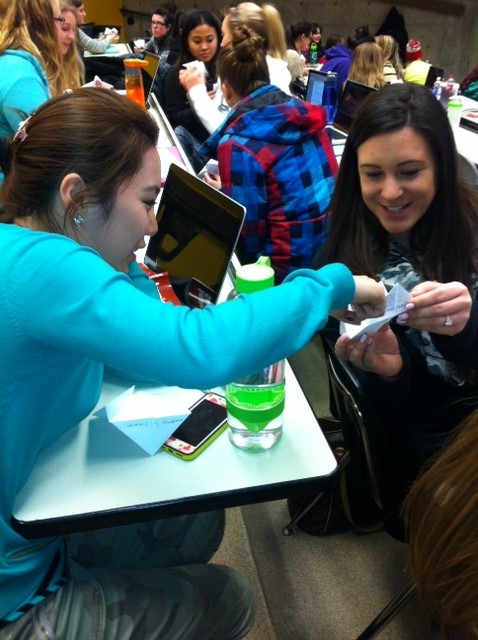
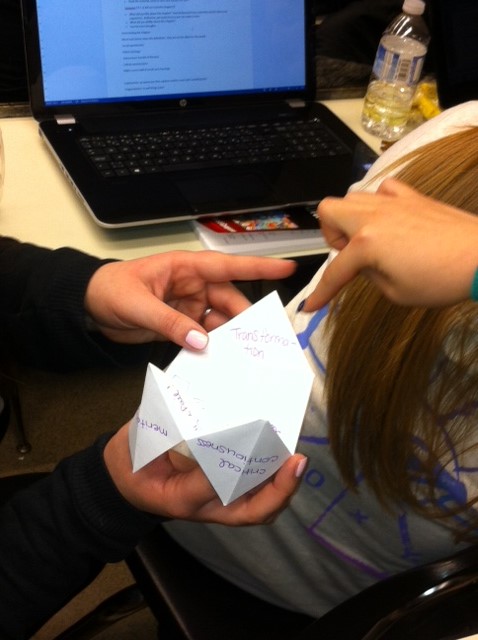

http://www.origamiway.com/how-to-make-a-paper-fortuneteller.shtml
Made me smile
When I (Lydia) came across this comic on Facebook it made me laugh. I thought a chance to smile might be nice on such a cold winter day.

 Literacy Teaching and Teacher Education