Yearly Archives: 2014

Multicultural Education that Avoids Stereotyping

Stereotypes are the main basis of prejudice and discrimination; yet multicultural education often reinforces stereotypes. How to resolve this problem?
My (Clive) social foundations ITE class this year is a dream come true: bursting with talent; an extremely diverse group but with a strong sense of camaraderie; full of fun but serious about learning to teach well. On Monday we had the second of three classes on inclusive education, with a focus that day on multicultural education. It was a wonderful session. Every student participated, and many spoke openly about their own racial and ethnic background. For example:

  • Jim: Identifies as Black, born in Canada, of Caribbean ancestry, not tall enough to play basketball well, doesn’t like rap music.
  • Janni: Born in Canada; her parents are of South Asian ancestry but grew up in South Africa and talk often about their life in that country.
  • Sandi: Parents of Indian background, most of her schooling in Germany, often refers to herself as Tamil Canadian.
  • Ali: Identified by others as Black, ½ Somali, ¼ Italian, lived much of his early life in Saudi Arabia before his family moved to Canada, family is Muslin but he isn’t really religious.
  • Mike: Born in Canada but of ¾ Irish and ¼ Scots ancestry, classical musician, worried in school that when teachers saw his Irish name they would look down on him.

Given this ethnic complexity in today’s world, how can we take the common approach of talking about ethnic groups and resolving to respect the people who belong to them? In what sense do students have an ethnic identity? True, people differ a lot, but their differences rarely run along ethnic, racial, or religious lines. The differences within such categories are much greater than between them. A large proportion of a person’s identity comes from individual qualities, as advocates of differentiation and multiple intelligences have said for some time. Ethnicity is important and should be respected, but individuals have complex ethnicities and draw on each facet in distinctive ways.

As the discussion unfolded, we came to the conclusion that in school we should focus largely on: (a) historical and current cases of bias and discrimination and their enormous human cost; (b) the positives of being inclusive; (c) the limits to ethnic and racial labelling; (d) commonalities that cut across sub-groups; and (e) the importance of individual identity.

At a personal level, many students seemed relieved at the thought that they could develop their own identity and didn’t have to fit a standard ethnic identity. I think many school students would feel the same way, and adopting this approach in the classroom would strengthen community and individual self-esteem.

 

Women in Leadership Positions in Higher Education

In our study of literacy/English teacher educators we asked participants about their career path. They did a timeline (personal and professional) of turning points. A number have held administrative positions in the university but many found the workload crushing. So I (Clare) was very interested in the recent study, Lost leaders – Women in the Global Academy, which studied females in administrative positions in higher education. http://www.universityworldnews.com/article.php?story=20140108162154821
It showed that “[g]ender equality legislation, socio-economic and de-traditionalisation factors have all played a part in this welcome trend [increase in female students in higher education], yet so far they appear to have had relatively little impact on opportunities for women to reach senior management and academic leadership positions in the sector.”  Why are women under-represented in senior leadership positions in universities? In the study they found that “[m]any women … discussed the benefits of gaining power and influence in organisations to effect change. However, leadership was frequently constructed as loss – loss of status and self esteem in the case of unsuccessful applications, but loss of independence, autonomy, research time and well-being when applications were successful.”
I believe there is a real loss not only to women themselves when they choose to not pursue leadership positions but also to institutions when women are under-represented at the decision-making table. I have held a number of senior administrative positions and I can relate to feelings of loss but I also felt there were much higher expectations for me than for my male counter-parts. As a result the position became untenable.  I felt it was a loss to me definitely. Was it a loss to the institution?  Hhhhmmm….. Clare

Truly Engaging Students and Meeting Their Needs: Reconciling Our Ideals with Their Realities


John LoughranAs our team continues its research and writing on teaching, I (Clive) have been re-reading John Loughran’s wonderful book What Expert Teachers Do (Routledge, 2010). http://www.routledge.com/books/details/9780415579674/
This week I came across a section that reports a common gap between teacher and student views of good teaching (pp. 210-11). For example:
Teacher view:
Students should have opportunities to be active and think about their learning experiences
Student view:
Learning is associated with gaining right answers, and thinking and personal understanding are just different and often frustrating ways of achieving required outcomes
Teacher view:
Linking experiences from both within and outside school greatly assists learning
Student view:
The final grade is the critical outcome and the basis by which progress is judged

Loughran’s colleague Jeff Northfield, on whose teaching experiences these findings were based, was able to bridge the gap to a degree, but only by “listening carefully to his students [and] capitalising on opportunities as they arose.”Cover of What Expert Teachers Do
This helped me see that in developing ideas about good teaching (and good teacher education) we must work closely with our students, listening to them as they describe the realities of their world. Together we must come up with a pedagogy they understand and accept, one that both meets their immediate needs and ensures deeper gains for the long-term. We need to reconcile broader ideals with hard realities.
I think this can be done; but we must actually do it. Part of what is involved is practicing with our students the constructivism and dialogical teaching we believe in, and that really does work.  Clive

AERA Division K New Faculty Preconference

Attention Division K New Faculty! Only a few spots remaining for the New Faculty Preconference.The deadline for applications is January 31, 2014!

The pre conference starts on Wednesday, April 2 at 4:00. We meet again on Thursday, April 3 from 9:00 – 12:00.  This Division K New Faculty Seminar is an exciting opportunity to dialogue, socialize, and share with other new faculty and the facilitators and is designed to:

•             Provide support for new teaching and teacher education faculty,

•             Engage Division members with each other and with the Division’s activities,

•             Examine various methodological approaches to research,

•             Create professional networks that will last a lifetime, and

•             Make important scholarly connections that create a community of new scholars.


The preconference organizers are established scholars who will discuss ways to thrive in your career. Our division is committed to supporting new faculty! There is a maximum of 25 participants.

To apply for the pre-conference submit a two-page letter of application that includes a description of: (a) applicant’s background; (b) the applicant’s current position and years of service; (c) research interested and methodological approaches to research; and (d) one or two problems of issues in transitioning from being a graduate student to the role of faculty member.

Send your application and questions to Clare Kosnik at ckosnik@oise.utoronto.ca

The Pre-conference Facilitators are:

Renée T. Clift, University of Arizona
Tom Dana, University of Florida
Valerie Kinloch, The Ohio State University
Clare Kosnik, University of Toronto/Ontario Institute for Studies in Education
Rich Milner, University of Pittsburgh,


International Baccalaureate symbol

IB schooling in Mumbai

While in Mumbai, I (Pooja) had some candid conversations with my cousins (who now have school-aged children) about schooling. The International Baccalaureate (IB) has quickly become the new standard. My cousins spoke highly about the IB curriculum, noting that it encouraged students to view themselves as “global citizens.”  The curriculum, they commented, deviated away from that of traditional schooling in India. The skills were now focused on: critical thinking; intercultural awareness; independent learning; evaluating and constructing arguments; and independent learning.

The pressures to get their children into an International Baccalaureate (IB) program were high. My cousins already had aspirations of sending their young children to top-performing universities outside of India (mostly in the U.S., Canada, and U.K.).   A major concern I heard was that if they did not get into an IB program, how would they compete in this highly globalized world? I understood this to mean that in order to be competitive one had to be complete their formal education outside of India. This  was concerning  because competition aside, IB schools are extremely expensive, and so, not available to the vast majority of families in India. While very few are privileged to apply and possibly attend IB schools in India, most school children in India still attend public school. I am interested in learning more about the public school curriculum in Mumbai? How are public schools currently preparing their students to be  “global citizens?” or is this a notion that is still intangible for most? Pooja

Unsung: Behind the Glee: A MUST Watch Video

There is an amazing documentary, Unsung: Behind the Glee, which chronicles the journey of two rival Toronto high school glee clubs as they gear up for a musical showdown at the annual Show Choir Canada National Championship.Musical Notes

http://ww3.tvo.org/video/196690/unsung-behind-glee

 This documentary is fascinating because
·      it has incredible music and dance;
·      shows the value of the arts in the lives of some adolescents;
·      and clearly demonstrates the commitment of teachers.
Yes it is a competition (and many of the students are elite singers/dancers) but it is an inside look at the work and enthusiasm of teachers and students alike. For some students their involvement in music and dance literally “saved” them. For some of the teachers, their music/dance groups are like their family (they scold, praise, encourage, laugh, cry). There are powerful stories of kids overcoming huge adversity through their involvement in these musical groups.
Clive and I watched it last night and I was moved to tears. It is only available until January 27th so give yourself an hour (stop preparing for class or marking or doing housework ….) and watch it.
For those of you not in the arts (like me) it was very informative. For those of you in the arts you will probably relate to the stories and unfolding events. Whether students are elite or just enjoy music and dance (for appreciation), the arts have a very important place in the curriculum and should be well funded. The arts are not a frill but are part of the basics of life.
Clare

Telling Stories in Pre-Service

I (Cathy) instruct part-time at Brock University. Many of my mid-term evaluations from my pre-service students read, “Please, tell more stories”. It made me laugh, but it made a point. We all love stories, no matter what our age: family stories; folktales from another culture; scary stories… it doesn’t matter. So today, in our first classes for 2014 I focused on storytelling, but turned the tables somewhat and encouraged my student teachers to be the tellers. They were asked to share personal stories about their teaching practicum, which they had completed just before the winter break. I started us off by sharing a story about a disastrous placement I experienced many years ago when I was a student teacher. The flood gates were opened. My, oh my, such stories! Hilarious stories about indignant kindergardeners; touching stories about tough grade eight boys weeping because they thought they had hurt the student teacher’s feelings; frightening stories about overly demanding associate teachers; and joyous stories about building up deflated ELL students. The passion in the room was palpable; it glowed in their eyes, exuded in their hand gestures and spilled about the room with the rise in the decibel levels. Clearly, they loved working with the kids, the learning (good and bad) and the chance to make a difference. They loved teaching, and even in this climate of little prospects of obtaining a teaching position for a few years, they were exactly where they belonged. And so was I.  Cathy

Winter Clothing is a Basic

thermometer with snowflakesMany of us in North America are enduring the coldest weather in decades. This morning it is -39 Celsius (= -40 F). Bone chilling does not even begin to describe the experience of being out in this weather. Whenever we have frigid weather like this I recall my time as a classroom teacher. I taught in very high needs schools and when winter roared in, many of the children suffered terribly because they did not have adequate winter clothing. Last night on Chris Matthews’ show, Hardball, on MSNBC http://www.msnbc.com/hardball/watch/the-need-to-sustain-the-social-safety-net-108521539760
there was talk about the American Congress wanting to end welfare benefits. All those politicians who vote to end or reduce welfare benefits they should visit an urban school in the depths of winter and tell some children that they do not deserve a winter coat and mittens.

When I was a teacher, every year I would go to children’s clothing stores and beg for winter gear (coats, mittens, boots) for my students who were so inadequately dressed. Never once did I leave a store empty-handed. Many of the teachers on staff engaged in similar missions and many who were moms or dads would bring in winter clothes that their own children had out-grown. So those politicians who want to micro-manage teachers and impose an array of  standards should accompany those teachers to children’s stores to beg for donations. I am sure this reality-check would have a real influence because they would learn what teaching is all about. Their view that teachers need to be told what to do and should be penalized for not focusing solely on the “basics” might change. Aren’t winter clothes a basic? I think so. Stay warm! Clare

Social Justice through Activism in Mumbai

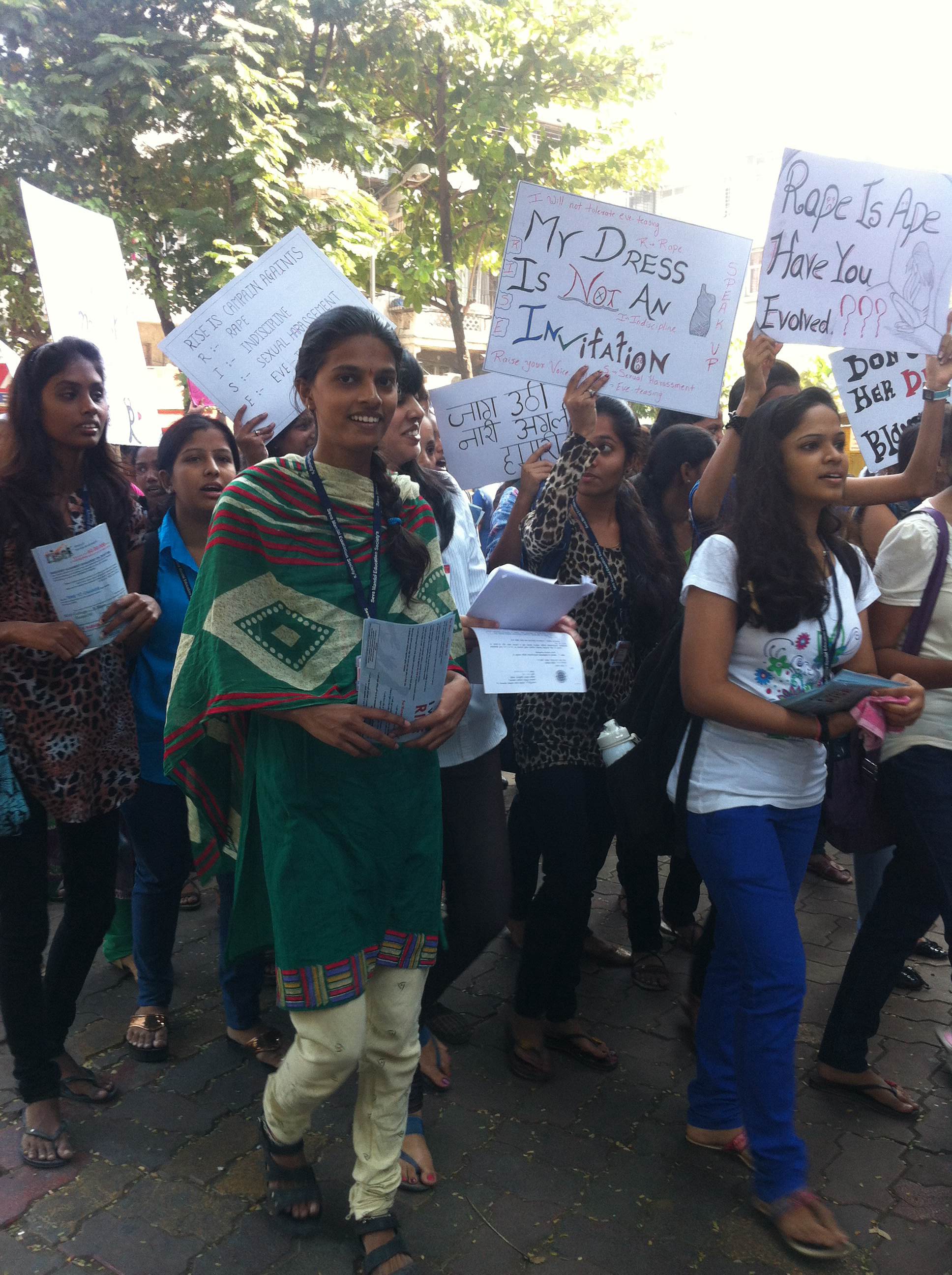
Women protesting in MumbaiWhile I (Pooja) was only in Mumbai, India for two short weeks, I was able to observe (and participate in!) acts of social justice through activism. I was pleased to notice so many young women in organizational and leadership roles.

A week before I had arrived the Indian Supreme Court had reinstated a law criminalizing acts of homosexuality (Section 377 in the Indian Penal Code). I, along with many others, was shocked. This was a huge step backwards for India and its people, in my opinion. Within a matter of days rallies were organized all over India to protest. One of the major rallies was held in the park around the corner from where I was staying. Although the news of Section 377 was truly saddening, I was uplifted to see the youth organize themselves so poignantly. This rally received a lot of coverage and gave hope back to many who had been personally affected by this decision.  Below is a link with some images capturing the spirit of the protest in Matunga, Mumbai:

http://www.demotix.com/news/3509928/lgbt-community-rallies-against-supreme-court-decision-mumbai#media-3509482

A few days later, while taking a morning walk, I passed by a large group of young girls Women protesting in Mumbaiprotesting against the treatment of women in India. Over the past year, media sources in India had shed light on a few horrific rape cases from around India. I asked one of the young women protesting what had inspired them to take this injustice upon themselves. She told me they had organized themselves because they wanted to have their voices heard and their message conveyed: “We are not going to stand for the mistreatment of any woman, anywhere.” For the past week they got together, outside of school hours, to make signs and spread the word. In total there were about 100 young women protesting. They had made there message clear. They stood in solidarity with women all across India. Pooja