Monthly Archives: October 2015

To Device Or Not To Device: Place of Laptops in the Classroom

One of my (Clare) colleagues circulated this letter about use of laptops in the classroom. For me it is a real conundrum. I know that some students toodle around Facebook  during class but others responsibly use their laptop. I thought others might find this article interesting.

Pulling the plug on classroom laptop usage

By: Eric Andrew-Gee, The Globe And Mail | August 22, 2015

When university courses resume this September, Canadian students may find themselves learning the meaning of two new letters: HB.

The standard pencil, for many years alien to digitized lecture halls, is coming back into fashion on campus as a growing number of professors across North America ban laptops from their classrooms.

Many of these instructors are responding to a body of research showing that computer screens are distracting for people trying to learn, and that handwritten notes lead to better conceptual understanding than typed ones.

Computer-free lectures seem to mark a departure from the optimism around technology that has prevailed on many campuses in recent years, and academics who have banned laptops say they are part of a growing wave.

“It’s become pretty common now,” said Arash Abizadeh, a professor of political theory at McGill University who banished laptops from his classes in 2010.

It was about five years ago that Paul Thagard, a professor of philosophy at the University of Waterloo, started noticing a “wall” of screens in his lectures. When he installed a graduate student at the back of the classroom to spy on his plugged-in students, he learned that 85 per cent of them were using their computers for something unrelated to class.

“Since I teach cognitive science, I know how limited attention is,” he said. “Pedagogically, I thought this was a disaster.”

A 2003 study by researchers at Cornell University came to the same conclusion as Prof. Thagard’s sleuth: Students who use laptops during class also engage in “high-tech ‘doodling’ ” – sending e-mails, exchanging instant messages, surfing the Web.

The study found that these students scored significantly worse on a pop quiz about a given lesson’s content than students whose laptops were closed – a finding consistent with troves of research showing that “multitasking” is virtually impossible for most people.

Online distractions have become only more seductive in the past decade, with the advent of Facebook, Twitter and other social networks.

“Both the form and the content of a Facebook update are almost irresistibly distracting, especially compared with the hard slog of coursework,” Clay Shirky, a professor of new media at New York University, wrote in a 2014 essay for the website Medium, explaining why he, of all people, was banning laptops from his lectures.

It may be intuitive that the Internet can impede focus, but researchers have also recently come to a more surprising conclusion about the impact of laptops in classrooms.

In The Pen Is Mightier Than The Keyboard, their cleverly titled 2014 paper on the subject, Pam Mueller of Princeton University and Daniel Oppenheimer of the University of California, Los Angeles, wrote that even when students use computers only for note-taking, they retain less information than students who take notes by hand.

That is because scratching out words on a piece of paper forces students to synthesize as they write, distilling the gist of a lesson, rather than copying a professor’s words down verbatim. The joint study found that note typers were less able to answer conceptual questions about a given lecture than students who took notes longhand.

“In high school, I took typing – and so I know, as someone who can touch type, that I can type things without having any idea what I’m typing,” Prof. Abizadeh said.

Most professors who ban laptops insist that they are not grouchy Luddites and tout their use of technology in other spheres.

Pierre Martin, a political science professor at the University of Montreal with a device-free classroom, said he was the first in his department to create a website for his courses. “I’m actually a rather compulsive user of technology,” he said. “It’s because I am that I know it’s bad for the students.”

But sheer frustration with the sight of glazed student eyes is another motivating factor for professors who start anti-computer crusades. A widely watched YouTube video from 2010 shows a University of Oklahoma physics professor dunking a laptop in liquid nitrogen before smashing it to pieces. Perhaps turned off by such bellicose tactics, some students have objected to anti-laptop policies, saying that even if the devices are harmful, banning them is a paternalistic abuse of power.

Teachers such as Prof. Martin counter that doodling online distracts not just the person on Facebook, but everyone around them.

Laptops in class are like secondhand smoke, he argues.

Indeed, many now grudgingly – even gratefully – accept the bans.

“As many complaints as I get, I get compliments,” Prof. Thagard said.

Meaghan Eyolfson, a University of Ottawa law student, said her 20-person criminal law seminar is mostly laptop-free. Two students per class are allowed to type up notes and send them around to others.

She recognizes the policy’s advantages, even if it means more work. “Obviously, I pay 10 times more attention in the class,” she said. “It’s just a pain in the ass.”


This article was written by Eric Andrew-Gee from The Globe And Mail and was legally licensed through the NewsCred publisher network.


Finding a New Community- in Baseball

The wild ALDS Blue Jays Game Clare mentioned in her post earlier this week marked my (Cathy’s) induction into a new community.   The “baseball fan” community.  This may seem strange to people who know my family well, as they see us as a baseball family.  Both of my children were catchers in elite ball.  They toured the United states, and played in several world series tourneys. They trained year round.  My husband was a coach and scout.   For twelve years, every weekend during the official season I attended a baseball tournament in some city or other.  As the dutiful and loving wife and mother, I was ever supportive: cheering in the rain, patching their injuries; cursing poor sportsmanship, and; washing smelly baseball socks in hotel laundry mats in the dead of night.  Even today, with my children well into adulthood, my son coaches a rep team; my daughter plays on several adult softball teams; my husband is a rep pitching coach;  and I still attend some games. But it has always been their passion, not mine.  I was, and am, an artsy.  To their chagrin  I still occasionally refer to their uniforms as costumes and their practices as rehearsals.

This all changed this past season and Wednesday was the culminating event.  This year, I decided to be an “insider.”  I worked hard at not watching, but belonging.  I wanted to have a team .  I learned the names of all of the Jays players and their positions.  I learned about them as people, and watched specials about their lives and how many obstacles they had to overcome to get to wear a Jays cap.   I picked a favourite player, Jose Bautista, and proudly wore his name and number on the back of my new T-shirt.  I even wore a cap. Strangely,  I felt akin to complete strangers who also wore Bautista garb.   I quickly learned that I could cheer and sing, wave towels and even dance in the street after a game in Toronto, and it was smiled upon.  (As an artsy I would have willingly  done this anytime, but my husband would not have necessarily smiled!).  I even found a vendor outside of the Rogers Center who served gluten-free wieners, and brought my own bun so I could eat hot dogs like everyone else.  I learned it is work to belong to a new community- any community- but you have to really want it.

On Wednesday I watched the game at home with my husband and found myself  on the edge of my seat.  I was so tense!  I waved a towel to support my pitchers; Stroman, Sanchez, and Osuna.  I found myself yelling in protest in the 7th inning when  Toronto catcher Russell Martin’s return throw to the mound hit Choo’s bat and Odor raced home.  I shouted and danced when my man, Bautista, hit that remarkable home run.

As I reflect on this now, I have to laugh.  I actually know these players’ names.  I am emotionally involved in people I don’t even know.  I have acquired a new language, and a different way to communicate with people .  I can and want to discuss the plays, highlights, and quirks of the game.  I was texting friends and family throughout the game- about the game.  My son was lucky enough to be at the game and I waited up for him so I could talk to him about it- actually needed to talk about it!

I feel like I am part of something. It was worth the effort.  I suspect I still may slip up and refer to practices as rehearsals, but that is okay.  My literacy research informs me we belong to many communities and foster many identities.  I am no longer just the artsy and the baseball mom and wife. I am a FAN.jays game             My husband and I on our way to a game with my new-found community.

Canada’s Team, Blue Jays, Win a Wild Game

Blue Jays Woo Hoo!!!! The Toronto Blue Jays won the American League Division Series. After losing the first two games at home they went on to win the next three games. The fifth game last night was wild – a 58 minute seventh inning marked with wild calls, errors, bench clearing, and a game winning home run by Jose Bautista. The Jays are only the third team to lose the first games of a division series and come back to win. Canada is rocking. I (Clare) will be glued to my TV set for the next week when the Jays take on the mighty Kansas City Royals for the American League Championship.

Canadian Millennials Surveyed

Many of us have young adults, often referred to as generation Y or Millennials, in our classrooms. Millennials are growing up in a world much different than those generations before them. The challenges they face are unique and so it important to better understand “what’s weighing on them.” Huffington Post conducted a survey with 1,004 young adults between the ages of 18-30 across Canada. Below is what they found:
millenials

http://www.huffingtonpost.ca/2012/11/20/generation-y-canada-millennials-graphic-infographic_n_2136838.html

The Irony with Inquiry: Preparing pre-service teachers for the real world of classrooms

I (Yiola) am terribly excited about this week. This week my dear friend Julia, who is now a seasoned administrator in a local school board, will be visiting my pre-service classroom to share her insights on assessment, evaluation and reporting in the elementary schools.  I invited Julia to my class because I want students to hear from an administrator  the expectations and specifications for assessing and reporting on student learning. I look forward to presenting with Julia – going back and forth between what we talk about in class about best practice and what the day to day expectations are in schools for teachers. The process of assessment, of course, goes hand in hand, with instruction and pedagogy. And so, Julia and I got to talking…

It seems that so much of “real life” practice is still about the paper/pencil test or the worksheet. It also seems that while the ideas of inquiry pedagogy are “out there” and there are impressions of its practice, that when it comes to assessing students’ learning, there is the inclination to revert back to traditional methods.

I call this post “The Irony with Inquiry” because I spend much of my time framing my courses through an inquiry lens and using concrete examples of inquiry pedagogy from my own research (because it IS our there) and yet so much of what student-teachers see and experience in their placements is not connected to inquiry.   How then can we expect teachers to move their learning and practice forward?  We know from Hattie’s meta-analysis of thousands of studies of student achievement that the number one factor is the teacher.  It seems to me then that teacher knowledge and teacher development is just so important. And yet, this irony that manifests itself in theory vs. practice is out there.

Julia explains the reality when she described the following: we see new teachers stepping in and they are filled with wonderful ideas and good pedagogy and they want to do so many things all at once. The new teachers hit the ground, not running but, sprinting… there is limited time to think and so they ask their teaching partners or colleagues how to proceed. They are sometimes handed tests and worksheets to help them get through the first months of teaching. These worksheets become familiar and it is hard to develop new practices. 

Clare and Clive and our team of researchers have documented similar examples of the pressures and time crunches of early years teachers.

I tell student teachers to not try to do everything well at once but to focus on one domain at a time. Sometimes I wonder if even this is too hard to accomplish.

I am looking forward to this class, to the candid discussions that may arise, and to coming to some understanding of how we can better reconcile the ironies new teachers face.

How Self- Selected is Self -Selected Reading?

I (Cathy)  was touched by the following tale shared by guest bloggers Burkins and Yaris (Think Tank for 21st Century Literacy) on Brenda Power’s Choice Literacy blog site.  The post is titled, The Tyranny of Levels. It reminded me of the time I was visiting a classroom to observe my student teacher and saw two bins labelled Boy’s Books and Girl’s Books.  When I inquired about the bins, my student teacher assured me the children never dared choose from “the wrong bin.”  I was mortified.  Thankfully my student teacher also was mortified.  After that experience, the tale below did not seem very far fetched…

Daisy: A Cautionary Tale

Once upon a time, there was a third-grade girl, Daisy, who loved to read. She read all the time. While she liked to read about horses and outer space, she especially loved to read stories. She had read every single Magic Tree House, Junie B. Jones, and Amber Brown book ever written.  Recently, she had been into reading books about animals, and had devoured Shiloh and Charlotte’s Web.

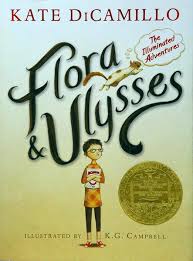
One day, as she browsed through books at the school library, she found a book with a beautiful cover of a girl wearing glasses and holding a comic book. When she saw it, she thought, “That girl looks like me!” She ran her fingers over the letters scrawled grandly across the cover and read the title aloud: Flora and Ulysses.

download

It was then that she noticed a small animal tucked up in the corner, which compelled her to read the back cover. As her eyes skimmed over the words describing a story about a squirrel who gets run over by a vacuum cleaner and strangely develops superpowers, she opened the book and began to read.

Before she knew it, the librarian was shouting a last call to check out books.  Daisy hurried to have her book scanned and joined the rest of the children lined up at the door to return to class. Ms. Wright, her teacher, walked up and down the line surveying the children’s choices. Every now and then she’d murmur things like, “Oh! Great author!” and “You’ll love this one.”  By the time Ms. Wright arrived at Daisy, she was nearly bursting with excitement.  Daisy couldn’t wait to tell her how she loved what she had read so far, and she longed to hear Ms. Wright say what a great choice she had made, choosing a book with a medal on the cover.

However, when Ms. Wright glanced at the book in Daisy’s hand, she looked between the book and Daisy and said, “Oh sweetheart, you’re going to need to return this book.”

Return this book?  Did she hear correctly? Confused, Daisy looked at her teacher who kneeled beside her, looked   her eyes, and said, “You’re a level R.  This book is much harder than that.  Run and put this back. You can choose something from the R bin when we get to the classroom.”

Crestfallen, Daisy handed the book back to the librarian. In her head, she kept hearing the echo of Flora’s voice speaking the same words she said when she witnessed Mrs. Tickham vacuum up the squirrel: Holy bagumba.

What was she going to read now?

Back in the classroom, Daisy dragged herself to the R bin and without even looking, grabbed the book that was on top.  She returned to her seat and muttered the title: Captain Underpants and the Attack of the Talking Toilets. Grudgingly, she began to read.

 Fellow teacher educators, I guess we still have much work to do… Be diligent. Our furture generations need you.

https://www.choiceliteracy.com/contributors-bio.php?id=11


FDK Update from a parent’s perspective: What are the early years up to?

Last year, I (Yiola) wrote several blogs about my Sylvia Clare’s first year of kindergarten. In Canada children begin school at four years of age, sometimes three, and they enter Junior Kindergarten (JK). The following year they are in Senior Kindergarten. So, my Sylvia Clare is in SK this year and my son, Gallaway, has begun JK.  The school year started well. The children are happy. A few of my favourite things about early years schooling:

  1. Regular communication from the teacher — brought home in “zippies”
  2. A lot of outdoor exploration
  3. Weekly library visits — I am fascinated by my children’s choice of books!… Sylvia Clare tends to select “Fancy Nancy” books and Gallaway selects books about Dinos doing sports
  4. Uniforms — mornings are so easy
  5. White collared uniform shirts covered in paint at the end of the day
  6. Cereal boxes / tissue boxes with paper towel rolls (towers) poking out — every invention you can imagine
  7. Listening to my son sing songs learned at school
  8. Being given clear instructions with strong convictions –  “Mommy, my teacher said so…”
  9. My favourite:  Picking the children up at the end of the day to be greeted by big hugs and smiles

I know children learn enormous amounts in the early years — vocabulary, numeracy, inquiry, motor skill development — so much happens in a kindergarten classroom. For me, as a parent, what I am most concerned about is my child’s well being. That is, their happiness.

The other day, Sylvia Care brought a note home that was written by a classmate. It was an apology note.  Sylvia Clare was teased at school and the child wrote her an apology. My initial reaction was that it was  somewhat funny. I did not really think it was significant. The following day when I picked the children up from school I spoke to one of Sylvia Clare’s teachers and brought up the note. First I said, “Hysterical” and then I paused when I noticed the teacher not laughing. I asked the teacher if Sylvia Clare was genuinely upset. In a serious tone the teacher explained that she was.  It was in that moment that I recognized how much respect the teacher had for her student.  Acknowledging Sylvia Clare’s feelings and addressing her hurt made me appreciate her teacher even more. Valuing young learners and appreciating their feelings is just so very important. The problem was quickly resolved; Sylvia Clare felt her feelings were validated, and her dignity restored. And only then, when a child feels secure, can learning occur.

And so we begin our second year of the Early Years with confidence, resilience and excitement.  I look forward to sharing, every now and then, the nuances of one FDK experience.

12011310_10156145932965121_2899238255311547961_n

Gallaway and Sylvia Clare during their first week of school.

After 2 Weeks We Tend to Remember…

I (Pooja) am taking a course at U of T this term which focuses on the practice and theory of teaching in higher education. When discussing approaches to teaching, the professor displayed Edgar Dales’ Cone of Learning graphic. Although this was something I was aware of, it served as a good reminder in how I design my courses and lessons each class.

Cone-Of-Learning

Happy Teachers’ Day

I (Clare) know that many of the readers of our blog are teachers — whether in primary/secondary schools or in phone1higher education. October 5th is World Teachers’ Day. I found the articles below which I thought I would share with you.
Happy Teachers’ Day!

IMG_0038October 5 is World Teachers’ Day, a global opportunity to show appreciation for the meaningful roles teachers play in our education and lives. Celebrate World Teachers’ Day by finding an event near you (or creating your own!), sending an e-card to an inspirational teacher in your life, or sharing pictures, stories, or links with the hashtag #worldteachersday on social media. Thanks to all the educators who have inspired us and who continue to enrich the world by sparking their students’ passion for learning. For more celebratory stories, read on!
I found this inspirational letter to a teacher which I want to share with you. http://www.literacyworldwide.org/blog/literacy-daily/2013/12/04/a-love-letter-to-teachers?utm_source=TW-09292015&utm_medium=email&utm_campaign=ThisWeek&utm_content=Story-1

To Those Who Give It Their All on a Daily Basis:
Let me start by saying thank you. Thank you for showing up each and every day, not just on holidays, and giving it your all. You are magnificent and deserve a moment to celebrate YOU.
Being a teacher, particularly a teacher of reading, means sharing so much of yourself in addition to your knowledge of strategies, letter sounds, and authors. As teachers of reading, you help breathe life and joy into books during a time in education when learning can too often and too quickly become rote and lifeless. You celebrate student success and embrace their frustrations, pushing them gently to overcome obstacles that feel insurmountable in the moment. You constantly doubt yourself, wondering if you are doing enough, planning enough, reaching your students enough. But it is that doubt and self-reflection that makes you a better and stronger teacher who is able to give it your all.
You give it your all in terms of your instruction, and you also consistently give of yourself. You share your reading life and preferences with your students. You share your students’ favorite authors and books as well as their struggles when encountering an unfamiliar and challenging text. Being a teacher of reading does not just mean giving students access to instructional best practices, it means giving students some insight into who you are as a reader, a teacher, and a person.
All too often, I hear “rigorous practice” separated from discussions of “fun” activities. Yet so many of you strive every day to reconnect “fun” with “rigor” by coming up with new ways to engage your students with difficult concepts and texts. This type of instructional savvy doesn’t just happen, nor is it inherent in every curriculum. It comes from teachers who give it their all, just like our friend Pete the Cat.
So know that at least one person out there knows how hard your job is and how much of yourself you give to your students every day.
Happy Holidays!
xoxo,
Mrs. Mimi
Mrs. Mimi is a pseudonymous teacher who taught both first and second grades at a public elementary school in New York City. She’s the author of IT’S NOT ALL FLOWERS AND SAUSAGES: MY ADVENTURES IN SECOND GRADE, which sprung from her popular blog of the same name. Mimi also has her doctorate in education from Teachers College, Columbia University.

For more info on World Teachers’ Day check out the UNESCO site: UNESCO http://www.unesco.org/new/en/unesco/events/prizes-and-celebrations/celebrations/international-days/world-teachersday-2015#.VgqU1M4XqHl