As many of you are gearing up for the start of school, I (Clare) want to share one of the  most inspiring talks on education I have heard. Rita Pierson is a high school teacher whose talk on motivating students was amazing. Her views are so in sync with many of our blogs that I wanted to share it with you. Like me, she believes that teaching is a relational act. In the face of standardized tests and prescriptive curriculum, she keeps her focus on the students. Her story of giving a student who only scored 2/20 a happy face on his test will bring a smile to every teacher. When the high school student wondered why he got a happy face when he only got 2 answers correct, her answer will surprise you. Her talk is only 6 minutes long but it is worth. I think teachers will find it inspiring. And every teacher educator should show this video to his/her student teachers because this is what true teaching is all about. Here is the link to the Ted Talk: https://www.youtube.com/watch?v=dilnw_dP3xk
All posts by ckosnik
5 rookie researcher mistakes
As we get ready to start a new academic year, I (Clare) found this advice for new graduate students extremely helpful and accurate. Excellent suggestions relevant to all graduate students.

One thing I have learned over the years I have been Whispering is, although the problems they face are similar, no two research students are alike. What works for one person may not work for another. For this reason I have developed a habit of ‘reverse advice’ lists, for example: “5 classic research presentation mistakes” “Are you getting in the way of your PhD?” , “5 ways to fail your PhD” and “5 ways to poster = fail”.
I like a reverse list because it highlights the problem more than the suggested solutions, leaving you free to choose your own.
This time of year I attend a lot of research student orientation sessions around RMIT, where I usually give my ‘top five newbie mistakes’ talk. I tell students there’s no need to take notes because I have blogged it (yet another reason to keep up a blog by the way)…
View original post 1,182 more words
10,000 Hits and Counting
Today marks a milestone for our blog. We had our 10,000th hit! Wow! I (Clare) started  this bl
 og in January as a way to share our research and it has grown beyond my wildest dreams. For a little education blog we now have 126 followers and visitors from around the world. My research team – Cathy, Yiola, Lydia, Pooja, and Clive – have faithfully written such interesting posts that I have learned much from them and about them. Thanks team. Thank you to our guest bloggers – Monica, Shelley, and Gisela – for enriching our site. And a huge thank you to Arif who has helped with the technical parts of the website and for his guidance in creating a dynamic
  blog.
blog.
 I would never have thought that blogging could be such a rewarding form of writing. I have learned much about this genre of writing and enjoyed searching for topics that I hoped would be of interest to others Thank you to all of our regular blog readers and followers whose regular visits motivated us to keep on going. We regularly get feedback from readers on our site. Thanks readers for your compliments and feedback. We read every comment and appreciate the time you take to write to us.
So a shout out to social media for making this blog an international adventure focused on literacy and literacy teacher education.![IMG_7907[3]](https://literacyteaching.net/wp-content/uploads/2014/05/img_79073.jpg?w=150&h=100)
Teacher inquiry: this just in from Piaget!
Yes, I (Clive) know I should get a life, but lately I’ve been reading Dewey, Vygotsky, and Piaget (there’s a constructivist connection).
Skimming through Piaget’s The Moral Judgment of the Child (R&KP, 1932) I came across this wonderful quote in the very last paragraph (p. 414).
“Educational experiment…is certainly more instructive for psychology than any amount of laboratory experiments…. But the type of experiment which such research would require can only be conducted by teachers or by the combined efforts of practical workers and educational psychologists. And it is not in our power to deduce the results to which this would lead.”
This captures so well what I was trying to say in my previous blog. Academics and teachers must inquire together, rather than taking pot-shots at each other.
It feels good to be backed up by the likes of Piaget.
Trivago Guy: Hot or Not?
It is interesting observing what captures the public’s interest. I (Clare) was inundated with  commercials for Trivago during the World Cup and the Winter Olympics. The commercial features a middle-aged man advertising the amazing features of Trivago (a travel website). I commented to Clive that I thought he was cool and much to my surprise he replied he thought he looked a little seedy. In the Globe and Mail today Sarah Hampson has a whole article on Tim Williams the Trivago Guy.Social media is buzzing about him with some saying he looks like he sleeps in his car (not good for a travel website) while others wonder about his small waist and beltless jeans. She notes that: “good or bad, Trivago Guy has people talking which is a measure of successful advertising campaigns.” Social media has catapulted Trivago Guy into fame.
 In the Toronto Star today there was an article about another unlikely media “darling” the Spanish duo Los Del Rio who sang the embarrassingly corny song, Hey Macarena. “They hit the jackpot in colossal fashion with one of the most infamous songs of all time” that became a staple for “every single wedding, sporting event, bar mitzvah, and other large social gathering on the planet.” Why did this happen? (and without social media).
What is the appeal of Trivago Guy or two “decidedly unfashionable middle-aged gents” crooning? I am not sure but it sure is fun watching for the next hot “thing.” I think teachers could have a great time discussing with students who and what captures the public interest. It would be interesting to hear teenagers’ views on Trivago Guy!
Congratulations to Tim Fletcher
Congratulations to our friend and colleague Tim Fletcher on the publication of Self-Study in Physical Education Teacher Education which he co-edited  with Alan Ovens. Tim has a long-time commitment to the practice and study of health and physical education. Teaching at Brock University where he is an Assistant Professor and conducting research on the preparation of teachers to teach phys ed, he understands the complexity of the issues facing teachers and teacher educators. Helping children and youth acquire the skills and attitudes to lead a healthy and active lifestyle is not easy but is critically important. This text will help us think differently about preparing teachers to teach health and physical education.
Here is a description of the book: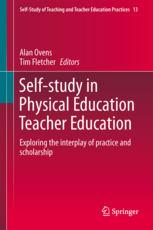
In this in-depth examination of self-study as a research methodology, an international selection of physical education scholars share their ideas and experiences and consider the value of self-study as a vector for highlighting the emerging conflicts, dilemmas, and debates currently developing in teaching and teacher education pedagogies. A vital new addition to Springer’s series Self-Study of Teacher Education Practices, the volume is divided into three sections assessing the significance of the approach itself, offering detailed subject-relevant case studies, and exploring the nuances and controversies attending the evolution of the methodology. The contributors show how self-study enables reflexivity in pedagogical practice, a notable lacuna in current critical research, and at the same time they make the technique accessible to scholars of physical education wanting a practicable introduction to the subject. The analysis also explores the implications of applying self-study to pedagogy itself, to the curriculum, and to human movement and educational practice more generally. By embracing more organic, emergent notions of research practice and learning, the book achieves a broader and more inclusive survey of pedagogical work in physical education teacher education that fully acknowledges the complexities of the field. http://www.springer.com/education+%26+language/learning+%26+instruction/book/978-3-319-05662-3
Teachers’ Contribution to Educational Inquiry
This past week I (Clive) had intense discussions with students in my Foundations of Curriculum graduate course; the topic was educational research and classroom-based teacher learning. Several were reluctant to accept that teachers are “researchers” and “knowledge generators” in an important sense.
I argued that teachers are in an excellent position to conduct inquiry because they are immersed in the classroom for ten full months, year after year: rarely do academics have such a rich context for educational research. They argued that teachers’ research methodology is not rigorous enough to produce genuine knowledge.
Thinking it over, I’ve decided to offer a compromise. I agree that education academics often have much to contribute because they are aware of other disciplines and other real-world contexts. Although they rarely have the same depth of educational experience as teachers, they often have greater breadth of knowledge in certain areas.
However, I will offer this compromise with three provisos:
(i) Teachers’ inquiry is just as rigorous as that of academics, since they observe so carefully the processes and outcomes of their teaching: they have a vested interest in doing so.
(ii) Teachers and academics have equal but somewhat different contributions to make to educational research.
(iii) Accordingly, the relationship between the two must be one of dialogue as equals, rather than “laying down the law” by one party or the other.
Of course, it is true that teachers could enhance their inquiry in certain ways; but the same is true of academics.
Teachers are not always conscious of what they have discovered through experience; it is often “implicit” knowledge. Hence, a major role of education academics is to study teachers and help make their insights explicit and available to others. But it is the teachers who discovered these insights and who must be given the credit.
I’ll try out this compromise on my students next week and see what they think!
How do you Know What To Blog About?
I (Clare) recently did a presentation to a group of teachers on a self-study I conducted with  Lydia Menna and Shawn Bullock on our efforts to integrate digital technology into my literacy methods courses. (Here is the powerpoint from that presentation. BERA + ECER-DT 2013in Dropbox) I talked about my initiatives which led to me showing how my efforts in my literacy teaching led to a greater use of digital technology in other parts of my life (e.g., using NVivo for data analysis). The success of my initiatives with my teaching gave me the confidence to take the plunge to do a website. My technical skills had improved and my identity shifted so that I now see myself as “digitally competent.” During the presentation I showed our website and one of the participants raised an interesting question: How do you get ideas for your blog? He recounted how he wanted to do a blog but did not know what to write about. I told him to just start! I believe that writing a blog is a different genre – it requires different writing skills than other forms of writing. Since we started this blog, I feel that my blog-writing skills have improved. I now focus on one topic in a blog; I am more comfortable sharing my insights; I will raise questions; I make links to other resources; and I no longer feel the blog needs to be perfect (so what if there is a typo. We will survive.) Blogging seems to have captured my interest and is a good match for me ( I have lots to say about education) and it is fun. I keep a Word document with blog ideas which is always plentiful and when I come across something “interesting” one of my first thoughts is – Would that make an interesting blog? This thought is followed by – Would others be interested in this topic/issue? Doing our blog as a “team” has truly been the way to go. I have learned so much from the posts by my team (Cathy, Lydia, Pooja, Clive and our guest bloggers) about them personally and professionally. And their blogs give me ideas about what to write about.
I really see our blog as connecting with the broader education community which is social media at its best. Blogging is good for me because it gets me thinking critically and hopefully, our posts are of use to our readers.
Facing Reality: New Teachers Working in Very Politicized Contexts
Those of us in education are feeling the pressure from external bodies to improve test  scores while teaching a standard curriculum (developed by “some” external body). This pressure is especially acute for new teachers who are trying to sort out teaching in general while figuring out their style, their particular goals, coming to terms with their changing identity … . In this politicized era trying to balance standards with what students actually need is a challenge for the most experienced and able teachers. I (Clare) read a fabulous article Professional knowledge and standards-based reforms: Learning from the experiences of early career teachers by Andrea Allard and Brenton Doecke. It is in English Teaching: Practice and Critique May, 2014, Volume 13, Number 1 pp. 39-54
http://education.waikato.ac.nz/research/files/etpc/files/2014v13n1art3.pdf
For those of use involved in teacher education this article gives voice to new teachers who find themselves in teaching situations that are a mismatch between the practices advocated in teacher education and the culture in their schools. It shows how these teachers try to negotiate the demands and come to terms with practices they feel are effective. It also raises questions about what we should be doing in teacher education to prepare student teachers for what they will face as teachers.
Here is the abstract:
This article explores the paradoxical situation of early career teachers in this era of standards-based reforms, beginning with the experiences of an English teacher working in a state school in Queensland, Australia and expanding to consider the viewpoints of her colleagues. Our goal is to trace the ways she and the other early career teachers at this particular school negotiate the tensions between the current emphases on standardisation of curricula, testing regimes and teaching standards and their burgeoning sense of their identities as teachers. We shall raise questions about the status of the professional knowledge that these early career teachers bring to their work, showing examples of how this knowledge puts them at odds with standards-based reforms, including the professional standards recently introduced by the Australian Institute for Teaching and School Leadership (AITSL) and the National Assessment Program –Literacy and Numeracy (NAPLAN).
I found this quote from a new teacher, Nola, about her first few weeks at this school fascinating and distressing.
“We did not do enough NAPLAN stuff [in the teacher education course] …Holy moley! –Coming into this school and it’s so NAPLAN focussed. Oh, it was like “What the heck? Yeah, I’ve heard about NAPLAN but — !” Everyone is like “NAPLAN, NAPLAN, NAPLAN” and I am just like–holy moley! I was not prepared for it. I did not know how to read the results or anything. I didn’t know what it meant. I was like “NAPLAN?” I didn’t know that NAPLAN was.”
Her distress is palpable!
Teaching Good Manners: An Aspect of Way of Life Education
I (Clive) appreciated Leah McLaren’s column in the Globe & Mail on Friday. She reported that Tatler editor-in-chief Kate Reardon was recently “pilloried in the British press” for “a graduation speech at a private girls’ school…in which she highlighted the importance of manners over good grades.” Among other things, Reardon said that “if you have good manners people will like you. And if they like you they will help you.” McLaren commented that “as both a feminist and a mother” she agrees with Reardon, but noted that “[w]hen it comes to instilling basic values and good behaviour, parents have never been more on their own.” http://www.theglobeandmail.com/life/parenting/the-importance-of-being-courteous/article19661557/
This should not be. Schools should support parents in this basic work (and they do to some extent). As I stressed in a recent posting, way of life (or values) education should be a major component of schooling, integrated into subject teaching and the life of the classroom and school.
The difficulty, however, is that we haven’t articulated a deep and comprehensive theory of way of life education. Advocacy in this area comes across as moralistic or, in the Reardon case, as old fashioned and conformist.
What could be more important than the quality of our way of life, in itself and in relation to others? It’s current neglect by advocates of “coverage” and testing is weird. “Good grades” as the goal of 12 years of schooling is totally inadequate. People should be pilloried for pushing such a position, yet it is so common.
Any goal can seem superficial when advocated in isolation. As educators, we need to develop for students, parents, and the general public a broad rationale for way of life (or values) education in terms of individual and societal happiness and what is ultimately important in life. We should help everyone – ourselves included – to stop fixating on narrow goals to the neglect of general human well-being.
 Literacy Teaching and Teacher Education