 Reading the New York Times Book Review section on Sunday, I (Clive) was reminded of the rather negative view of life frequently presented in “good literature.” In books reviewed, life was portrayed as hard to fathom, mainly painful, and ultimately tragic. Of one collection the reviewer said: “These stories know suffering, loneliness, lust, confinement, defeat.” (Lust was the one bright spot.)
This recalled my own education at school and university, where tragic literature was the good kind and comedy was mainly fluff. A “comic” life vision, emphasizing pleasure, happiness, and good relationships, was seen as shallow and naïve.
Certainly, some people find sad and violent books more entertaining than comedies; and a well written tragedy can be absorbing. But as Northrop Frye maintained, literature is supposed to educate as well as entertain. So we have to face the question: How well does tragic fiction educate about life? My view is that it helps, but a more balanced picture is needed.
Based on my own fiction choices, I’m coming to the conclusion that entertainment is a major purpose of fiction. You want something you can enjoy on a plane to offset the cramped conditions and bad food; or that you’re glad to read in the evening when you’re feeling tired. So I usually go for David Lodge, P. D. James, Jane Austen and the like, where there’s plenty of entertainment and a fairly positive worldview.
However, there’s no accounting for taste. The main thing is that we discuss the purpose of various types of fiction with our students, helping them figure out for themselves what to read, when, and why.
All posts by ckosnik
St. Patrick’s Day
Today is St. Patrick’s Day – an Irish holiday. St. Patrick’s day is a significant day here in Toronto and includes a big parade, people wear Green, restaurant and pubs turning themselves into Green enterprises, classrooms talking about and celebrating all that is Green and Irish. What began as a religious holiday is now a festive c  elebration in many parts of the world.
St. Patrick’s Day is about St. Patrick, the Apostle of Ireland. St. Patrick is credited for bringing Christianity to Ireland. The shamrock is what St. Patrick used to illustrate the Holy trinity. March 17th is believed to be the day St. Patrick died.
Thinking about schools and classrooms, should we teach St. Patrick’s Day from a perspective other than a festive celebration? Why is it a prominent celebration here in Canada? How is it that Irish and other ethnicities alike rejoice in St. Patrick’s Day? When I taught in the public schools we encouraged students to dress in Green, we had a parade through the halls of the school, we read books about St. Patrick’s day and Ireland, and had several activities (arts, crafts, writing) to honour the celebration. Yet not once do I recall and inquiry or examination of what the Day represents both historically and for today. What are the roles and responsibilities of teachers when it comes to celebrations and religious based traditions? In Toronto, Christmas has been the hotly debated and accommodated celebration for decades. What about the celebrations that are not framed in religion and yet are still entrenched in identity and power? Do we blindly and happily engage in the happiness and celebration without thought to the messages of exclusion and power we send when we honour one group and not another? Or do we engage in the often burdensome experience of exposing the inequities of such celebrations? Or, do we do nothing at all?
In an interesting article by Sallie Marston (1989), “Public rituals and community power: St. Patrick’s day parades in Lowell, Massachusetts, 1841–1874”, Marston states, “parades and other forms of mass public ritual are better characterized as demonstrations of community power and solidarity and serve as complex commentaries on the political economy of urban-industrial social relations”. Perhaps a safe and productive space for exploring the ‘power’ of celebrations is better served in teacher education classrooms. Teacher educators who take a critical stance in their practice raise consciously engaging issues and connect social theories to classroom practice and student learning. Yiola
Academics in Picture Books: Mad Scientist Stereotype
Yiola’s post yesterday commented on the positive impact of a children’s book. Today I  (Clare) want to talk about negative images in children’s books. I came across Melissa Terras’ fabulous research on how academics are illustrated in pictures books. Oh goodness! Academics are typically presented in a very unflattering light (old, male, a bit mad). These stereotypes do damage to our reputation with the general public and are definitely not a positive image we want to present to children. Below are some of the findings from her extensive research which I found to be frightening and discouraging. Check out Melissa’s blog for the entire article: http://melissaterras.blogspot.co.uk/2014/02/male-mad-and-muddleheaded-academics-in.html
What are academics in children’s books like?
The 108 academics found consist of 76 Professors, 21 Academic Doctors, 2 Students, 2 Lecturers, 1 Assistant Professor, 1 Child, 1 Astronomer, 1 Geographer, 1 Medical Doctor who undertakes research, 1 researcher, and 1 lab assistant. In general, the Academic Doctors tend to be crazy mad evil egotists (“It’s Dr Frankensteiner – the maddest mad scientist on mercury!”), whilst the Professors tend to be kindly, but baffled, obsessive egg-heads who dont quite function normally.
The academics are mostly (old, white) males. Out of the 108 found, only 9 are female: 90% of the identified academics are male, 8% are female, and 2% have no identifiable gender (there are therefore much fewer women in this cohort than in reality, where it is estimated that one third of senior research posts are occupied by women). They are also nearly all caucasian: only two of those identified are people of colour: one Professor, and one child who is so smart he is called The Prof: both are male: this is scarily close to the recent statistic that only 0.4% of the UK professoriat are black. 43% of those found in this corpus are are elderly men, 33% are middle aged (comprising of 27% male and 6% female, there are no elderly female professors, as they are all middle age or younger). The women are so lacking that the denoument of one whodunnit/ solve the mystery/ choose your own adventure book for slightly older children is that the professor they have been talking about was actually a woman, and you didn’t see that coming, did you? Ha!
Most of the identified academics work in science, engineering and technology subjects. 31% work in some area of generic “science”, 10% work in biology, a few in maths, paleontology, geography, and zoology, and lone academics in rocket science, veterinary science, astronomy, computing, medical research and oceanography.
The names given to the academics are telling, with the majority being less than complimentary: Professor Dinglebat, Professor P. Brain, Professor Blabbermouth, Professor Bumblebrain, Professor Muddlehead, Professor Hogwash, Professor Bumble, Professor Dumkopf, Professor Nutter, and two different Professor Potts. There is the odd professor with a name that alludes to intelligence: Professor I.Q, Professor Inkling, Professor Wiseman, but those are in the minority.
Academics are routinely shown as individuals obsessed with one topic who are either baffled  and harmless and ineffectual, or malicious, vindictive and psychotic, and although these can be affectionate sketches (“bless! look at the clueless/psychopathic genius!”) academics routinely come across as out of touch wierdos – and what is that teaching kids about universities? In this age of proving academic “impact”, it might be not so bad for us to be able to show we were relevant to society? That there is more to academia than science? Or for the kids books I show my kids to have more positive and integrated representations of professors and academics? Perhaps this is not the role of kids books though, and I should just be telling my kids my own tales of academic derring-do.
I think these images of professors can undermine our identity as academics. I certainly do not see myself as the mad professor!
“Pete the Cat” takes our home by storm!
Have you heard of Pete the Cat? This children’s book series is a favourite in our (Yiola)  home. My 4 year-old daughter and my 2 year-old son love reading/singing along to the stories.
What I like about Pete the Cat ( by Eric Litwin) is its simplicity – the language is simple and the rhythm of the language is catchy. My son is able to connect to the repetition and sings along with joy.
I also like the messages in the stories – they call to issues of mental health and wellness. Pete the cat is calm and does not worry about some of life’s potential anxiety ridden experiences. For example, in “Pete the Cat Rocking in My School Shoes”, Pete is confronted with unfamiliar spatial settings, noisy lunchrooms and bustling playgrounds; common childhood circumstances that can cause anxiety. Yet Pete handles each situation with grace and confidence because, “it’s all good”.
In “Pete the Cat and His Four Groovy Buttons” Pete’s buttons keep popping off of his shirt, but Pete does not get upset because “it goes to show that stuff will come and stuff will go. But do we cry? Goodness no! We keep on singing”.
When reading “Pete the Cat: I love my white shoes”, Pete steps in a variety of ‘stuff’ that cause his white shoes, which he LOVES, to change colour but Pete does not get upset.
The moral of the story is: “no matter what you step in keep walking along singing your song because its all good.”
Check out a Pete the Cat story here:
Public Education vs Charter Schools: The Battle in NYC
I (Clare) was watching Chris Hayes’ show (MSNBC – All in with Chris Hayes) the other  night. He had a really interesting segment on charter schools in NYC. His two guests (Brian Jones, NYC teacher, and James Merriman, NYC Charter School Center) had a “lively” discussion on the battle in NYC between the city and the charter school supporters. The teacher, Brian Jones, who argued passionately and articulately for public schools was outstanding. He laid out the reasons why we need to fully support public schools and the dangers of charter schools. Chris Hayes started the segment with a slick ad that is being used to support charter schools; this was cringe-worthy but it showed how all of us who support public education, need to stand up and make our voices heard. There are powerful (business) interests supporting charter schools which in itself raises a red flag for me.
Here is a link to the segment from Chris Hayes’ show: http://www.msnbc.com/all-in/watch/battle-wages-on-over-nyc-charter-schools-190737987700
 If you want to know more about Brian Jones check out:
· The video The Inconvenient Truth Behind Waiting for Superman which he co-narrated http://vimeo.com/41994760
· You Tube clip on the dangers of testing. https://www.youtube.com/watch?v=A73_keoCWo8
· Or this Tumblr feed: http://brianpjones.tumblr.com/BrianJones
Re-Conceptualizing Multiculturalism in Terms of Diversity and Individual Identity
In a blog in January, I (Clive) argued against teaching multiculturalism in a way that leads to  stereotyping, thus undermining students’ individual identity and well-being. In interviews this weekend after giving the 2014 Bluma Lecture, author and NYU professor Irshad Manji spoke eloquently of the dangers of a misguided approach to “multiculturalism,” expressing preference for terms such as “diversity,” “global citizenship,” and “individual identity.” In the Toronto Star she said:
Multiculturalism is about preserving a group mindset, which amounts to labelling. Diversity, on the other hand, is about…different points of view…. If you listen seriously to a new generation of Torontonians, multiculturalism’s time is done. Enough of hyphenated identities. The next stage in our city’s evolution is this: global citizenship. http://www.thestar.com/news/gta/2014/03/07/qa_irshad_manji_on_multiculturalism.html
Manji would like to see more emphasis on individual identity. In the Globe and Mail she commented:
[Mr. Trudeau] basically said national unity must be founded in one’s own confidence in one’s individual identity and from that we can begin to engage with others…. We don’t have that kind of multiculturalism today, in my view. What we have is more a fear of engaging based very much on feeling intimidated that I’m going to say something wrong or that somebody is going to be offended.
She is especially concerned about the impact of prevailing approaches to multiculturalism on vulnerable community members, notably women and children. In the Star she stated that “the vast majority of the world’s known cultures are patriarchal,” and in the Globe she said:
By giving rights to cultures, not just to individuals, what we wind up doing…is giving more power to those who are already powerful within certain communities. We give them more power to dictate what customs are to be respected and which customs are untouchable. The next time you’re told you must respect such and such a custom, ask yourself, “What does my respect for this custom do for the most vulnerable in that community?” And the most vulnerable tend to be women and children.
Whether or not the term “multiculturalism” has outlived its usefulness is something we should ponder; and if we’re too afraid to say it has, we prove Manji’s point. But whatever words we use, we can support Manji’s approach in teaching and teacher education by stressing the diversity and power differences within cultural communities, the commonalities across communities, and the importance of individual identity and well-being.
A Foot in Many Camps: Literacy Teacher Educators Acquiring Knowledge Across Many Realms and Juggling Multiple Identities
 For those of you have been following this blog, you know we are conducting a study of literacy/English teacher educators in four countries (Canada, U.S., Australia, and UK). Our first paper from the study has recently been published in Journal of Education for Teaching 39(5), 534-540. The paper A Foot in Many Camps: Literacy Teacher Educators Acquiring Knowledge Across Many Realms and Juggling Multiple Identities is available through this link: Foot In Many Camps
In the paper we describe how the teacher educators had a range of classroom teaching experience which they drew on in many ways. Most went far beyond simply telling stories about their previous work. All were heavily influenced by their own childhood experiences, which continue to affect their current work. Many felt that they needed to hold dual identities, teacher and academic, because they were still heavily involved in schools through their research and in-service activities. Several felt that there was a hierarchy in their department with those most removed from schooling at the highest tier. Most saw themselves in the field of literacy not teacher education and gravitate towards literacy-focused conferences and journals rather than those in teacher education. I (Clare) hope you find the paper interesting. We certainly have found this entire study fascinating.
Including All Students in the Conversation
I (Clive) am a great believer in whole-class and small-group discussion. However, three and four years ago I was terrorized by a series of individual students who dominated discussion in class, speaking at least 50% of the time – they would have talked 90% if I’d let them. I’m sure they did the same in their small group, if I wasn’t in the group.
This forced me to develop a set of techniques for giving everyone a turn. They’re simple but effective. Most students appreciate them, and they’ve enabled me to relax and not always be cutting people off (though I still have to be firm). I wish someone had introduced me to them long ago.
The techniques assume the class is no larger than 35 (I have any bigger class divided up) and is seated in a large circle (I arrange the seating before the students come in). They also assume that students get a lot of “air time” in class, otherwise it’s impossible for everyone to have a turn.
Here are the techniques:
- Going around the room, with each student (or every 2nd or 3rd student) saying what they think about the topic in hand (don’t worry if you don’t get all the way round).
- Discussion in 2s and 3s around the room, followed by reporting from each group.
- Numbering off to form small groups, followed by discussion and reporting back.
- Individual prepared presentations (ungraded, maximum 4 minutes) – 2 to 4 per class – with 3 people to the left or right of the presenter responding.
- Whole-class discussion after a “mini-lesson” from me, with a speakers list formed as people put up their hands.
I find students are very glad to be called on in these ways: no one has ever declined. And the approach greatly strengthens community as we hear from and get to know everyone, including many who’ve been largely “voiceless” throughout their school and university career. It fosters oral literacy and results in truly inclusive education.
If anyone has other strategies, please let me know!
Congratulations Tiffany Harris
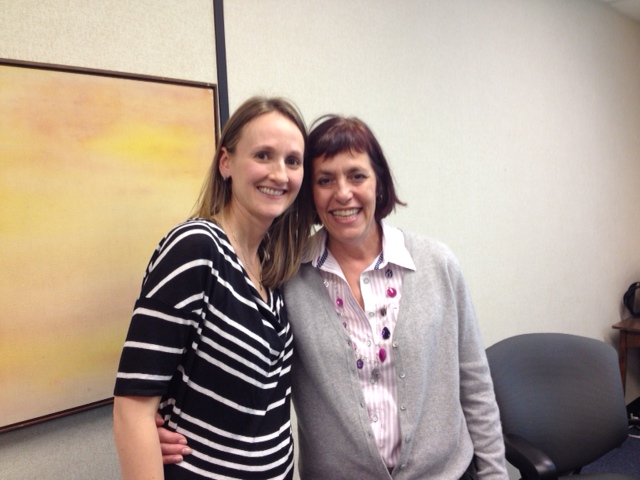
Congratulations to Tiffany Harris (member of our research team) who successfully defended her PhD thesis yesterday. The thesis, Multiliteracies Theory into Practice: An Inquiry into Junior-level Literacy Classrooms, was a study of classroom teachers (grades 4 – 6) which examined their understanding and use of a multiliteracies approach in their teaching. The thesis is outstanding because Tiffany closely studied her participants’ views of literacy, their practices, and the challenges they face. The analysis is outstanding because Tiffany is both a very accomplished classroom teachers and an excellent researcher. She brought to bear on her work her understanding of the work of teachers and her extensive knowledge of multiliteracies theory. As a result, her work will definitely contribute to our understanding of how literacy is evolving and how teachers are adjusting their teaching. It is rare to have a study that moves so effectively between theory and practice. Her thesis will soon be available through the Proquest Dissertation Database. Congratulations Dr. Harris. Attached is a picture of Tiffany and me (Clare) after her thesis defense.
Yiola Cleovoulou wins OISE Teaching Award
Congratulations to Yiola Cleovoulou a member of our research  teams who has just received the OISE teaching award for Excellence in Initial Teacher Education. She was nominated by her students which in itself is an honour. This is a very competitive award so to win it is a real accomplishment. I have team taught with Yiola and know that she is a truly outstanding literacy teacher educator. For more info on Yiola click on the link About Our Research then click on Meet the Research Team. Clare
 Literacy Teaching and Teacher Education