All posts by Dr. Cathy Miyata

Unknown's avatar

About Dr. Cathy Miyata

Cathy Miyata is a professor at Wilfrid Laurier University. She is also an acclaimed storyteller and writer. She has performed and lectured in Serbia, Japan, Malaysia, Germany, Greece, Portugal, Sweden, Mexico, the United States, Egypt, and across Canada

Entering a new communication paradigm

I (Cathy) have recently found myself in a new communication predicament. Diagnosed with vocal cord nodules, I have been instructed not to speak for 8 weeks. So here I am, and after only two weeks into my ‘treatment,’ I have observed some interesting things about peoples’ communication patterns.

  1. Since I can’t talk, people often whisper to me. I’m not sure why, but they do, or…
  2. They get MUCH LOUDER. I can hear just fine, but for some reason this is the reaction.
  3. People gesture wildly. Again, I can hear them, but they clearly need to emphasize what they are saying.

I could theorize about the reasons why they do this: a need overcompensate for my sake; empathy perhaps; or they are just plain uncomfortable with the situation. But wait, there is more…

I started carrying a note pad to write messages to communicate and discovered these patterns:

  1. If the message is longer than two sentences, people get restless. The common quip is “Are you writing a novel?”
  2. Once I start to write an answer, if they don’t want to wait, they answer their posed question for me! I am always fascinated by ‘my response.’
  3. Some people prefer me to print as opposed to write, so I have to rewrite/print the message. My son actually told me to “just text him” at the dinner table. (BTW, my handwriting has improved dramatically due to the necessity of being understood)

In an effort to be more current and efficient, I started using the “speak feature” on my iPad and iPhone, but this has its own set of complications:

  1. The response process: typing, highlighting the text, and then tapping the ‘speak’ feature, takes less time than it does for me to write a note in longhand, yet people are less patient with the electronic process. I suspect they feel it should be immediate.
  2. Most people have trouble understanding the electronic voice. They frequently say, “I didn’t get that.” I think it’s because the intonation is usually off. I often have to repeat the message. (I have totally given up on using a ‘cool’ voice app as people can’t understand the regular voice. I was hoping to use the Stephen Hawkings app).
  3. Instead of listening to the voice again, often people reach for my iPhone to read the message in print for themselves, but sometimes the print is too small for them to read, so I have to enlarge it- which takes even more time.
  4. Interestingly, people often want to type their response on my iPad instead of speaking back to me. They take the iPad right out of my hands to do this. I also tried using the chat feature on Skype so I could respond to the person on the screen, but the other person only wanted to type in chat too. Although they were right there in front of me, and were perfectly capable of talking- they didn’t! This leads me to believe that people are getting more comfortable communicating through print  than speaking.

Finally, I play a large role in this and am just a quirky:

  1. I often try to mouth the words which becomes a great game of “guess what Cathy is trying to say.”
  2. As I am familiar with rudimentary sign language, having taken several courses to communicate with my niece and having taught in a total language classroom, that is my default. I sign to people, which of course they don’t understand because it is another language! One friend told me “I have no idea what you are saying, but I love to watch.”

Sadly, my friends and colleagues who are ELL totally empathize with me, as they tell me this is all too familiar for them. I truly feel for them now.

All in all, this is a fascinating study in multimodal communications. Mostly, I just listen. I was told that people pay a great deal of money to attend ‘silent retreats,’ so I am trying to treat this like a gift in self-discovery. Apparently, I have a lot to learn.


Ode to Children’s Writers

I (Cathy) finished my third Kate Morton novel yesterday, The Forgotten Garden. Intriguing style. Here is the synopsis shared on http://www.austcrimefiction.org

When thirty-eight year old Cassandra Ryan discovers her grandmother Nell’s secret – that she was not the biological child of her parents, but a foundling – she is intrigued. Inside the suitcase found with the abandoned child at the Port of Brisbane in 1913 Cassandra finds a package of letters, a children’s storybook, and a coded manuscript belonging to Eliza Makepeace Rutherford: the Victorian authoress of dark fairy-tales who disappeared mysteriously in the early twentieth century. And so begins the quest to solve a century-old literary mystery.

I found the story line more interesting than some of Morton’s other books, partly because it was about a woman- Eliza Makpeace (Authoress)- who wrote fairy tale stories for children. The stories were included in the novel as chapters: The Cuckoo’s Flight, The Crone’s Eyes, and The Golden Egg. I particularly enjoyed the Crones Eyes. Deliciously dark!

As a collector and teller of traditional folk lore (I love the collections of Lang, Grimm and particularly, Jacobs), I found her stories strikingly similar to the old folk tales of Europe- frightening and heroic. People often died in those, not like in the Disney versions of today (e.g., in the original Andersen version of The Little Mermaid, the mermaid dies). As I was mulling this over, I happened to come across Morton’s acknowledgements:

I would also like to pay tribute here to authors who write for children. To discover early that behind the black marks on white pages lurk worlds of incomparable terror, joy, and excitement is one of life’s great gifts. I am enormously grateful to those authors who’s works fired my childhood imagination and inspired in me a love of books and reading that has been a constant companion. The Forgotten Garden is in part an ode to them.                                               Kate Morton

I was warmed by this acknowledgement. I think the stories of our youth live in us forever. If you enjoy traditional lore as much as I, I highly recommend reading The Forgotten Garden. For my part, I plan to write to Kate Morton’s publisher to obtain permission to tell them. They would make a delightful set at a festival and would hopefully fire the imaginations of the children (and adults) who listen.

garden

Second Wave Change

Every once and a while I check online to see if my favorite literacies scholar, Allan Luke, has presented something new I can learn from.

Allen

Although not ‘new’, this time I happened upon a  short and poignant video called Second Wave Change.  It’s a succinct  explanation of  the kind of substantive content our students need to be discussing and thinking about to change our world.  This is a perfect video for student teachers.

So worth watching, but Allen Luke always is.


Delightful Listening

I (Cathy) finished an audio book the other day. New author for me; Kate Morton. The book was The Lake House.

lake h

I dreaded the conclusion because I was really enjoying listening to the book. But it finally dawned on me, it wasn’t just the story I was enamored with, it was the voice. The narrator was superb. Her accent was clearly British, which of course was perfect for the book , a Victorian tragedy, but I loved how she could capture the differences between the ‘old British class system’ by changing her dialect. Her pacing, tone and characterizations  were also quite wonderful. I enjoyed her performance so much, I Googled her:

Caroline Lee

Caroline Lee is a gifted actor and narrator who has worked extensively in theatre, film and television. She has performed for various theatre companies including the Melbourne Theatre Company, Hildegard and Playbox, and she received the Green Room Award for Best Actress in Fringe/Independent Theatre for her roles in Alias Grace and Ordinary Misery. Caroline’s film and television credits include the internationally popular drama Neighbours, as well as Blue Heelers, Halifax FP and Dogs in Space. In 1998 she won the Sanderson Young Narrator of the Year award.

caroline lee


I have listened to dozens of audio books, but this was the first time I felt the narrator added tremendously to the storyline. A perfect marriage between author and actor. As a result, I am already listening to another Kate Morton book, The Shifting Fog, but for the first time, I checked the name of the narrator first.

Only on chapter two and already delighted!

.

Literacies Gaming

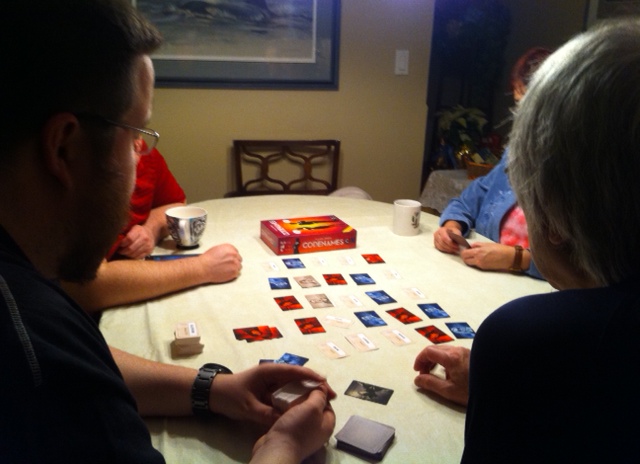
I (Cathy), my family, and friends have been playing many different kinds of ‘party’ games as of late . Some have boards, in some you create the board as you play, and with others there are just cards. One of my favorites is a game called Codenames.

group

This game intrigues me because it is similar to coding data in a study as it’s about making associations between words, categorizing, and/or generalizing. (There is a narrative component to the game where everyone is considered a spy, but we just ignore all that). It can be played in teams or individually.

In this game many word cards are laid out in a grid across the table (25). One person is designated the clue giver and gives his/her team (or other person) a word and a number. The clue word might be ‘flight’ and the number might be ‘2’. The team then has to identify two words in the word grid they think are associated with flight. The challenge for the clue giver is they may not pick just any words they want in the grid to associate. They may only use certain assigned words and sometimes it is very difficult to make associations. The challenge for the team is, if they pick the wrong word, the point goes to the opposition.

Let’s have a trial run… Your clue is ‘weapons, 2”

again

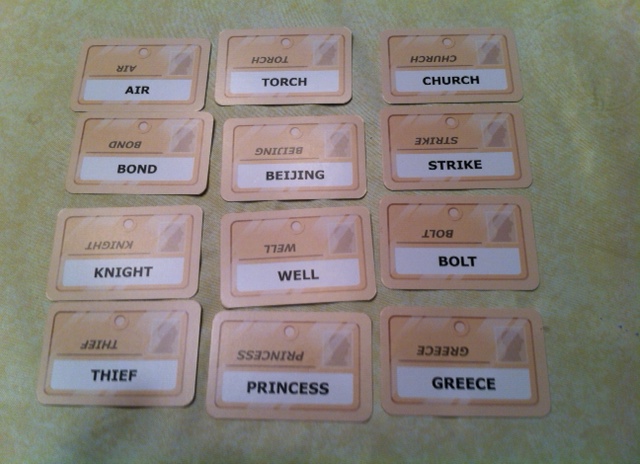
If you guessed pistol and missile, you just won two points for your team. Let’s try one more, but a little bit more challenging this time! Your clue is ‘Olympics, 3’

third try

If you guessed Bolt, Greece, and Beijing, you earned another three points. (If this is mystifying to you, Usain Bolt set the world record for the 100 m dash at the Beijing Olympics, and Greece is the birth place of the Olympics).

This is a wonderful means of exploring word meanings and associations. It is also interesting how so many words can be both verbs and nouns, or connected as possible compound words, or have special meaning depending on culture and context. (Knowing your teammates well also helps, as I find I can understand my husband’s clues better than other people can). On many levels it is a great pass time with friends and also a great language game for the classroom. It is also, on many levels, literacies in action!

*****


The Future of Education?

I (Cathy) recently read a blog posted on the The Huffington Post.  If you are not familiar with the Huffington Post, it is an American online news aggregator and blog, that has been public for 10 years.   In 2012, The Huffington Post became the first commercially run United States digital media enterprise to win a Pulitzer Prize.

I qualify the source only because I am always suspect of individuals or groups that make claims or forecasts about education, yet  know little about the systems. As I consider The Huffington Post a relatively reliable and informative source, I gave the claims made by , a guest blogger who was the Former President for the  Society for Quality Education a second look.

In this blog, Dare proposes that all education systems are cartels  (an association of manufacturers or suppliers with the purpose of maintaining prices at a high level and restricting competition) and these cartels will be disrupted by the world of technology.  Dare suggests:

A software company might put together a complete online curriculum, with built-in testing and reporting, that allows students to progress at their own speed using tablet computers. Already much of this software exists, although it is not yet well organized. Another (or the same) software company might make it possible for parents to access individuals, or groups of individuals, who are willing to coach a group of other people’s children, possibly in their own homes or in a community centre, for a reasonable fee. Part of the software company’s services could be to vet the coaches and ensure they pass health and safety checks.

Dare uses Uber and Airbnb as examples of disrupters to systems and claims educational systems are next.  He goes on to say:

In fact, disruption is already taking place in the post-secondary sector — see UoPeople, the world’s first non-profit, near tuition-free, accredited online university. Currently, students can earn an undergraduate degree in business administration and computer science for $4,000 US, and more programs are being added.

I am fascinated by this blog for a number of reasons.  First, Dare assumes that a young adults  seeking to educate themselves  are comparable to young child who are learning to read and learning to socialize. I have taught children to read (and socialize) and I simply do not  think a  computer can do it.  There is a lot more to education than just text book learning!  Secondly,  Dare implies in the blog that teachers are oblivious to the affordances of technology and reject it for fear it will disrupt the “cartel” in which they participate.   Every teacher I know (from K to HE) incorporates (in degrees) technology into the teaching and learning in their classroom.  They are also aware that students can go online and teach themselves many things. They even encourage it.  The Khan Academy was designed for such learning and is largely responsible for the premise of flipped classrooms which are very popular right now  in Canadian colleges.  I do not think technology will disrupt the educational system.  I think it will just continue to enhance both teaching and learning. Technology and education will evolve together.

Lastly, Dare is completely oblivious to the most significant aspect of education – the relationship.  Countless studies have suggested a caring, attentive teacher can do more for a student than any other factor. Personally, I just can’t see technology completely replacing a good teacher, especially in the education of the young. People simply need people.

Thoughts?

http://www.huffingtonpost.ca/malkin-dare/ontario-education-future_b_8916284.html

Celebrating Oshogatsu


Our family celebrates the new year by following some of the  traditional Japanese customs practiced on New Years Day.  The celebration is called oshogatsu.  In our oshogatsu the family gets together and feasts on special dishes.  Every dish is symbolic of something we might wish to take with us into the new year (e.g., health, joy, prosperity).  The trick is to eat a little bit of everything-then you’re covered!

I wish you a little bit of everything for the new year!  Happy New Year to you.

Cathy

oshogatsu

Ho Ho Ho!

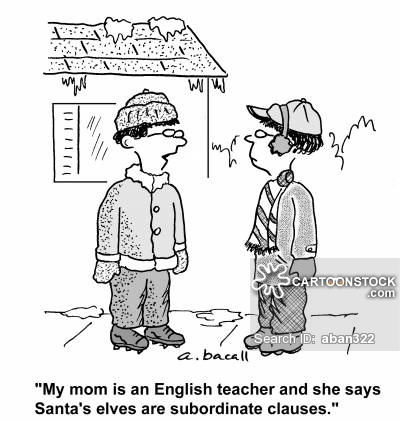
"My mom is an English teacher and she says Santa's elves are subordinate clauses."
“My mom is an English teacher and she says Santa’s elves are subordinate clauses.”


Wishing you and yours a very merry season filled with laughter!                                                   Cathy

Time Out

I (Cathy) read this lovely blog the other day and wanted to share it with you. It seemed appropriate for this time of year, when so many people seem rushed and pressured, preparing for the holiday season.  I think it applies to teachers and teacher educators alike.  But most of all, it’s about our students.  Where some of us live, we can’t take our students outside due to the weather, but I think if you got creative, you could think of someway for them to “unwind”.

I played hooky a few weeks ago.  I filled out my paperwork for half a personal day and took the afternoon off.

It’s not something that was easy for me to do.  I’m usually overcome with guilt and angst whenever I take time off.  I can count on one hand the times I’ve actually taken a personal day, and sick days are used only when I am so ill, I can’t muster the strength to crawl to the shower—one every few years. There’s too much work to be done to miss school—the students need me too much, right?

So, I don’t take time off.

Yet that day, I did. Where I live, the weather can be fickle and complicated.  We never really know what’s going to happen on any given day. But this month, we were given a delightful weather gift.  We had six uninterrupted weeks of perfect days—blue skies, exquisitely clear air, and leaves that turned color slowly.  Every day dawned beautifully—and stayed that way.

But I knew our streak was almost over.  Forecasts predicted plunging temperatures and heavy rain. That’s why, on a whim, I decided to take the afternoon off.

I went home and settled on our back patio.  I sipped a cup of tea and read my way through a few back issues of my favorite magazines.

As the afternoon came to an end and it came time for me to go gather my children from their school, I thought about how peaceful and easy the afternoon had been. I felt full of energy. I’d put a stop to the hamster wheel and it felt terrific.

Since I felt so good after a simple and easy afternoon, I wondered how something like that would feel to our students.  I worry about them. I fear they feel the effects of our “teacher anxiety.”  Amid the push for high achievement, along with the immense pressure to have students reading and writing on grade level—now!—we forget that sometimes we all just need a break. It doesn’t have to be pedal-to-the-metal every moment of every day, right?  Certainly not.  In fact, I’d argue that kind of approach does more harm than good.

So, to all literacy teachers out there, grant yourself permission:  Sometime soon, on a day that feels just right, let yourself put down the lesson plans for an afternoon.  Ignore the to-do list and the upcoming assessments and the small-group conferences you have planned.  Instead, gather your class and tell them to pick out a light book or magazine.  Take them somewhere lovely and different, away from their routine.  Join them in sinking into a comfortable spot to read—in a corner of the school library, beneath a favorite tree in the courtyard, or spread out on the bleachers near the football field.  It doesn’t matter where—just so it’s away and interrupts the routine of intensity. Make sure it’s easy.

 Jennifer Schwanke                                                                                                                                      Contributor, Choice Literacy

https://www.choiceliteracy.com/articles-detail-view.php?id=2353